A parts list, signed by whoever did the work. Minnesota brands a title RECONSTRUCTED where a vehicle has been altered from its original construction by the removal, addition or substitution of essential parts, and this declaration is how the state finds out what was substituted and where each piece came from. It is also part of what clears a salvage brand, and it is signed by the person who made the repairs rather than by the owner.
Written against PS2015 (PS2015A-26, 7/26), issued under Minnesota Statutes 168A.30. Being honest on this form costs less than being caught by it. Minnesota Statute 168A.30 provides that falsifying information on any required document shall be guilty of a felony, and the sentence is printed in the middle of the page in bold.
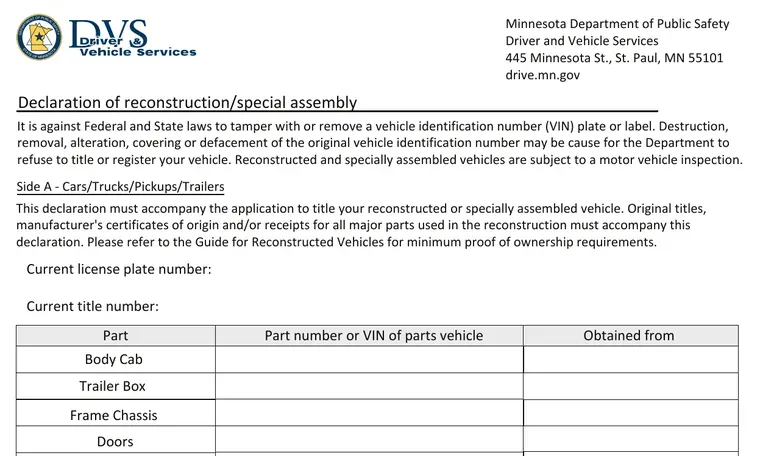
Two documents, and they are not the same thing. Take the blank PS2015 from the assets.dps.mn.gov copy so you get the revision that is current today.
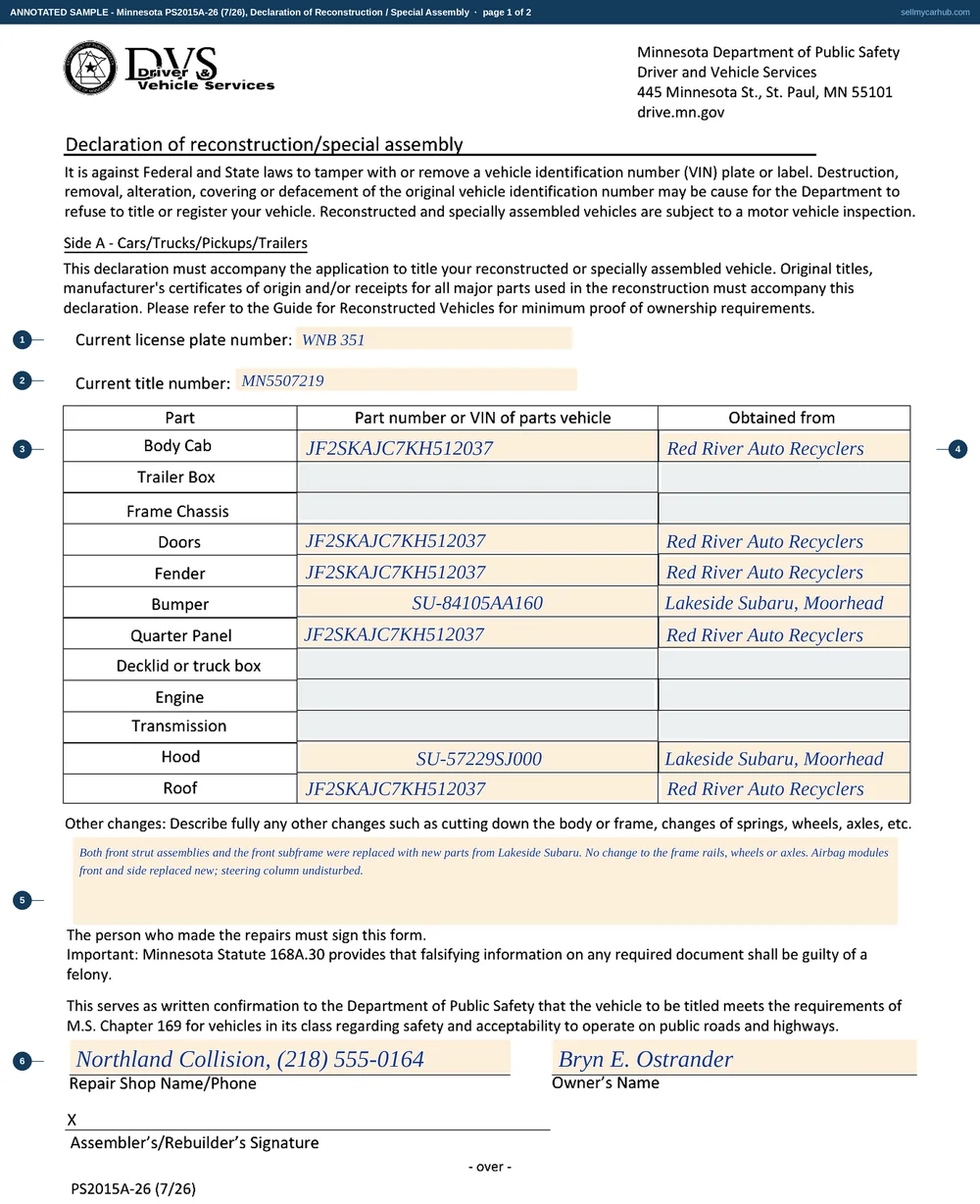
This is all 2 pages of the actual PS2015, rendered from the PDF the Minnesota Driver and Vehicle Services publishes and completed end to end: letterhead, every field, and the blocks at the foot.
The two boxes at the head of side A.
Watch out: On a vehicle carrying a salvage brand the title number is the salvage title's. That certificate is surrendered as part of clearing the brand, so copy the number before it goes.
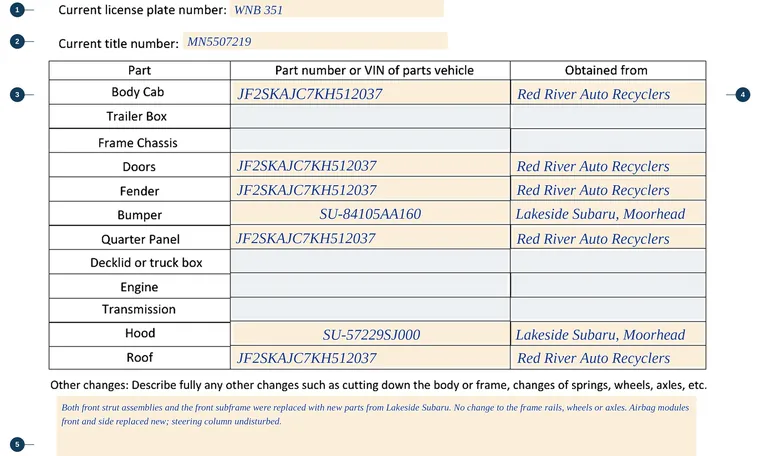
Twelve named components, from body or cab down to roof. Leave alone the ones that were not replaced.
Watch out: A grid completed all the way down on a vehicle that had a front-end rebuild reads as carelessness, and every line on it is a line somebody may ask for a receipt against.
The middle column - the number of the part itself, or the identification number of the vehicle it came off.
Watch out: A donor vehicle's identification number is the strongest entry you can make here, because it can be looked up. A generic part number cannot.
The right-hand column: the recycler, the dealer or the individual each part came from.
Watch out: Name the business rather than the town. This column and the receipts are read together at the inspection.
The deep box under the grid, for anything the twelve rows do not cover.
Watch out: The form names its own examples - cutting down the body or frame, changes of springs, wheels, axles. Structural work that is not in the grid belongs here or nowhere.
The repair shop's name and telephone number on the left, the owner's name on the right.
Watch out: A telephone number that reaches somebody matters. This is the shop the department rings when the inspection turns up a part the grid does not explain.
The signature rule at the foot of side A, under the confirmation that the vehicle meets the requirements of chapter 169 for its class.
Watch out: The person who made the repairs signs, and they are certifying roadworthiness as well as parts. A shop that will do the work but not sign this is telling you something.
| On the form | What to put in it |
|---|---|
| Side A, cars, trucks, pickups and trailers | The current licence plate number and the current title number, then the parts grid. |
| The parts grid | Twelve rows, each naming a component: body or cab, trailer box, frame or chassis, doors, fender, bumper, quarter panel, decklid or truck box, engine, transmission, hood, roof. |
| Part number or VIN of parts vehicle | The middle column, one line per component - the identifying number of the part or of the vehicle it was taken off. |
| Obtained from | The right-hand column: where each part came from. |
| Other changes | A deep free-text box - describe fully any other changes such as cutting down the body or frame, changes of springs, wheels, axles. |
| Repair shop name and phone, and owner's name | Two boxes at the foot of the side, above the signature rule. |
| Assembler's or rebuilder's signature | The signature line, under the sentence that the person who made the repairs must sign this form. |
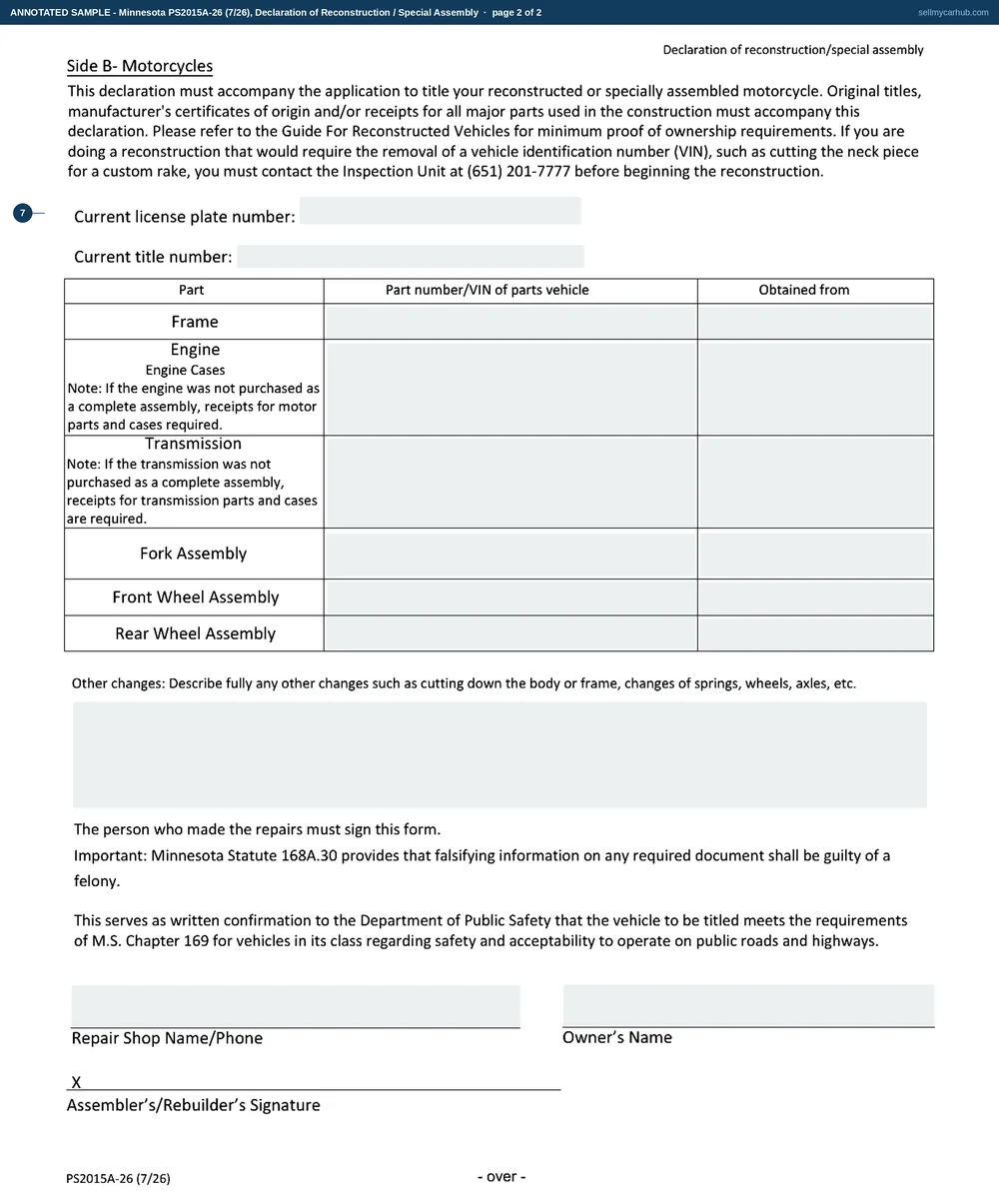
| Side B, motorcycles | The same structure for a motorcycle, with its own parts list: frame, engine, transmission, fork assembly, front wheel assembly, rear wheel assembly. |
| The confirmation | Printed above the signature: this serves as written confirmation to the Department of Public Safety that the vehicle to be titled meets the requirements of chapter 169 for vehicles in its class regarding safety and acceptability to operate on public roads and highways. |
Every line here was read off PS2015 (PS2015A-26, 7/26) itself — the PDF is here — and off the Minnesota Driver and Vehicle Services pages. This is plain-language help with a form, not legal advice, and where our wording and the agency's differ, theirs governs.
Back to all Minnesota seller paperwork, or what selling a car in Minnesota involves.