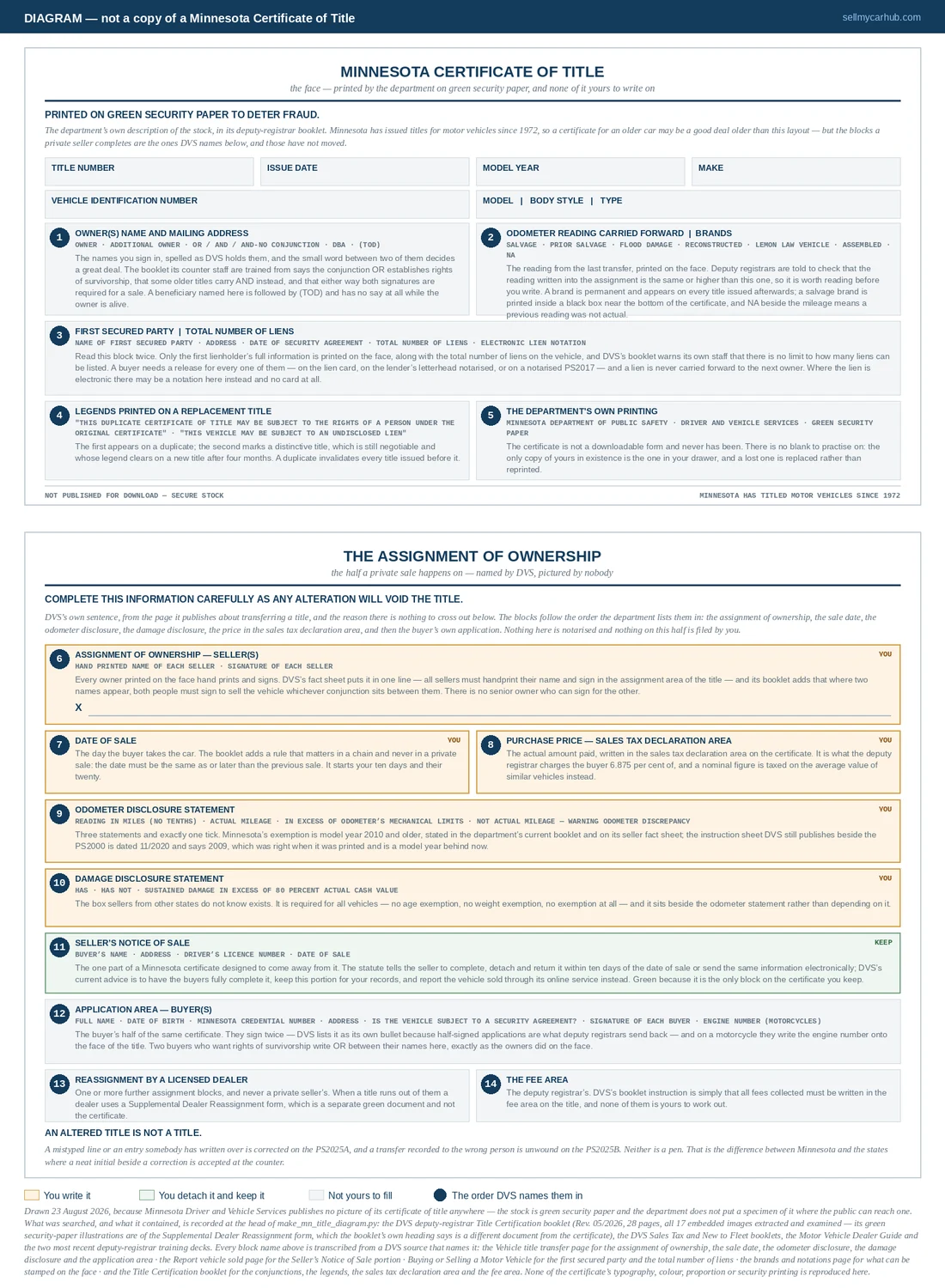
A Minnesota certificate does the whole private sale by itself. You complete the assignment of ownership - printed names, signatures, date of sale, mileage, damage disclosure - and the purchase price in the sales tax declaration area; the buyer completes the application half and takes it to a deputy registrar with the tax and the fees. Nothing is notarised, nothing may be crossed out, and one part of the certificate is designed to be torn off and kept by you. The layout below is drawn rather than photographed, and every block name in it is transcribed from a DVS source that is cited beside it.
Last updated .
Your 11 boxes
As a private seller you complete these and nothing else:
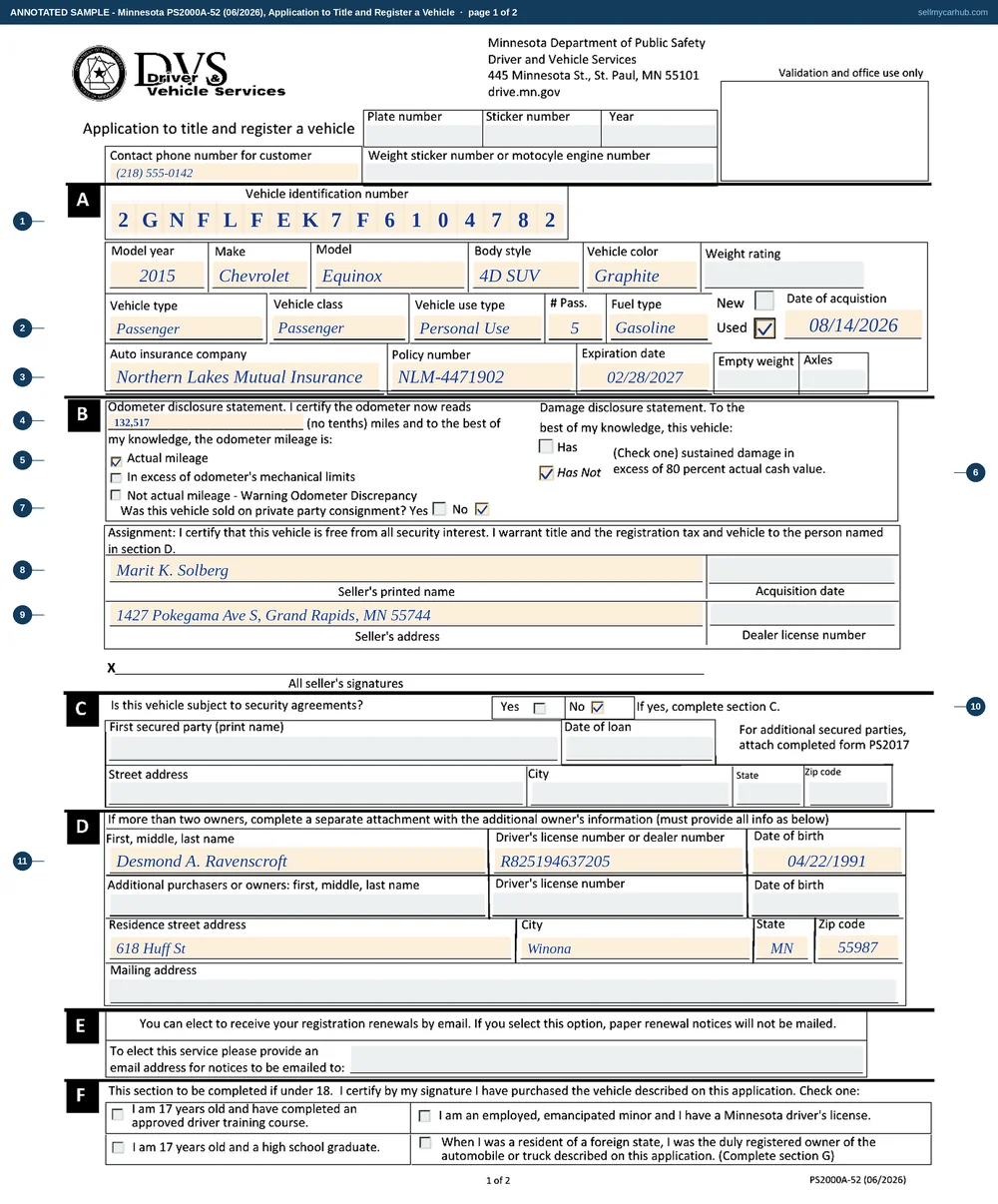
There is no blank Minnesota certificate to download and nothing to rehearse on. The title is printed on green security paper, DVS publishes no specimen of it, and the only copy in existence is the one in your drawer. What you can download is the PS2000A application, which repeats the assignment, the odometer statement, the damage disclosure and the sales tax declaration in the same words - and that is the document shown filled in below.
There is no correcting a Minnesota title with a pen. An alteration voids it, and the route back is the PS2025A correction application, or the PS2025B ownership-correction affidavit if the wrong person ended up on the record.
Minnesota titles are printed on green security paper and the state has issued them since 1972, so the certificate in your drawer may be a good deal older than the wording on this page. What has not moved is the set of blocks a private seller completes, which is the set DVS names in its own fact sheet and in the deputy-registrar booklet its counter staff are trained from. A salvage title looks different in one respect worth knowing: the brand is printed inside a black box near the bottom of the certificate.
The certificate itself
A Minnesota certificate, face and assignment, drawn block by block from DVS sources
Two panels. The upper one is the face of the certificate, where DVS prints what it knows and where a lienholder is named. The lower one is the half the sale happens on: the assignment of ownership, the two disclosures, the sales tax declaration, the buyer's application area and the Notice of Sale stub. Every block name is transcribed from a DVS page, form or booklet, cited in the caption. The numbered steps below run in the order you fill them in, which is not the order they are printed in.
Amber — you write it, in pen
Grey — not yours to fill
Numbered — the face first, then the assignment
Click or tap the picture to open it full size.
Drawn, not photographed — and here is exactly what was searched. Minnesota publishes no picture of its certificate of title. Its titles are printed on green security paper to deter fraud, and DVS does not put a specimen anywhere a member of the public can reach. What was examined: the DVS deputy-registrar Title Certification booklet, Rev. 05/2026, all 28 pages and all 17 embedded images — its green security-paper illustrations are headed Supplemental Dealer Reassignment form, which is a different document from the certificate; the DVS Sales Tax and New to Fleet booklets; the Motor Vehicle Dealer Guide; and the two most recent Time with Training decks for deputy registrars, 100 pages apiece. None contains a Minnesota title. So this is a diagram and it says so on its own face. The block names come from the sources that name them: the Vehicle title transfer page for the assignment of ownership, sale date, odometer disclosure and damage disclosure, the brands and notations page for what can be stamped on the face, the report-of-sale page for the Seller's Notice of Sale portion, and the booklet itself for the lien block, the conjunctions and the sales tax declaration area.
The document that goes with it
PS2000A, completed for one private Minnesota sale
When the transfer cannot happen on the certificate alone — a car that was never titled, a title that has run out of room, a bonded application — this is the form that carries it, and it is also the form the buyer meets at the counter. It repeats the assignment word for word, which makes it the clearest published picture of what a Minnesota seller actually signs. Amber is what gets written on a straightforward cash sale; grey belongs to the deputy registrar, a dealer or a lender.
Click or tap the picture to open it full size.
Look at section B. The odometer statement, the damage disclosure and the seller's signature all sit in one band, which is how they sit on the certificate too — and the words above the signature are the warranty: I certify that this vehicle is free from all security interest. I warrant title and the registration tax and vehicle to the person named in section D. That last clause is Minnesota's plate rule in miniature: the registration goes with the car.
Step by step
Every box, in the order you meet it
1
You fill this in
Check it is the current title
Before anything else, make sure the certificate in your hand is the most recently issued one. DVS requires the assignment of ownership to take place on the most current title issued, and a duplicate invalidates every title before it.
Watch out: If you applied for a duplicate two years ago and later found the original, the original is now waste paper. Signing it wastes the buyer's trip and starts a correction you did not need.
2
You fill this in
Read the owner names and the conjunction
Every name printed on the face has to hand print and sign. The word between two names matters for what happens on a death, not for what happens at a sale - either way both people sign.
Watch out: OR establishes rights of survivorship, and DVS's booklet notes that some older titles carry AND instead. Neither lets one owner sign for the other while both are alive.
3
You fill this in
Check the lien block on the front
Only the first secured party's full details are printed on the face, along with the total number of liens on the vehicle. If there is one, the buyer needs a release for every one of them.
Watch out: Count the liens, do not just read the name. DVS's booklet warns deputy registrars that there is no limit to how many liens can be listed and that only the first is printed in full - so a title that looks like it has one lender can have three.
4
You fill this in
Hand print and sign the assignment
Printed name and signature for each seller, in the assignment of ownership block. The certification above it warrants title and assigns the registration tax and the vehicle to the buyer.
Watch out: Hand print means hand print. A signature scrawled in the printed-name box and nothing legible beside it is the commonest reason a Minnesota assignment is queried at a counter.
5
You fill this in
The date of sale
The day the buyer takes the car. DVS's booklet adds a rule that catches nobody in a private sale and everybody in a chain: the date must be the same as or later than the previous sale.
Watch out: This date starts all three Minnesota clocks - your ten days, the buyer's twenty and DVS's thirty. Back-dating it to cover a delay shortens the buyer's own deadline, which is the opposite of a favour.
6
You fill this in
The odometer disclosure statement
The reading in whole miles, no tenths, and one of three boxes: actual mileage, in excess of odometer's mechanical limits, or not actual mileage with its printed discrepancy warning.
Watch out: Compare your figure against the reading already printed on the face of the title before you write it. The counter does - the booklet tells deputy registrars to make sure the assignment reading is the same or higher - and a number that is lower is a conversation you want to have before the money moves, not after.
7
You fill this in
The damage disclosure statement
Has or has not sustained damage in excess of 80 percent actual cash value. One tick, required on every vehicle, with no age or weight exemption of any kind.
Watch out: This is the box out-of-state sellers forget exists, because most states have no such thing. Eighty percent of actual cash value is a high bar and a car that has been badly repaired can still sit under it - but if an insurer once totalled the vehicle, the honest tick is Has.
8
You fill this in
The purchase price
The actual amount paid, written into the sales tax declaration area on the certificate.
Watch out: The deputy registrar charges the buyer 6.875 percent of it. A nominal figure does not make the tax go away - DVS collects on the average value of similar motor vehicles where a vehicle is acquired for a minimal amount of money or gifted.
9
You fill this in
The Seller's Notice of Sale portion
The stub printed on the certificate for exactly this. DVS's advice is to have the buyers fully complete it, and then to keep this portion for your records rather than posting it.
Watch out: Get their driver's licence number onto it while they are standing there, and photograph their identification as DVS suggests. That stub plus the photograph is the whole of your evidence about who took the car.
10
You fill this in
Leave the plates alone
Nothing to unbolt. The plate and the registration taxes are assigned to the new owner, and the tabs go with them.
Watch out: Two exceptions and only two. A special plate you paid for can move to another vehicle you own for a $5 transfer fee, and a buyer from another state means the plates do come off and they get a 60-day non-resident permit instead.
11
You fill this in
Report the sale online within ten days
Section 168A.10 gives you ten days from the date of sale to return the Notice of Sale or transmit the same information electronically. DVS's online service is the electronic route.
Watch out: Sold to a Minnesota dealer, skip it - DVS says you do not need to mark the vehicle as sold. Sold to anybody outside Minnesota, report it as removed from state rather than as sold.
12
The buyer fills this in
The buyer completes the application area
Full name, date of birth, Minnesota credential number and residential address for every buyer, the security agreement question answered, and a signature in both the application and the assignment.
Watch out: If a buyer has no Minnesota licence or identification card they must submit a copy of another acceptable form of identification with the application, and a company never lists a credential number at all.
13
The buyer fills this in
The buyer pays at a deputy registrar
6.875 percent sales tax on the price you wrote, plus about $37 in title fee, transfer tax, filing fee, technology surcharge, public safety vehicle fee and local office surcharge.
Watch out: If the car is ten model years or older and both the price and the fair market value are under $3,000, the tax is $10 instead of 6.875 percent. On a $2,800 car that is the difference between $10 and $192.50, and plenty of buyers do not know it exists.
14
The buyer fills this in
Twenty days, then two dollars
The buyer has twenty calendar days from the assignment to execute the application and get the certificate to the department, and a $2 late transfer penalty after that.
Watch out: The penalty is trivial and the consequence is not: failure to comply suspends the vehicle's registration, and DVS warns separately that it will suspend if the documents and fees are not in within 30 days - on a plate that is still, until they file, associated with your name.
Before the pen
Seven rules for writing on green security paper
Seven habits worth having before you write anything on a Minnesota title, and the first one is the one that voids certificates.
Nothing may be altered, ever
This is the Minnesota rule that catches everyone. An alteration voids the certificate outright, so there is no crossing out, no writing over and no correction fluid - a slip means PS2025A and another trip.
Hand print, then sign, in that order
Every seller does both. DVS's fact sheet says all sellers must handprint their name and sign in the assignment area of the title, and the printed name is what the counter reads.
Two disclosures, not one
The odometer statement and the damage disclosure sit side by side and both have to be answered. The damage one has no exemptions at all.
Whole miles, and one box ticked
The mileage box says no tenths. Leaving all three boxes blank is not the same as ticking actual mileage - the booklet tells deputy registrars to check that a box is checked.
The price goes in the tax box on the certificate
Not on a separate receipt and not left for the buyer. It is what the deputy registrar charges 6.875 percent of, and a blank there stops the transfer rather than reducing the bill.
Do not sign until the whole thing is filled in
The PS2000 prints the instruction in capitals across the foot of the signature block - DO NOT SIGN UNTIL FORM IS COMPLETED IN ENTIRETY - and it is just as true of the certificate, where a blank filled in later by somebody else is an alteration.
Nothing is witnessed, so you are the last check
There is no notary in a Minnesota private sale. Nobody between you and the deputy registrar is going to notice a transposed digit in the identification number or a mileage figure a decimal point out.
The ink rule is Minnesota DVS' own: “All sellers and buyers must complete and sign the assignment of ownership section of the title. This includes the sale date, odometer disclosure and damage disclosure. Complete this information carefully as any alteration will void the title.”
— Minnesota DVS, Buying or Selling a Motor Vehicle.
Check your source
Three Minnesota beliefs that cost sellers a second trip
Three things Minnesota sellers are told with total confidence that are wrong. Each correction links the DVS page, form or statute it comes from.
“Take your plates off before they drive away.”
Not in Minnesota, and doing it leaves the buyer with an unplated car and you with plates you cannot use. DVS's own boxed note is that when you sell your vehicle, the license plate and registration taxes are assigned to the new owner. The registration you have already paid for goes across too, under section 168.15. The only plate you may take is a special plate you paid extra for, moved to another vehicle you own for a $5 transfer fee - and if your buyer lives in another state, that is the one case where the plates do come off.
“Reporting the sale online gets my name off the car.”
It does not, and DVS puts that in the second line of the page you report it on: reporting the transfer of ownership does not transfer the ownership of the vehicle. The report is a dated note on the record. Ownership moves when the buyer takes your completed certificate to a deputy registrar, pays the tax and the fees, and has a new title issued - which they have twenty calendar days to do, and which DVS backs with a threat to suspend the registration if the documents and fees are not submitted within 30 days.
“Anything ten years old is exempt from the mileage box.”
Ten years stopped being the answer for cars built from 2011 onwards, and Minnesota is one of the states where you can read the old rule and the new rule on the same agency's website. The current cut-off is model year 2010 and older, and the deputy-registrar booklet states it plainly: the odometer reading is needed on vehicles in their 20th year of life or newer beginning with model year 2011. The instruction sheet DVS still publishes beside the PS2000 is dated 11/2020 and says a model year of 2009 or older, which was correct when it was printed and is a year behind now.
Minnesota asks for a lot of signatures and witnesses none of them. Here is who signs what:
Every owner printed on the face
All of them hand print and all of them sign. DVS's booklet is explicit that where two names appear, both people must sign to sell the vehicle, whether the conjunction between them is OR or AND.
The buyer, twice
Once in the assignment of ownership and once in the application area. DVS's booklet lists that as its own bullet because half-signed applications are what deputy registrars send back.
An individual trading under a business name
One signature. The booklet's worked example is William Adam Smith DBA Smith Plumbing, and only William Smith signs.
A transfer-on-death beneficiary
Not while the owner is alive. If the owner is living, only the owner's signature is required to sell the vehicle, and the beneficiary named on the face has no say in it.
An executor, for a probated estate
The executor completes the title as seller, signing for each person listed on the title, with certified letters from a Minnesota court attached.
A lienholder
Not on the assignment. A secured party releases on the lien card, on its own letterhead notarised, or on a notarised PS2017, and the release travels with the certificate.
A notary
Nowhere in an ordinary sale. Minnesota notarises lien releases, estate affidavits, repossessions and transfer-on-death designations, and none of those is a private sale between two people.
Once it is signed
Once the assignment is complete and the Notice of Sale is filed, your part is over. The plate stayed on the car, the registration went with it, and the twenty-day clock that starts at the handover belongs to the buyer.