Sell My Car Hub

How to fill out Minnesota PS2017

One sheet that does three separate jobs, and a seller only ever needs the middle one. Ticking Release turns it into the document that takes a lender off a Minnesota title - and it is the one form in the ordinary run of a sale that has to be notarised, in a boxed notice on its own face: this form must be notarized to release a lien.
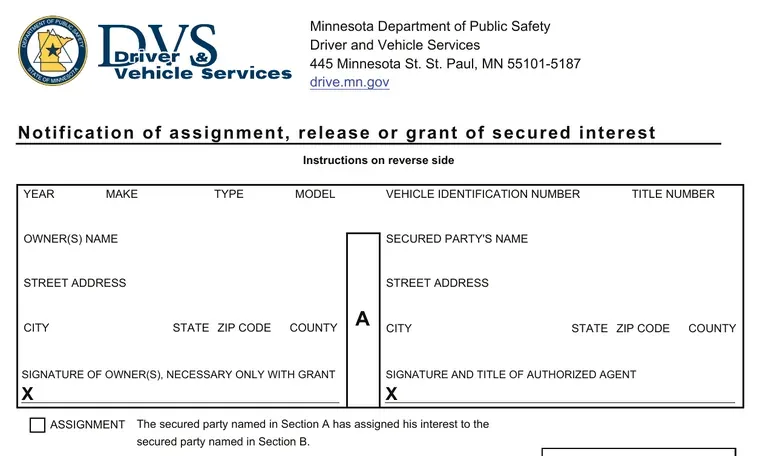
Written against PS2017 (5/2026), issued under Minnesota Statutes 168A.17 to 168A.20. Only the first side of this form is fillable; the fees and the numbered instructions for all three transactions are printed on the reverse, and the reverse is the half that tells a lender what it has to do and by when.

Two documents, and they are not the same thing. Take the blank PS2017 from the assets.dps.mn.gov copy so you get the revision that is current today.

Filled in

What a completed one looks like

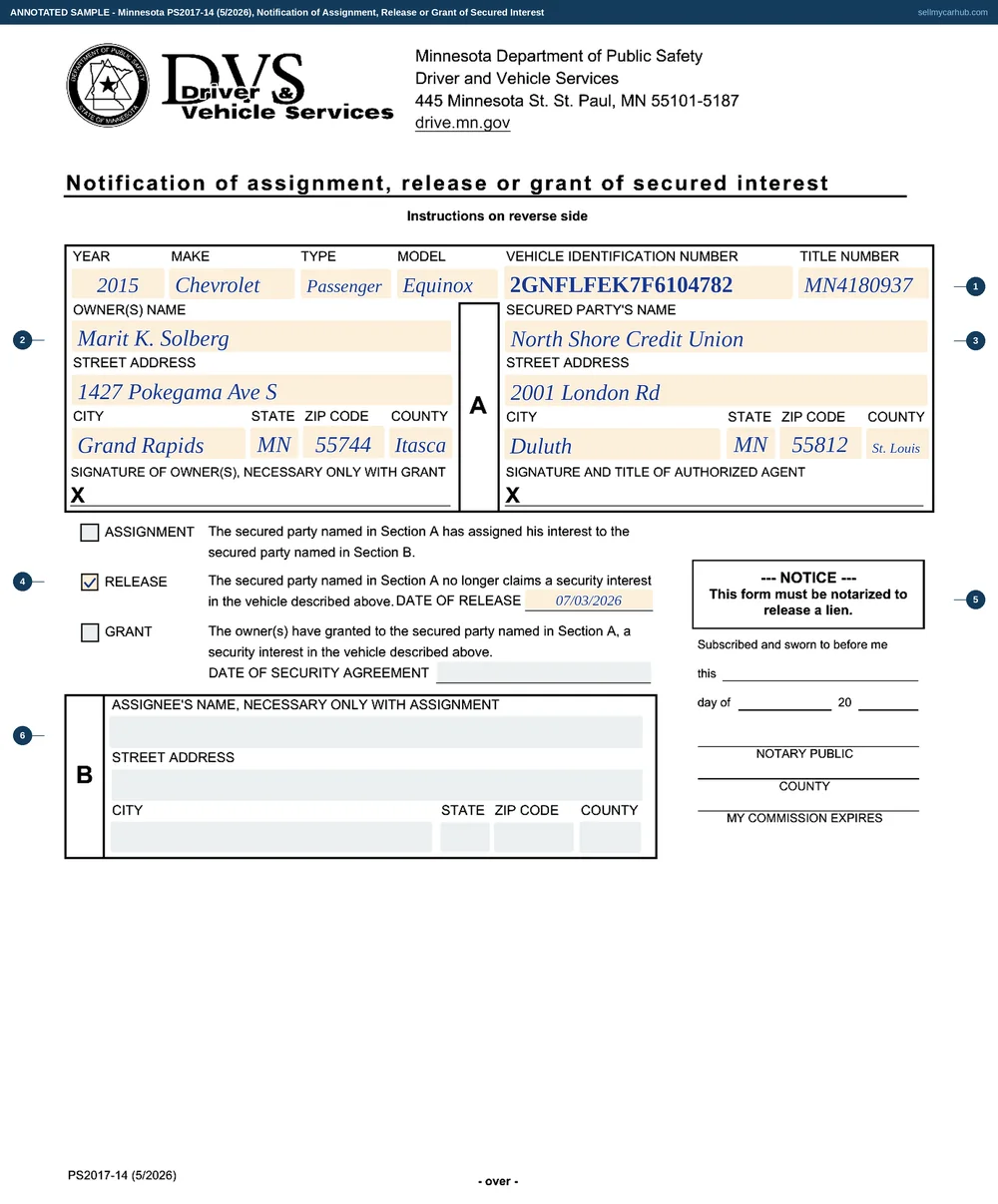
This is the actual PS2017, rendered from the PDF the Minnesota Driver and Vehicle Services publishes and completed end to end: letterhead, every field, and the blocks at the foot.

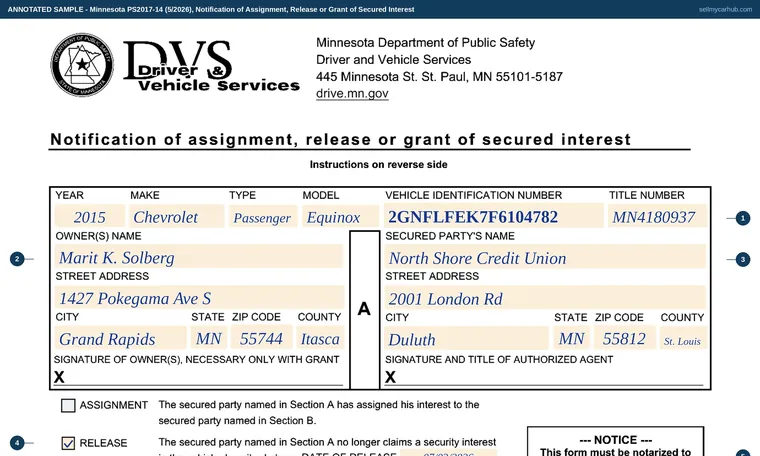
Minnesota form PS2017 filled in as a lien release: a 2015 Chevrolet Equinox, VIN 2GNFLFEK7F6104782, title number MN4180937, owner Marit K. Solberg of Grand Rapids, secured party North Shore Credit Union of Duluth, the Release box ticked with a date of release of 3 July 2026, and section B left grey and empty.
The face of the form completed as a release. Section B is greyed because an assignee only exists where a lender is handing its interest to another lender. The two signature rules and the notary block on the right are printed rules with no fillable box behind them, which is why they are the only thing left blank here - and the boxed notice beside them is what makes filling them in compulsory.
Field by field

Every line, in the order you meet it

  1. 1
    The lienholder fills this in

    The vehicle row

    Year, make, type, model, vehicle identification number and title number, copied from the certificate this release will travel with.

    Watch out: Type is the department's own classification, not a body style. If the lender guesses at it the release still works, but a title number that disagrees with the certificate stops the transaction.

  2. 2
    The lienholder fills this in

    Owner's name and address

    The left-hand column of section A: the owner as the title spells them, then street address, city, state, zip code and county.

    Watch out: County is asked for on both sides of section A and is the box lenders outside Minnesota most often leave blank.

  3. 3
    The lienholder fills this in

    Secured party's name and address

    The right-hand column of section A - the lender releasing its interest.

    Watch out: It has to be the lender named on the title. A servicer that bought the loan is an assignment first and a release second, which is what the top tick is for.

  4. 4
    The lienholder fills this in

    Tick Release

    The middle of the three boxes: the secured party named in section A no longer claims a security interest in the vehicle described above.

    Watch out: One tick only. A form with two boxes ticked is a form nobody can act on, and the three transactions carry three different fees.

  5. 5
    The lienholder fills this in

    Date of release

    The date the security agreement was satisfied, on the line beside the Release tick.

    Watch out: The instructions give the lender 15 days from satisfaction to complete the form, so a date months in the past on a form signed today invites a question.

  6. 6
    The lienholder fills this in

    Leave section B alone

    Assignee's name, street address, city, county, state and zip code - all of it completed only with an assignment.

    Watch out: Empty is the correct state of section B on a release. Helpfully writing the buyer's details into it turns the form into something else.

  7. 7
    The lienholder fills this in

    Signature and title of authorized agent

    The right-hand rule in section A, signed by the person releasing on the lender's behalf.

    Watch out: The owner's rule on the left stays empty. It is marked necessary only with grant and a release signed by the owner is not a release.

  8. 8
    Somebody else fills this in

    The notary block

    Subscribed and sworn to before me, the day, the month, the year, the notary's signature, county and commission expiry.

    Watch out: This is the step lenders skip and deputy registrars refuse. The notice beside it says the form must be notarized to release a lien, and DVS repeats it on its own lien page.

At a glance

What goes where

On the formWhat to put in it
The vehicle rowYear, make, type, model, vehicle identification number and title number, straight across the top. Every one of them has to match the certificate the form will be submitted with.
Section A, owner and secured partyTwo columns. On the left the owner's name, street address, city, state, zip code and county; on the right the secured party's name and the same five lines again.
Signature of owner(s), necessary only with grantThe left-hand signature rule. On a release the owner does not sign at all - the qualifier is printed on the form.
Signature and title of authorized agentThe right-hand rule, and on a release this is the only signature the form carries.
AssignmentThe first of three ticks: the secured party named in section A has assigned his interest to the secured party named in section B.
ReleaseThe second tick: the secured party named in section A no longer claims a security interest in the vehicle described above, with a date of release beside it.
GrantThe third tick: the owner(s) have granted to the secured party named in section A a security interest in the vehicle described above, with a date of security agreement.
Section B, assigneeName, street address, city, state, zip code and county for the assignee - completed only where the first box is ticked and a lender is handing its interest to another lender.
The notary blockSubscribed and sworn to before me this ___ day of ___ 20___, notary public, county, my commission expires - and beside it the boxed notice that the form must be notarized to release a lien.
The fee lines on the reversePrinted in the instructions rather than on the face. An assignment is $1 plus $12 filing fee; a release is the $12 filing fee; a grant is $2 plus $12 filing fee.

What gets this one rejected

Rules that decide whether it is accepted

Every line here was read off PS2017 (5/2026) itself — the PDF is here — and off the Minnesota Driver and Vehicle Services pages. This is plain-language help with a form, not legal advice, and where our wording and the agency's differ, theirs governs.

Back to all Minnesota seller paperwork, or what selling a car in Minnesota involves.

Want the paperwork handled instead?

Get My Instant Offer → Online · about 2 minutes · free

Or send the details — we'll come to you

If the lender on your title merged, moved or closed and nobody will answer the phone, tell us - we deal with that weekly.

or call/text (877) 405-1808