Sell My Car Hub

How to fill out Minnesota PS2000A

The document that stands in for the back of the title, and the one every Minnesota deputy registrar keys a transfer from. It is two sides lettered A to J, and it matters to a seller because section B repeats the assignment word for word: the odometer disclosure, the damage disclosure, the seller's printed name and address, and the certification warranting title and assigning the registration tax and the vehicle to the buyer. A seller signs section B and nothing else on it.

Written against PS2000A (06/2026), issued under Minnesota Statutes 168A.02, subdivision 1. This is DVS's most-revised form and the copy read for this page is the fifty-second edition of it, so check the footer on the PDF you download against the one named above before you rely on where a box sits.

Two documents, and they are not the same thing. Take the blank PS2000A from the assets.dps.mn.gov copy so you get the revision that is current today.

Filled in

What a completed one looks like

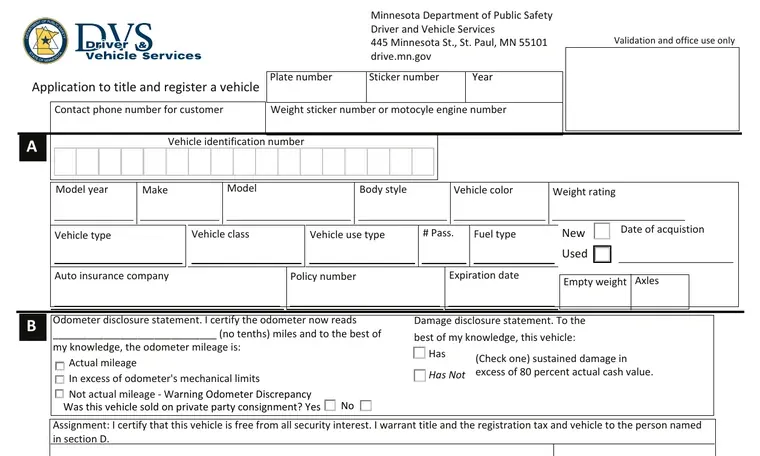
This is all 2 pages of the actual PS2000A, rendered from the PDF the Minnesota Driver and Vehicle Services publishes and completed end to end: letterhead, every field, and the blocks at the foot.

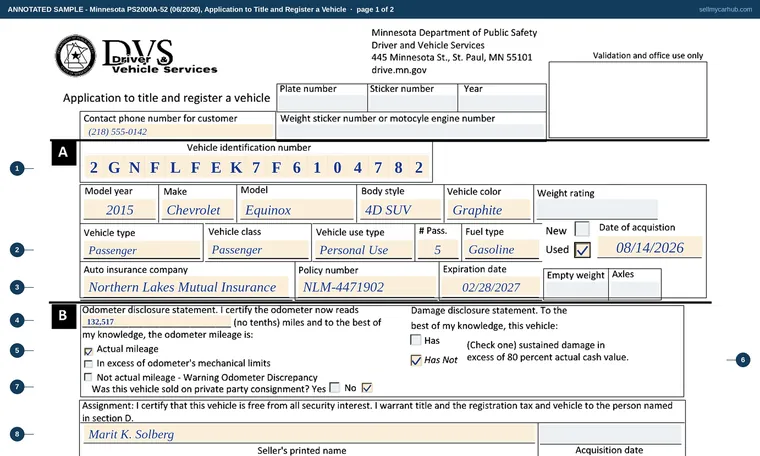
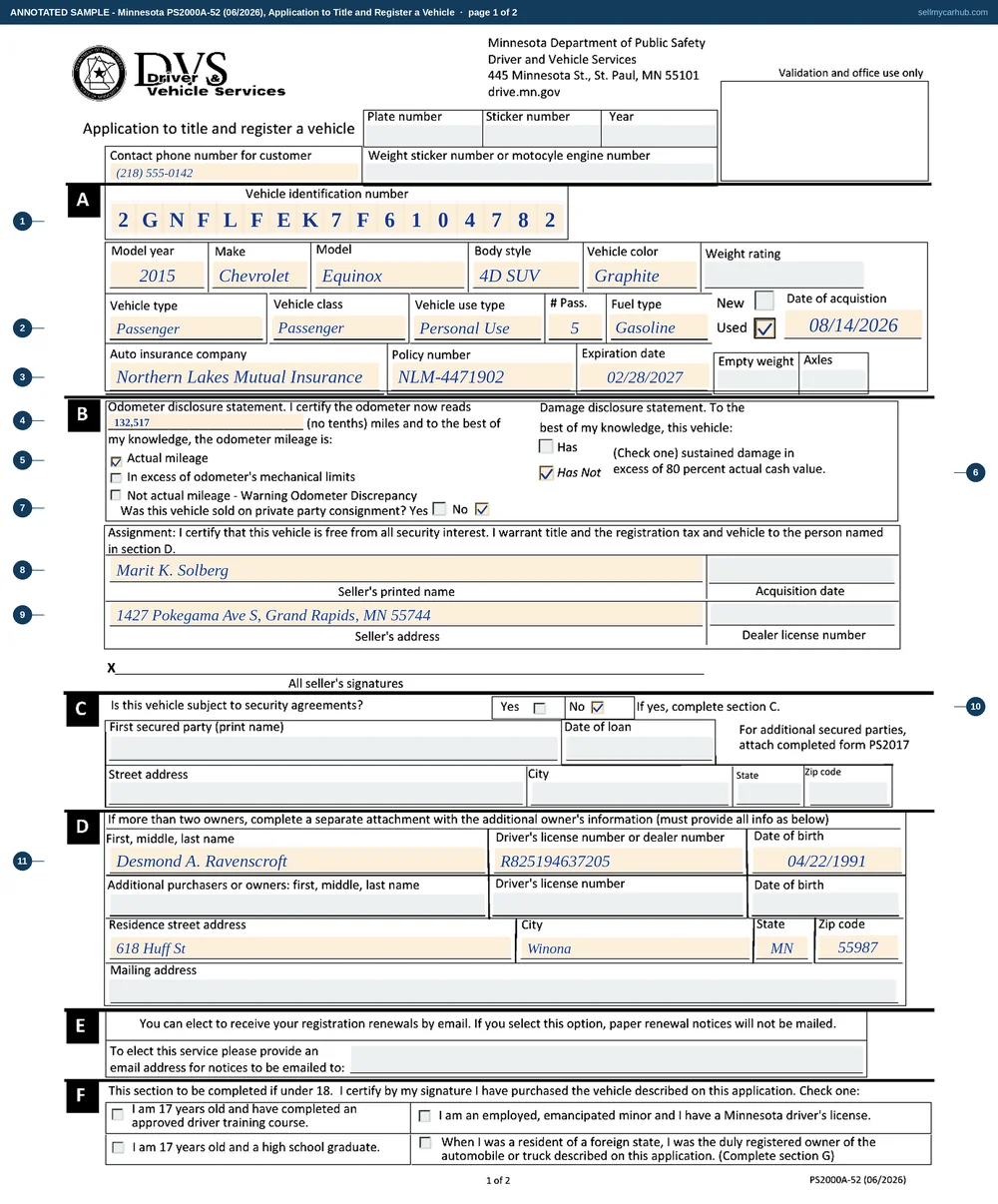
Minnesota form PS2000A filled in for a private sale: a 2015 Chevrolet Equinox, VIN 2GNFLFEK7F6104782, seller Marit K. Solberg of Grand Rapids completing section B with an odometer reading of 132517 and the actual mileage box ticked, the damage disclosure answered Has Not, buyer Desmond A. Ravenscroft of Winona in section D, the security agreement question answered No, and a full purchase price of 7,400 dollars carried through the tax declaration to a net sales tax due of 508.75.
Page 1 of 2. Sections A to F. Section B is the seller's - the two disclosures, the printed name, the address and the certification - and everything above and below it belongs to the buyer. The rule marked X under section B is empty because DVS puts no fillable box behind a signature line: it is signed in ink, after everything above it is done.
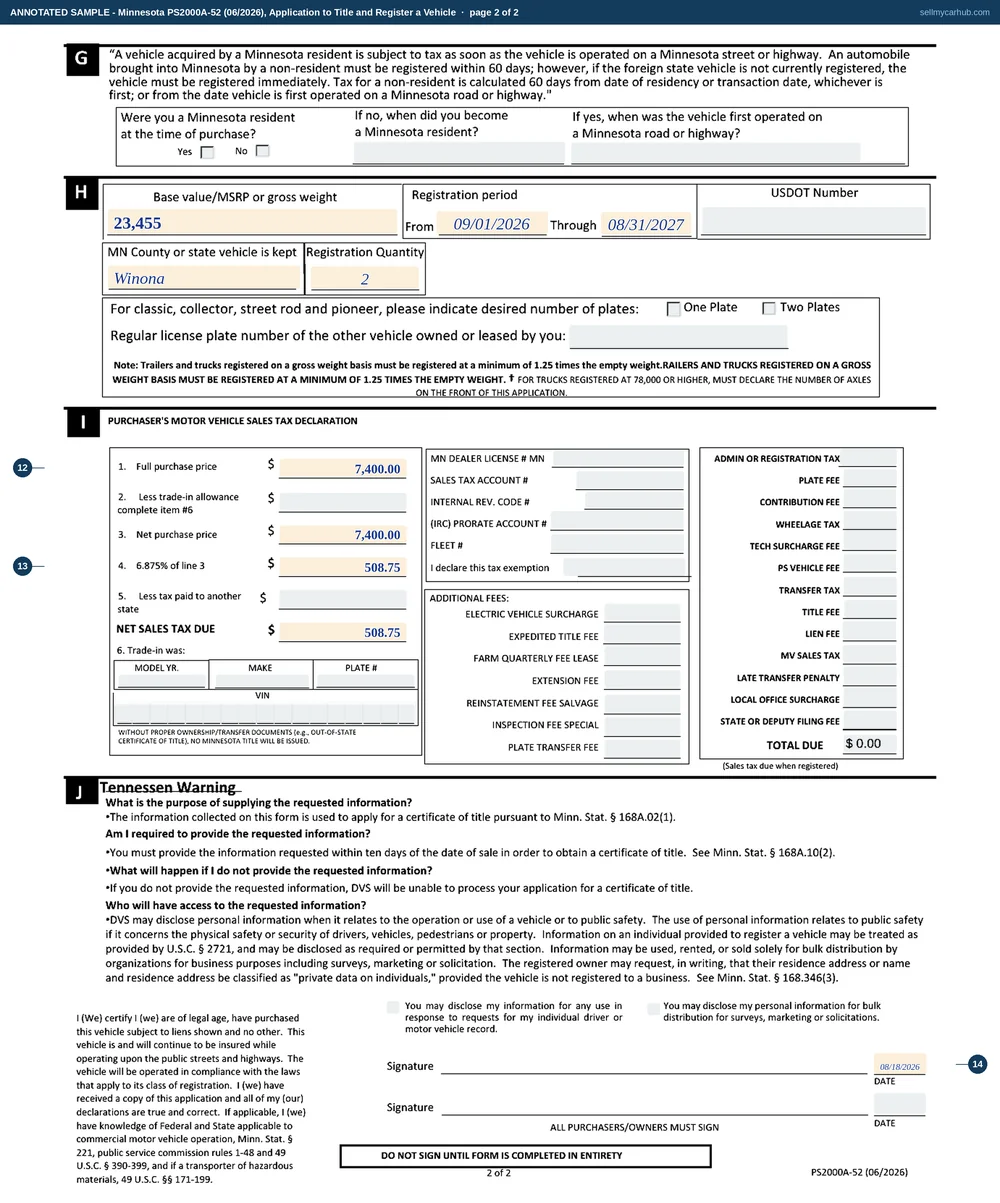
Minnesota form PS2000A filled in for a private sale: a 2015 Chevrolet Equinox, VIN 2GNFLFEK7F6104782, seller Marit K. Solberg of Grand Rapids completing section B with an odometer reading of 132517 and the actual mileage box ticked, the damage disclosure answered Has Not, buyer Desmond A. Ravenscroft of Winona in section D, the security agreement question answered No, and a full purchase price of 7,400 dollars carried through the tax declaration to a net sales tax due of 508.75.
Page 2 of 2. Sections G to J. The tax declaration does its arithmetic in the open, the fee column down the right-hand edge is the deputy registrar's to complete, and the two purchaser signature rules are blank for the same reason section B's is.
Field by field

Every line, in the order you meet it

  1. 1
    The buyer fills this in

    Vehicle identification number

    Seventeen characters across the top of section A, copied off the title rather than off the windscreen.

    Watch out: Read it from the certificate. Seventeen characters read through glass at arm's length is where a transposed digit comes from, and a wrong one here follows the car onto its new title.

  2. 2
    The buyer fills this in

    Vehicle type, class and use type

    Four dropdowns on one row in section A, plus number of passengers and fuel type.

    Watch out: Use type is a Minnesota classification with its own published definitions, and Collector, Pioneer, Classic and Street Rod all mean a vehicle not used for general transportation. Ticking one of those on a daily driver changes what may lawfully be done with it.

  3. 3
    The buyer fills this in

    Auto insurance company and policy number

    Insurer, policy number and expiration date, on the row above the disclosure band.

    Watch out: This is the buyer's insurance, not yours. The certification lower down promises the vehicle is and will continue to be insured, and a policy that starts next week is not that.

  4. 4
    You fill this in

    The odometer reading

    The current figure in whole miles in the section B box marked no tenths.

    Watch out: Read it off the dash on the day of the handover. A figure taken from a service invoice a month earlier disagrees with the car, and an odometer statement cannot be withdrawn once it is on a Minnesota record.

  5. 5
    You fill this in

    One of the three mileage statements

    Actual mileage, in excess of odometer's mechanical limits, or not actual mileage with its printed discrepancy warning.

    Watch out: The third one puts a permanent notation on the buyer's record. It is the right answer for a replaced cluster and the wrong answer for an instrument you simply do not trust.

  6. 6
    You fill this in

    The damage disclosure

    One tick against the printed 80 percent threshold: has, or has not, sustained damage in excess of that share of actual cash value. Every vehicle, no exceptions.

    Watch out: There is no age, weight or value exemption on this one, which is what catches sellers who have done this in another state. An honest Has on a car an insurer once wrote off costs you nothing you were going to keep.

  7. 7
    You fill this in

    Private party consignment

    Yes or No, in the small pair of boxes under the mileage statements.

    Watch out: Consignment means somebody else sold the car for you. Two people meeting over a set of keys is not consignment, and the answer is No.

  8. 8
    You fill this in

    Seller's printed name and address

    Your name printed, and your address, on the two ruled lines in the middle of section B.

    Watch out: Spell it as the title spells it. If the certificate says Marit K. and your licence says Marit Kirsten, the deputy registrar has to reconcile the two before anything else happens.

  9. 9
    You fill this in

    All seller's signatures

    The printed rule marked X across the foot of section B, under the certification warranting title and assigning the registration tax and vehicle to the person named in section D.

    Watch out: Every owner named on the title signs here, and this rule is the one line on the form with no fillable box behind it - it is meant to be signed in ink after the rest is complete.

  10. 10
    The buyer fills this in

    Section C, security agreements

    A Yes or a No, and where the answer is Yes, the first secured party, the date of loan and that lender's address.

    Watch out: This is about the buyer's financing, not about a lien of yours. Your lender comes off with a release before any of this; a lien is never carried forward to the next owner in Minnesota.

  11. 11
    The buyer fills this in

    Section D, the new owner

    First, middle and last name, driver's licence number, date of birth, residence street address, and a mailing address if it differs.

    Watch out: Where two buyers want rights of survivorship they write OR between their names. A company never puts a personal credential number in this box.

  12. 12
    The buyer fills this in

    Section I, full purchase price

    Line 1 of the tax declaration, copied from the price written on the certificate.

    Watch out: The two documents are read side by side. A price on the application that does not match the price on the title is the discrepancy a deputy registrar is trained to notice.

  13. 13
    The buyer fills this in

    Section I, 6.875% of line 3

    The tax, worked out on the net purchase price after any trade-in allowance.

    Watch out: On a private sale there is no trade-in, so line 3 is the same as line 1. The only lawful way to a smaller number is a genuine exemption with its code entered beside it.

  14. 14
    The buyer fills this in

    Sign section J

    Every purchaser signs and dates the certification, above the printed instruction not to sign until the form is completed in entirety.

    Watch out: There is no notary block anywhere on this form. Nobody witnesses the signature and nobody checks the boxes above it, which is why the instruction in capitals exists.

At a glance

What goes where

On the formWhat to put in it
Section A, the vehicleVehicle identification number across the top, then model year, make, model, body style, vehicle color and weight rating, and beneath them vehicle type, vehicle class, vehicle use type, number of passengers, fuel type, a New or Used tick and the date of acquisition.
Auto insurance company and policy numberMinnesota's no-fault law reaches the application: the insurer, the policy number and its expiration date sit in section A above the odometer band.
Section B, odometer disclosure statementI certify the odometer now reads ______ (no tenths) miles, then three exclusive boxes: Actual mileage; In excess of odometer's mechanical limits; Not actual mileage - Warning Odometer Discrepancy.
Section B, damage disclosure statementHas or Has Not, one tick, sustained damage in excess of 80 percent actual cash value. It has no exemption of any kind.
Was this vehicle sold on private party consignment?A bare Yes or No sitting under the odometer boxes. On an ordinary sale between two people the answer is No.
Section B, the assignmentSeller's printed name, seller's address, an acquisition date and a dealer license number, over a one-sentence certification that the vehicle is free from all security interest and that the seller warrants title and passes the registration tax as well as the vehicle to whoever is named in section D.
All seller's signaturesA printed rule marked X across the foot of section B. It is the one line on the form with no fillable box behind it, and it is the seller's.
Section C, security agreementsIs this vehicle subject to security agreements? Yes or No - then first secured party, date of loan and address, with a note that additional secured parties go on a separate form.
Section D, the new ownerFirst, middle, last name, driver's license number or dealer number, date of birth, then a second row for additional purchasers or owners, then residence street address and a separate mailing address line.
Sections E and FAn email address to receive registration renewals electronically instead of on paper, and a block completed only where the purchaser is under 18.
Section GThe non-resident band: were you a Minnesota resident at the time of purchase, when did you become one, and when was the vehicle first operated on a Minnesota road or highway.
Section H, registrationBase value or gross weight, registration period from and through, the county the vehicle is kept in, registration quantity, a one-plate or two-plate choice for collector classes, and a USDOT number.
Section I, purchaser's motor vehicle sales tax declarationFive numbered lines - full purchase price, less trade-in allowance, net purchase price, 6.875% of line 3, less tax paid to another state - ending at net sales tax due, with a trade-in description row underneath.
The fee columnNineteen labelled boxes down the right-hand edge running from admin or registration tax to total due, taking in plate fee, wheelage tax, tech surcharge fee, PS vehicle fee, transfer tax, title fee, lien fee, late transfer penalty, local office surcharge and state or deputy filing fee.
Section J, Tennessen warningMinnesota's data-practices notice, followed by two disclosure ticks and the certification every purchaser signs above the words DO NOT SIGN UNTIL FORM IS COMPLETED IN ENTIRETY.

What gets this one rejected

Rules that decide whether it is accepted

Every line here was read off PS2000A (06/2026) itself — the PDF is here — and off the Minnesota Driver and Vehicle Services pages. This is plain-language help with a form, not legal advice, and where our wording and the agency's differ, theirs governs.

Back to all Minnesota seller paperwork, or what selling a car in Minnesota involves.

Want the paperwork handled instead?

Get My Instant Offer → Online · about 2 minutes · free

Or send the details — we'll come to you

If the reason the car is still on the drive is the queue at the deputy registrar, tell us instead and we will come to it.

or call/text (877) 405-1808