Sell My Car Hub

How to fill out Minnesota PS2080A

The one document in the Minnesota set that exists because a car sold cheaply looks suspicious. Motor vehicle sales tax is charged on the purchase price, and a deputy registrar who thinks the price is below what the vehicle is worth can tax the average value instead - so this affidavit is where a buyer lists, repair by repair, why the price was what it was. Its own subtitle is exact: this form is for use when claiming below fair market value purchase price.
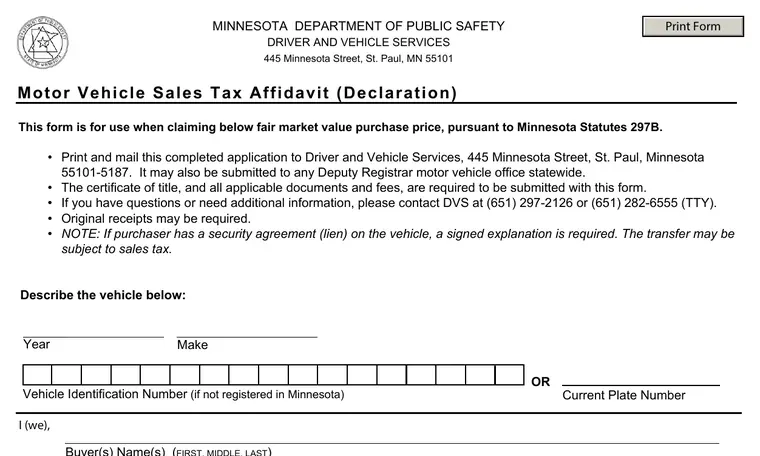
Written against PS2080A (10/13), issued under Minnesota Statutes chapter 297B. This is one of the older forms in the DVS set and its footer is dated 2013. The mechanism has not changed, but check the current fee and tax figures against the department's own pages rather than assuming everything on a form of that age is still current.

Two documents, and they are not the same thing. Take the blank PS2080A from the assets.dps.mn.gov copy so you get the revision that is current today.

Filled in

What a completed one looks like

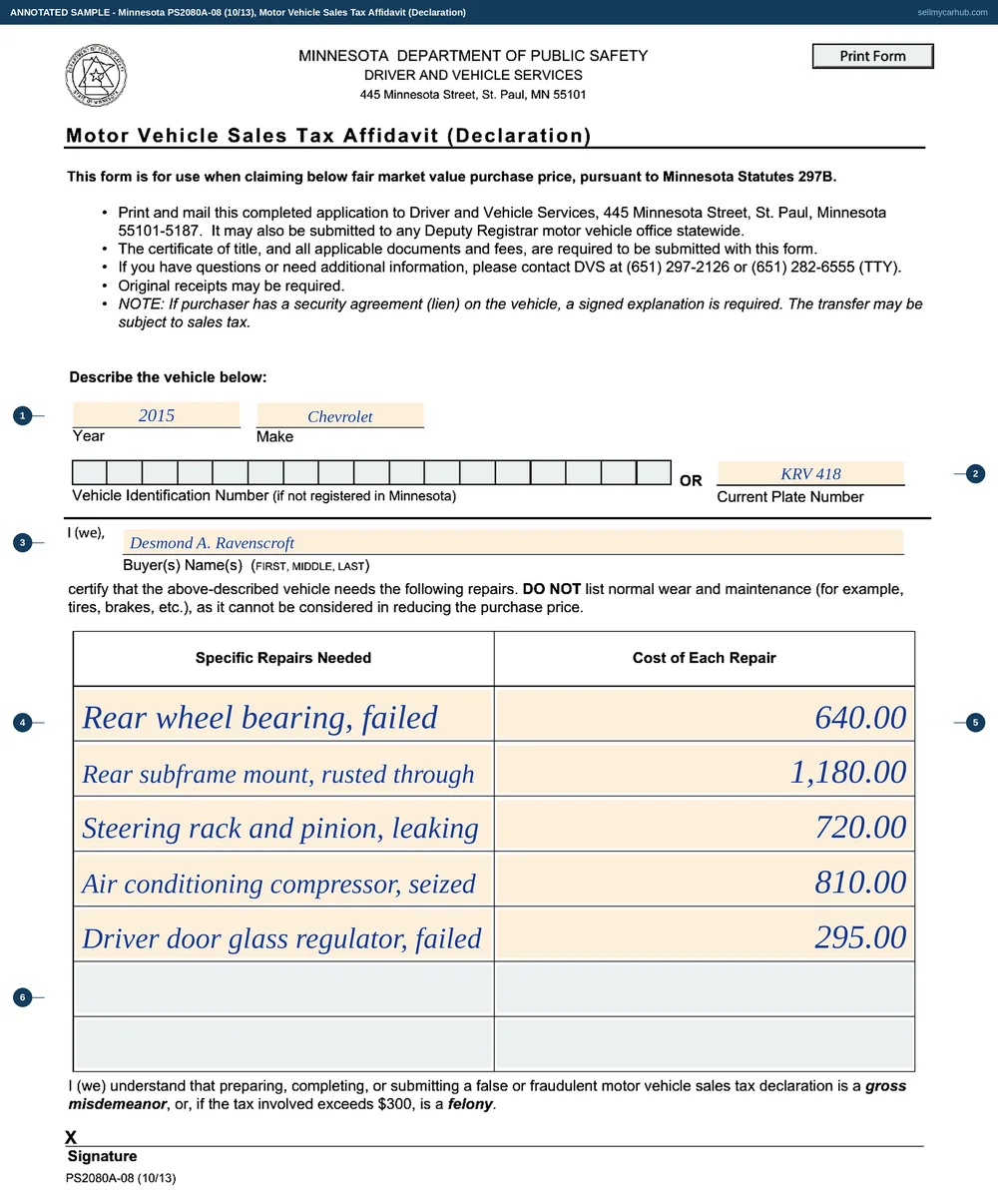
This is the actual PS2080A, rendered from the PDF the Minnesota Driver and Vehicle Services publishes and completed end to end: letterhead, every field, and the blocks at the foot.

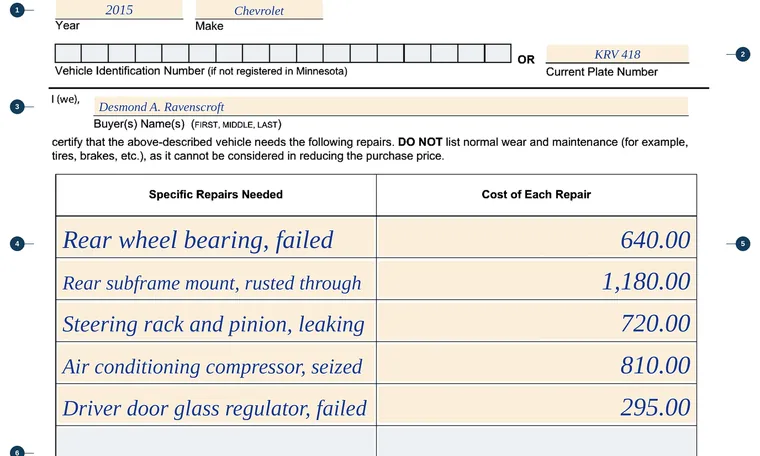
Minnesota form PS2080A filled in: buyer Desmond A. Ravenscroft declaring a below-market purchase price on a 2015 Chevrolet Equinox with plate KRV 418, listing a failed rear wheel bearing at 640 dollars, a rusted-through rear subframe mount at 1,180 dollars, a leaking rack and pinion at 720 dollars and a failed air conditioning compressor at 810 dollars, and signed at the foot.
The whole affidavit as DVS publishes it. Four defects, four figures, and nothing in the grid that could be called normal wear and maintenance - which is the only kind of list this form is for.
Field by field

Every line, in the order you meet it

  1. 1
    The buyer fills this in

    Year and make

    The two boxes at the head of the vehicle description.

    Watch out: Model year, not the year it was first registered. On a car bought late in a model year those are different numbers and the tax tables use the first one.

  2. 2
    The buyer fills this in

    Vehicle identification number, or plate

    The form prints OR between them: the identification number if the vehicle is not registered in Minnesota, the current plate number if it is.

    Watch out: In Minnesota the plate stays with the car, so a vehicle you have just bought from a Minnesota seller already has its plate - the plate number is the one to use.

  3. 3
    The buyer fills this in

    Buyer's names

    The single wide line under the words I (we), which opens the certification.

    Watch out: All the buyers, spelled as they are spelled in section D of the application. This is a sworn declaration and the names have to be the ones the record will carry.

  4. 4
    The buyer fills this in

    Specific repairs needed

    The left-hand column, one defect per row, described rather than summarised.

    Watch out: Rusted-through rear subframe mount is a defect. Needs work is not. The person reading it has to be able to picture what is wrong with the car.

  5. 5
    The buyer fills this in

    Cost of each repair

    The right-hand column, one figure per row, in line with its own defect.

    Watch out: These are the numbers a deputy registrar weighs against the price. Original receipts may be required, which is worth remembering before the figures get generous.

  6. 6
    The buyer fills this in

    Leave wear and maintenance off

    Not a box - an exclusion printed above the grid, and the commonest reason the form fails to do its job.

    Watch out: Tyres and brakes are named in the exclusion by way of example. So is anything else a car of that age would be expected to need.

  7. 7
    The buyer fills this in

    Sign it

    The ruled line marked X at the foot, under the sentence about gross misdemeanor and felony.

    Watch out: No notary, no witness. The declaration stands on the signature alone, which is why the penalty sentence sits immediately above it.

At a glance

What goes where

On the formWhat to put in it
Describe the vehicle belowYear and make on one row, then the vehicle identification number if the vehicle is not registered in Minnesota, or the current plate number if it is - the form offers them as alternatives with OR printed between.
I (we), _____ Buyer(s) Name(s)One wide line for the buyer's first, middle and last name. The certification that follows is the buyer's, not the seller's.
Specific Repairs NeededThe left-hand column of an eight-row grid. This is the substance of the form: each defect, described.
Cost of Each RepairThe right-hand column of the same grid, one figure per row.
The exclusionPrinted in the sentence above the grid: do not list normal wear and maintenance, for example tires, brakes, etc., as it cannot be considered in reducing the purchase price.
The penalty sentenceI (we) understand that preparing, completing, or submitting a false or fraudulent motor vehicle sales tax declaration is a gross misdemeanor, or, if the tax involved exceeds $300, is a felony.
SignatureA single ruled line marked X at the foot. There is no notary block on this form.

What gets this one rejected

Rules that decide whether it is accepted

Every line here was read off PS2080A (10/13) itself — the PDF is here — and off the Minnesota Driver and Vehicle Services pages. This is plain-language help with a form, not legal advice, and where our wording and the agency's differ, theirs governs.

Back to all Minnesota seller paperwork, or what selling a car in Minnesota involves.

Want the paperwork handled instead?

Get My Instant Offer → Online · about 2 minutes · free

Or send the details — we'll come to you

A car that needs more work than it is worth is exactly the kind we buy - describe it and we will price it as it stands.

or call/text (877) 405-1808