Sell My Car Hub

How to fill out Minnesota PS2024

Not the seller's form, and here because a person whose car has been taken will search for it. This is the document a secured party swears to say the vehicle was lawfully repossessed and to apply for a title in its own name - it is an affidavit and a title application on one sheet, it is notarised, and it carries the same odometer and damage disclosures a private sale does. Reading it tells a former owner exactly what has been said about their vehicle.
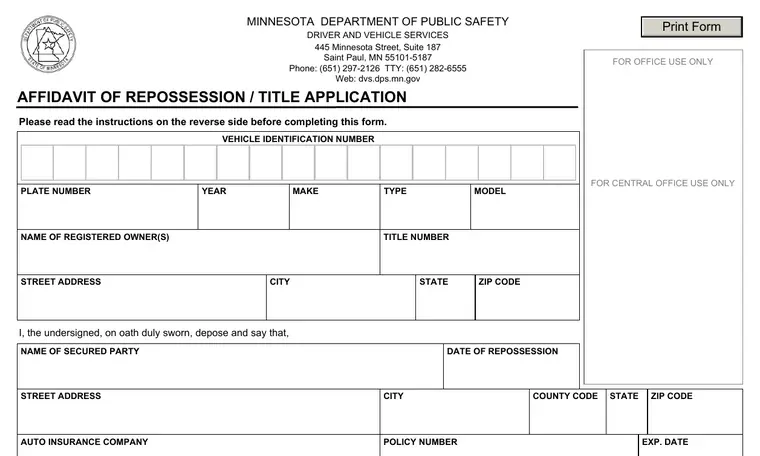
Written against PS2024 (Rev 05/18), issued under Minnesota Statutes 168A.13. If your car has been repossessed, this is the form that moves it out of your name - but it does not end what you owe. The security agreement, not the title, governs the money, and a title issued to a lender is the start of that conversation rather than the end of it.

Two documents, and they are not the same thing. Take the blank PS2024 from the assets.dps.mn.gov copy so you get the revision that is current today.

Filled in

What a completed one looks like

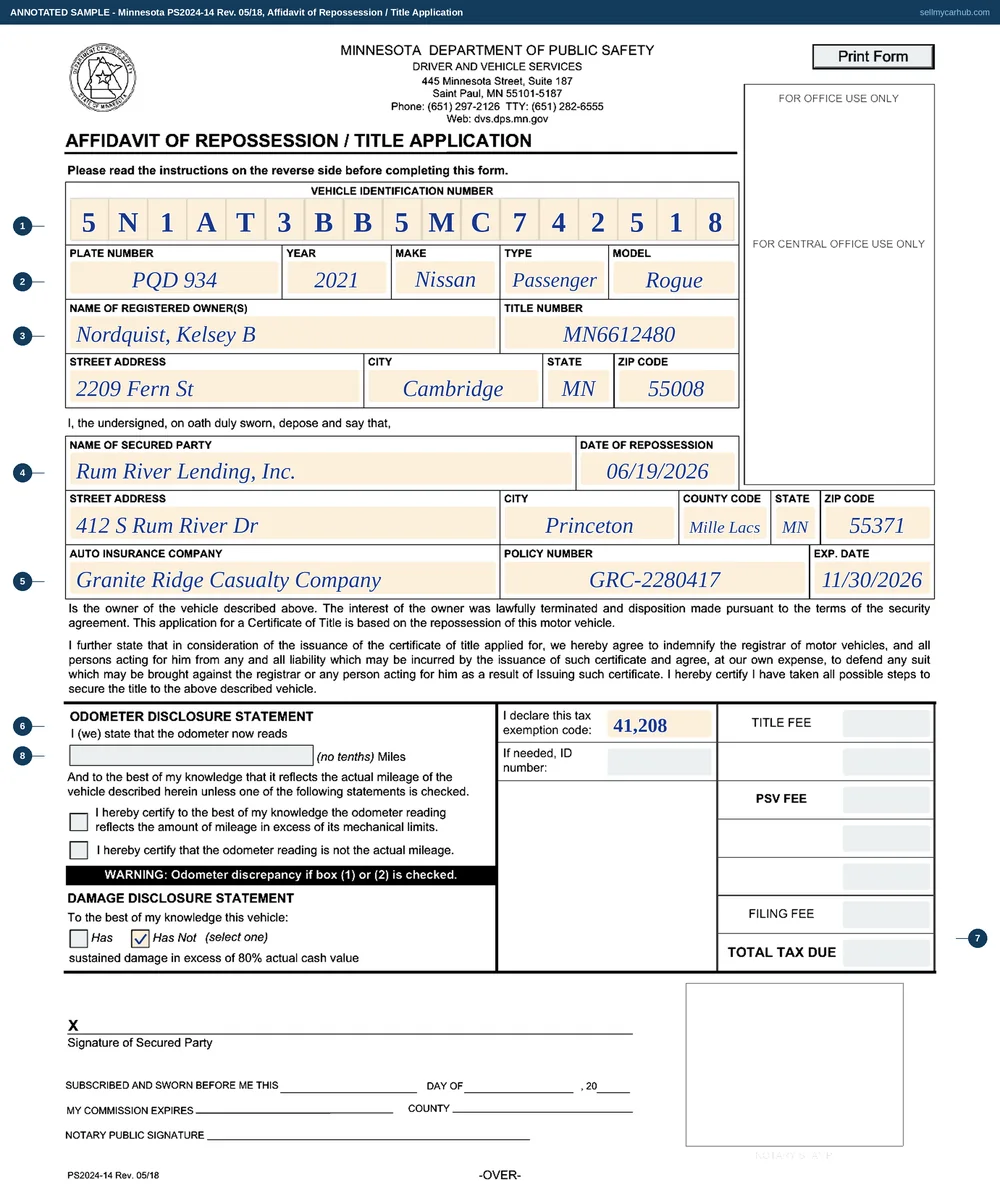
This is the actual PS2024, rendered from the PDF the Minnesota Driver and Vehicle Services publishes and completed end to end: letterhead, every field, and the blocks at the foot.

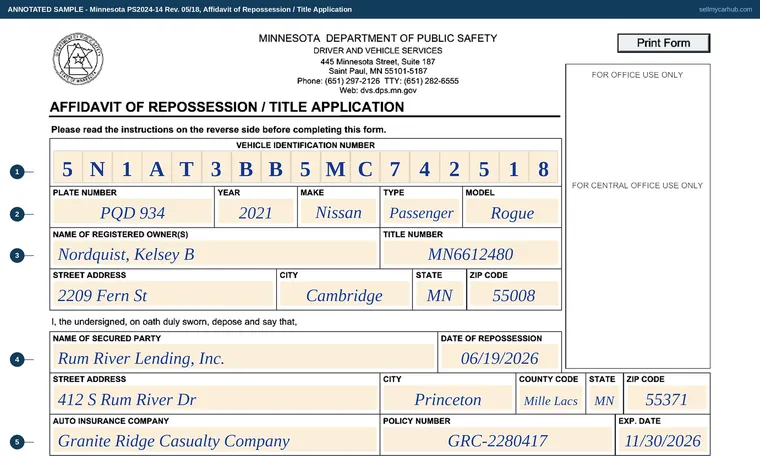
Minnesota form PS2024 filled in: Rum River Lending, Inc. of Princeton swearing the repossession of a 2021 Nissan Rogue, VIN 5N1AT3BB5MC742518, plate PQD 934, title number MN6612480, registered to Kelsey B. Nordquist of Cambridge, repossessed on 19 June 2026, with an odometer reading of 41,208 miles, the damage disclosure answered Has Not, and the signature and notary block left blank.
The whole affidavit as published. The odometer and damage statements are the same two disclosures a private seller makes on a title, made here by a lender about a car it has taken; the fee column on the right is the deputy registrar's, and the sworn signature block at the foot has no fillable boxes because it is signed and stamped in person.
Field by field

Every line, in the order you meet it

  1. 1
    The lienholder fills this in

    Vehicle identification number

    The wide box across the top of the form.

    Watch out: It has to match the security agreement and the title record. A repossession affidavit against the wrong identification number is a claim against somebody else's car.

  2. 2
    The lienholder fills this in

    Plate, year, make, type, model

    The row beneath, describing the vehicle as the record describes it.

    Watch out: In Minnesota the plate is still on the vehicle, so this is simply what was on it when it was taken.

  3. 3
    The lienholder fills this in

    Name of registered owner and title number

    The person the vehicle was titled to, and the number of that certificate.

    Watch out: This is the name that is about to come off the record. It is worth a former owner checking it is spelled correctly, because a corrected record afterwards is a harder job.

  4. 4
    The lienholder fills this in

    Name of secured party and date of repossession

    The two boxes that open the sworn statement, with the secured party's full address beneath.

    Watch out: The date is the fact everything else hangs off. It is what the lawfulness of the taking is measured from and what a former owner would compare against their own notices.

  5. 5
    The lienholder fills this in

    Insurance

    Auto insurance company, policy number and expiration date - the repossessing party's own.

    Watch out: The lender is applying to be the owner, and Minnesota's no-fault law attaches to owners. This block is not about the cover the former owner had.

  6. 6
    The lienholder fills this in

    The odometer statement

    The reading in whole miles, with either exception statement ticked only if true.

    Watch out: The warning printed under the two statements is that there is an odometer discrepancy if box 1 or 2 is checked, and that discrepancy follows the vehicle onto every future title.

  7. 7
    The lienholder fills this in

    The damage disclosure

    Has or Has Not sustained damage in excess of 80% actual cash value.

    Watch out: Required here exactly as it is on a private sale. A lender that ticks Has Not on a car it has never seen is certifying something it does not know.

  8. 8
    The lienholder fills this in

    Sign before a notary

    Signature of secured party, then subscribed and sworn before me, the day, the month, the year, county and commission expiry.

    Watch out: The indemnity above the signature is broad - it covers the registrar and all persons acting for him against any and all liability - and that is what the notarised oath is buying.

At a glance

What goes where

On the formWhat to put in it
The vehicle blockVehicle identification number across the top, then plate number, year, make, type and model, with the registered owner's name, the title number and the owner's address beneath.
Name of secured party and date of repossessionThe two boxes that open the sworn statement, followed by the secured party's street address, city, county code, state and zip code.
Auto insurance company, policy number, expiration dateThe repossessing party's own cover, because it is applying to be the owner.
The sworn statementThe interest of the owner was lawfully terminated and disposition made pursuant to the terms of the security agreement, and this application for a Certificate of Title is based on the repossession of this motor vehicle.
The indemnityIn consideration of the issuance of the certificate of title applied for, we hereby agree to indemnify the registrar of motor vehicles and all persons acting for him from any and all liability.
Odometer statementI (we) state that the odometer now reads ______ (no tenths) miles, with the two exception statements and the printed warning that there is an odometer discrepancy if either is checked.
Damage disclosure statementHas or Has Not sustained damage in excess of 80% actual cash value - the same disclosure a private seller makes, made here by the lender.
Signature of secured party and notary blockSubscribed and sworn before me this ___ day of ___, 20___, with county, commission expiry and a notary stamp area.
The fee columnTitle fee, PSV fee, filing fee and total tax due down the right-hand edge, with an exemption code box and an identification number box.

What gets this one rejected

Rules that decide whether it is accepted

Every line here was read off PS2024 (Rev 05/18) itself — the PDF is here — and off the Minnesota Driver and Vehicle Services pages. This is plain-language help with a form, not legal advice, and where our wording and the agency's differ, theirs governs.

Back to all Minnesota seller paperwork, or what selling a car in Minnesota involves.

Want the paperwork handled instead?

Get My Instant Offer → Online · about 2 minutes · free

Or send the details — we'll come to you

If a lender has taken the car or is about to, tell us where things stand - sometimes selling first is the better outcome.

or call/text (877) 405-1808