Ten blocks on a Louisiana certificate, and only four of them ever carry your handwriting. It is the ordinary sort of title — department-printed face, assignment on the back — right up to the moment you sign it, at which point it needs somebody watching in a way that most states' certificates do not.
Last updated .
Your 4 boxes
As a private seller you complete these and nothing else:
There is no blank certificate to download and there never will be: a Louisiana title is a controlled document the OMV prints and posts. The link above goes to the department's own policy on what a title file has to contain, and the checklist beside it is ours to print and keep next to the certificate you already hold.
An alteration or an erasure on a Louisiana title voids it.
Not figuratively. The OMV will not accept a certificate carrying one without a notarised affidavit of correction signed by the seller and the purchaser, and on an odometer figure it will not accept the affidavit either — the record has to be put back by issuing a fresh title in the previous owner's name. Get a clean form and start again rather than tidying.
Drawn, not copied
What is on a Louisiana title, and which half of it is yours
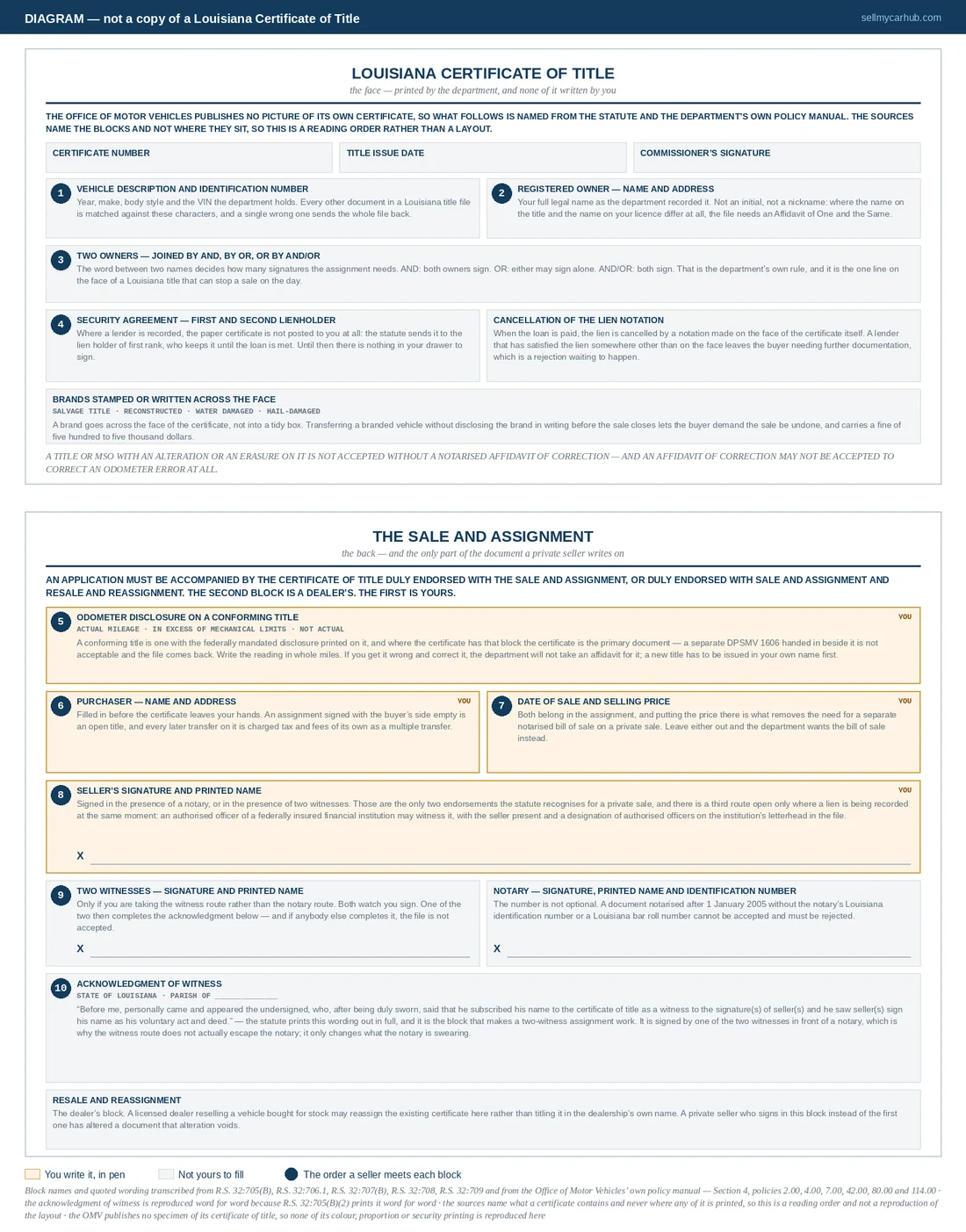
The OMV publishes no picture of its own certificate — not on a form, not in the 152-document policy manual, not anywhere we could find, and the whole sweep is written up in the file that produced this drawing. So this is a diagram rather than a photograph. Every block name and the whole of the sworn acknowledgment come from R.S. 32:705, R.S. 32:707 and R.S. 32:708 and from the department's own policies, all cited along the foot of the image.
Amber — you write it, in pen
Grey — not yours to fill
Numbered — the order a seller meets each block
Click or tap the picture to open it full size.
A diagram, and labelled as one on the image itself. It carries none of the certificate's colour, proportions or security printing, and the sources it is built from name what a Louisiana title contains without ever saying where on the sheet any of it is printed — so the order here is the order a seller meets these blocks, not the layout of the paper.
One real document, filled in
The nearest thing to a signed assignment that the OMV does publish
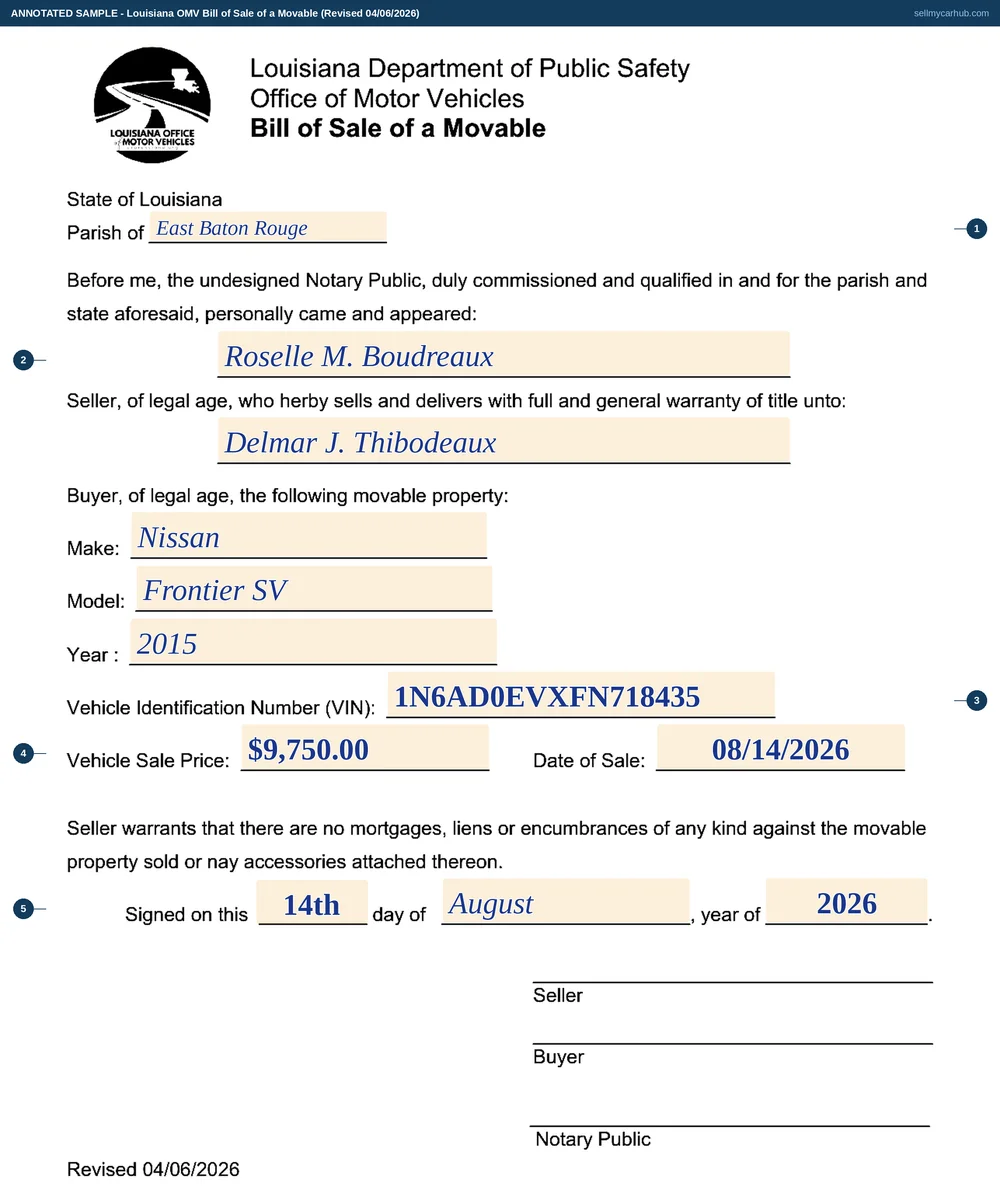
The department will not show you its certificate, but it does publish the act that stands beside it. This is the OMV's own Bill of Sale of a Movable, rendered from its PDF and completed end to end for the sale the rest of this section follows. Read the opening line: Before me, the undersigned Notary Public. That is the same sentence the assignment on the title is asking you to satisfy.
Click or tap the picture to open it full size.
The actual OMV bill of sale, revised 04/06/2026. Two things to notice: the form is written as an authentic act passed before a notary, and the notary's line at the bottom has nowhere on it to put the Louisiana identification number that the department rejects files for missing.
Published by the Office of Motor Vehicles on the YouTube channel it links from its own website. No runtime is shown beside it because YouTube refused every request for the page that prints one, and a length we cannot read is not a length we will state. Nothing loads from YouTube until you press play.
Step by step
Every box, in the order you meet it
1
Somebody else fills this in
Vehicle description and identification number
Printed on the face by the department: year, make, body style and the VIN it holds on record.
Watch out: Check it against the plate on the dashboard before anything else. Every other document in the file is matched to these characters, and a title carrying a VIN that has been retyped anywhere along the way is a file the counter stops on.
2
Somebody else fills this in
Registered owner, name and address
Your full legal name as the OMV recorded it, which is the name from your driver's licence or ID card.
Watch out: If the certificate says R. M. Boudreaux and the licence says Roselle Marie Boudreaux, the file needs an Affidavit of One and the Same completed by the notary. A missing middle name on its own does not; a different first name, surname or suffix does.
3
Somebody else fills this in
Two owners, and the word between them
AND means both of you sign the assignment. OR means either of you can. AND/OR means both again.
Watch out: Read it before you book the notary, not after. Two owners on an AND title and only one available on the day is a wasted appointment unless the absent one has left a mandate behind.
4
The lienholder fills this in
Security agreement, first and second lienholder
Where a lender is recorded, the certificate was never posted to you. R.S. 32:708(A) sends it to the lien holder of first rank, who holds it until the mortgage is liquidated.
Watch out: Do not agree a completion date until you have the paper in your hand. A lender's telephone assurance that the loan is closed is not a lien termination, and the OMV wants the release either noted on the face of the certificate or documented some other way.
5
You fill this in
Odometer disclosure on a conforming title
Whole miles, no tenths, and one of three notations: actual mileage, in excess of mechanical limits, or not actual.
Watch out: If the certificate has this block, it is the only place the mileage may go, and a separate DPSMV 1606 in the same envelope is a rejection rather than a spare. If it has no block, the separate statement becomes the primary document and you need one.
6
You fill this in
Purchaser, name and address
Written in before the certificate leaves your hands, in full, from the buyer's licence rather than from what they say their name is.
Watch out: An assignment handed over with this empty is an open title. It leaves the vehicle registered to you for as long as it takes somebody to fill it in, and if it changes hands twice on the same certificate the OMV bills tax and fees on both transfers.
7
You fill this in
Date of sale and selling price
Both belong in the assignment. Putting the price there is what removes the need for a separate notarised bill of sale on a private sale.
Watch out: Leave either one out and the department wants the notarised bill of sale instead — and if the two documents disagree about the figure, you have handed the counter a discrepancy to resolve rather than a price to tax.
8
You fill this in
Seller's signature and printed name
Signed in the presence of a notary, or in the presence of two witnesses. Printed underneath either way.
Watch out: In the presence of means at the moment. A certificate signed at home and carried to a notary afterwards has not been endorsed the way R.S. 32:705(B) describes it, and a notary who notices will not take it.
9
Somebody else fills this in
The two witnesses
Only where you are taking the witness route. Both watch you sign and both subscribe their names.
Watch out: Pick two people who can also come back for the acknowledgment, because one of them has to swear it. A witness who signs and then goes home has left you with a title that fails on the block underneath.
10
Somebody else fills this in
Acknowledgment of Witness
A sworn statement by one of the two witnesses that they signed as a witness and saw the seller sign. The statute prints the wording in full and the certificate carries it.
Watch out: Completed by anybody other than one of the two witnesses, the file is not accepted — the department says so in terms. This is the block that makes the two-witness route work, and the reason it is not really cheaper than simply finding a notary.
Before the pen
Before the pen, and what the OMV does about ink
Louisiana is stricter about what happens to a title after the ink is down than about what colour the ink is. The rules below are the department's, and the first of them is printed on one of its own forms.
Black ink or a typewriter
The instruction is printed on the OMV's own notice of transfer, directly under the heading. Blue is not refused anywhere in writing, but black is what the department asks for and there is nothing to gain by testing it.
Never correction fluid, never an erasure
A title carrying an alteration or an erasure is not accepted at all without a notarised affidavit of correction signed by both seller and purchaser — and on an odometer figure, even that will not do.
A strike-through is sometimes survivable
The OMV lists the alterations it will take with a properly endorsed supporting document behind them: a misspelled name corrected with a strike over, an error in the address, an error in the date of sale that changes no fee. Everything else needs the affidavit.
Full first names, no initials
The notary is required to insert the full first and last names of the parties. Initials, nicknames and pet names cannot be used for first names, and no title or rank goes in front of one.
Nothing gets signed until the notary is watching
An assignment signed the night before and taken to a notary in the morning is not what R.S. 32:705(B) describes. The statute says in the presence of, and it means at the moment.
Three of these come from people who have sold a car in another state and one from people who have sold too many in this one. Each has a source next to it.
“Louisiana is a notary state, so the title has to be notarised. Full stop.”
The statute gives you two doors. A notary is one; two witnesses plus a completed Acknowledgment of Witness is the other, and both are equally good. What is true is that the second door leads back into the first, because the acknowledgment is itself sworn in front of a notary.
“Leave the plate on. The buyer needs something to drive home with.”
The plate is registered to you and is not transferable to the person buying the car. Leaving it on leaves a live registration in your name on a vehicle in somebody else's driveway. The buyer's cover comes from R.S. 32:707(H) instead: sixty days' protection from a no-tag citation with proof of application in hand.
“Write a lower price on the title. It saves the buyer some tax.”
It does not save anybody anything and it costs both of you. Tax is assessed on the sale price, and the price on the assignment is what the OMV works from — but that price is also the figure the buyer's two-year plate fee is calculated from, and a figure that does not match the bill of sale is a file the counter stops on rather than a discount.
“An open title is fine. The next person can just fill in their own name.”
It is fine for exactly nobody. Where more than one private transfer shows on the paperwork the OMV processes a multiple transfer and charges tax and fees on each assignment, and in the meantime the vehicle is still registered to you, because ownership does not move until somebody applies for a title.
Who signs depends on what is printed on the face of the certificate, and on nothing else. Read the owner line before you book anybody.
One name on the face
That person signs the assignment, in front of a notary or in front of two witnesses.
Two names joined by AND
Both sign. Neither can act for the other without a mandate that says so.
Two names joined by OR
Either one signs alone, and the file is accepted.
Two names joined by AND/OR
Both sign, the same as AND. The slash buys nothing at the counter.
A lender on the face
You never had the certificate to sign. It went to the lien holder of first rank when it was issued, and it comes back once the mortgage is terminated.
The owner has died
Nobody signs as the owner. A judgment of possession, a validated small succession affidavit, or an Affidavit of Heirship decides who may, and then that person signs and has it notarised.
The owner cannot be there
A mandate, notarised if it was executed in Louisiana, with the vehicle's make, year and VIN written into it. An agent cannot transfer the vehicle into their own name unless the mandate says so in terms.
A dealer is buying it
Since 1 January 2023 a sale to or from a Louisiana-licensed dealer needs no notarisation at all, which is the one place the state has taken the requirement away.
Once it is signed
Take the plate off, cancel it, then cancel the insurance, and file the notice of transfer within fifteen days. Nothing you do afterwards moves the ownership: that happens when the buyer applies for a title, which is why the notice matters and why the buyer's five-day deadline is worth mentioning to them before they drive off.