The separate mileage statement, and the one form in this set most likely to be filled in when it should not be. Louisiana's rule is that a title with the federally mandated disclosure printed on it - a conforming title - is the primary document, and a separate odometer statement is not acceptable alongside one. This sheet exists for the other case: a non-conforming title with no odometer block on it, where the separate statement becomes the primary document and the file is short without it.
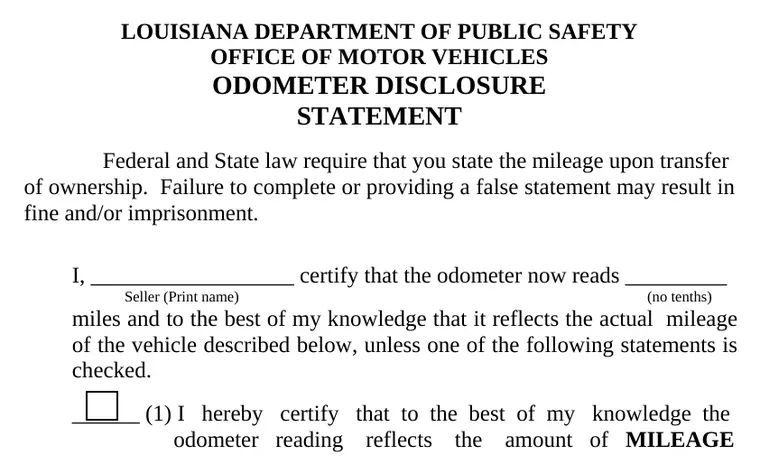
Written against DPSMV 1606 (R10/94), issued under 49 CFR 580.17, federal odometer disclosure requirements. The revision on this one is R 10/94 - the OMV has been publishing the same sheet since 1994, and it predates the twenty-year odometer rule by twenty-seven years. Nothing printed on it is wrong, but nothing printed on it tells you which vehicles are exempt either; that lives in Policy 80.00 rather than on the form.
Two documents, and they are not the same thing. Take the blank DPSMV 1606 from the public.powerdms.com copy so you get the revision that is current today.
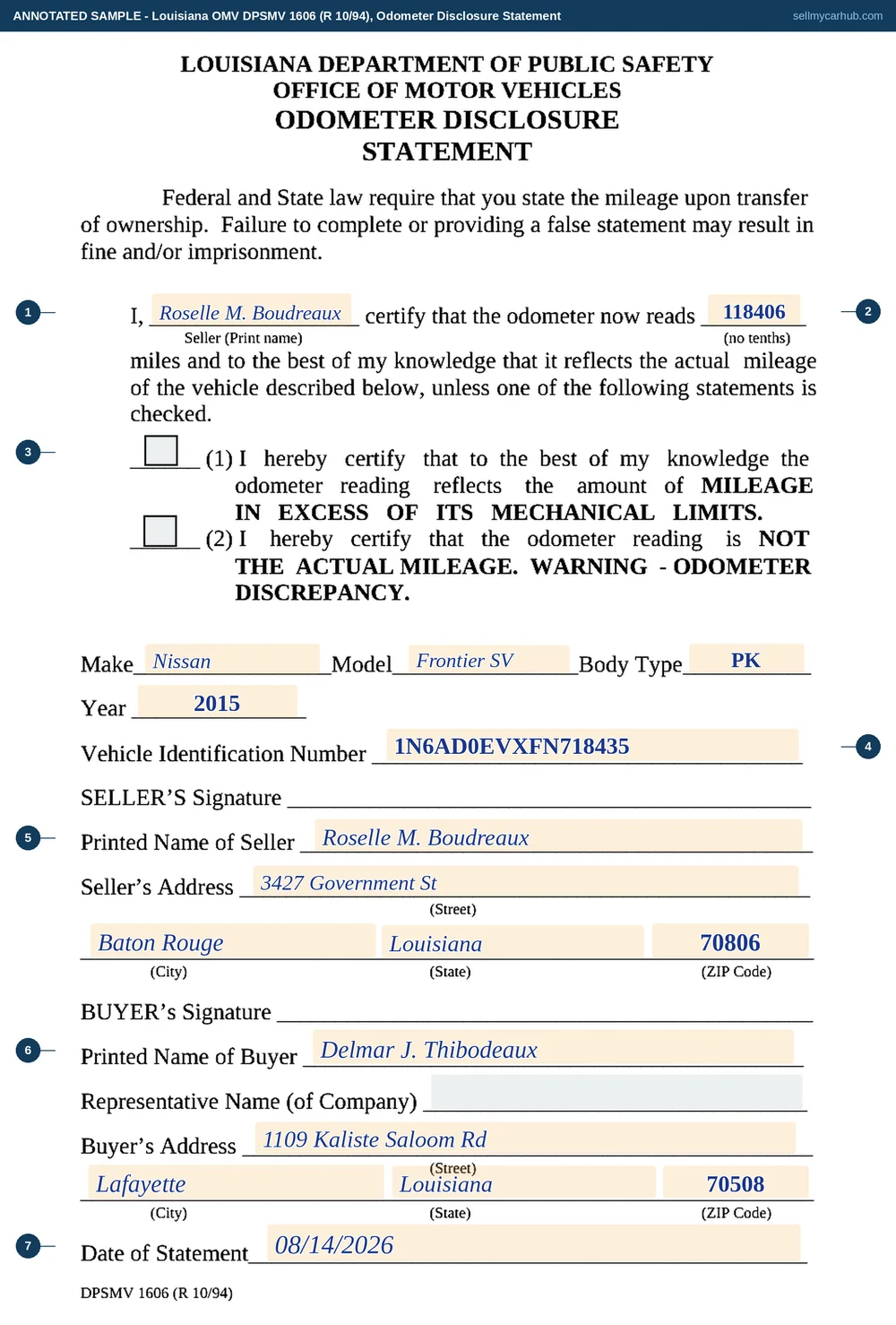
This is the actual DPSMV 1606, rendered from the PDF the Louisiana Office of Motor Vehicles publishes and completed end to end: letterhead, every field, and the blocks at the foot.
The name blank in the certification sentence, near the top of the sheet.
Watch out: This is a certification, not a heading. The name that goes here is the name signing at the bottom, and it should read the same as the name on the face of the certificate.
The second blank in the same sentence, marked no tenths underneath.
Watch out: Whole miles as displayed. Do not round, do not add the tenths, and do not adjust for a cluster that was replaced - if the reading is not the actual mileage, that is what statement (2) is for.
Two tick boxes under the certification: mileage in excess of its mechanical limits, and not the actual mileage.
Watch out: Leave both empty if the reading is honest. Ticking (2) puts an odometer discrepancy on the record permanently, so it is not somewhere to hedge - but leaving it untouched on a vehicle you know has a replaced or rolled cluster is a false statement on a form that names the penalty at the top.
A full-width rule under the Make, Model, Body Type and Year row.
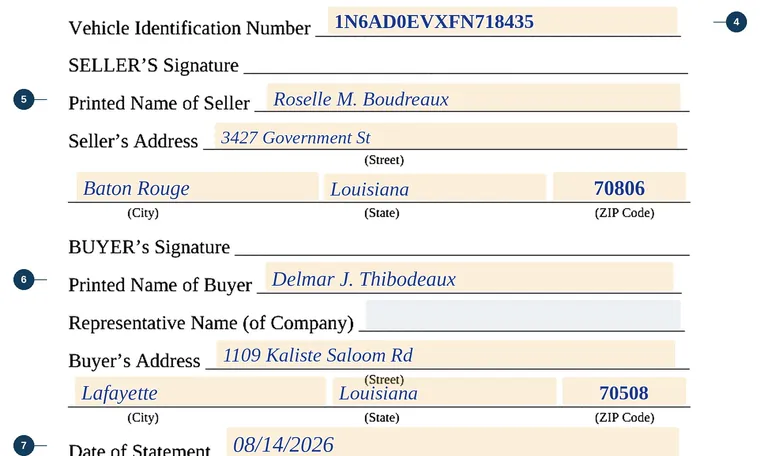
Watch out: This is the only line on the sheet that ties the reading to a specific vehicle. A statement with a wrong character in the VIN is a statement about somebody else's car.
The rule directly under the seller's signature line.
Watch out: Print it as well as signing it. The department's requirement is a statement signed and printed by both parties, and a signature nobody can read is exactly what the printed line is there to solve.
The buyer's half, lower down: signature, printed name, and a Representative Name line for a company buyer.
Watch out: The buyer has to sign this at the same time you do, in front of you. A statement taken away to be signed later is a statement neither of you watched the other make.
The last rule on the sheet.
Watch out: The date of the transfer, matching the date of sale everywhere else in the file. A statement dated a week after the money moved invites the question of what the reading was on the day.
| On the form | What to put in it |
|---|---|
| The federal warning | Printed across the head of the sheet: Federal and State law require that you state the mileage upon transfer of ownership. Failure to complete or providing a false statement may result in fine and/or imprisonment. |
| I, [seller], certify that the odometer now reads [ ] miles | A sentence with two blanks in it, the second marked no tenths. Everything else on the page hangs off this line. |
| Statement (1) | I hereby certify that to the best of my knowledge the odometer reading reflects the amount of MILEAGE IN EXCESS OF ITS MECHANICAL LIMITS. A tick box, and the capitals are the form's own. |
| Statement (2) | I hereby certify that the odometer reading is NOT THE ACTUAL MILEAGE. WARNING - ODOMETER DISCREPANCY. The second tick box, and the warning line under it is what gets carried onto the record. |
| Make, Model, Body Type, Year | Four boxes across two rows, describing the vehicle the reading belongs to. |
| Vehicle Identification Number | A single full-width rule. This is what ties the statement to the title file. |
| SELLER'S Signature, Printed Name of Seller | Two rules. Both are needed - the OMV asks for a statement signed and printed by both parties, and a signature on its own is half of that. |
| Seller's Address | Street on one rule, then city, state and ZIP across three boxes on the next. |
| BUYER's Signature, Printed Name of Buyer, Representative Name (of Company) | The mirror image, plus a line for the representative where the buyer is a business. |
| Buyer's Address | Street, then city, state and ZIP again. |
| Date of Statement | A single rule at the foot. It should be the date of the transfer. |
Every line here was read off DPSMV 1606 (R10/94) itself — the PDF is here — and off the Louisiana Office of Motor Vehicles pages. This is plain-language help with a form, not legal advice, and where our wording and the agency's differ, theirs governs.
Back to all Louisiana seller paperwork, or what selling a car in Louisiana involves.