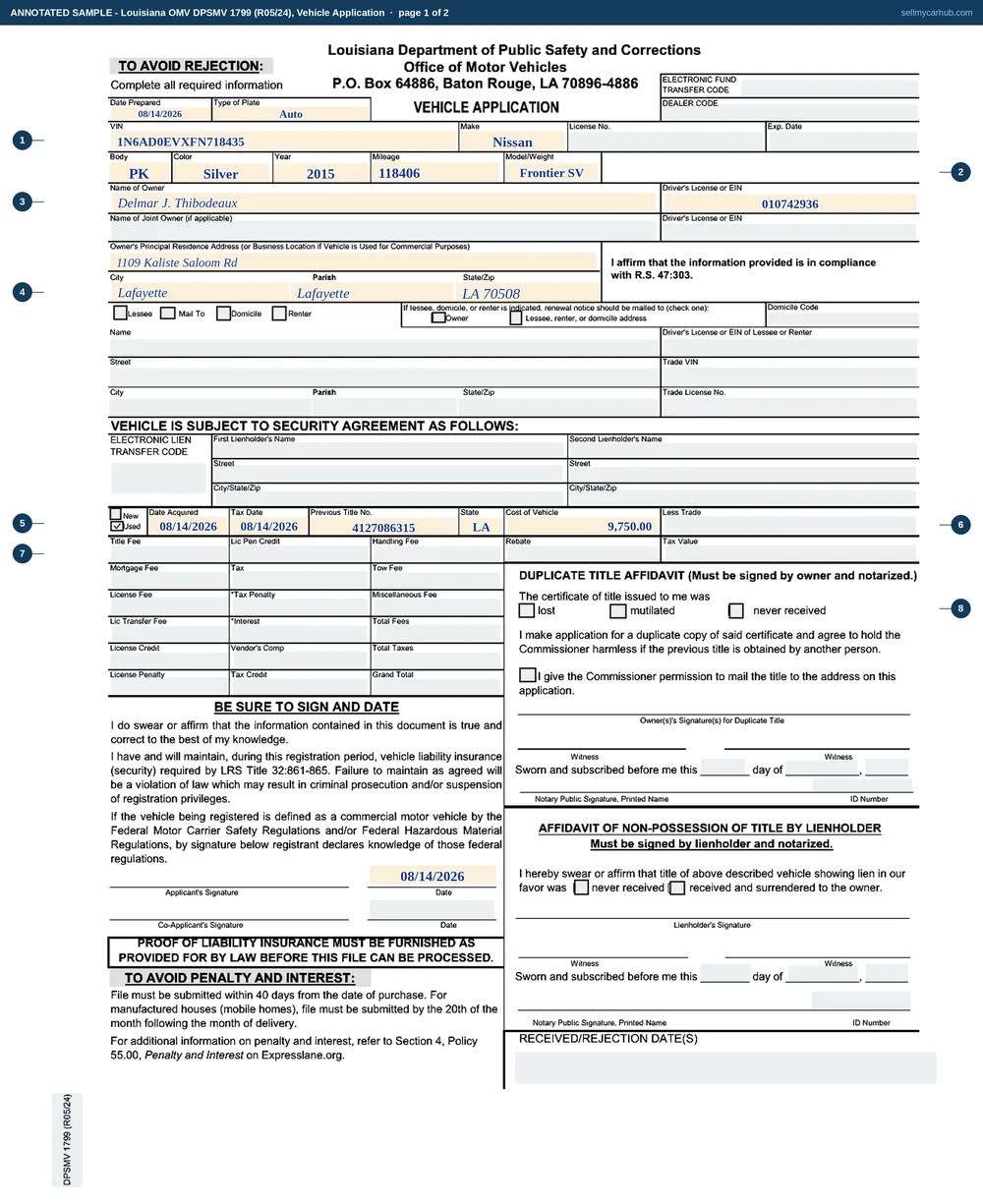
| Date Prepared, Type of Plate | Top-left pair, under the words TO AVOID REJECTION: Complete all required information. Type of Plate is the class being asked for - auto, truck, commercial, transfer, or the name of a specialty plate. |
|---|
| Electronic Fund Transfer Code, Dealer Code | Top-right, and both belong to the trade. A private buyer walking into an OMV office or a Public Tag Agent leaves them empty. |
|---|
| VIN, Make, License No., Exp. Date | The identification row. License No. and Exp. Date describe a plate being carried over, which on a private passenger sale there will not be, because Louisiana plates are not transferable between owners. |
|---|
| Body, Color, Year, Mileage, Model/Weight | Five boxes of description. Mileage is a plain number here rather than a certified disclosure - the certification lives on the title or on the DPSMV 1606. |
|---|
| Name of Owner, Name of Joint Owner, Driver's License or EIN | Two owner rows, each with its own identification box. A company goes in with its EIN rather than a licence number. |
|---|
| Owner's Principal Residence Address, City, Parish, State/Zip | Parish is asked for separately from city, and it is not decoration - it is the parish rate the sales tax is worked out at. Beside it the form prints its own reason: I affirm that the information provided is in compliance with R.S. 47:303. |
|---|
| Lessee / Mail To / Domicile / Renter | Four ticks and a second address block for a vehicle whose renewal notice should go somewhere other than the owner, with a Domicile Code the office fills in. |
|---|
| Vehicle is subject to security agreement as follows | Electronic Lien Transfer Code, then first and second lienholder with street and city, state and zip for each. Empty on a cash sale. |
|---|
| New / Used, Date Acquired, Tax Date, Previous Title No., State, Cost of Vehicle, Less Trade | The transaction row. Previous Title No. is the number off the certificate being surrendered, and Cost of Vehicle is the figure the tax is assessed on. |
|---|
| The fee column | Twenty boxes down the left: title fee, licence penalty credit, handling fee, rebate, tax value, mortgage fee, tax, tow fee, licence fee, tax penalty, miscellaneous fee, licence transfer fee, interest, total fees, licence credit, vendor's compensation, total taxes, licence penalty, tax credit and grand total. The office fills these in, not you. |
|---|
| BE SURE TO SIGN AND DATE | Three printed declarations above the signature: that the information is true, that liability insurance required by LRS Title 32:861-865 has been and will be maintained, and that a registrant of a commercial motor vehicle knows the federal safety and hazardous material regulations apply. Then Applicant's Signature and Co-Applicant's Signature with a date beside each. |
|---|
| Duplicate Title Affidavit | A boxed block on the right, headed Must be signed by owner and notarized. Three ticks - lost, mutilated, never received - a promise to hold the Commissioner harmless if the previous title turns up in somebody else's hands, an optional permission to post the title to the address on the application, two witness lines and a notary line with an ID Number box. |
|---|
| Affidavit of Non-Possession of Title by Lienholder | The second boxed block, headed Must be signed by lienholder and notarized. Two ticks - never received, or received and surrendered to the owner - then the lienholder's signature, two witnesses and a second notary line. |
|---|
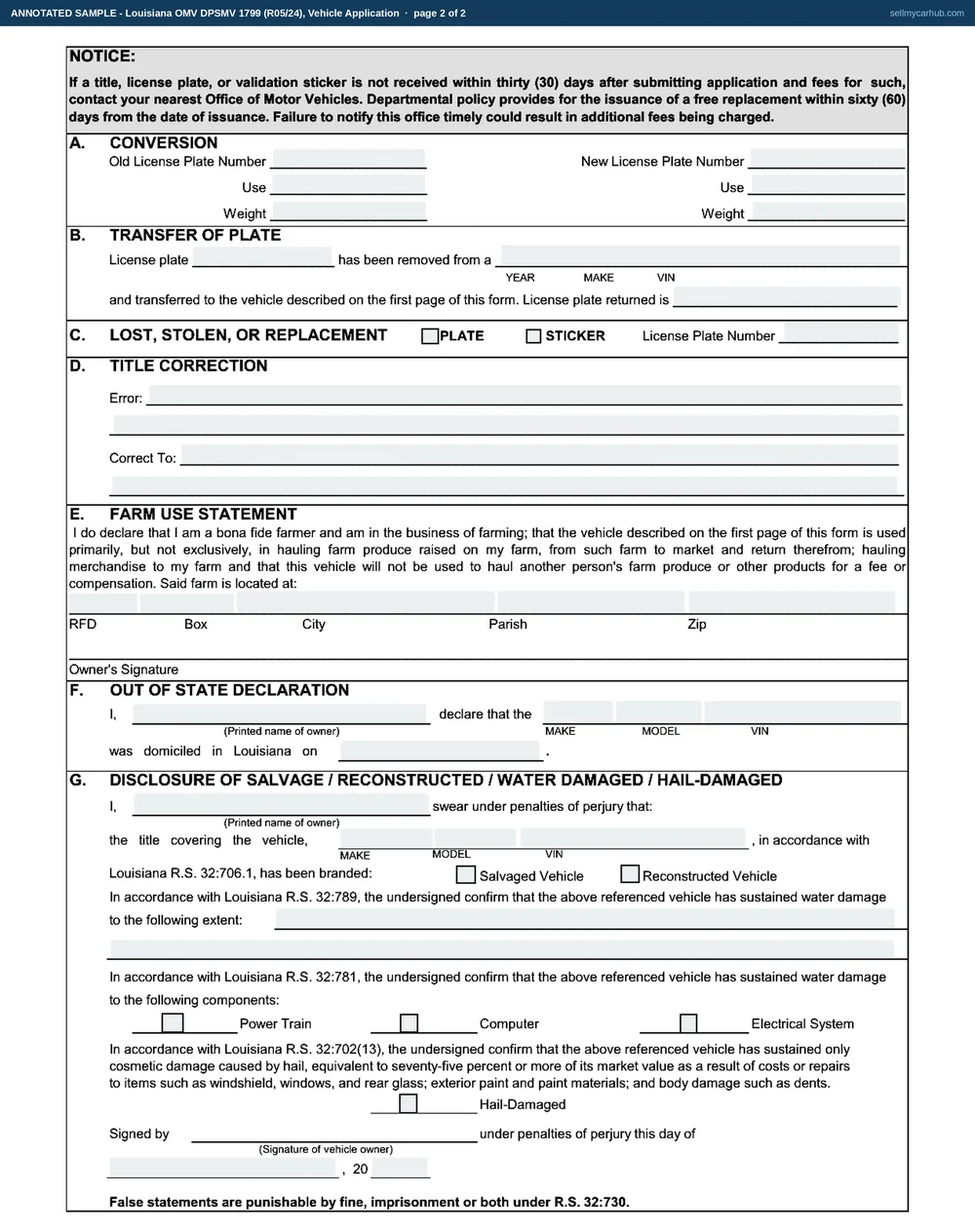
| Page two, sections A to G | Conversion, transfer of plate, lost or stolen plate or sticker, title correction, farm use statement, out of state declaration, and a disclosure block for salvage, reconstructed, water damaged and hail-damaged vehicles that ends with the words False statements are punishable by fine, imprisonment or both under R.S. 32:730. |
|---|
 Step 1 · the form itself
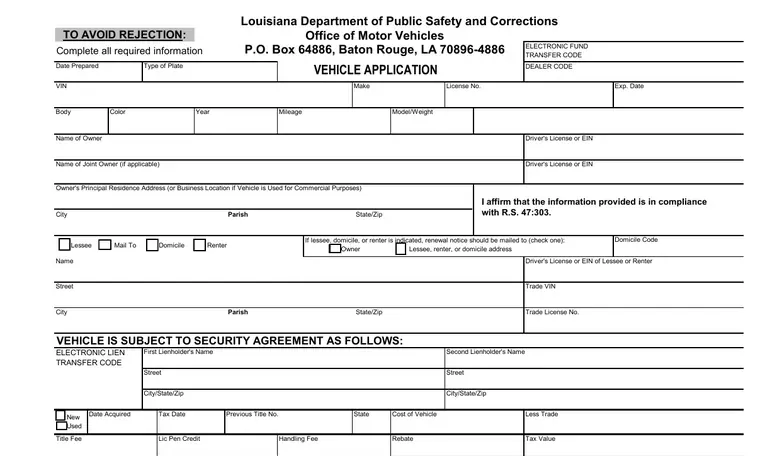
Blank DPSMV 1799 — Vehicle Application
PDF at public.powerdms.com · new tab
View the blank DPSMV 1799
Step 1 · the form itself
Blank DPSMV 1799 — Vehicle Application
PDF at public.powerdms.com · new tab
View the blank DPSMV 1799
 Step 2 · how to fill it in
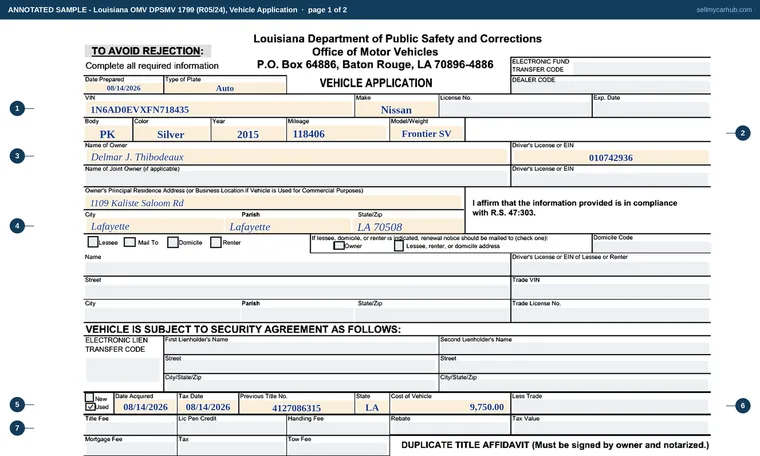
Our filled-in DPSMV 1799 guide
PDF · 4 pages · 810 KB · new tab
See our filled-in example
Step 2 · how to fill it in
Our filled-in DPSMV 1799 guide
PDF · 4 pages · 810 KB · new tab
See our filled-in example