Sell My Car Hub

How to fill out Louisiana Bill of Sale

One page, and it is written as an authentic act rather than as a receipt: it opens Before me, the undersigned Notary Public, duly commissioned and qualified, and it ends on a notary's line. Louisiana does not always need it. The OMV's own rule is that a separate bill of sale is not required for a private sale where the selling price is included as part of the title assignment - so this form is what you reach for when the price is not on the title, when the certificate has no room for it, or when the buyer wants a document of their own with a warranty of title on it.
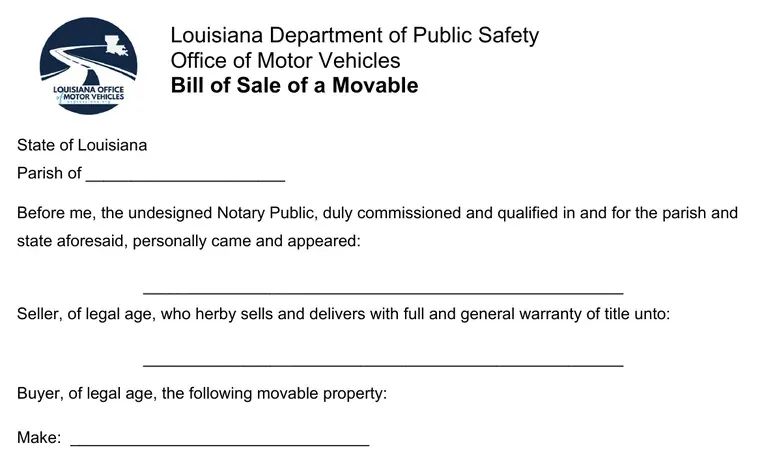
Written against Bill of Sale (Rev 04/06/2026), issued under R.S. 32:705, acceptance and delivery of certificate. The version below was revised on 6 April 2026 and the OMV titles it Bill of Sale of a Movable, while listing it on its forms index as Bill of Sale of a Motor Vehicle. Same document, two names. It carries no DPSMV number at all, so there is no code to check it against - the revision date at the foot is the only marker it has.

Two documents, and they are not the same thing. Take the blank Bill of Sale from the public.powerdms.com copy so you get the revision that is current today.

Filled in

What a completed one looks like

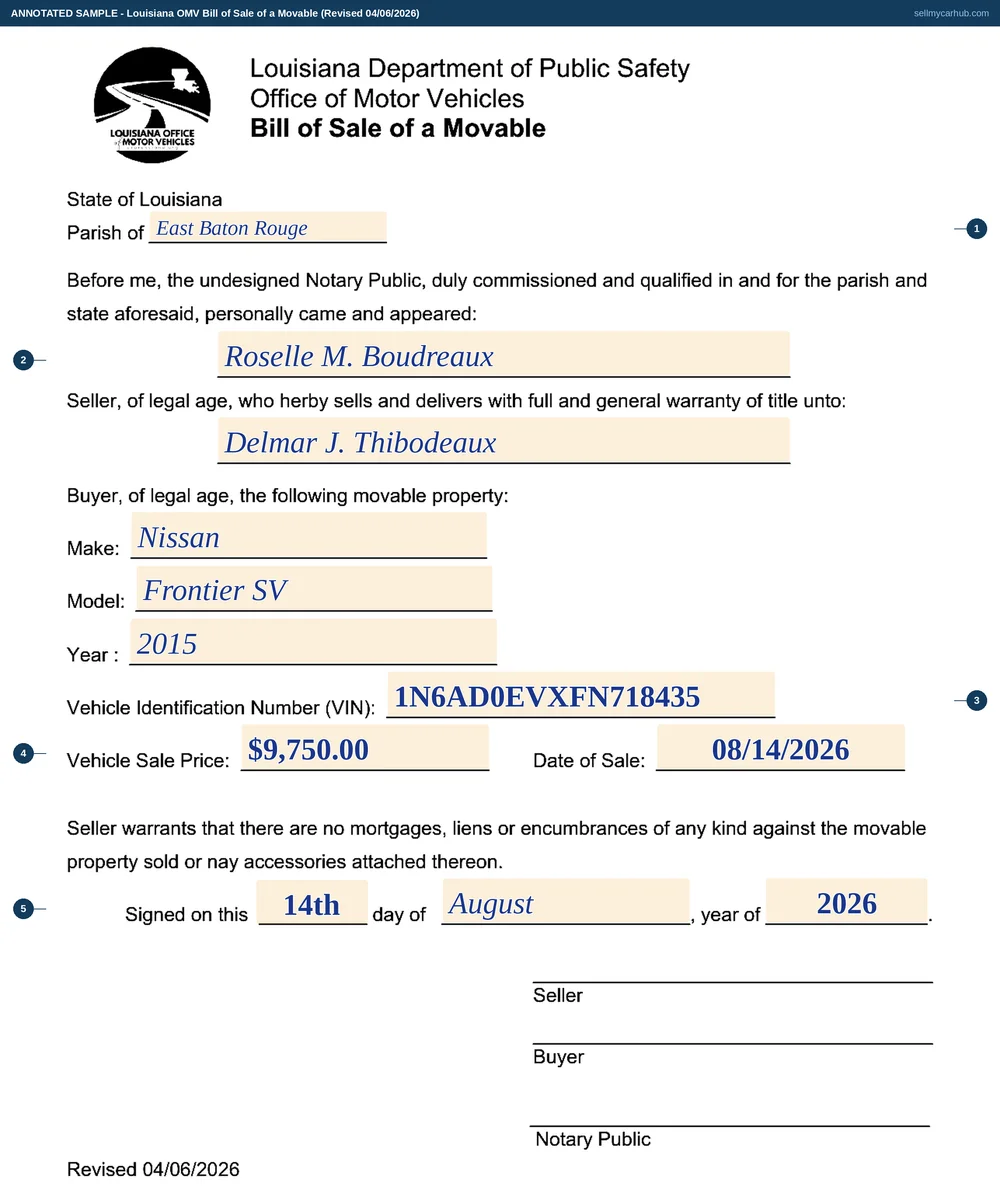
This is the actual Bill of Sale, rendered from the PDF the Louisiana Office of Motor Vehicles publishes and completed end to end: letterhead, every field, and the blocks at the foot.

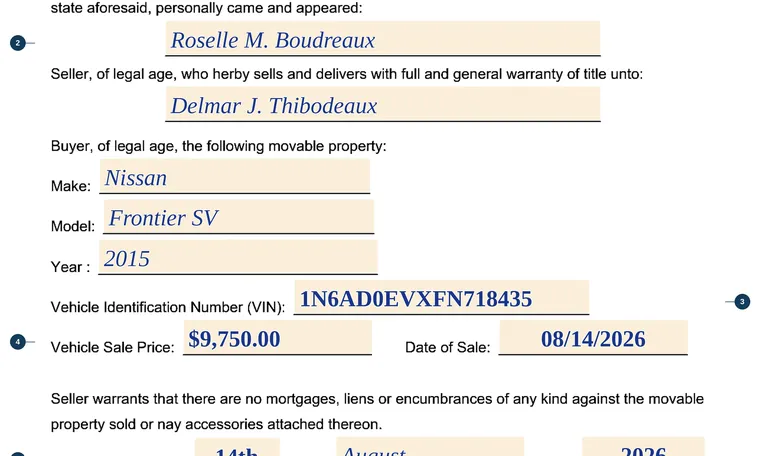
A Louisiana OMV Bill of Sale of a Movable filled in: Parish of East Baton Rouge, seller Roselle M. Boudreaux, buyer Delmar J. Thibodeaux, a 2015 Nissan Frontier SV with VIN 1N6AD0EVXFN718435, a sale price of $9,750.00, a date of sale of 14 August 2026, and the day, month and year written out above the seller, buyer and notary signature lines.
The actual OMV bill of sale, revised 04/06/2026, completed for the same sale as the other pages in this section. The three rules at the bottom right are the whole execution block - and the notary's identification number has to go beside that bottom name even though the form gives it no line.
Field by field

Every line, in the order you meet it

  1. 1
    You fill this in

    Parish of

    The blank in the second line, after State of Louisiana.

    Watch out: This is the parish where the act is passed - where the notary is commissioned and where you are standing when you sign. It is not necessarily the parish either of you lives in, and it is not the parish the buyer will register the vehicle in.

  2. 2
    You fill this in

    Seller

    The first long rule, under the words personally came and appeared.

    Watch out: Full legal name, spelled as it is spelled on the certificate of title. The notary is required to insert the full first and last names of the parties, so an initial here is a problem the notary is supposed to catch.

  3. 3
    You fill this in

    Vehicle Identification Number (VIN)

    Fourth of the description rules, under Make, Model and Year.

    Watch out: Seventeen characters copied off the face of the certificate. The point of this document is to describe one specific vehicle well enough that the department can match it to the title file, and the VIN is the only line that does that.

  4. 4
    You fill this in

    Vehicle Sale Price

    Left-hand box of the price row, with Date of Sale to its right.

    Watch out: Write the actual consideration - the money that changed hands. If this figure and the one in the title assignment differ, this document stops proving the price and starts raising a question about it.

  5. 5
    You fill this in

    Signed on this day of, year of

    Three short blanks immediately above the signature rules.

    Watch out: Fill them in front of the notary, not before. They are the date the act was passed, which is the date the notary is attesting to, and they should agree with the Date of Sale box above.

At a glance

What goes where

On the formWhat to put in it
State of Louisiana, Parish ofThe parish the act is passed in, which is the notary's parish rather than necessarily yours.
Before me, the undersigned Notary PublicNot a heading. It is the operative sentence, and it is what makes the rest of the sheet an act rather than a note - which is why the OMV's used-title page says that if the bill of sale, invoice, or title is notarized, the file will be acceptable.
SellerA single rule under the appearance clause, and the printed words that follow it carry more weight than the blank: of legal age, who hereby sells and delivers with full and general warranty of title.
BuyerThe second rule, followed by of legal age, the following movable property.
Make, Model, Year, Vehicle Identification Number (VIN)Four rules, one per line, and this is the full description the OMV asks for when it wants a bill of sale to stand for the price.
Vehicle Sale Price, Date of SaleA pair on one row. The price is the actual consideration involved, which is the phrase the department uses on its own used-title page.
Seller warrants that there are no mortgages, liens or encumbrancesA printed warranty covering the vehicle and any accessories attached thereon. There is no box to tick and no way to qualify it on the form.
Signed on this day of, year ofThree blanks - day, month, year - above the signature block.
Seller, Buyer, Notary PublicThree signature rules stacked in the bottom right corner, and that is the whole execution block.

What gets this one rejected

Rules that decide whether it is accepted

Every line here was read off Bill of Sale (Rev 04/06/2026) itself — the PDF is here — and off the Louisiana Office of Motor Vehicles pages. This is plain-language help with a form, not legal advice, and where our wording and the agency's differ, theirs governs.

Back to all Louisiana seller paperwork, or what selling a car in Louisiana involves.

Want the paperwork handled instead?

Get My Instant Offer → Online · about 2 minutes · free

Or send the details — we'll come to you

Chasing a notary on a Saturday for a form with a typo in it is nobody's idea of a weekend. Tell us about the car instead.

or call/text (877) 405-1808