Sell My Car Hub

How to fill out Louisiana DPSMV 1608

Four boxes and a sworn sentence, and it exists because Louisiana taxes a vehicle according to where the vehicle lives rather than where it was bought. It is the buyer's declaration that the domicile code entered on the vehicle application is the right one, and that if any tax turns out to be owed to that political subdivision, it is theirs to pay. A seller meets it when the buyer lives somewhere that is not obviously one parish or another - a town on a parish line, a business address that differs from a home address, a vehicle garaged away from where its owner sleeps.
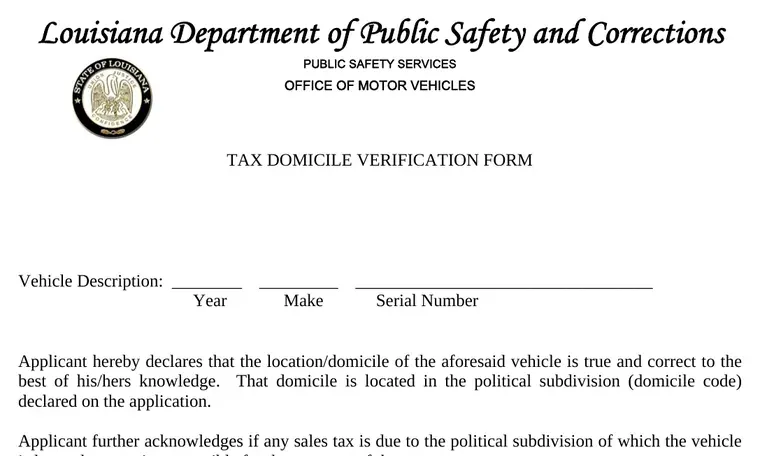
Written against DPSMV 1608 (R0518), issued under R.S. 47:303, collection of sales and use tax. The revision code on this one is R0518 - printed as four digits with no separator, which is how the OMV dates a good many of its forms. There is no month-and-year in brackets to compare against, so the code itself is the only marker of which edition you are holding.

Two documents, and they are not the same thing. Take the blank DPSMV 1608 from the public.powerdms.com copy so you get the revision that is current today.

Filled in

What a completed one looks like

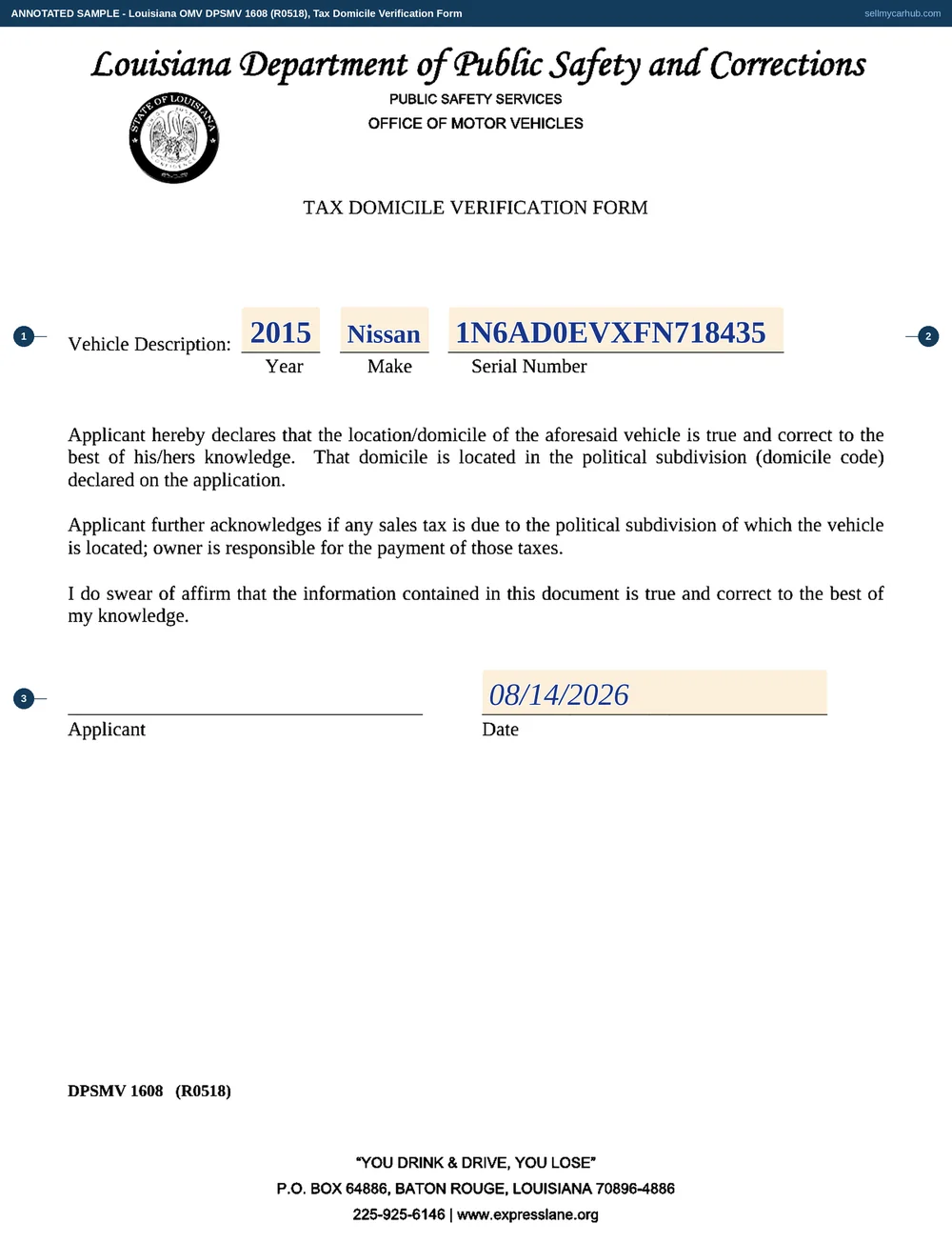
This is the actual DPSMV 1608, rendered from the PDF the Louisiana Office of Motor Vehicles publishes and completed end to end: letterhead, every field, and the blocks at the foot.

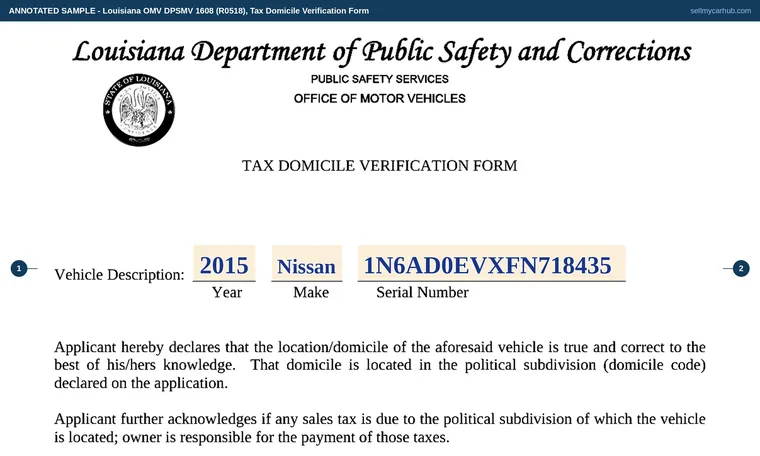
A Louisiana DPSMV 1608 tax domicile verification form filled in: a 2015 Nissan, serial number 1N6AD0EVXFN718435, and a date of 14 August 2026 above the applicant's signature rule, with the printed declaration about the political subdivision and domicile code between them.
The actual DPSMV 1608 at revision R0518. Four fillable boxes on the whole page - the rest of it is the declaration itself, and the signature rule at the foot carries no fillable box, so it is left for ink.
Field by field

Every line, in the order you meet it

  1. 1
    The buyer fills this in

    Year and Make

    The first two boxes of the vehicle description row.

    Watch out: Copy them from the certificate of title rather than the advertisement. A body style described one way here and another way on the application is a small mismatch that still has to be reconciled.

  2. 2
    The buyer fills this in

    Serial Number

    The third and widest box on the description row.

    Watch out: This is the VIN. The OMV uses serial number on its older forms and vehicle identification number on its newer ones, and both mean the seventeen characters on the face of the title.

  3. 3
    The buyer fills this in

    Applicant and Date

    Two rules at the foot of the page, under the sworn statement.

    Watch out: Signed by the person whose name is going on the title, and dated the day it is signed. There is no notary block and none is needed - the oath on this form stands on its own.

At a glance

What goes where

On the formWhat to put in it
Vehicle Description: Year, Make, Serial NumberThree boxes on one row. Serial Number is the OMV's older wording for the vehicle identification number and it means the same thing.
The declarationApplicant hereby declares that the location/domicile of the aforesaid vehicle is true and correct to the best of his/hers knowledge. That domicile is located in the political subdivision (domicile code) declared on the application.
The acknowledgmentApplicant further acknowledges if any sales tax is due to the political subdivision of which the vehicle is located; owner is responsible for the payment of those taxes.
The oathI do swear of affirm that the information contained in this document is true and correct to the best of my knowledge. The typo is the form's own.
Applicant, DateTwo rules at the foot, and no notary block. This is sworn on its own terms rather than before anybody.

What gets this one rejected

Rules that decide whether it is accepted

Every line here was read off DPSMV 1608 (R0518) itself — the PDF is here — and off the Louisiana Office of Motor Vehicles pages. This is plain-language help with a form, not legal advice, and where our wording and the agency's differ, theirs governs.

Back to all Louisiana seller paperwork, or what selling a car in Louisiana involves.

Want the paperwork handled instead?

Get My Instant Offer → Online · about 2 minutes · free

Or send the details — we'll come to you

Parish lines, domicile codes and a form with a typo in its own oath. Tell us about the vehicle and skip the lot.

or call/text (877) 405-1808