Three pages of sworn statement that let a vehicle move out of an estate without letters of office. It is a Probate Act document that the Secretary of State accepts, which is why it reads like nothing else in the Illinois set - creditor classes, a spouse's award, heirs and legatees - and why the vehicle appears only in paragraph 6(b).
Written against RT OPR 31 (RT OPR 31.18, February 2026), issued under 755 ILCS 5/Art. XXV, Probate Act. The value threshold printed on the current affidavit is $150,000, and the office's web summary of the small estate route still gives a lower figure. Read the note in paragraph 6(b) before either number decides anything for you, and take advice on an estate rather than from a form page.
Two documents, and they are not the same thing. Take the blank RT OPR 31 from the ilsos.gov copy so you get the revision that is current today.
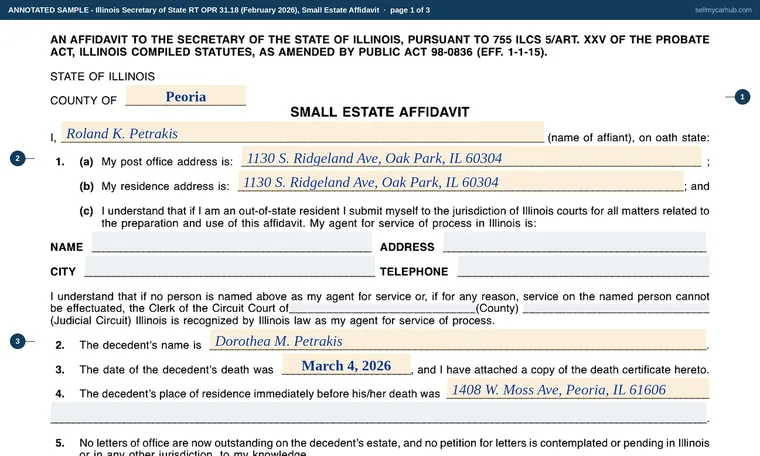
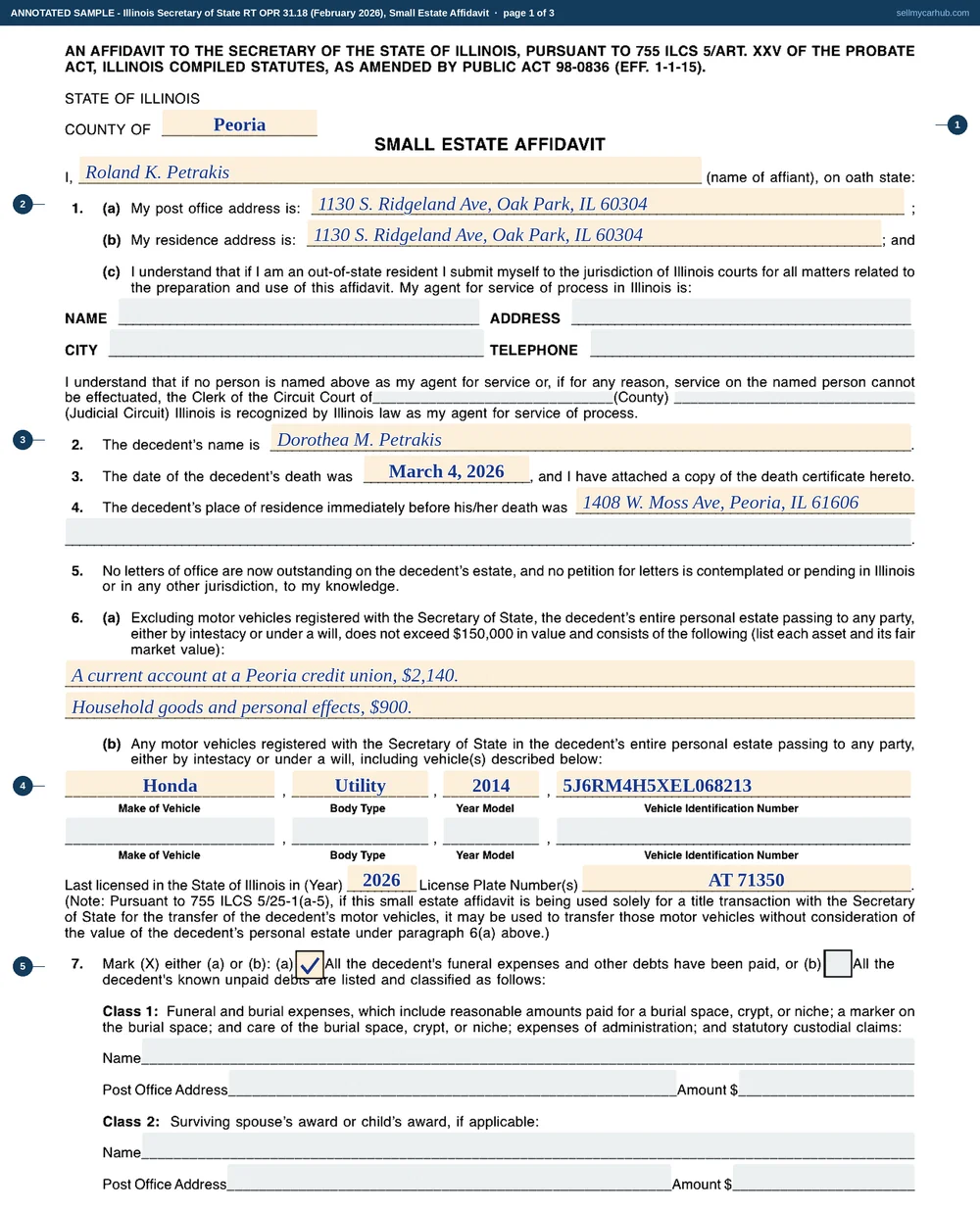
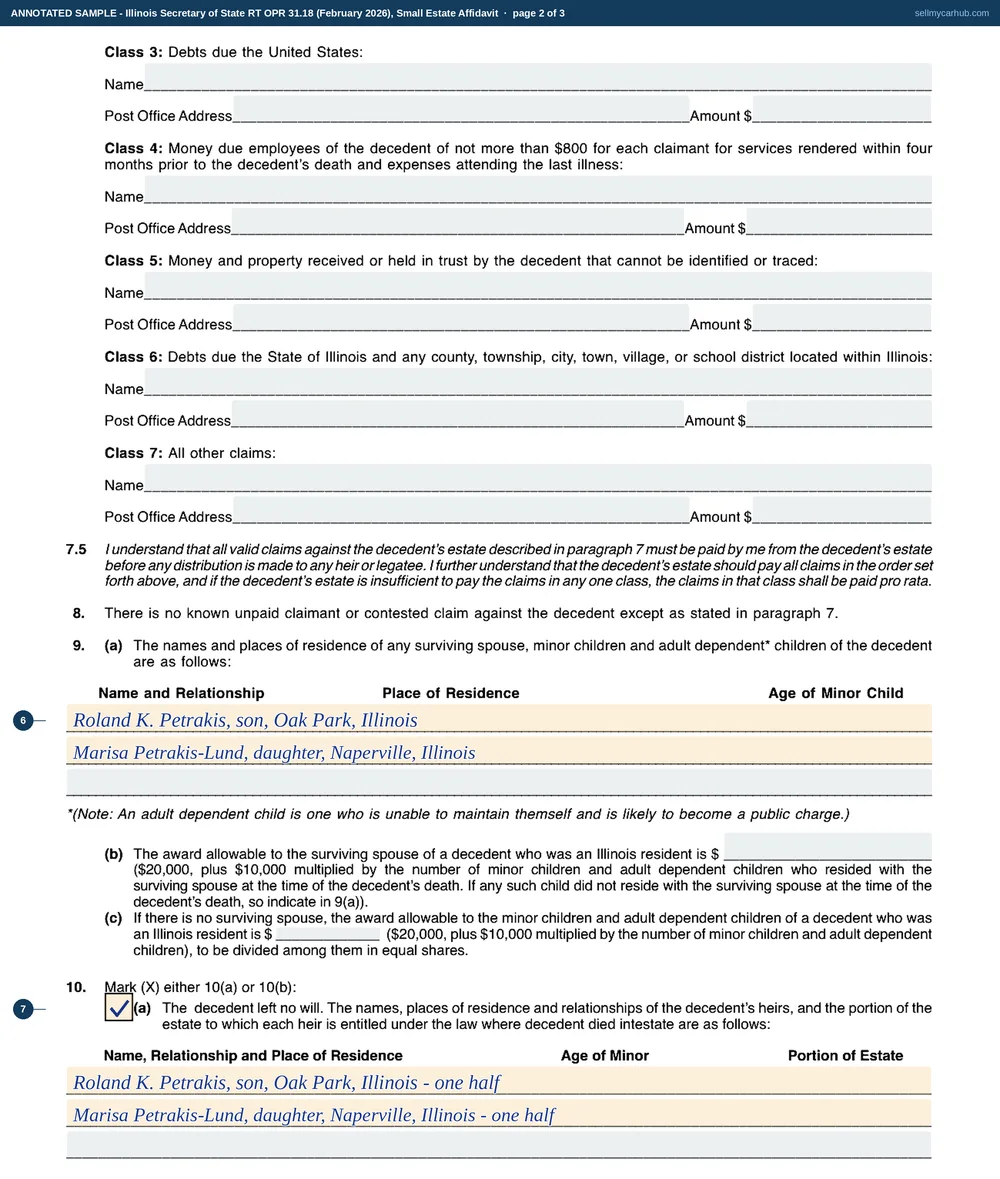
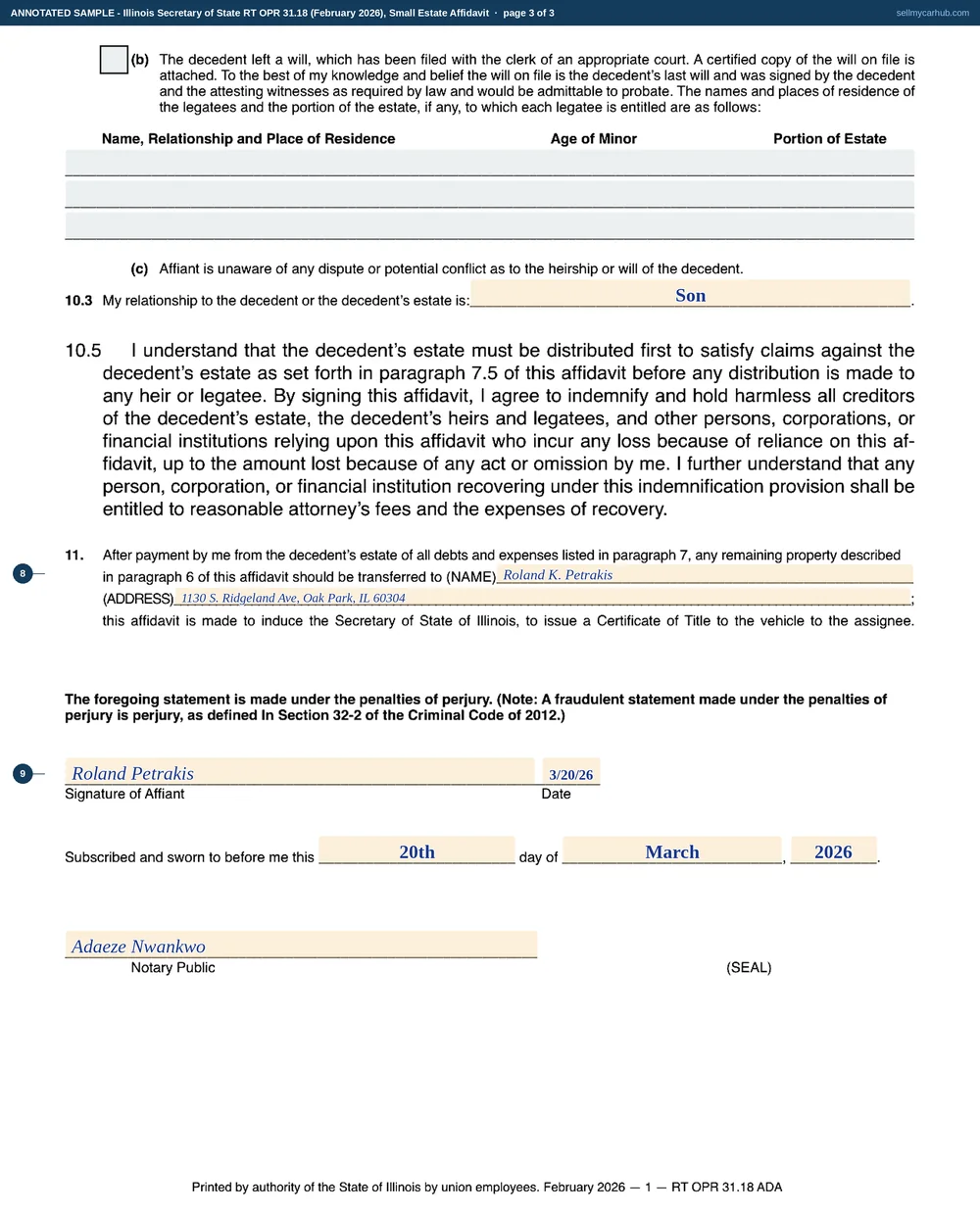
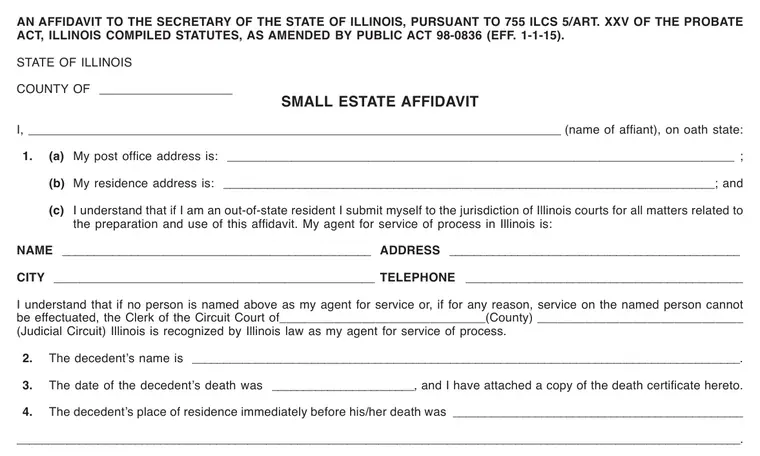
This is all 3 pages of the actual RT OPR 31, rendered from the PDF the Illinois Secretary of State publishes and completed end to end: letterhead, every field, and the blocks at the foot.
State of Illinois, the county, and I, ______, on oath state.
Watch out: The county is where the affidavit is sworn, not necessarily where the decedent lived. Paragraph 4 asks for that separately.
Post office address, residence address, and - if you live outside Illinois - a named agent for service of process here, with an address, city and telephone.
Watch out: If no agent is named, or service on them cannot be effected, the affidavit says the Clerk of the Circuit Court of the named county and judicial circuit becomes your agent by law. Leave those two blanks empty and you have still appointed somebody.
Name, date of death with the death certificate attached, and the place of residence immediately before death.
Watch out: A copy of the death certificate is attached to the affidavit itself - the Secretary of State asks for one with the application as well.
Make, body type, year model and VIN, with room for two vehicles, then the year and plate numbers they were last licensed under in Illinois.
Watch out: Read the note directly beneath. Used solely for a title transaction, the affidavit works without regard to the value in 6(a) - which is the difference between a straightforward afternoon and valuing an entire estate.
Either mark that all funeral expenses and other debts have been paid, or list every known unpaid debt in its class with a name, address and amount.
Watch out: The classes are in statutory order and the order is not decorative - 7.5 says the estate pays them in that order and pro rata within a class it cannot cover.
Names, relationships and residences of a surviving spouse, minor children and adult dependent children, with ages, and then the award calculation.
Watch out: The affidavit defines an adult dependent child as one who is unable to maintain themself and is likely to become a public charge. It is a narrower category than it sounds.
Box (a) for no will, with heirs and portions under intestacy. Box (b) for a will filed with the clerk of an appropriate court, with a certified copy attached and the legatees and their portions.
Watch out: Sub-paragraph (c) is not optional either: the affiant states they are unaware of any dispute or potential conflict as to heirship or the will.
A name and an address, and the sentence that this affidavit is made to induce the Secretary of State to issue a certificate of title to the assignee.
Watch out: This is the operative line for the vehicle. Everything above it establishes that you are entitled to say it.
Under penalties of perjury, then subscribed and sworn before a notary with a seal.
Watch out: The note beside it points out that a fraudulent statement made under penalties of perjury is perjury as defined in the Criminal Code. Then attach the decedent's title, which does not need to be assigned, and a VSD 190.
| On the form | What to put in it |
|---|---|
| County, and the affiant | State of Illinois, county, and then I, ______, on oath state - your name inside the sentence. |
| Paragraph 1, addresses and the agent for service | Post office address, residence address, and an acknowledgement that an out-of-state affiant submits to Illinois jurisdiction, with a named agent for service of process and their address, city and telephone. |
| Paragraphs 2 to 4, the decedent | Name, date of death with a copy of the death certificate attached, and place of residence immediately before death. |
| Paragraph 6(a), the personal estate | Excluding motor vehicles, the personal estate and its fair market value, listed asset by asset. |
| Paragraph 6(b), the vehicles | Make, body type, year model and vehicle identification number - two rows of them - and then the year and plate numbers they were last licensed under in Illinois. |
| Paragraph 7, unpaid debts in seven classes | Funeral and burial, spouse's or child's award, debts due the United States, money due employees, money held in trust, debts due Illinois and its local bodies, and all other claims. Each with a name, a post office address and an amount. |
| Paragraph 9, spouse and children | Names, relationships, residences and the ages of any minor children, then the calculated award. |
| Paragraph 10, will or no will | Two boxes. Either the decedent left no will, with the heirs and their portions, or a will has been filed with the clerk of an appropriate court and a certified copy is attached, with the legatees and their portions. |
| Paragraph 11, who gets the vehicle | A name and address. The line beneath says this affidavit is made to induce the Secretary of State of Illinois, to issue a Certificate of Title to the vehicle to the assignee. |
| Signature and notary | Signed under penalties of perjury, then subscribed and sworn before a notary with a seal. |
Every line here was read off RT OPR 31 (RT OPR 31.18, February 2026) itself — the PDF is here — and off the Illinois Secretary of State pages. This is plain-language help with a form, not legal advice, and where our wording and the agency's differ, theirs governs.
Back to all Illinois seller paperwork, or what selling a car in Illinois involves.