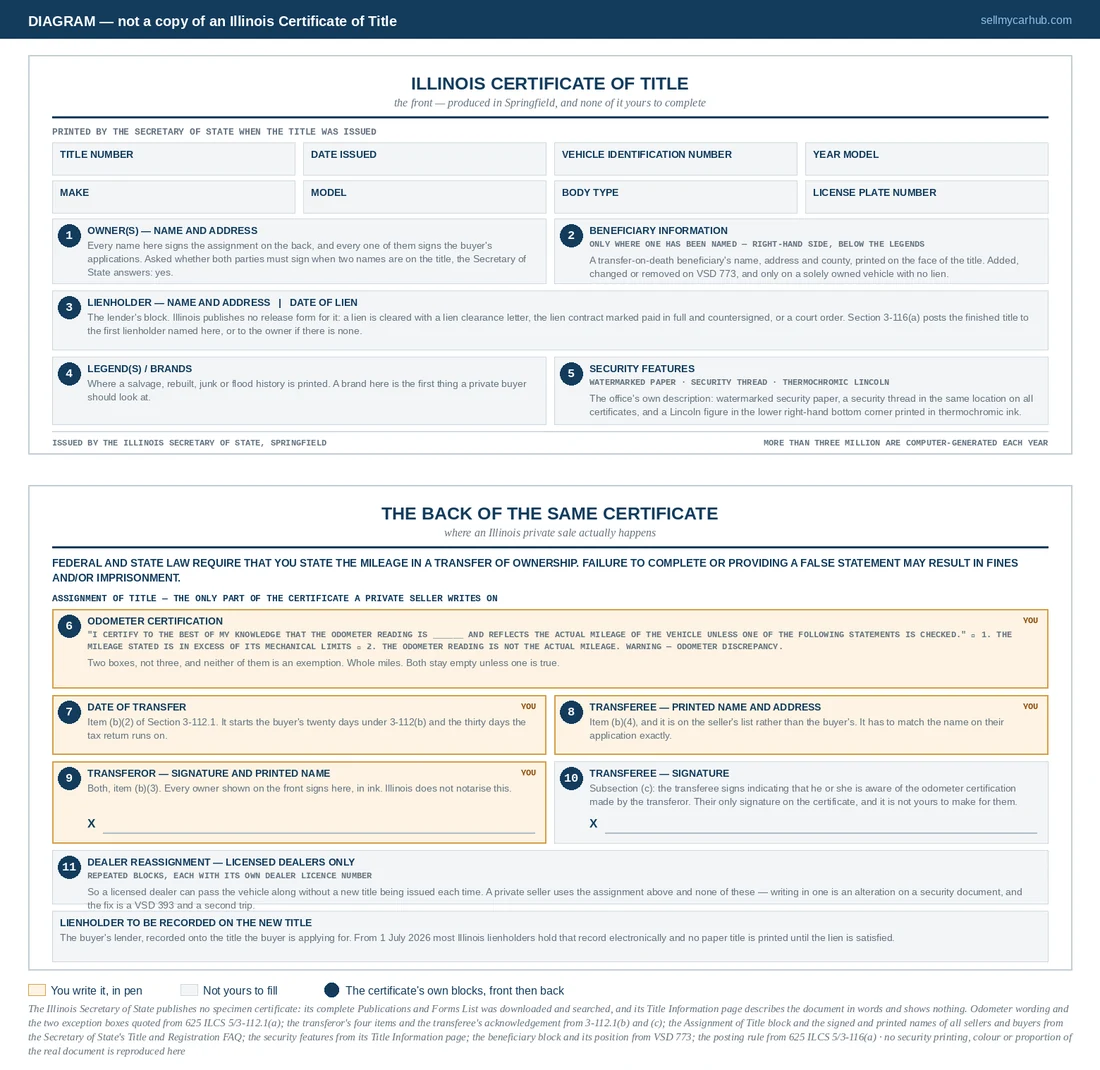
An Illinois private sale happens on the back of the certificate, in the block the Secretary of State calls the Assignment of Title. There is no downloadable version of it and no published photograph of one, so the diagram below is drawn - and every block name and every printed sentence in it is transcribed from a source named in the caption, mostly from Section 3-112.1 of the Illinois Vehicle Code, which sets out the odometer certification the certificate has carried since January 1990 in exactly the words it is printed in.
Last updated .
Your 7 boxes
As a private seller you complete these and nothing else:
There is no blank Illinois title to download and no picture of one to look at - the certificate arrives from Springfield on secure paper and the office publishes neither. What is downloadable is the statute that dictates the wording of its most important block, and the form that repeats it. This walkthrough is built on both.
Four things and the transfer stands: the reading, the date, both printed names, and both signatures.
The statute is unusually literal about this block. It does not say the title shall provide for an odometer statement; it prints the sentence, quotation marks and all, and lists the two boxes underneath it.
Drawn, not photographed
Where an Illinois certificate keeps the four blocks that are yours
Illinois prints its certificate on secure paper and publishes no picture of one anywhere - which is checked below, not assumed. So this is a diagram, and it says so across the top of itself. The front is the state's work: vehicle, owner, lienholder, legends and, on a title where one has been named, a beneficiary block on the right-hand side. The back carries the Assignment of Title, and that is the half a private seller writes on. The eleven markers below number the certificate's own blocks, front then back — they are a different set from the numbered steps further down this page, which follow the order you meet them in rather than the order they are printed in.
Amber — you write it, in pen
Grey — not yours to fill
Numbered — the blocks of the certificate, front then back
Click or tap the picture to open it full size.
A diagram, drawn here and labelled as one. The Secretary of State publishes no specimen certificate: the Illinois Title Security Features section of its own Title Information page describes the document in words and shows nothing, and all 143 vehicle publications on the office's Publications and Forms List were downloaded and searched without finding one. The odometer sentence and its two boxes are quoted from 625 ILCS 5/3-112.1; the beneficiary block and its position come from the office's own VSD 773.
The same statement, on a form you can hold
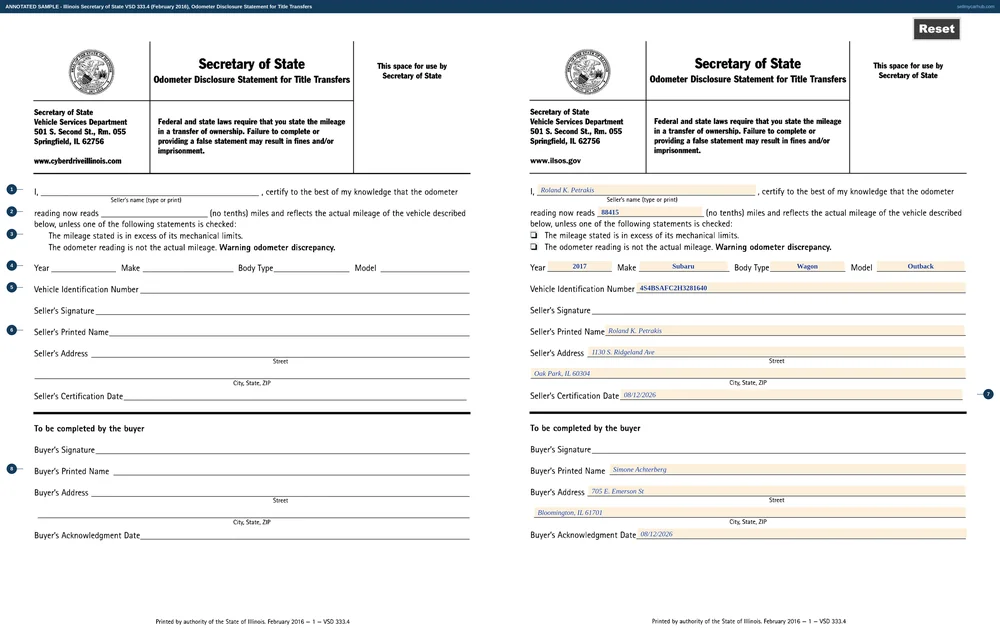
VSD 333 carries the title's odometer block, word for word
When the assignment on a certificate has been spoiled, or the title is an older one whose block has run out of room, Illinois hands the same statement over on its own sheet. Comparing the two is the fastest way to understand what the certificate is asking: the sentence, the two exception boxes and the buyer's acknowledgement are identical, because both are the wording Section 3-112.1(a) sets out.
Click or tap the picture to open it full size.
Look at the two rules marked Seller's Signature and Buyer's Signature. They are the only lines on this form with no fillable field behind them, which is Illinois telling you something: everything else may be typed, those two are ink. And note that the sheet prints the form twice - the Secretary of State made only the right-hand copy fillable, and left the older domain name on the left one.
Step by step
Every box, in the order you meet it
1
You fill this in
Before the pen: check who is on the face
Turn the certificate over to the front and read the owner names. Every one of them signs the assignment, and every one of them signs the buyer's applications.
Watch out: Asked whether both parties have to sign when there are two names on the back of the title, the Secretary of State's whole answer is Yes. A co-owner who has moved out of state is a problem to solve before the buyer arrives, not after.
2
You fill this in
The odometer reading
The current mileage in whole miles. The certification printed above it reads: I certify to the best of my knowledge that the odometer reading is and reflects the actual mileage of the vehicle unless one of the following statements is checked.
Watch out: Whole miles, no tenths. And the reading you write here has to be the reading that ends up on the buyer's application - the Secretary of State's own checklist asks the buyer to confirm the two match before filing.
3
You fill this in
The two exception boxes
Box 1: the mileage stated is in excess of its mechanical limits. Box 2: the odometer reading is not the actual mileage - warning, odometer discrepancy. Leave both alone if the reading is true.
Watch out: There is no third box and no exempt box. On a car old enough to fall outside 3-112.1(d), you are simply not required to make the statement; ticking box 2 to mean I would rather not say brands the car for the rest of its life.
4
You fill this in
The date of transfer
The day the car actually changed hands. Subsection (b)(2) makes it one of the four items the transferor supplies.
Watch out: This date starts the buyer's twenty days under 3-112(b) and it is the date the tax return is measured from too. Post-dating it to be helpful moves both clocks and helps nobody.
5
You fill this in
Your printed name and signature
Both, not one. Subsection (b)(3) asks for the transferor's printed name and signature, and the FAQ repeats it: the title must indicate the signed and printed names of all sellers and buyers.
Watch out: Sign as the face of the certificate has your name. A married name signed over a maiden name on the front is the sort of mismatch that comes back from Springfield as a request for VSD 393.
6
You fill this in
The buyer's printed name and address
Item (b)(4), and it is on your side of the list rather than the buyer's. Write it from something with their address on it.
Watch out: The buyer's name here has to match the name on their application. The Secretary of State's checklist asks them to verify exactly that, and a nickname in this box is one of the ordinary reasons an application is returned.
7
The buyer fills this in
The buyer signs to acknowledge
Subsection (c): the transferee must sign on the title form indicating that he or she is aware of the odometer certification made by the transferor.
Watch out: This is the buyer's only signature on the certificate itself. If they take the car and post the title back to sign later, the mileage statement is unwitnessed and the car is not properly assigned.
8
Dealers only
Do not touch the dealer reassignment blocks
The rows below the assignment belong to licensed dealers passing a car along, and to the buyer's lender.
Watch out: A private seller writing in a dealer block has altered a document printed on security paper. The fix is VSD 393 and a second trip; it is easier to read the block headings first.
9
You fill this in
Then post VSD 703
The Seller's Report of Sale, to the Vehicle Services Department in Springfield. Date of sale, year, make, VIN, and both names and addresses.
Watch out: It releases your responsibility for the vehicle and it does not transfer ownership - the form says both things on the same page. Doing this and skipping the assignment leaves you worse off than doing neither.
Before the pen
Before you sign for the Secretary of State
Six habits. The one that catches Illinois sellers out is that a slip in the assignment is fixed by a second form and a second signature, never by crossing anything out.
Nothing crossed out
A mistake in the assignment is corrected on VSD 393 by whoever made it, with the other party signing alongside. There is no tidying-up on a document printed on security paper.
Not the odometer, though
VSD 393 carries its own limit in a note: this affirmation cannot be used for odometer disclosure or corrections. A wrong reading goes on VSD 333 instead.
Whole miles
VSD 333 says no tenths beside the box, and the title says the same. Rounding up to the next thousand is a false statement in a sentence that mentions imprisonment.
Printed and signed, both
Every seller and every buyer. The Secretary of State's own wording is the signed and printed names of all sellers and buyers.
Keep the registration card
If plates are moving to your next car, the most recent registration identification card goes in with the application. Lost it, and VSD 76 stands in - but only if you notice before you are at the counter.
Print the application, then move
A VSD 190 printed from the ERT system has to reach a facility with its documents and payment within seven days.
The ink rule is the Secretary of State's own: “When the transferor signs the title transfer such transferor acknowledges that he or she is aware that Federal regulations and State law require him or her to state the odometer mileage upon transfer of ownership.”
— Illinois Vehicle Code, 625 ILCS 5/3-112.1.
Check your source
The Illinois advice that sends people to the wrong office
Three things said confidently about selling a car in Illinois. One of them will cost you a plate, one will cost you a wasted trip to Springfield, and one is simply a different state's rule wearing an Illinois badge.
"Leave the plates on for the buyer, they can sort the registration out later."
In Illinois that is not a favour, it is an offence. The Secretary of State's position is that license plates belong to an owner, not the vehicle, so you cannot transfer ownership of license plates when you sell a car. VSD 393 spells out the consequence for anyone who tries to make the plates part of the deal: selling an active license plate in Illinois is unlawful and will result in revocation of the plate.
"Download the title application and fill it in at home."
There is nothing to download. VSD 190 is not among the 586 documents on the Secretary of State's Publications and Forms List, and the direct file address returns a 404. It comes from the Electronic Registration and Title system, which lets you complete and print one, from a counter, or on the phone - and a printed one has to reach a facility within seven days. RUT-50 is the same story from a different agency: the Department of Revenue says these forms have unique transaction numbers that should not be duplicated, and asks that you not photocopy one.
"Send the tax return to the Department of Revenue and the title application to the Secretary of State."
Half right, and the wrong half costs a fortnight. The cheque for the tax is made payable to the Illinois Department of Revenue - and then handed in at the Secretary of State counter with everything else. The Secretary of State's own brochure puts it in four words: do not send tax payment to the Department of Revenue. If you file RUT-50 online instead, the Department warns that you must print the copy it generates, because the Secretary of State cannot process the title without it.
The Assignment of Title takes four items from you and one signature from the buyer. Section 3-112.1 lists them in this order:
Every owner named on the face
All of them. Two names on the back of the title means two signatures on the assignment and two on the applications - the Secretary of State answers that question with the single word yes.
You, as transferor
Signature and printed name, the odometer reading with any brand, the date of transfer, and the transferee's printed name and address. Section 3-112.1(b) lists those four items as the transferor's.
The buyer, as transferee
Signs to show they are aware of the odometer certification you made. That is subsection (c), and it is the buyer's only signature on the certificate.
A notary
Not on the title. Illinois does not notarise the assignment, though four of the forms behind it do carry a notary block.
Somebody signing for you
RT 5, the one-page power of attorney, and it has to name the vehicle. Its authority is to sign all papers and documents required to secure Illinois title and/or registration of, or transfer interest in, that vehicle - not vehicles in general.
A lender
Nowhere on the certificate. Illinois clears a lien with a letter, a countersigned contract or a court order, and from 1 July 2026 most lienholders do it electronically instead.
Once it is signed
Signing is the middle of it. In Illinois the plates come off the car and stay with you, and the report that closes your side is VSD 703 - which is not the same thing as the buyer's title application, and does not stand in for it.