The form that prevents all of the above. It puts a transfer-on-death beneficiary on the face of an Illinois title while the owner is alive, so the car never enters an estate at all. It also removes or changes one, which is the half people forget exists.
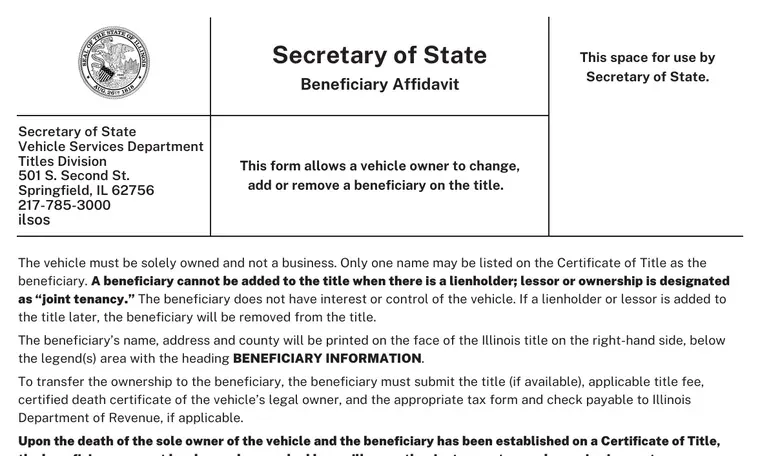
Step 1 · the form itself
Blank VSD 773 — Beneficiary Affidavit
PDF at ilsos.gov · new tab
View the blank VSD 773
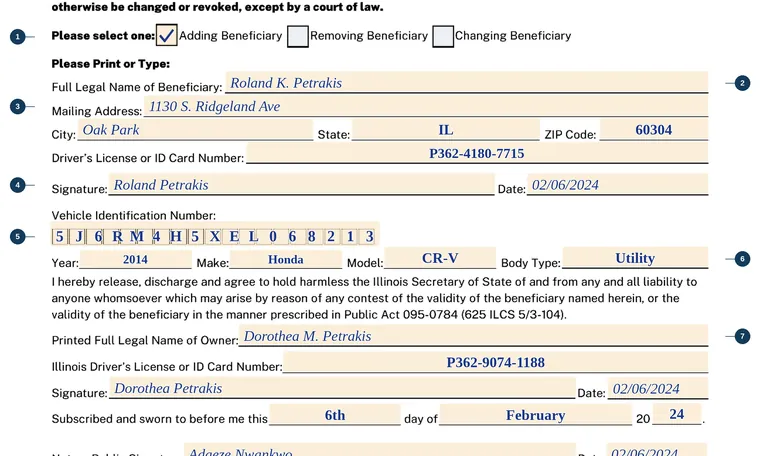
Step 2 · how to fill it in
Our filled-in VSD 773 guide
PDF · 3 pages · 540 KB · new tab
See our filled-in example
Two documents, and they are not the same thing. Take the blank VSD 773 from the ilsos.gov copy so you get the revision that is current today, then print our VSD 773 guide and keep it beside you while you fill theirs in.
Written against VSD 773 (VSD 773.4, February 2026), issued under 625 ILCS 5/3-104, Public Act 095-0784. This is the cheapest estate planning available to an Illinois car owner and almost nobody uses it. It is worth doing the week you pay a car off, because a lien on the title blocks it.
Last updated .
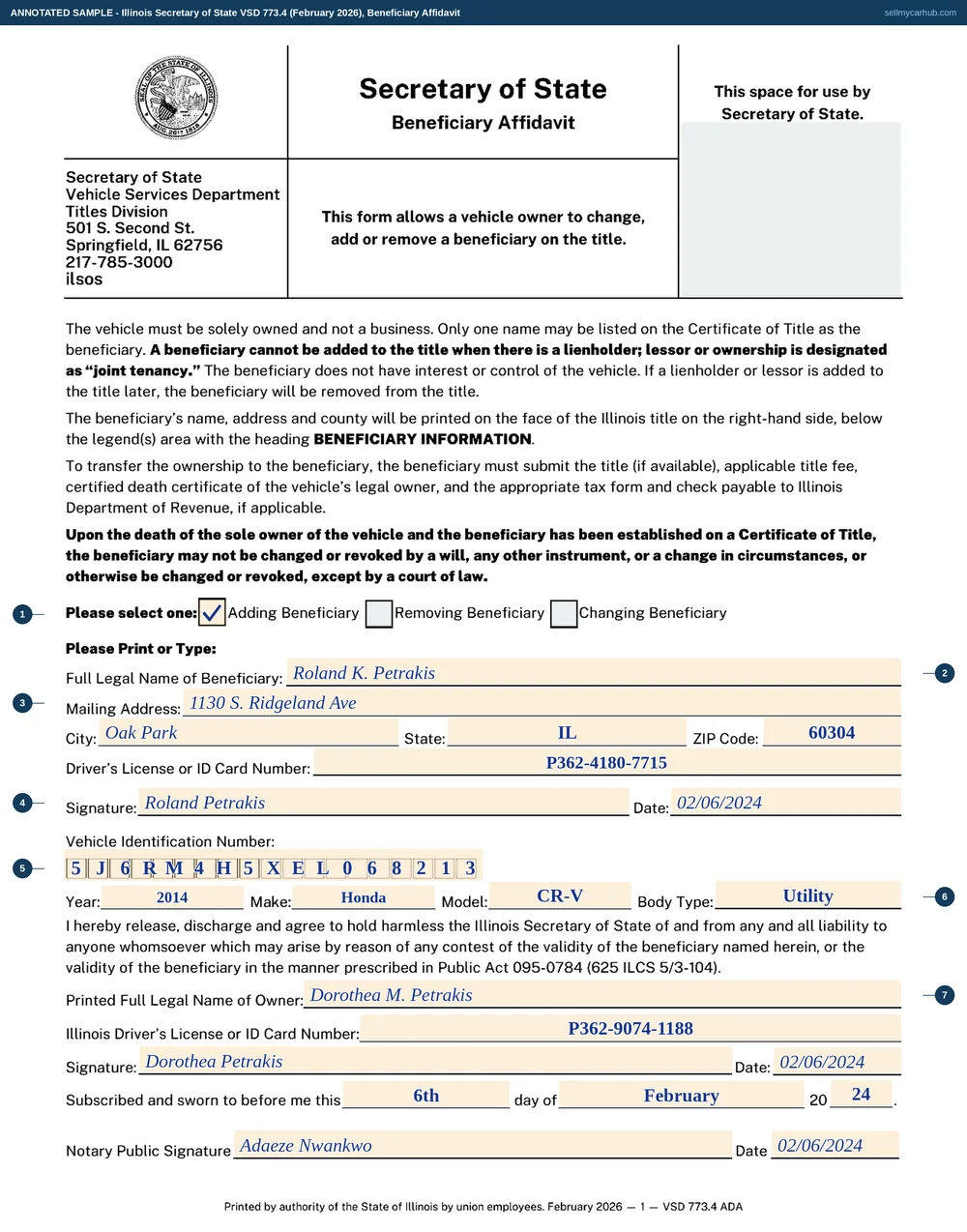
This is the actual VSD 773, rendered from the PDF the Illinois Secretary of State publishes and completed end to end: letterhead, every field, and the blocks at the foot.
Click or tap the picture to open it full size.
Download or print this example PDF · 3 pages · 540 KB
Three boxes across the top of the form.
Watch out: Removing is a real option and it is on the same sheet. If a relationship has changed, a new form is the only thing that changes the title.
One name.
Watch out: Legal name. If it does not match the beneficiary's own documents later, the Secretary of State sends them to item 6 of VSD 393 to prove the two names are the same person - so get it right now.
Mailing address, city, state, ZIP, and a driver's licence or ID card number.
Watch out: The county is printed on the finished title alongside the name, so the address is doing more work than a contact detail.
Signature and date, in the upper half of the form.
Watch out: This is the only Illinois form here where the person who benefits signs before the person who owns the car does. They have to actually be there.
A row of printed boxes, one character each.
Watch out: One character per box, starting at the left. This is the field most likely to be filled in as running text, and a VIN that spills its own boxes is a returned form.
Four boxes across one row under the VIN.
Watch out: Off the title, not off the car. The affidavit is being matched to a record.
Printed full legal name of owner, signature and date.
Watch out: Above it is a release and hold-harmless in favour of the Secretary of State against any contest of the validity of the beneficiary named. That is what you are signing, and it is the price of skipping probate.
| On the form | What to put in it |
|---|---|
| Adding, Removing or Changing | Three boxes at the top. One of them, not two. |
| Full Legal Name of Beneficiary | One person. The form says only one name may be listed on the Certificate of Title as the beneficiary. |
| Mailing Address, City, State, ZIP Code | Four boxes for the beneficiary. |
| Driver's License or ID Card Number | The beneficiary's. |
| Signature and Date | The beneficiary's own signature, before the vehicle is even described. |
| Vehicle Identification Number | A comb of nineteen character boxes. |
| Year, Make, Model, Body Type | Four boxes on one row. |
| Printed Full Legal Name of Owner, signature and date | The owner's half, at the foot, above a hold-harmless clause. |
Every line here was read off VSD 773 (VSD 773.4, February 2026) itself — the PDF is here — and off the Illinois Secretary of State pages. This is plain-language help with a form, not legal advice, and where our wording and the agency's differ, theirs governs.
Adding, changing or removing a beneficiary is title business, so Aurora owners may want the Aurora DMV+ address and where to check its hours before going in.
Back to all Illinois seller paperwork, or what selling a car in Illinois involves.