Sell My Car Hub

How to fill out Virginia VSA 66

One form doing two unrelated jobs, and the tick at the top decides which. Transfer of Lien moves an existing security interest from one lender to another - a refinance, or a credit union selling on a loan book. Supplemental Lien adds a second lender behind the first. Neither of them releases anything, which is the misunderstanding that brings most sellers to this page.
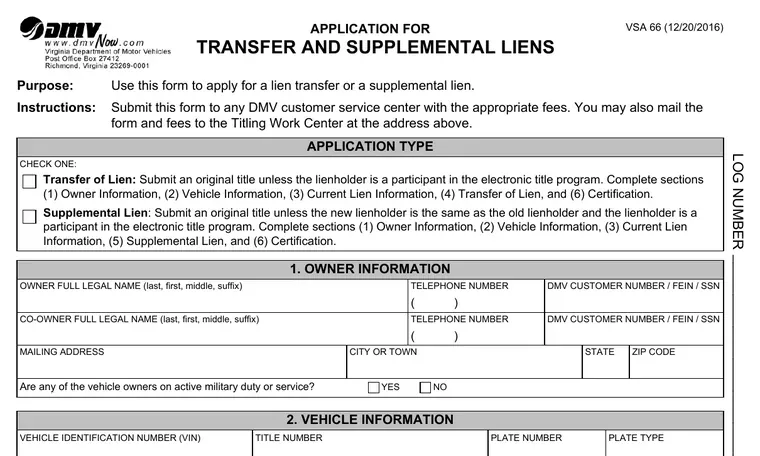
Written against VSA 66 (12/20/2016), issued under Va. Code 46.2-637. A seller trying to clear a loan is usually on the wrong form. The route out of a lien in Virginia is the lienholder marking the certificate satisfied and sending it on to the owner - and where the title is electronic, the lender releasing it so a paper one can be printed. This form is for moving a lien between lenders or stacking a second one on top, and using it will not get a certificate into your hands any faster.

Two documents, and they are not the same thing. Take the blank VSA 66 from the dmv.virginia.gov copy so you get the revision that is current today.

Filled in

What a completed one looks like

This is all 2 pages of the actual VSA 66, rendered from the PDF the Virginia Department of Motor Vehicles publishes and completed end to end: letterhead, every field, and the blocks at the foot.

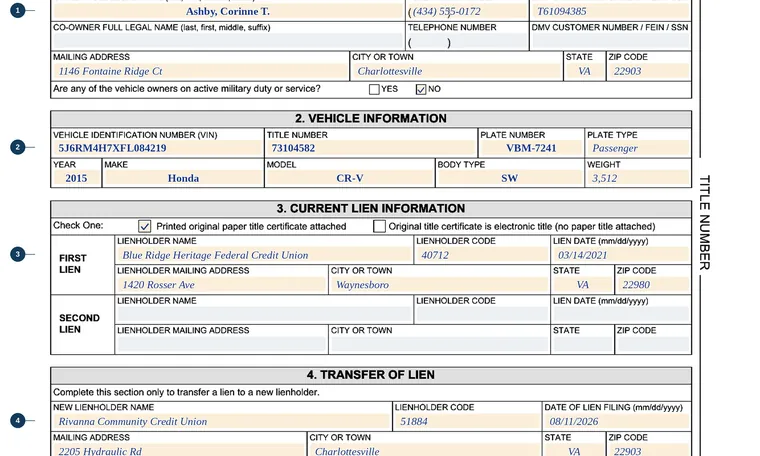
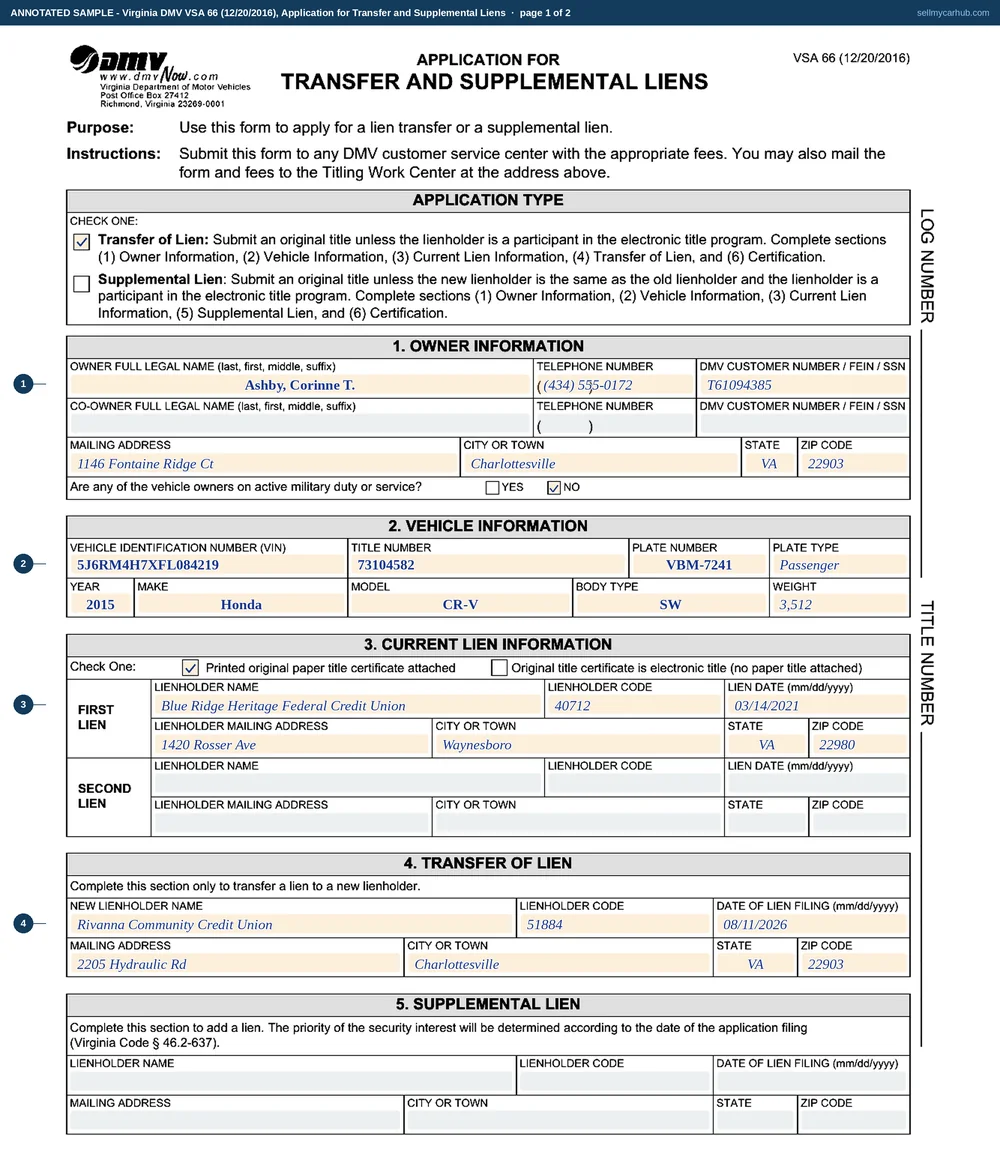
The Virginia DMV VSA 66 filled in as a transfer of lien: owner Corinne T. Ashby of Charlottesville, a 2015 Honda CR-V with its title and plate numbers, an existing first lien to Blue Ridge Heritage Federal Credit Union with its lienholder code and lien date, and a new lienholder block naming Rivanna Community Credit Union.
Page 1 of 2. Application type, the owner, the vehicle, the lien that exists today and the lender it is moving to.
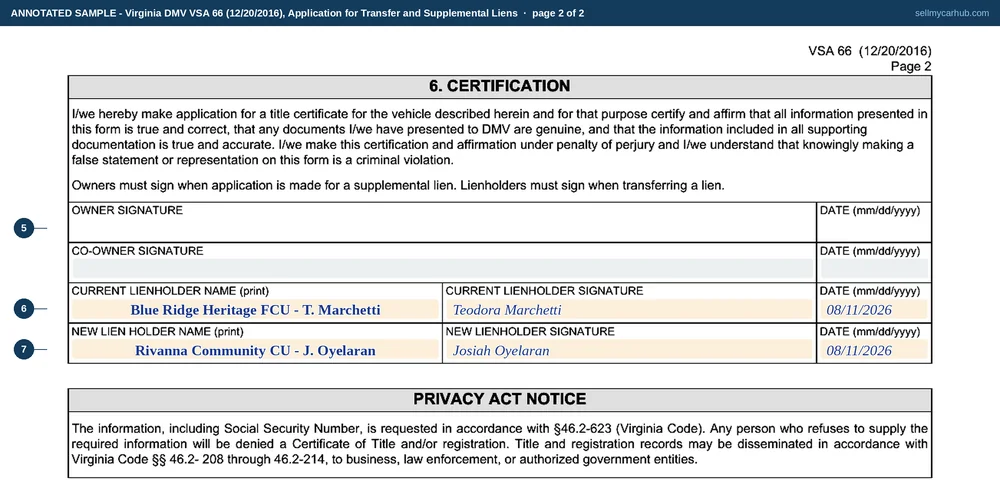
The Virginia DMV VSA 66 filled in as a transfer of lien: owner Corinne T. Ashby of Charlottesville, a 2015 Honda CR-V with its title and plate numbers, an existing first lien to Blue Ridge Heritage Federal Credit Union with its lienholder code and lien date, and a new lienholder block naming Rivanna Community Credit Union.
Page 2 of 2. The certification block, where the two lenders sign against each other. The owner and co-owner rows above them stay empty on a transfer - the sentence at the head of the block gives the owner's signature only to a supplemental lien.
Field by field

Every line, in the order you meet it

  1. 1
    You fill this in

    The application type

    One tick at the very top, and it determines which sections you complete.

    Watch out: Read the two paragraphs beside the ticks before choosing. Each one lists its own sections, and they differ by exactly one.

  2. 2
    You fill this in

    Section 1, owner information

    Names, telephone, customer number, mailing address and the active-duty question.

    Watch out: The name has to match the certificate. This form does not change ownership and cannot be used to correct a name.

  3. 3
    You fill this in

    Section 2, the vehicle

    VIN, title number, plate number and type, then year, make, model, body type and weight.

    Watch out: Title number and VIN both. They are the two ways DMV finds the record and a mismatch between them stops the application at the desk.

  4. 4
    The lienholder fills this in

    Section 3, the lien that exists

    Paper or electronic, then the current lienholder's name, code, lien date and address.

    Watch out: The lien date is the date the security interest was filed, not the date the loan was signed. The lender has it; a guess here is worse than a blank.

  5. 5
    The lienholder fills this in

    Section 4 or section 5

    The new lienholder on a transfer, or the additional lienholder on a supplemental.

    Watch out: One or the other, never both. The form prints them as separate sections for a reason.

  6. 6
    You fill this in

    Owner signature

    On page two, and only where the application is for a supplemental lien - which is why it is empty in the sample above.

    Watch out: The line above the block splits the work in one sentence: owners must sign when application is made for a supplemental lien, lienholders must sign when transferring a lien.

  7. 7
    The lienholder fills this in

    The two lenders sign

    Current lienholder name, signature and date, then new lienholder name, signature and date.

    Watch out: Both, on a transfer. A lien cannot leave one institution without that institution saying so on this page.

At a glance

What goes where

On the formWhat to put in it
Application typeTwo ticks, each with its own list of which sections to complete. Transfer of Lien wants sections 1, 2, 3, 4 and 6. Supplemental Lien wants 1, 2, 3, 5 and 6.
Section 1, owner informationOwner and co-owner full legal names in last, first, middle, suffix order, telephone numbers, DMV customer number, FEIN or SSN, a mailing address, and a yes-or-no on whether any of the vehicle owners are on active military duty or service.
Section 2, vehicle informationVehicle identification number, title number, plate number and plate type on the first row; year, make, model, body type and weight on the second.
Section 3, current lien informationA tick for whether a printed original paper title certificate is attached or the original title certificate is electronic with no paper attached, then first-lien and second-lien blocks - lienholder name, lienholder code, lien date and mailing address for each.
Section 4, transfer of lienCompleted only to move a lien to a new lienholder: new lienholder name, lienholder code, date of lien filing and mailing address.
Section 5, supplemental lienCompleted only to add a lien, with a printed note that the priority of the security interest will be determined according to the date of the application filing, citing Virginia Code 46.2-637.
Section 6, certificationOn page two. Owner signature and date, co-owner signature and date, then current lienholder name printed with signature and date, and new lienholder name printed with signature and date. A single line above them allocates the work: owners must sign when application is made for a supplemental lien, lienholders must sign when transferring a lien.

What gets this one rejected

Rules that decide whether it is accepted

Every line here was read off VSA 66 (12/20/2016) itself — the PDF is here — and off the Virginia Department of Motor Vehicles pages. This is plain-language help with a form, not legal advice, and where our wording and the agency's differ, theirs governs.

Back to all Virginia seller paperwork, or what selling a car in Virginia involves.

Want the paperwork handled instead?

Get My Instant Offer → Online · about 2 minutes · free

Or send the details — we'll come to you

If the lender still holds the title electronically and the buyer wants the car this weekend, tell us what is owed and we will tell you whether it is worth waiting.

or call/text (877) 405-1808