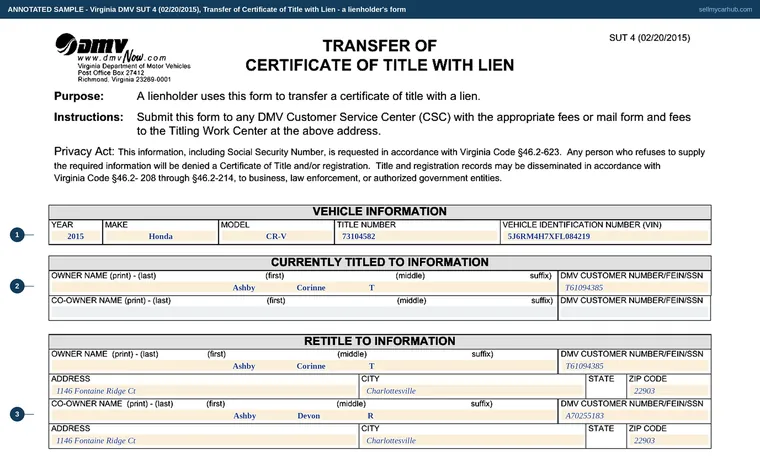
Not the seller's form. Its purpose line names the person who uses it in eight words - a lienholder uses this form to transfer a certificate of title with a lien - and every certification on it is signed by the lender or their authorised representative. It matters to a private seller for one reason: it is the route by which a name is added to or removed from a title that still has a loan on it, and it decides whether tax is charged on the move.
Written against SUT 4 (02/20/2015), issued under Va. Code 58.1-2403. Read the two notes on the form rather than the headline. The first two certifications are tax-exempt only where an original owner stays on the title and the tax was paid when the car was first titled here; the third is taxable on the loan balance. A seller handing a car to a family member who takes over the payments is on the taxable branch, however much it feels like the first one.
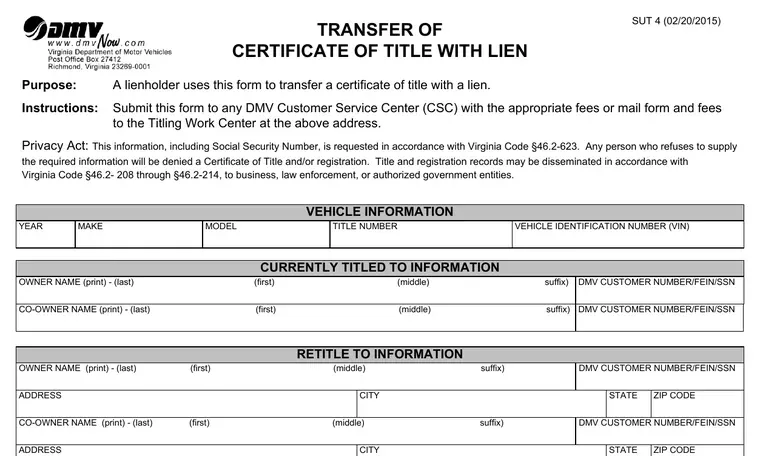
Two documents, and they are not the same thing. Take the blank SUT 4 from the dmv.virginia.gov copy so you get the revision that is current today.
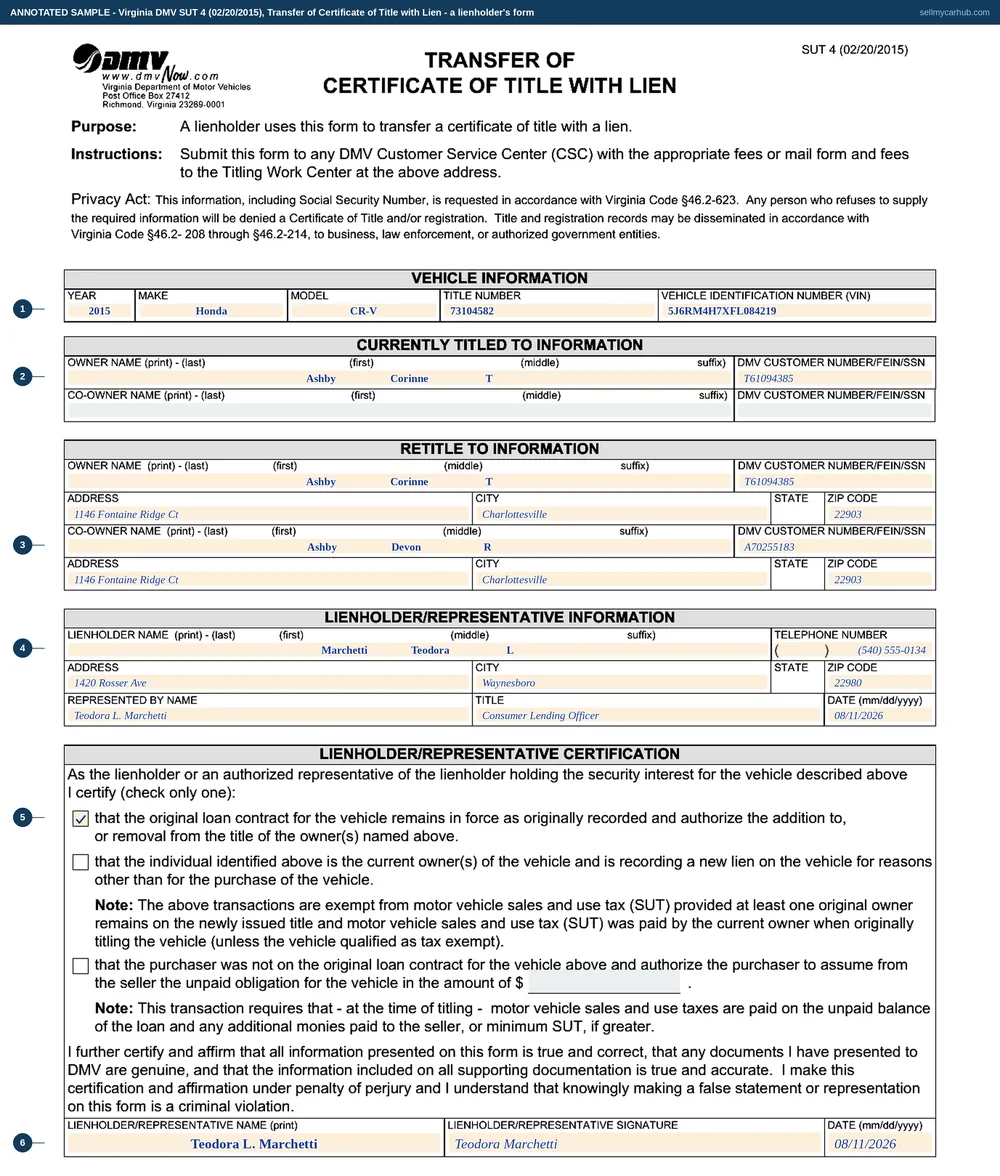
This is the actual SUT 4, rendered from the PDF the Virginia Department of Motor Vehicles publishes and completed end to end: letterhead, every field, and the blocks at the foot.
Year, make, model, title number and VIN.
Watch out: The lender takes these from its own file. An owner asked to supply them should read them off the certificate rather than the registration card.
The names as the certificate carries them today, with customer numbers.
Watch out: Four boxes, in last-first-middle-suffix order. A name written across them as one string is the commonest thing to have to redo.
The names the new certificate should carry, with addresses.
Watch out: Adding a name means both people appear here. Removing one means only the remaining owner does.
Institution name, telephone, address, then the individual representing it and their job title.
Watch out: A branch manager's own name goes in the represented-by line. The institution's name goes above it.
Loan in force, new lien for other reasons, or a purchaser assuming the obligation.
Watch out: The third one is a sale. Its note spells out that tax is charged on the unpaid balance plus anything paid to the seller, or the minimum tax if that is greater.
Printed name, signature and date from the representative, under the usual affirmation.
Watch out: Under penalty of perjury and with no notary, exactly like every other Virginia form in this file.
| On the form | What to put in it |
|---|---|
| Vehicle information | Year, make, model, title number and the vehicle identification number across a single row. |
| Currently titled to information | Owner name printed across four boxes - last, first, middle, suffix - with the DMV customer number, FEIN or SSN, and a co-owner row underneath. |
| Retitle to information | The same layout again for the names the certificate is going into, each with an address, city, state and ZIP code. |
| Lienholder or representative information | The lienholder's name split across four boxes, a telephone number, address, then the name of the person representing them, that person's job title and a date. |
| Lienholder certification, first option | That the original loan contract for the vehicle remains in force as originally recorded, and authorising the addition to or removal from the title of the owners named above. |
| Lienholder certification, second option | That the individual identified above is the current owner and is recording a new lien for reasons other than the purchase of the vehicle. A printed note follows: both of the first two transactions are exempt from motor vehicle sales and use tax provided at least one original owner remains on the newly issued title and the tax was paid by the current owner when the vehicle was originally titled. |
| Lienholder certification, third option | That the purchaser was not on the original loan contract, authorising them to assume the unpaid obligation, with a blank for the amount. Its note is the opposite of the one above: this transaction requires that at the time of titling, taxes are paid on the unpaid balance of the loan and any additional monies paid to the seller, or minimum tax, if greater. |
| Signature block | Lienholder or representative name printed, signature and date, under the standard Virginia affirmation. |
Every line here was read off SUT 4 (02/20/2015) itself — the PDF is here — and off the Virginia Department of Motor Vehicles pages. This is plain-language help with a form, not legal advice, and where our wording and the agency's differ, theirs governs.
Back to all Virginia seller paperwork, or what selling a car in Virginia involves.