The form that moves a vehicle out of a default rather than out of a sale, and it is not a borrower's to sign. It is completed by the recorded lien holder or their authorised agent, certifying a lawful repossession and conveying the vehicle to whoever the lender has sold it to. A private seller meets it from the wrong end - as the person whose car has gone - and the reason it is worth reading is that it shows exactly what a lender has to swear to before your name comes off the record.
Written against TC-569B (Rev 12/12), issued under Utah Code 41-1a-704. If your car has been repossessed, this is the document that will take your name off the title, and you never see it. What you can do is the same thing any seller does: take the plate off if you still have it, and report the vehicle as no longer yours, so that a plate registered to you is not on a car being moved by somebody else.
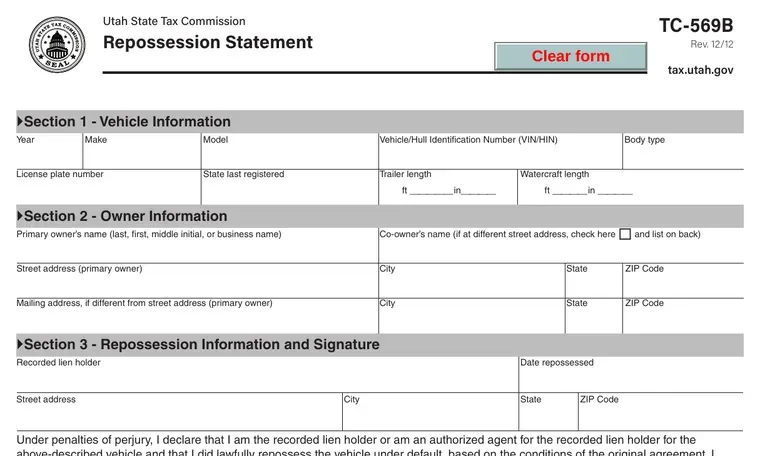
Two documents, and they are not the same thing. Take the blank TC-569B from the files.tax.utah.gov copy so you get the revision that is current today.
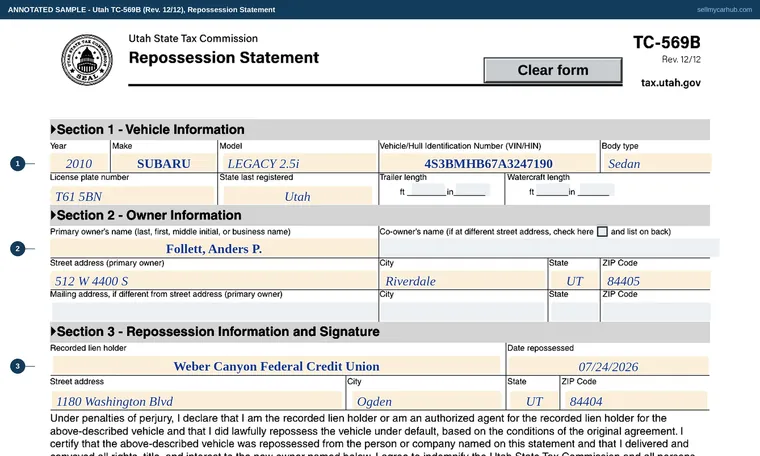
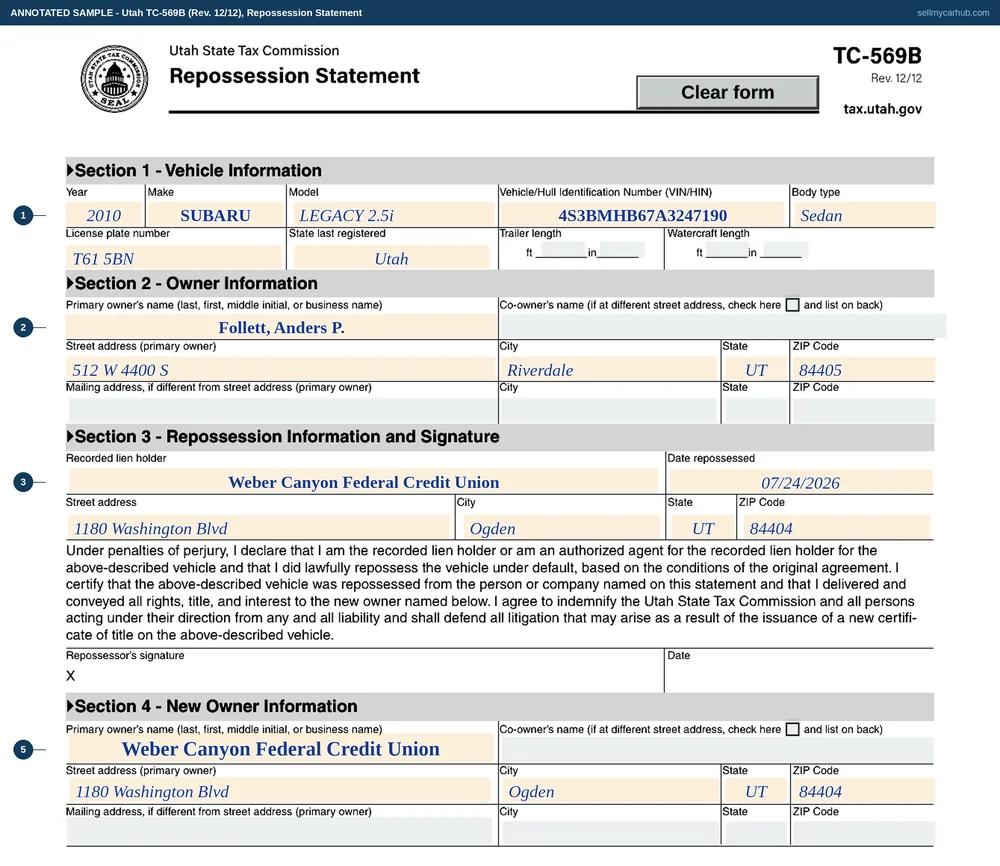
This is the actual TC-569B, rendered from the PDF the Utah State Tax Commission, Motor Vehicle Division publishes and completed end to end: letterhead, every field, and the blocks at the foot.
Year, make, model, identification number, body type, plate number and the state it was registered in.
Watch out: The plate and the identification number both go in because the Division is ending one registration and starting another.
The name and address of the person or company the vehicle was repossessed from.
Watch out: This is the borrower. Leaving it out because they have moved does not make the statement easier to accept - it makes it unverifiable.
The recorded lien holder's name and address, and the date the vehicle was repossessed.
Watch out: The name has to match the lien recorded against the vehicle. A loan sold on to another institution needs the record updated before this statement will work.
A signature under the perjury declaration that the repossession was lawful and made under default on the original agreement.
Watch out: The same paragraph conveys the vehicle onward, so signing it is both a certification about the past and a transfer to whoever is named in Section 4.
The name and address of whoever the vehicle is going to.
Watch out: It is often the lender itself, pending a sale. Naming a buyer who has not yet been found leaves the Division issuing a title to somebody who is not there.
| On the form | What to put in it |
|---|---|
| Section 1 - Vehicle Information | Year, make, model, identification number and body type, with the trailer and watercraft measurements the Division puts on all of its 569-series statements. |
| License plate number and State last registered | The live registration the repossession is about. |
| Section 2 - Owner Information | The person the vehicle was taken from - name, co-owner, street address and mailing address. This is the borrower, not the lender. |
| Section 3 - Repossession Information: Recorded lien holder | The lender's name, which has to be the lien holder actually recorded against the vehicle. |
| Date repossessed | The day possession was taken, beside the lender's name. |
| The lender's street address, city, state and ZIP | On the rule underneath. |
| The certification | A declaration under penalties of perjury that the signer is the recorded lien holder or an authorized agent for the recorded lien holder, and that they did lawfully repossess the vehicle under default, based on the conditions of the original agreement. |
| The conveyance | In the same paragraph: that the vehicle was repossessed from the person or company named on this statement, and that the signer delivered and conveyed all rights, title, and interest to the new owner named below. |
| The indemnity | An agreement to indemnify the Utah State Tax Commission and all persons acting under their direction from any and all liability, and to defend all litigation that may arise as a result of the issuance of a new certificate of title. |
| Repossessor's signature and Date | One line, marked with a printed X. No notary block. |
| Section 4 - New Owner Information | Who the vehicle is going to, with a co-owner block and both addresses - which may be the lender itself, or an auction's buyer. |
Every line here was read off TC-569B (Rev 12/12) itself — the PDF is here — and off the Utah State Tax Commission, Motor Vehicle Division pages. This is plain-language help with a form, not legal advice, and where our wording and the agency's differ, theirs governs.
Back to all Utah seller paperwork, or what selling a car in Utah involves.