The route for a vehicle you own but cannot prove you own - no title, and no way to get the last owner to sign. It is a two-part process, and the two parts go to two different places: the TxDMV first, your county second.
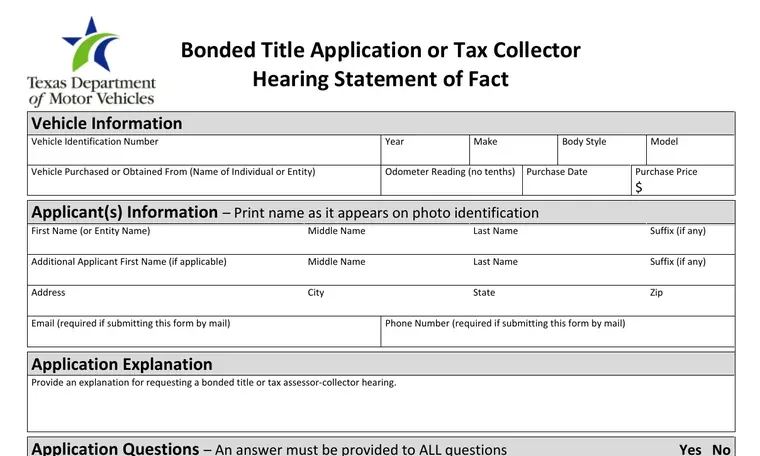
Step 1 · the form itself
Blank VTR-130-SOF — Bonded Title Application or Tax Collector Hearing Statement of Fact
PDF at txdmv.gov · new tab
View the blank VTR-130-SOF
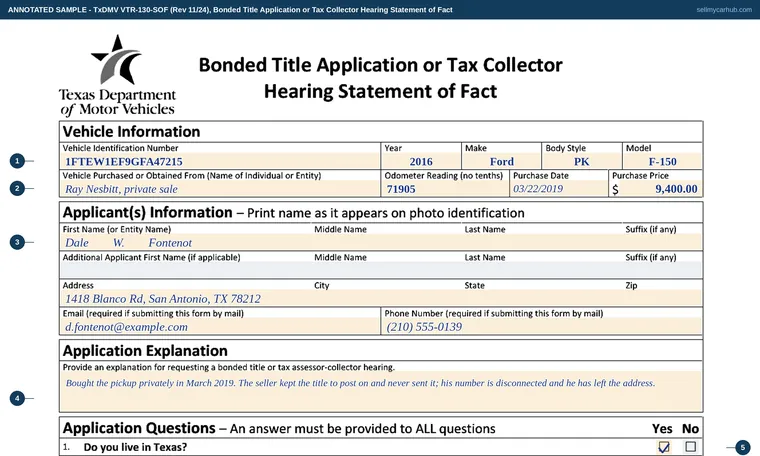
Step 2 · how to fill it in
Our filled-in VTR-130-SOF guide
PDF · 2 pages · 580 KB · new tab
See our filled-in example
Two documents, and they are not the same thing. Take the blank VTR-130-SOF from the txdmv.gov copy so you get the revision that is current today, then print our VTR-130-SOF guide and keep it beside you while you fill theirs in.
Written against VTR-130-SOF (Rev 11/24), issued under Texas Transportation Code 501.053. Two offices, two stages, and a year-long window on the notice in between. Start it well before you want to sell the car, and exhaust the certified copy of title first, which is a fraction of the cost and a fraction of the wait.
Last updated .
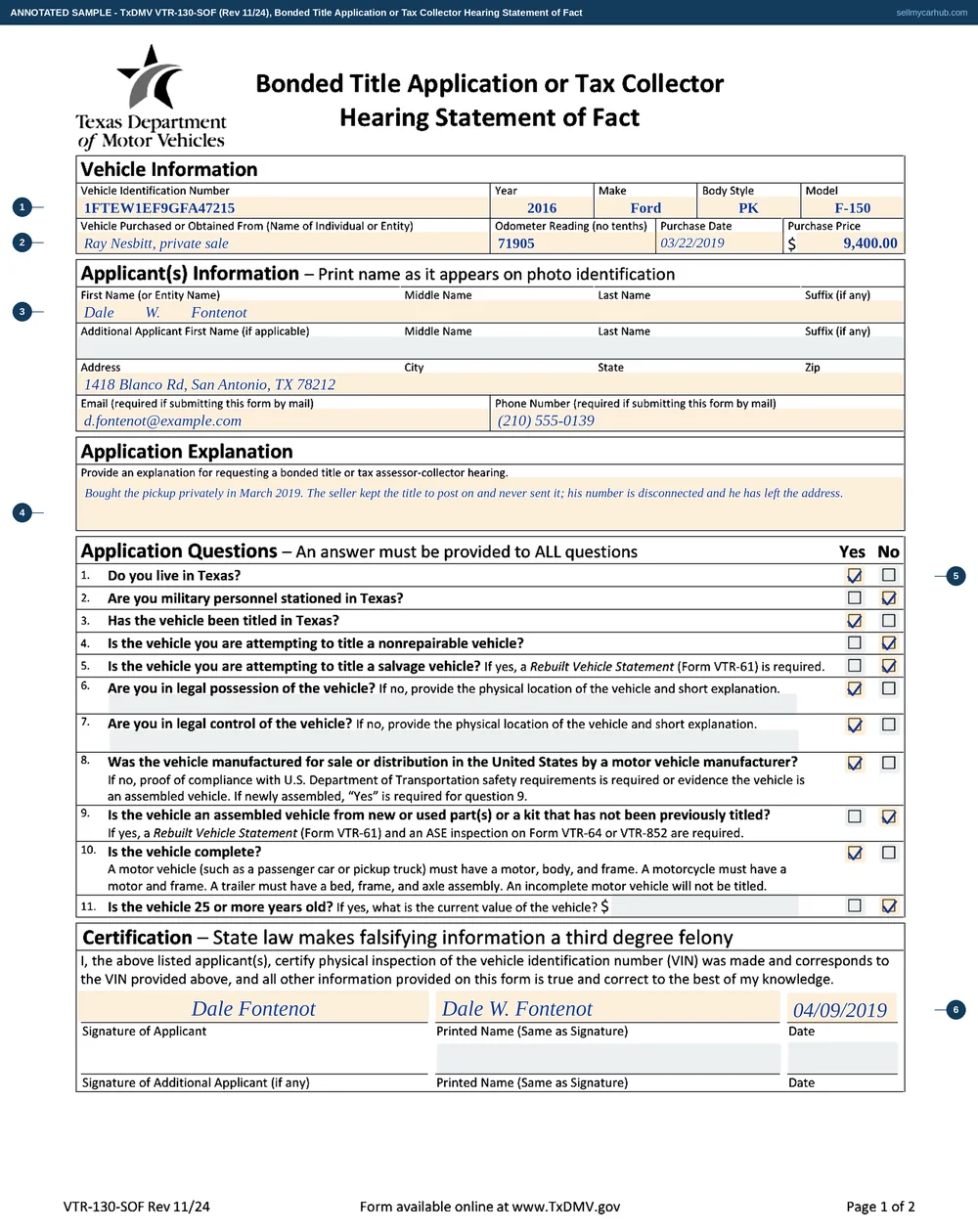
This is the actual VTR-130-SOF, rendered from the PDF the Texas Department of Motor Vehicles publishes and completed end to end: letterhead, every field, and the blocks at the foot.
Click or tap the picture to open it full size.
Download or print this example PDF · 2 pages · 580 KB
VIN, year, make, body style and model for the vehicle you cannot prove you own.
Watch out: You are certifying further down that a physical inspection of the vehicle identification number was made and corresponds to the VIN you have written here. Read it off the car, not off an old advert.
Who you purchased or obtained the vehicle from, the odometer reading with no tenths, the purchase date and the purchase price.
Watch out: These four are the spine of the claim. A purchase price with nothing behind it invites the question of what evidence of ownership - a bill of sale, a cancelled cheque - you are attaching.
Your name printed as it appears on your photo identification, the address, and an email and phone number.
Watch out: Both the email and the phone number are marked required if submitting this form by mail. They are how the Regional Service Center comes back to you, and a blank there stalls the file.
A free-text box asking for your explanation for requesting a bonded title or tax assessor-collector hearing.
Watch out: Plain chronology beats indignation. What you bought, when, from whom, what you were given, and what you have tried since - that is the account a representative can act on.
Yes or no on Texas residence, military posting, whether the vehicle has been titled in Texas, whether it is nonrepairable or salvage, legal possession, legal control, US manufacture, whether it is assembled, whether it is complete, and whether it is 25 or more years old.
Watch out: Several answers pull in another document. A salvage vehicle needs a Rebuilt Vehicle Statement on Form VTR-61; an assembled one needs that plus an ASE inspection on Form VTR-64 or VTR-852; a vehicle 25 or more years old needs its current value written on the same line.
You certify the VIN was physically inspected and that everything else on the form is true, then sign, print and date.
Watch out: This is the end of part one, not the end of the process. Part one goes to a TxDMV Regional Service Center with a $15.00 processing fee; part two goes to your county afterwards with the Notice of Determination and, if you are bonding, the original bond.
| On the form | What to put in it |
|---|---|
| Vehicle information | VIN, year, make, body style, model - then who you bought or obtained it from, the odometer reading with no tenths, the purchase date and the purchase price. |
| Applicant information | Names printed as they appear on photo identification, address, and an email and phone number - both of which the form marks as required if you are submitting by post. |
| Application explanation | A free-text box asking for your explanation for requesting a bonded title or tax assessor-collector hearing. This is the part a clerk actually reads. |
| The application questions | Eleven numbered yes/no questions, and the form says an answer must be provided to all of them. Do you live in Texas. Are you military personnel stationed in Texas. Has the vehicle been titled in Texas. Is it nonrepairable. Is it salvage - and if yes, a Rebuilt Vehicle Statement (VTR-61) is required. Are you in legal possession. Are you in legal control. Was it manufactured for sale in the United States. Is it an assembled vehicle. Is it complete. Is it 25 or more years old. |
| Part 1, what goes to the TxDMV | Both pages of this form, a $15.00 processing fee, any evidence of ownership you have, an original release of lien if the vehicle carries one less than ten years old, and a VIN inspection on Form VTR-68-A if there is no Texas record. |
| Part 2, what goes to the county | After the TxDMV processes it you take a Form 130-U, both pages of this form again, the Notice of Determination (VTR-130-ND) with all its enclosures, the original bond, a release of lien, evidence of ownership, proof of insurance and photo ID to the county tax assessor-collector. |
Every line here was read off VTR-130-SOF (Rev 11/24) itself — the PDF is here — and off the Texas Department of Motor Vehicles pages. This is plain-language help with a form, not legal advice, and where our wording and the agency's differ, theirs governs.
No title and no way to reach the last owner? Our page answers who does the VIN inspection bonded titles often need in Austin, and how appointments work.
Back to all Texas seller paperwork, or what selling a car in Texas involves.