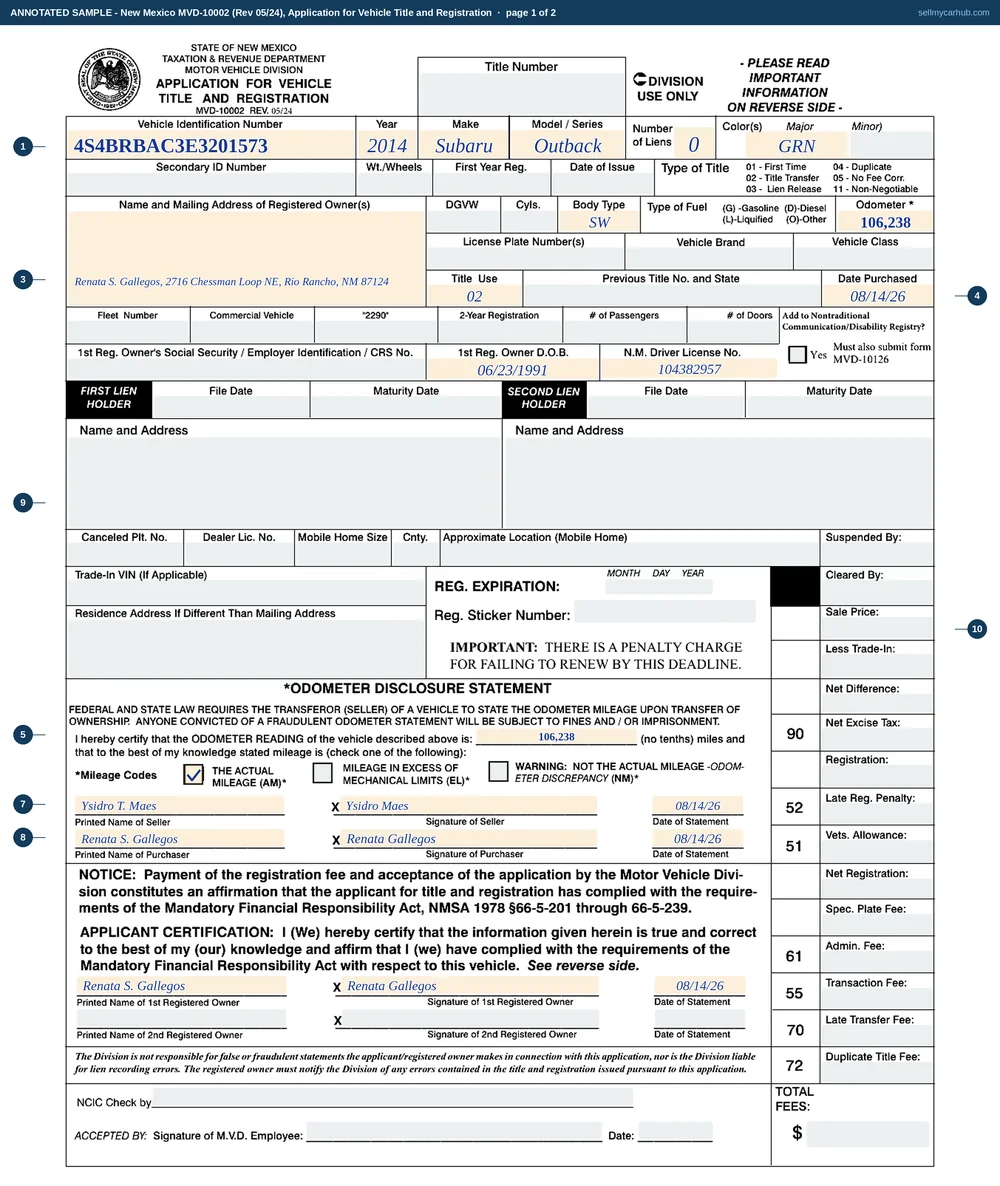
The single sheet every New Mexico transfer funnels into, and mostly not the seller's to fill. The buyer files it; the counter completes the fee ladder down its right edge - sale price, less trade-in, net excise tax, registration, penalties. What makes it a seller's document anyway is the block across its middle: a full federal odometer disclosure with a printed name, signature and date line for the seller as well as the purchaser, so your pen touches this application even though it is not your application.
Written against MVD-10002 (Rev 05/24), issued under NMSA 1978 §§66-5-201 through 66-5-239 (the financial responsibility notice printed on the form). Sign the odometer disclosure before the buyer drives away. This is the one block of the buyer's application that cannot be completed without you, and a buyer stuck at a counter with an unsigned disclosure has thirty days of penalty clock running and your telephone number.
Two documents, and they are not the same thing. Take the blank MVD-10002 from the realfile.tax.newmexico.gov copy so you get the revision that is current today, then print our MVD-10002 guide and keep it beside you while you fill theirs in.
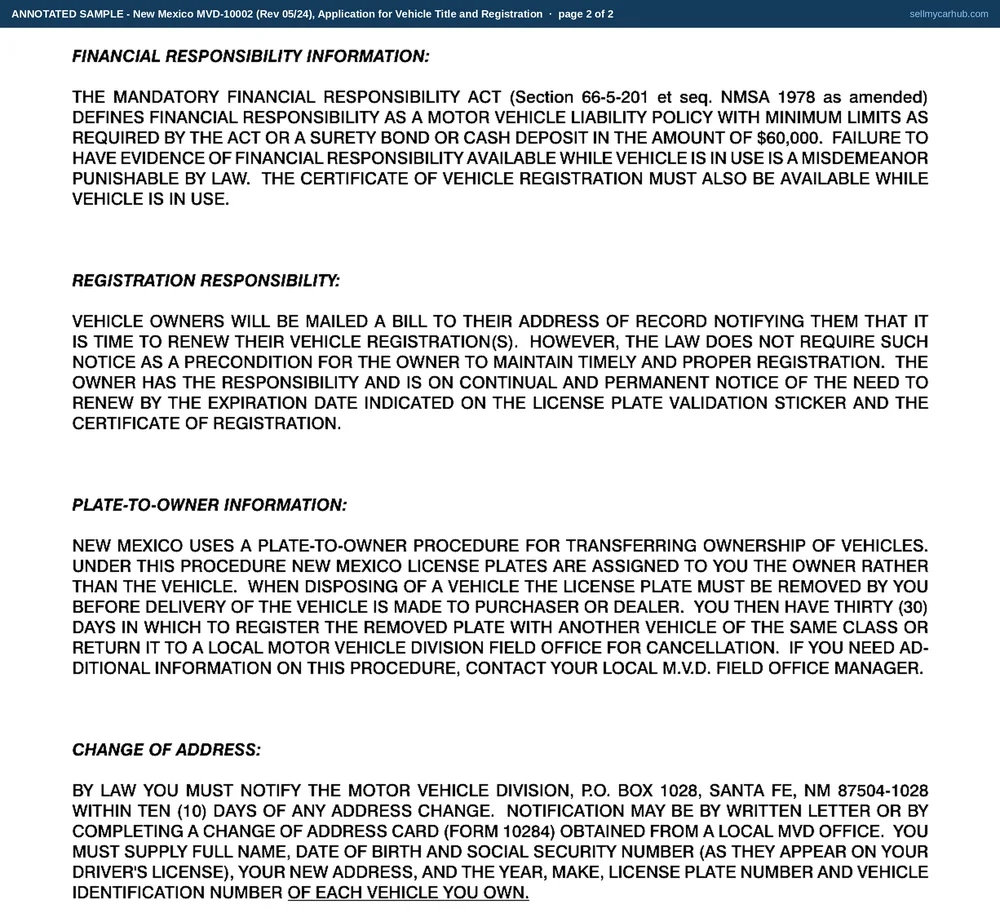
This is all 2 pages of the actual MVD-10002, rendered from the PDF the New Mexico Taxation and Revenue Department, Motor Vehicle Division publishes and completed end to end: letterhead, every field, and the blocks at the foot.
VIN, year, make, model, colours and body type, copied from the face of the certificate rather than from the car or from memory.
Watch out: Seventeen characters for anything 1981 or newer, checked against the title character by character. A transposed pair here is the commonest reason a packet makes two trips.
The printed code list at the top right. A private-party purchase is 02, Title Transfer.
Watch out: 04 is a duplicate and 03 a lien release - picking those codes changes what the counter processes, not just what it is called.
The buyer as their identification spells them, at a bona fide New Mexico residence address - a post box alone does not register a car.
Watch out: Two owners must choose a connective here. 'Or' lets either sell alone later; 'and' requires both signatures on everything, and the division will not write 'and/or' on a new title.
The assignment date from the certificate - the day the deal was actually signed.
Watch out: This date is checked against the title and any bill of sale, and the earliest one governs the 30-day requirement. An optimistic later date is a discrepancy, and discrepancies are rejectable.
Whole miles into the blank that says (no tenths), matching the reading on the certificate's assignment exactly.
Watch out: Two documents from one sale disagreeing about the mileage is precisely what the prescreen exists to catch. Copy the number, do not re-read the dash a week later.
AM, EL or NM. There is no exempt box on this form - the three printed choices are the whole menu.
Watch out: On a pre-2011 vehicle that federal law exempts, the clerk records the exemption in the system; do not tick NM to approximate it, because NM is a warning brand that follows the vehicle.
Print, sign and date under the certification. This is the only place the seller touches the application.
Watch out: The sentence you are signing is a federal certification with criminal penalties for fraud. Sign it the way the certificate spells your name, on the day you actually hand the car over.
The buyer countersigns the same certification, acknowledging the reading and the code.
Watch out: Do this at the car, together. The clerk verifies both acknowledgements, and a missing one sends the buyer back to find you.
Only if the buyer is financing: the lender's name, mailing address, file date and maturity date, exactly complete.
Watch out: The division names the specific omissions that bounce an application: lien file and maturity date, lienholder name and mailing address. An authorized agent can fax or email the missing pieces, but only after the delay has happened.
Sale price through net registration, down the right edge, marked for the division's use.
Watch out: The counter computes the excise tax here, against the higher of your declared price or the book-value floor the division applies to private sales. Writing your own arithmetic in the column reads as alteration.
| On the form | What to put in it |
|---|---|
| Vehicle Identification Number, Year, Make, Model / Series | The top rule of the vehicle block. On any 1981-or-newer vehicle the VIN is seventeen characters, and the division's prescreen list has clerks checking it character by character. |
| Number of Liens, Color(s) (Major / Minor) | The lien count is what the buyer's new lender turns into a filing; colours come from the division's own abbreviation table - GRN for green, SIL for silver or aluminum. |
| Type of Title | Six numbered codes printed on the form: 01 First Time, 02 Title Transfer, 03 Lien Release, 04 Duplicate, 05 No Fee Corr., 11 Non-Negotiable. A private sale is an 02. |
| Name and Mailing Address of Registered Owner(s) | The buyer, spelled as their identification spells them. Two buyers decide here whether their names join with 'and' or 'or' - and the division's rule is that 'and/or' is never written onto a new title. |
| Odometer, Type of Fuel, Body Type, DGVW, Cyls. | The mechanical row. Fuel is one of four printed codes: (G) gasoline, (D) diesel, (L) liquified, (O) other. |
| License Plate Number(s), Vehicle Brand, Vehicle Class | The plate the buyer is bringing to the vehicle or being issued; any brand - salvage, reconstructed - carries forward from the old title here. |
| Title Use, Previous Title No. and State, Date Purchased | The date purchased is the assignment date from the certificate, and it is the date the 30-day clock and the late-transfer penalty are measured from. |
| 1st Reg. Owner's Social Security / Employer Identification / CRS No., D.O.B., N.M. Driver License No. | Identity for the tax half of the transaction - this is a Taxation and Revenue Department form, and the excise tax is assessed to a person. |
| FIRST LIEN HOLDER / SECOND LIEN HOLDER, File Date, Maturity Date, Name and Address | The buyer's own financing, if any. The division rejects applications lacking the lien file and maturity date or the lienholder's name and mailing address. |
| Trade-In VIN (If Applicable) | The system wants only the traded vehicle's VIN - the manual notes a copy of the trade-in's title or registration is no longer required. |
| ODOMETER DISCLOSURE STATEMENT | The seller's block on the buyer's form: the reading in whole miles - the blank says (no tenths) - then one of three printed codes, THE ACTUAL MILEAGE (AM), MILEAGE IN EXCESS OF MECHANICAL LIMITS (EL), or WARNING: NOT THE ACTUAL MILEAGE - ODOMETER DISCREPANCY (NM). |
| Printed Name of Seller, Signature of Seller, Date of Statement | Your three entries. The sentence above them is federal: the transferor of a vehicle is required to state the odometer mileage upon transfer of ownership, and a fraudulent statement carries fines and/or imprisonment. |
| Printed Name of Purchaser, Signature of Purchaser, Date of Statement | The buyer countersigns the same certification, which is what the clerk's prescreen checks for. |
| The right-hand fee column | Sale Price, Less Trade-In, Net Difference, Net Excise Tax, Registration, Late Reg. Penalty, Vets. Allowance, Net Registration - Division Use Only. Nothing in this column is the applicant's to write. |
| The financial responsibility notice | Printed above the fee column: payment of the registration fee and acceptance of the application constitutes an affirmation that the applicant has complied with the Mandatory Financial Responsibility Act, NMSA 1978 §66-5-201 through 66-5-239. |
Every line here was read off MVD-10002 (Rev 05/24) itself — the PDF is here — and off the New Mexico Taxation and Revenue Department, Motor Vehicle Division pages. This is plain-language help with a form, not legal advice, and where our wording and the agency's differ, theirs governs.
Back to all New Mexico seller paperwork, or what selling a car in New Mexico involves.