New Mexico's certificate is form MVD-10030 - the Bill of Sale's own instructions name it - and it is security stock the division never reproduces, not even in its own manual. So this page works from the division's written descriptions instead: a diagram of the assignment's blocks with every label sourced, and then the MVD-10009, which repeats the same certification word for word, shown genuinely filled in.
Last updated .
Your 7 boxes
As a private seller you complete these and nothing else:
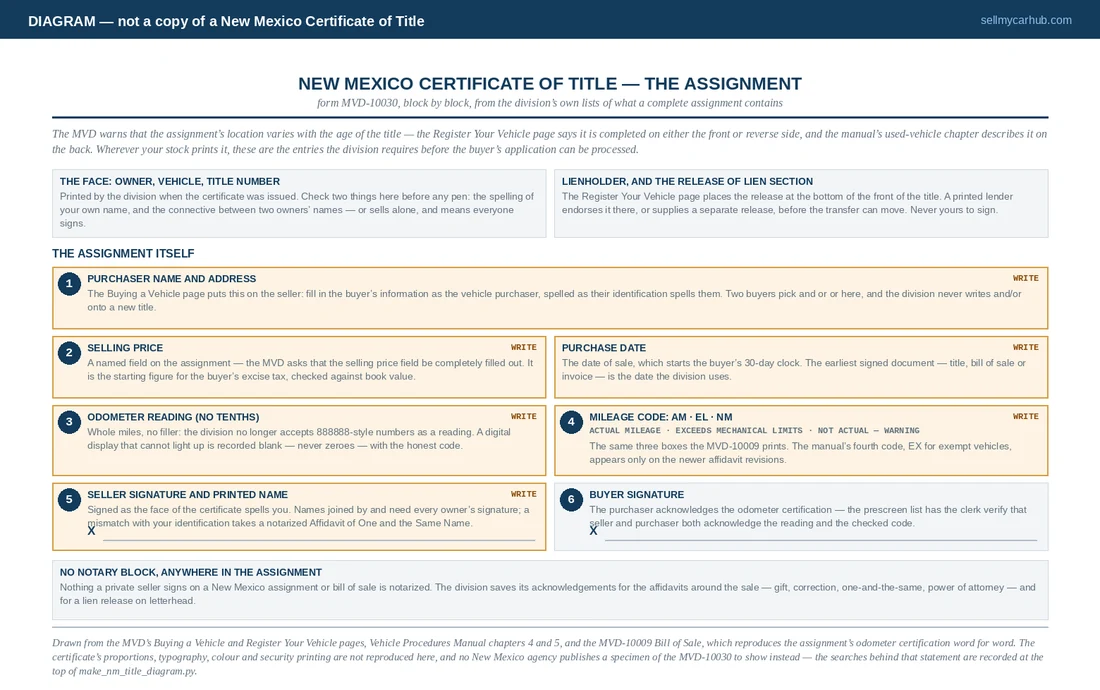
There is no blank New Mexico certificate to show you, and no specimen either: the MVD-10030 exists only as issued security stock, and the division publishes no sample of it in any manual, form or page we searched. The diagram below is built from the MVD's own written requirements instead, and is labelled as a diagram on the image itself.
Photocopies are not acceptable for processing any type of title transaction, and a title with a sticker on it - even one hiding nothing - is returned unprocessed.
One pen, one pass, nothing crossed out. The division's clerks are told to reject the transaction if there are any erasures, alterations, type-overs or discrepancies on any of the documents - and a highlighter counts, because highlighted areas vanish when the sheet is scanned.
The assignment, mapped
What the assignment of a New Mexico title asks for, block by block
The division publishes no picture of the MVD-10030 anywhere we could find - not in its procedures manual, not in a form, not on a page - so this is a diagram, drawn from the MVD's own written lists of what the assignment must contain, and it says so across its top. Every block label below carries the sentence it was transcribed from.
Amber — you write it, in pen
Grey — not yours to fill
Numbered badges - each one keyed to a step in the walkthrough further down
Click or tap the picture to open it full size.
Drawn from the MVD's Buying a Vehicle and Register Your Vehicle pages and from Vehicle Procedures Manual chapters 4 and 5, which itemise what a complete assignment contains: the buyer's information, the purchase date and selling price fields, the odometer certification, and the signatures. Nothing here reproduces the certificate's typography, colour, layout or security printing.
The same certification, on a real document
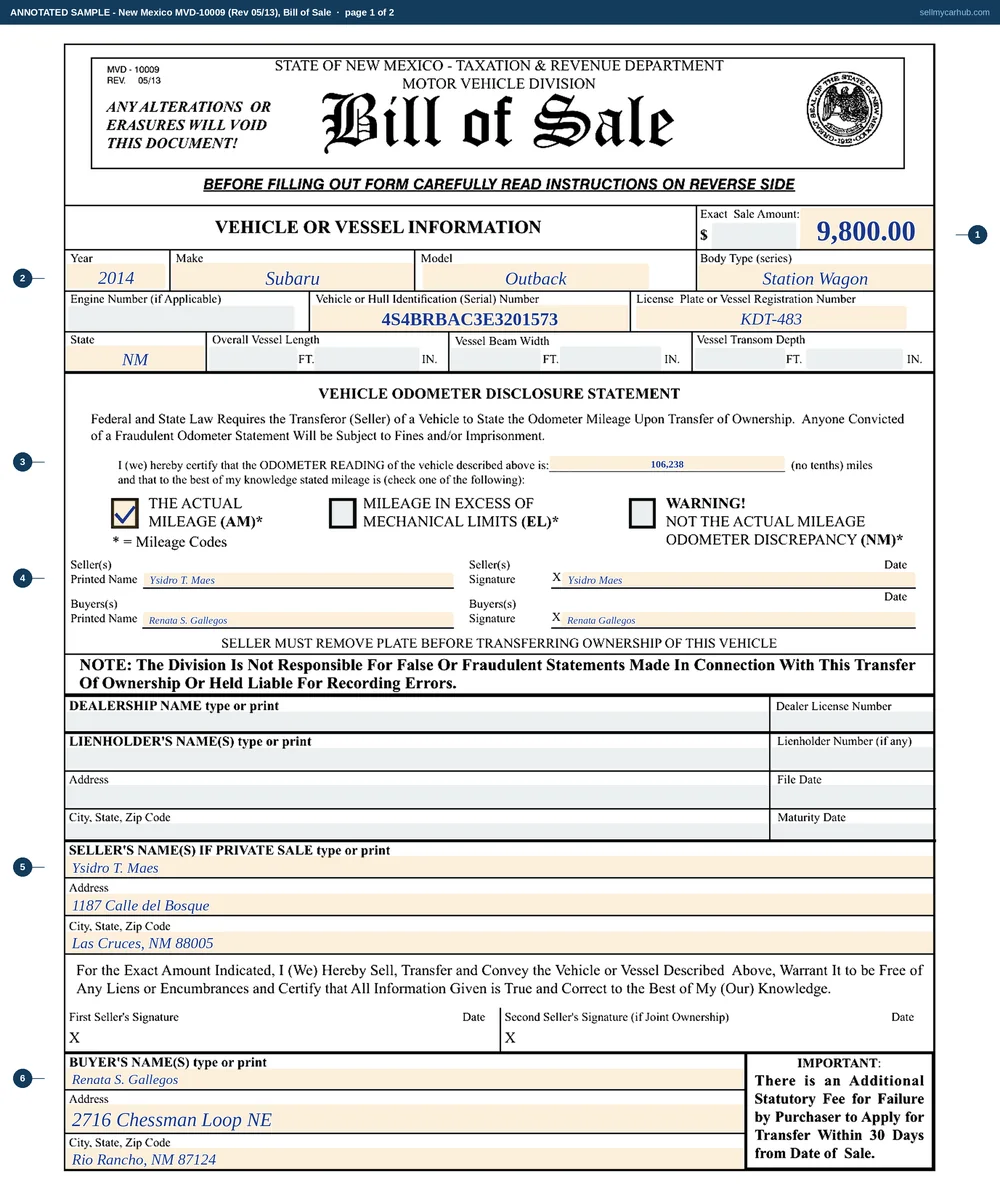
The Bill of Sale carries the identical odometer certification, so here is one completed
When the assignment on the certificate is incomplete or out of room, the MVD-10009 is the document the division itself says shall be used to carry out a transfer between individuals - and its odometer statement, its no-tenths mileage blank and its three code boxes are the same certification the title's assignment carries. This one is filled in for the sale that runs through every page of this state.
Click or tap the picture to open it full size.
The amber boxes are the seller's; the dealer and lienholder blocks stay grey in a private sale. The capitalised instruction printed across the middle of the sheet - SELLER MUST REMOVE PLATE BEFORE TRANSFERRING OWNERSHIP OF THIS VEHICLE - is the plate-to-owner rule in the division's own words.
Step by step
Every box, in the order you meet it
0
You fill this in
Before any pen: read the face of the certificate
Two checks. First, any lienholder printed on it - a printed lien needs a release before the title can move, even one paid off a decade ago. Second, the connective between owners' names: 'or' lets one of you sign alone, 'and' or 'and/or' means everyone signs.
Watch out: Check the spelling of your own name against your identification while you are there. If the two differ, the fix is a notarized Affidavit of One and the Same Name - cheaper to discover now than at the buyer's counter visit.
1
You fill this in
Buyer's name and address
Into the assignment, spelled the way the buyer's identification spells it. The division's Buying a Vehicle page puts this on the seller: ensure the seller has signed the appropriate section and filled in your information as the vehicle purchaser.
Watch out: Names get no second chances on this document - an addition in different ink, an erasure or a type-over is grounds for rejection, and the repair is an affidavit, not a correction on the sheet.
2
You fill this in
Selling price and purchase date
Both are named fields in the assignment - the MVD's page says the purchase date and selling price fields should be completely filled out - and both feed directly into the tax the buyer pays.
Watch out: The date you write starts the buyer's 30-day clock, and the earliest signed document controls. Writing a friendlier later date on a second piece of paper does not move it; the division uses the original.
3
You fill this in
Odometer reading, no tenths
Whole miles off the dash, into a blank that says '(no tenths)'. If the display cannot light up at all, the manual's answer is to record the mileage field blank - never zeroes - with the appropriate code.
Watch out: Do not write 888888 or any other filler: the division's instruction is that non-accurate numbers may no longer be used as an odometer reading. The reading plus the code below is the whole certification.
4
You fill this in
One mileage code of three
AM if the reading is the truth, EL if the odometer has rolled past its mechanical limit, NM if the reading is not the actual mileage - a dead cluster, a replaced engine, an unknowable history.
Watch out: A five-digit odometer showing 24357 on a car that has plainly done more is the textbook EL. Ticking AM there is a federal odometer certification you know to be wrong, and both of you are signing under it.
5
You fill this in
Seller signature and printed name
Sign and print under the certification. If the title names two owners joined by 'and', the second owner signs too - the counter will not waive a missing co-owner.
Watch out: Sign as the certificate spells you. The division rejects discrepancies in the names of sellers, and reconciling a signature that does not match the printed owner takes a notarized affidavit.
6
The buyer fills this in
Buyer's signature on the certification
The buyer signs the odometer certification as its acknowledging party - the manual's prescreen list has the clerk verify that the seller and purchaser acknowledge the accuracy of the odometer reading.
Watch out: Get this signature while you are both standing at the car. A buyer who left with an unsigned certification has left you unable to complete the document you already signed.
7
The lienholder fills this in
The lien release section
Only in play if a lienholder is printed on the certificate. The lender endorses the designated release area, or supplies an MVD-10041, or a notarized release on letterhead - and a bank's signer must state their position with the company.
Watch out: A lien whose maturity date passed more than a year ago is the one case the division stops asking for a release. Anything younger, the release is on you to chase - the buyer cannot.
8
You fill this in
The plate, off the car
Not a form field, but part of the transfer: the plate is yours under the plate-to-owner rule, it comes off before the buyer takes the vehicle, and it has 30 days to be reassigned to a same-class vehicle or handed in for cancellation.
Watch out: The Bill of Sale prints this instruction in capitals across its middle. A plate left on the car keeps generating records - tolls, cameras, abandonment - that all point at you.
Before the pen
Before the buyer arrives
Six habits that keep a New Mexico packet out of the reject pile, starting with the one about ink:
Find the certificate early
If it is lost, the duplicate is $5.00 and comes from a field office or by mail from Santa Fe - but only to the registered owner, so it cannot be fetched after the handshake by the buyer.
Read the connective before promising anything
'Or' sells on one signature; 'and' needs every owner present or a notarized power of attorney that is still inside its 30-day life.
Settle the lien line first
A lien printed on the certificate blocks the transfer until released. If the loan is long paid, chase the letterhead release now; if the lien matured over a year ago, say so at the counter.
Whole miles, one code, no filler
New Mexico banned 888888-style placeholder readings. Blank beats invented, and the code does the explaining.
Keep every sheet in one ink
The clerk is told to treat mixed ink and mismatched typeset as possible alteration. Fill each document in one sitting with one pen.
Do not gift-wrap a sale
A 'gift' with money behind it needs two notarized perjury statements to file - and the division treats an unaffidavited gift as a sale taxed at book value.
The ink rule is the New Mexico MVD's own: “Reject the transaction if there are any erasures, alterations, type-overs or discrepancies on any of the documents. To the extent possible, documents should have the same typeset, ink, etc., to avoid being reviewed by staff as an alteration.”
— New Mexico MVD, Register Your Vehicle - used vehicle documents.
Check your source
What New Mexico sellers get told that the MVD has already contradicted
Three confident claims that circulate about selling a car in New Mexico. Each is wrong in a way the division has already written down:
"Leave the plate on so the buyer can drive it home legally."
Backwards in New Mexico. The state is 'Vehicle Plate to Owner': the plate is assigned to you, not the vehicle, and the MVD makes removing it the seller's responsibility before the buyer takes possession. You then have 30 days to put it on another vehicle of the same class or hand it to the division for cancellation. The Bill of Sale prints the instruction in capital letters; the buyer's plate comes from their own registration visit.
The sale itself, nothing: the assignment, the Bill of Sale and the Odometer Disclosure Statement all close on plain signatures, and the manual's list of what a bill of sale must contain asks for names, addresses and signatures only. The notaries guard the edges - the Affidavit of Gift needs both parties notarized separately, the power of attorney is sworn twice, and the correction and one-and-the-same affidavits each carry a seal block. Knowing which half of the paperwork needs the stamp saves a trip.
"Write a low price on the title and save the buyer some tax."
The division planned for this. On any non-dealer sale, the excise tax is computed on the higher of the declared price or 80% of the N.A.D.A. average trade-in or wholesale value - the clerk looks the vehicle up by VIN and mileage. A price that undershoots book value changes nothing except the accuracy of a document you signed; calling it a gift instead requires a notarized affidavit from both parties under a perjury statute the form quotes in full, a fourth degree felony.
Six signatures that can appear in a New Mexico transfer, and the two that never do:
You, in the assignment
Seller's signature plus printed name. The mileage certification above it is federal law's, and your signature under it certifies the reading and the code.
A co-owner, if the connective says so
Names joined by 'or': either of you alone. Joined by 'and' - or the retired 'and/or' - every named owner signs, to assign, to apply, or to borrow against the car.
The buyer, twice over
Once acknowledging the odometer certification, and again on the title application they file. Their name goes into the assignment exactly as their identification spells it.
The lienholder, in the release section
If a lender is printed on the certificate, their endorsement in the designated release area - or a separate release - comes before any transfer. A bank's agent must state their position with the company.
Nobody, in front of a notary
The assignment, the bill of sale and the odometer statement all close on plain signatures. New Mexico saves its notaries for the affidavits around the sale - gift, correction, one-and-the-same, power of attorney.
A person you appoint - for 30 days only
The MVD-11020 lets an attorney-in-fact sign in your place, sworn before a notary; it expires within 30 days of signing, so it is paperwork for a sale that is actually happening.
Once it is signed
In New Mexico the signing is the middle of the job. The plate comes off before the buyer leaves, it has 30 days to find a new car or a counter, and the Sold Unit in Santa Fe gets its one-page notice - those three steps, not the handshake, are what end your connection to the vehicle.