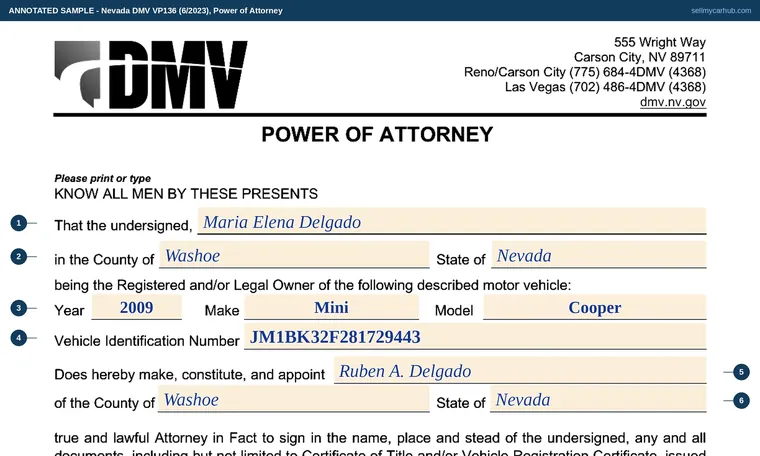
Lets one named person sign title and registration paperwork in place of the registered owner. This is the form for selling a car when the owner cannot be at the table — deployed, hospitalised, working out of state, or simply three time zones from the buyer.
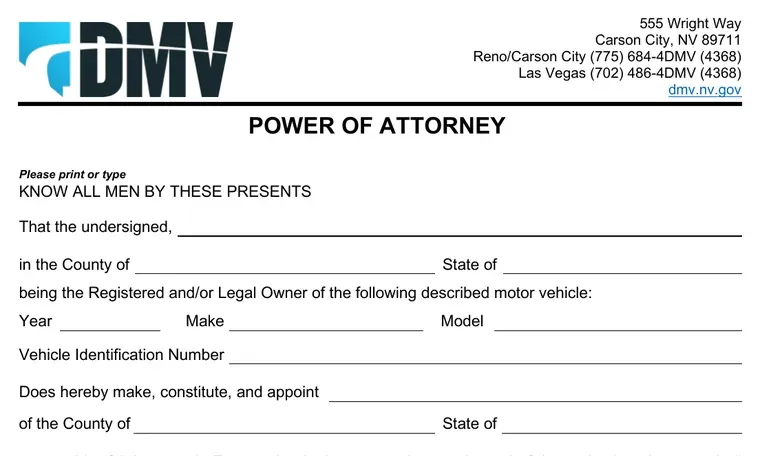
Written against VP 136 (6/2023), issued under the Nevada DMV's own vehicle programs authority; the form itself cites no statute and neither do we. June 2023 revision. One line on this form causes more rejected transfers than the rest of it put together: it may not be used to disclose the odometer reading. The owner has to sign the odometer line themselves.
Two documents, and they are not the same thing. Take the blank VP 136 from the dmv.nv.gov copy so you get the revision that is current today, then print our VP 136 guide and keep it beside you while you fill theirs in.
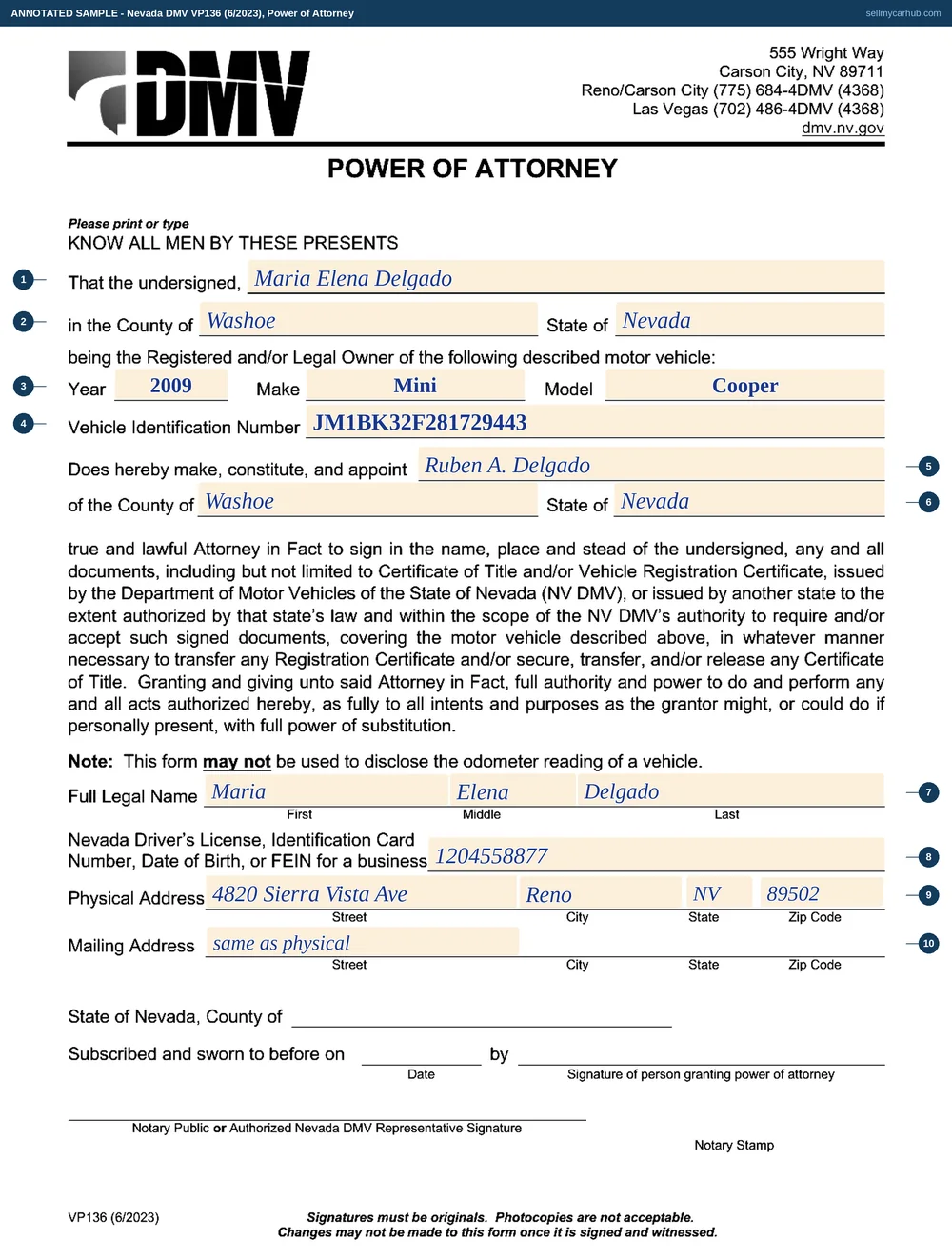
This is the actual VP 136, rendered from the PDF the Nevada Department of Motor Vehicles publishes and completed end to end: letterhead, every field, and the blocks at the foot.
The registered owner's full legal name — the person handing over the authority.
Watch out: Match the title exactly. If the title says Maria E. Delgado, this is not the place to modernise it to Maria Delgado.
Where the owner lives, not where the car is.
Watch out: Nevada residents write their county — Washoe, Clark, Elko. The state box is not automatically Nevada; an owner posted out of state writes where they actually are.
The vehicle the power is limited to.
Watch out: Copy from the title, not from memory. This form does nothing for a car it does not describe.
The full VIN on one line.
Watch out: Seventeen characters, checked twice. A VIN that does not match the record makes the power useless at the counter and there is no fixing it afterwards — changes are not allowed once it is signed.
The person receiving the authority — the attorney in fact.
Watch out: One person, by name. Whoever writes their name here is the only person who can sign for the owner, so it has to be whoever will physically be at the DMV or the handover.
Where that person lives.
Watch out: They do not have to live in the same county, or in Nevada at all.
The owner's name again, split across first, middle and last.
Watch out: This block identifies the person granting the power, not the one receiving it. It catches people out because it sits below the appointment paragraph.
Nevada driver's licence or ID card number; date of birth if there is none; FEIN for a business.
Watch out: A business granting the power uses its FEIN and names the authorized representative — a company cannot sign for itself.
Street, city, state and ZIP where the owner actually lives.
Watch out: A PO box is not a physical address. That belongs on the mailing line underneath.
Where post should go, if it differs.
Watch out: "Same as physical" is fine and clearer than leaving it empty, which reads as an oversight.
| On the form | What to put in it |
|---|---|
| The grantor | The registered owner's name, and the county and state they live in. |
| The vehicle | Year, make, model and VIN — the car the power is limited to. |
| The attorney in fact | The person being given the authority, and their county and state. |
| Grantor's identity block | Full legal name, Nevada licence or ID number or date of birth, physical and mailing address. |
| Notarization | Signed in front of a notary or an authorized Nevada DMV representative. |
Every line here was read off VP 136 (6/2023) itself — the PDF is here — and off the Nevada Department of Motor Vehicles pages. This is plain-language help with a form, not legal advice, and where our wording and the agency's differ, theirs governs.
Back to all Nevada seller paperwork, or what selling a car in Nevada involves.