Sell My Car Hub

How to fill out Minnesota PS2004

The form that stops any of the estate paperwork ever being needed. An owner names a beneficiary now, the letters TOD appear next to that name on the title, and the vehicle passes on death without probate and without sales tax. It is signed before a notary, it is not itself a title application, and it has one clause worth understanding before it is signed: while the owner is alive the beneficiary has no ownership interest of any kind and no say in a sale.
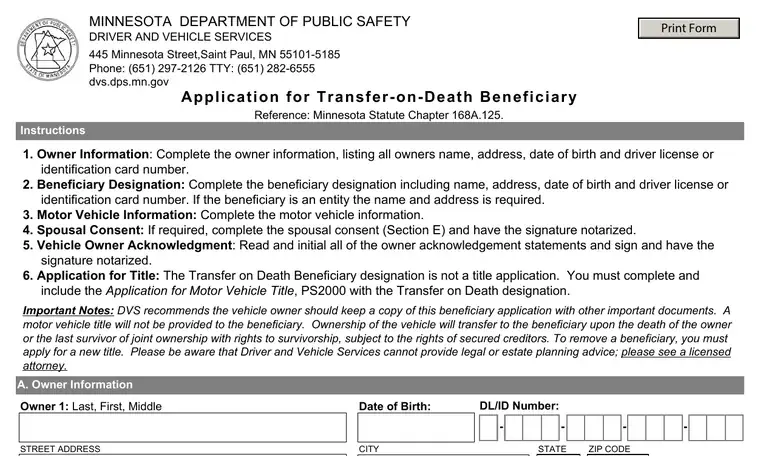
Written against PS2004 (Rev 09/2017), issued under Minnesota Statutes 168A.125. DVS says in its own note on this form that it cannot provide legal or estate planning advice and to see a licensed attorney. A transfer-on-death designation interacts with a will, with a surviving spouse's rights and with claims against an estate, and a car is rarely the only thing in play.

Two documents, and they are not the same thing. Take the blank PS2004 from the assets.dps.mn.gov copy so you get the revision that is current today.

Filled in

What a completed one looks like

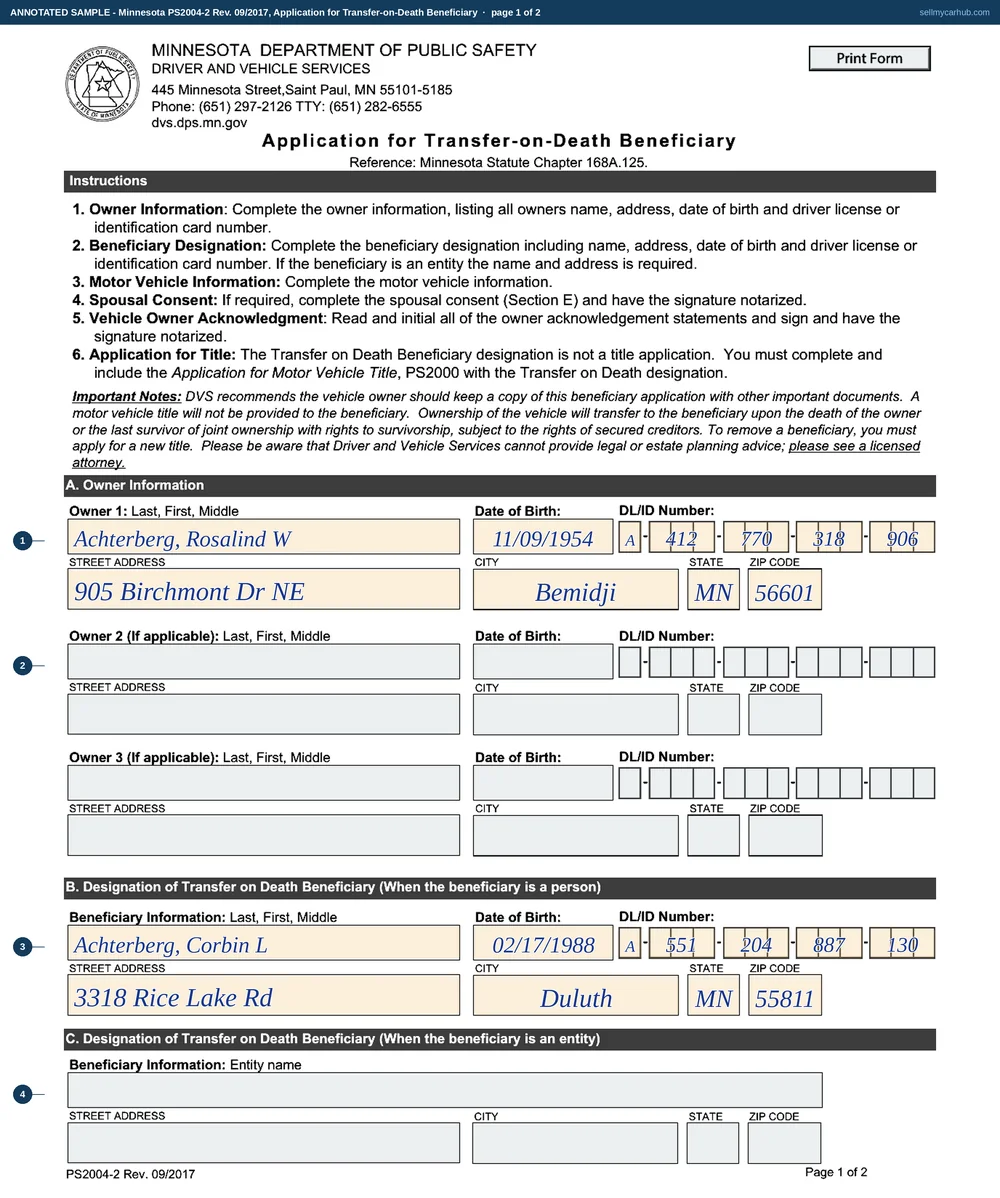
This is all 2 pages of the actual PS2004, rendered from the PDF the Minnesota Driver and Vehicle Services publishes and completed end to end: letterhead, every field, and the blocks at the foot.

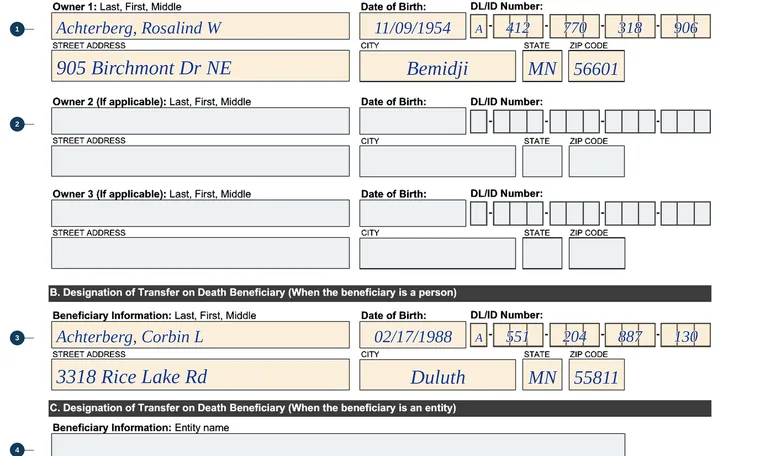
Minnesota form PS2004 filled in: owner Rosalind W. Achterberg of Bemidji designating Corbin L. Achterberg as transfer-on-death beneficiary of a 2022 Subaru Outback, VIN 4S4BTANC4N3216847, plate HDX 706, with the entity beneficiary block left grey and empty, the spousal consent block left grey, and all six owner acknowledgements initialled above a signature rule and notary block that carry no fillable boxes.
Page 1 of 2. Sections A to C. The owner block, the beneficiary block, and the entity block below it left grey because a beneficiary is either a person or an organisation, never both.
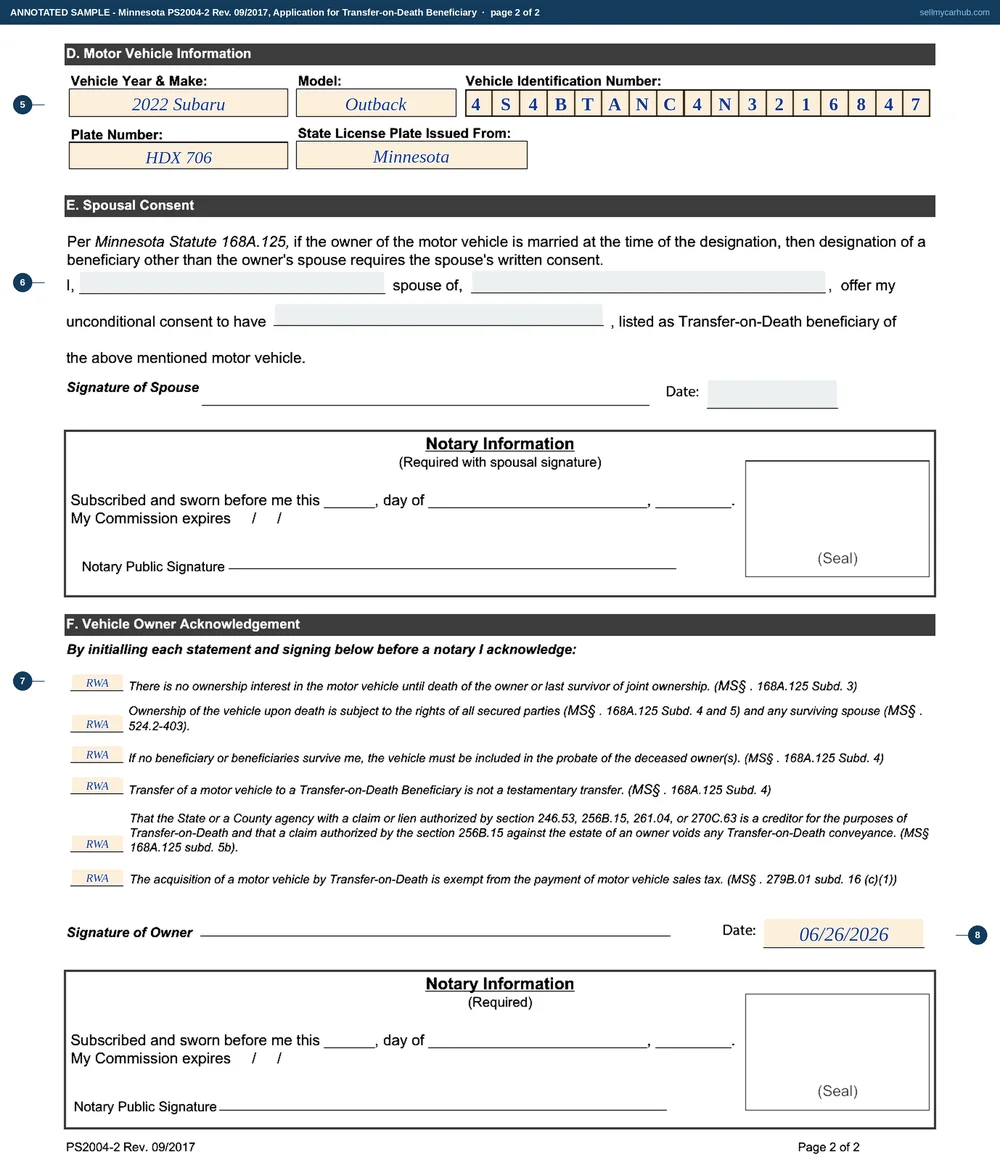
Minnesota form PS2004 filled in: owner Rosalind W. Achterberg of Bemidji designating Corbin L. Achterberg as transfer-on-death beneficiary of a 2022 Subaru Outback, VIN 4S4BTANC4N3216847, plate HDX 706, with the entity beneficiary block left grey and empty, the spousal consent block left grey, and all six owner acknowledgements initialled above a signature rule and notary block that carry no fillable boxes.
Page 2 of 2. Sections D to F. Spousal consent is greyed because the owner in this sample is unmarried - and the six statements above the signature are initialled one at a time, which is what makes this an acknowledgement rather than a form. Both notary blocks are printed rather than fillable, so they stay empty here.
Field by field

Every line, in the order you meet it

  1. 1
    You fill this in

    Section A, owner information

    Every owner on the title: name, date of birth, driver's licence or identification card number and address.

    Watch out: All of them. A designation made by one of two joint owners is a designation the other one has not made, and the vehicle only reaches the beneficiary on the death of the last survivor.

  2. 2
    You fill this in

    Section B, the beneficiary

    Name, date of birth, licence or identification number and address of the person who should receive the vehicle.

    Watch out: A date of birth and a credential number matter more here than they look. This name has to be matched to a real person years later, possibly by somebody who never met them.

  3. 3
    You fill this in

    Section C, or not

    The entity block, for a beneficiary that is an organisation rather than a person.

    Watch out: One or the other. Filling in both leaves DVS to decide which you meant, and it will not.

  4. 4
    You fill this in

    Section D, the vehicle

    Year and make, model, vehicle identification number, plate number and the state the plate was issued from.

    Watch out: One designation per vehicle. A household with three cars in one name needs three of these forms and three title transactions.

  5. 5
    Somebody else fills this in

    Section E, spousal consent

    Where the owner is married and the beneficiary is not the spouse: the spouse's unconditional consent, signed and notarised.

    Watch out: The notary block here is separate from the one at the foot and is marked required with spousal signature. Two signatures, two notarisations.

  6. 6
    You fill this in

    Initial all six acknowledgements

    Six statements in section F, each initialled individually, each carrying its own statutory citation.

    Watch out: Read the fifth one. A state or county claim under the medical assistance statutes voids the conveyance entirely, which is the circumstance in which people who relied on this form discover it did not work.

  7. 7
    You fill this in

    Sign before a notary

    The owner's signature at the foot of section F, with the notary block completed beneath it.

    Watch out: The initials and the signature are notarised together. A form signed at the kitchen table and notarised afterwards is not what the block above it certifies.

  8. 8
    You fill this in

    Attach a title application

    Instruction 6: the designation is not a title application, and a PS2000 goes with it.

    Watch out: The whole point is to get TOD printed next to a name on a new certificate, and a new certificate needs an application. Sending this on its own achieves nothing at all.

At a glance

What goes where

On the formWhat to put in it
Section A, owner informationUp to three owners, each with last, first, middle name, date of birth, a driver's licence or identification card number split across five boxes, and a street address, city, state and zip code.
Section B, designation of beneficiaryThe same block again for a person - name, date of birth, licence number, address.
Section C, when the beneficiary is an entityEntity name and address, for a beneficiary that is a charity or a company rather than a person.
Section D, motor vehicle informationVehicle year and make, model, vehicle identification number, plate number, and the state the plate was issued from.
Section E, spousal consentWhere the owner is married and the beneficiary is somebody other than the spouse, the spouse's written consent - with its own notary block, required with the spousal signature.
Section F, vehicle owner acknowledgementSix statements to be initialled one by one, each with its own statutory citation, then the owner's signature before a notary.
The six acknowledgementsThere is no ownership interest until death of the owner or last survivor; ownership on death is subject to the rights of all secured parties and any surviving spouse; if no beneficiary survives, the vehicle goes into probate; a transfer on death is not a testamentary transfer; a state or county claim can void the conveyance; and acquisition by transfer on death is exempt from motor vehicle sales tax.
The instruction that catches peopleNumbered 6 on the first page: the Transfer on Death Beneficiary designation is not a title application, and it must be submitted with an application for motor vehicle title.

What gets this one rejected

Rules that decide whether it is accepted

Every line here was read off PS2004 (Rev 09/2017) itself — the PDF is here — and off the Minnesota Driver and Vehicle Services pages. This is plain-language help with a form, not legal advice, and where our wording and the agency's differ, theirs governs.

Back to all Minnesota seller paperwork, or what selling a car in Minnesota involves.

Want the paperwork handled instead?

Get My Instant Offer → Online · about 2 minutes · free

Or send the details — we'll come to you

If a car has come to you through an estate and you would rather not keep it, tell us what stage the paperwork is at.

or call/text (877) 405-1808