Sell My Car Hub

How to fill out Maine MVT-12

One side of paper on which a lender states that a security interest is discharged. Maine's ordinary route is the face of the certificate, where the lien is printed and where the lender signs it off - so this exists for the cases where that is impossible or has already gone wrong: a certificate that reached the Bureau still showing a lien that was paid years ago, a lender that has been absorbed by another institution, a release that arrived after the title was reissued. The Bureau's duplicate-title application names it directly for exactly that situation.
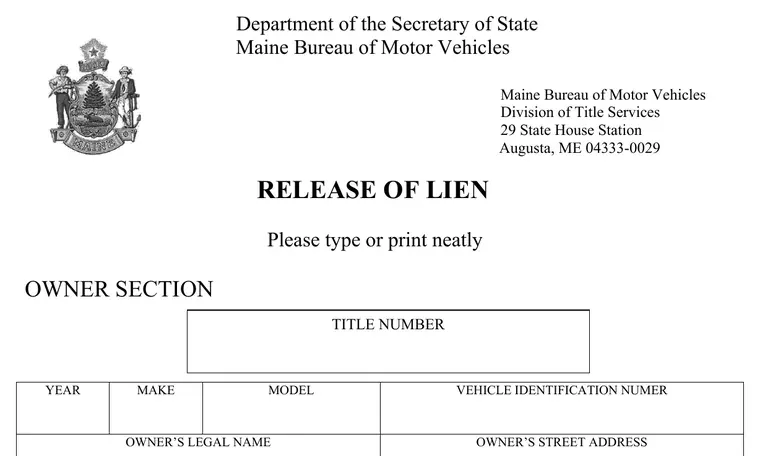
Written against MVT-12 (Rev 9-2021), issued under 29-A M.R.S. section 705. The three date boxes are the ones that hold this form up. Actual date of release is the day the debt was cleared, date signed is the day the officer put pen to paper, and those are frequently months apart - which is precisely why the Bureau asks for both instead of one.

Two documents, and they are not the same thing. Take the blank MVT-12 from the maine.gov copy so you get the revision that is current today, then print our MVT-12 guide and keep it beside you while you fill theirs in.

Filled in

What a completed one looks like

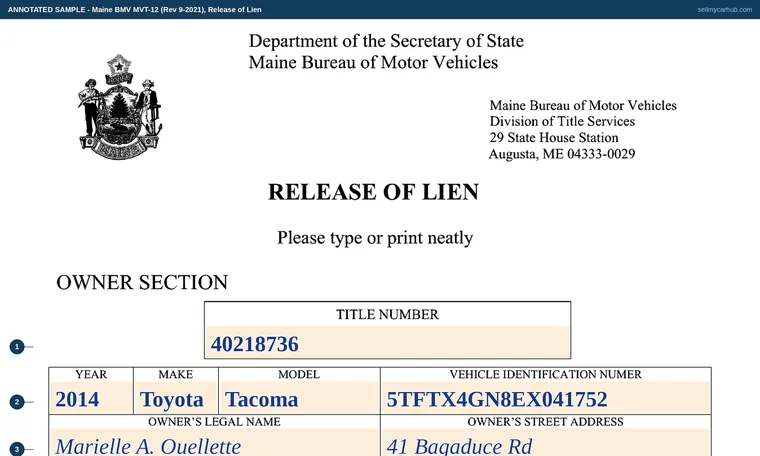
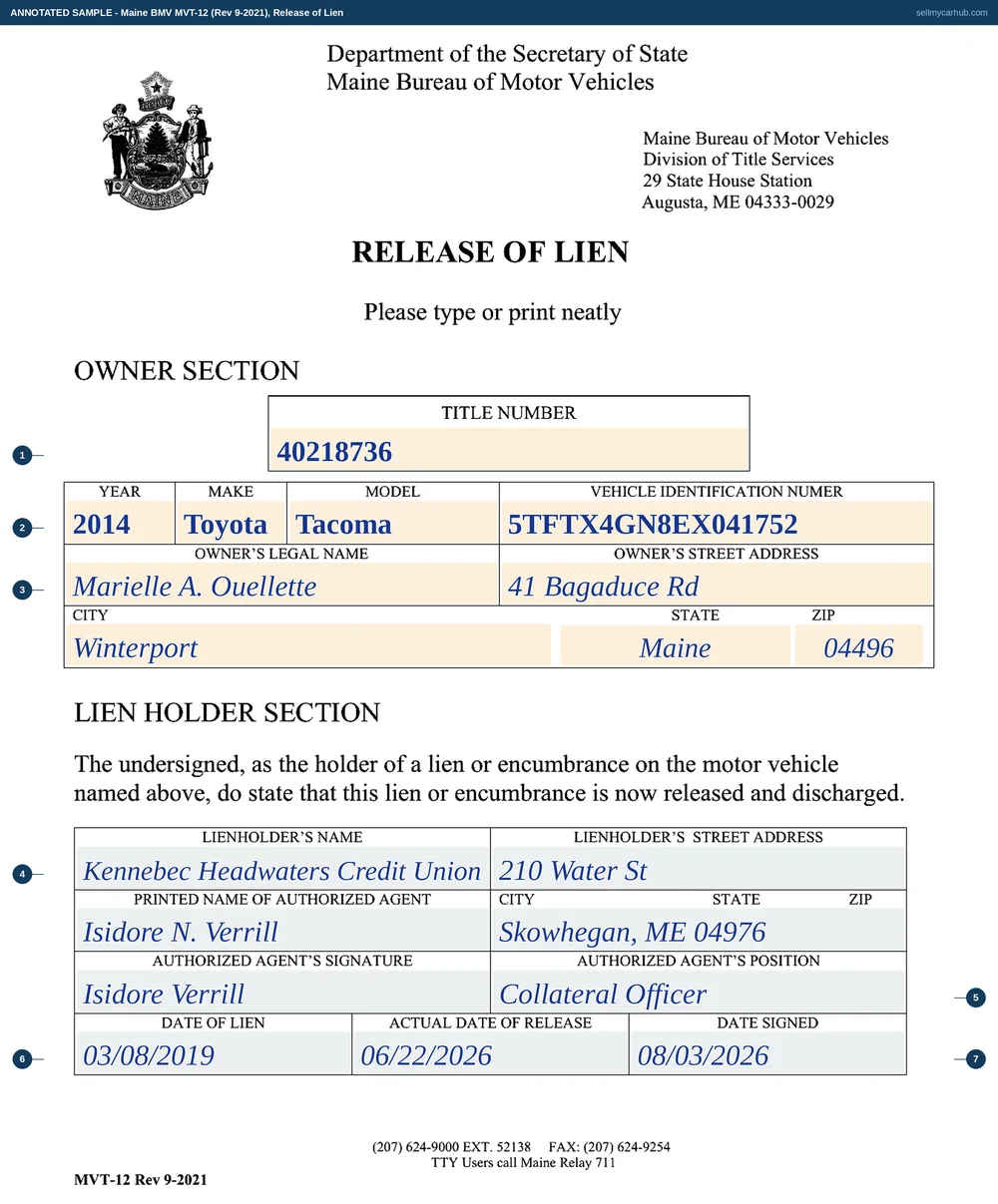
This is the actual MVT-12, rendered from the PDF the Maine Bureau of Motor Vehicles publishes and completed end to end: letterhead, every field, and the blocks at the foot.

The Maine MVT-12 Release of Lien filled in as an annotated sample. The owner section names Marielle A. Ouellette of Winterport with the title number and the 2014 Toyota Tacoma and its vehicle identification number. The lienholder section is completed by Kennebec Headwaters Credit Union of Skowhegan, with Isidore N. Verrill signing as collateral officer, and the three date lanes carry the date of lien, the actual date of release and the date signed as three different dates.
Everything above the printed sentence is the owner's record and everything below it belongs to the lender. Note the three dates along the foot: the loan was taken out in 2019, cleared in June, and the officer signed in August. The Bureau asks for all three because they are rarely the same day.
Field by field

Every line, in the order you meet it

  1. 1
    You fill this in

    The title number

    Copied off the face of the certificate into the first box.

    Watch out: This is the only part of the sheet a seller usefully prepares. Without it the release has nothing to attach itself to.

  2. 2
    You fill this in

    The vehicle row

    Year, make, model and vehicle identification number.

    Watch out: Take the identification number from the certificate rather than the door pillar, so that the release and the record it is matched against agree character for character.

  3. 3
    You fill this in

    Owner name and address

    Your legal name and street address as the Bureau holds them.

    Watch out: If you have moved since the title was issued, the name still has to match. An address change is a separate conversation and not a reason to alter this box.

  4. 4
    The lienholder fills this in

    The lienholder's own block

    The institution's name and address, under the printed sentence releasing and discharging the lien.

    Watch out: Hand the form over rather than filling this in helpfully. A release completed in the owner's handwriting is the thing counters look for.

  5. 5
    The lienholder fills this in

    Printed name, signature, position

    Three separate lanes for the authorised agent.

    Watch out: Position is the one that gets missed. A release signed by a name with no role attached is returned, and the second attempt takes another fortnight.

  6. 6
    The lienholder fills this in

    Date of lien

    The day the security interest was created.

    Watch out: It is on the face of the certificate beside the lienholder's name. If the two disagree, the Bureau believes the certificate.

  7. 7
    The lienholder fills this in

    Actual date of release and date signed

    The day the debt was cleared, and the day the form was executed.

    Watch out: These are genuinely different questions. Writing today's date in both is the commonest way this form comes back.

At a glance

What goes where

On the formWhat to put in it
Owner section, title numberThe number off the face of the certificate. It is the first box on the sheet because it is what the Bureau matches the release against.
Owner section, the vehicleYear, make, model and vehicle identification number in one row.
Owner section, the ownerLegal name, street address, city, state and postcode - the owner as the Bureau's record has them, not as the buyer will be.
Lien holder section, the sentencePrinted rather than typed in, and it is the whole substance: the undersigned, as the holder of a lien or encumbrance on the motor vehicle named above, do state that this lien or encumbrance is now released and discharged.
Lienholder identityThe institution's name and street address, city, state and postcode.
Authorized agentThree separate lanes - the agent's printed name, their signature, and their position. Position is a box on the form and not an afterthought.
Three datesDate of lien, actual date of release, and date signed. They are asked for separately because they are three different days and the Bureau reconciles them.

What gets this one rejected

Rules that decide whether it is accepted

Every line here was read off MVT-12 (Rev 9-2021) itself — the PDF is here — and off the Maine Bureau of Motor Vehicles pages. This is plain-language help with a form, not legal advice, and where our wording and the agency's differ, theirs governs.

Back to all Maine seller paperwork, or what selling a car in Maine involves.

Want the paperwork handled instead?

Get My Instant Offer → Online · about 2 minutes · free

Or send the details — we'll come to you

If your lender is being slow with the release and the buyer is losing interest, get a standing offer from us that does not expire while you wait.

or call/text (877) 405-1808