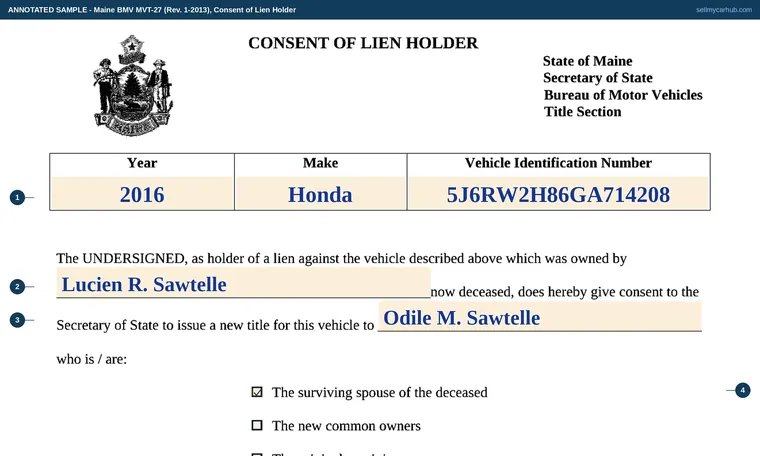
The form for a financed vehicle whose owner has died. The debt does not die with them, so the lender does not release anything - it consents to a new certificate being issued to whoever inherits the vehicle, and asks to be named as first lienholder on that new certificate. The Bureau's own death-of-an-owner instructions point at it four separate times, once for a surviving spouse, once for a joint owner, once for a common owner and once where the lien must otherwise be released outright.
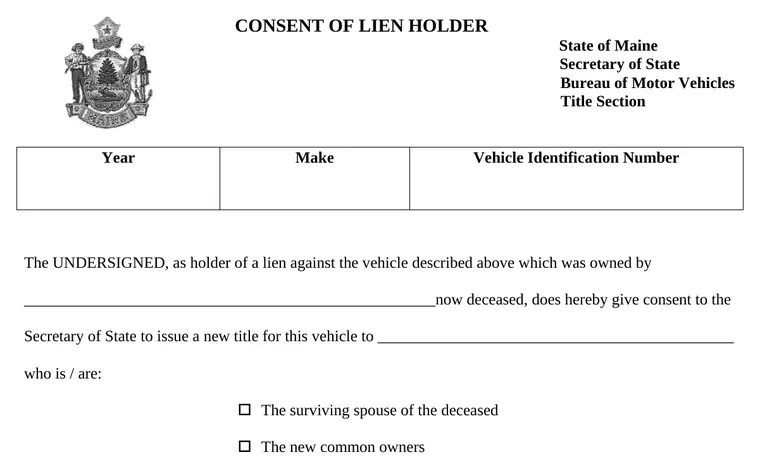
Written against MVT-27 (Rev 1-2013), issued under 29-A M.R.S. section 705. This form is signed under penalties of false statement and carries no notary block, which sets it apart from almost every other Maine affidavit in this section. The sworn document in an estate transfer is the survivor's affidavit; the lender's consent beside it is simply signed.
Two documents, and they are not the same thing. Take the blank MVT-27 from the maine.gov copy so you get the revision that is current today, then print our MVT-27 guide and keep it beside you while you fill theirs in.
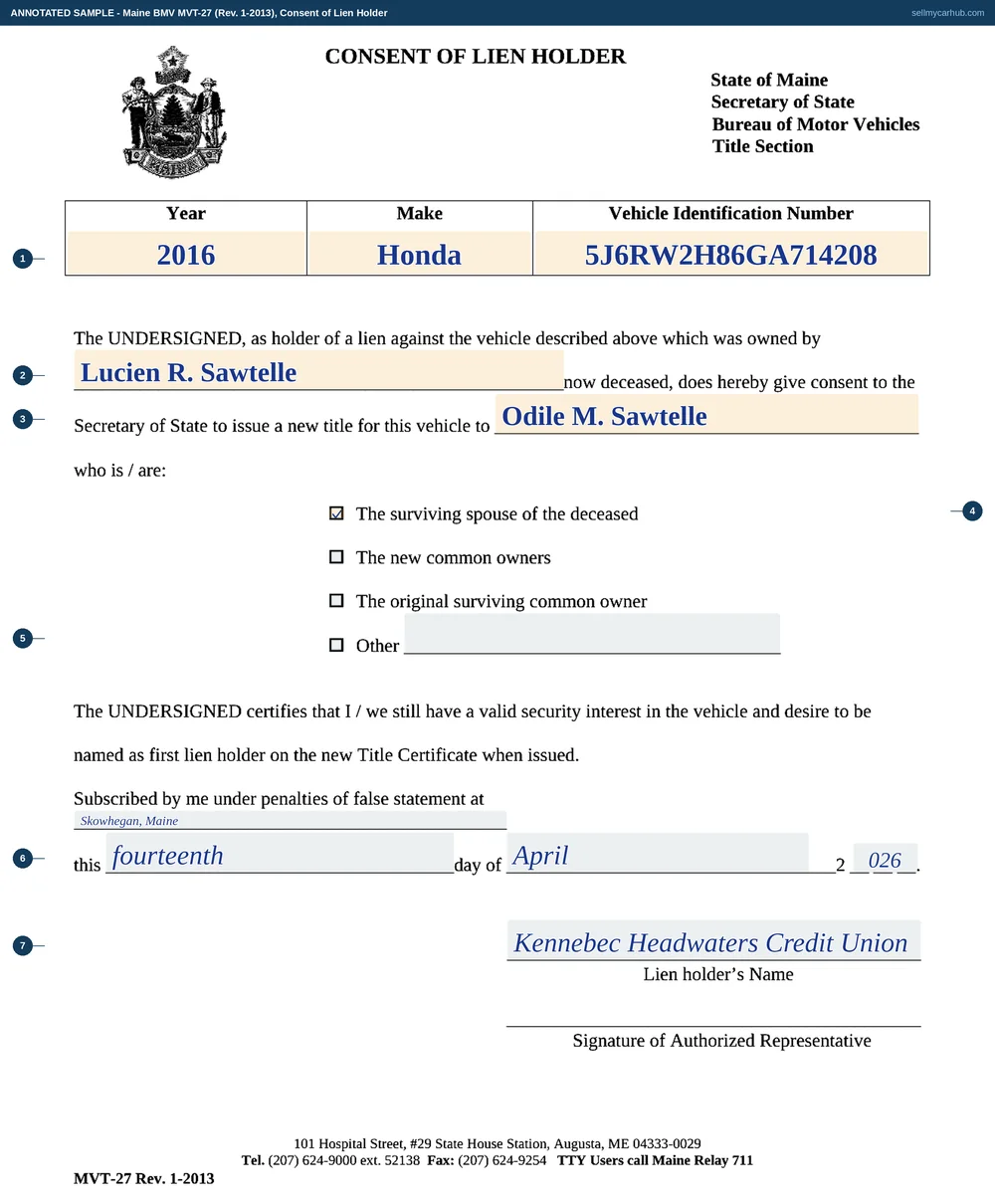
This is the actual MVT-27, rendered from the PDF the Maine Bureau of Motor Vehicles publishes and completed end to end: letterhead, every field, and the blocks at the foot.
The three boxes along the top edge take the year, the make and the identification number.
Watch out: There is no title number box on this form, so the identification number is the only handle the Bureau has. Copy it from the certificate.
Written into the printed sentence, ahead of the words now deceased.
Watch out: Use the name exactly as the face of the certificate prints it, not the name on the death certificate if the two differ. This form is matched against the title record.
The survivor or survivors, in the second half of the same sentence.
Watch out: This has to be the same person the accompanying affidavit names. Two documents naming two spellings of one person is a fortnight's delay.
Surviving spouse, new common owners, original surviving common owner, or Other with an explanation.
Watch out: Read the front of the certificate before ticking. Whether it says joint ownership decides between two of these boxes and the difference is not cosmetic.
Where it was subscribed and the day, month and year.
Watch out: The year is printed as a 2 followed by three blanks, so only the last three digits are written in. It catches people out every time.
The institution's name, then the signature of an authorized representative.
Watch out: The certification above the signature is that the lender still has a valid security interest and wants to be first lienholder on the new certificate. If neither is true, the lender should be releasing instead.
| On the form | What to put in it |
|---|---|
| The vehicle | Year, make and vehicle identification number, in three boxes across the top. |
| The deceased | A name written into the middle of a printed sentence, followed by the words now deceased. |
| Who the new title goes to | A second name in the same sentence, then four tick boxes describing who that person is: the surviving spouse of the deceased, the new common owners, the original surviving common owner, or Other with a line to explain. |
| The certification | Printed: the undersigned certifies that I or we still have a valid security interest in the vehicle and desire to be named as first lien holder on the new title certificate when issued. |
| Subscribed clause | A place and a date, written as this day of, with the year printed as a 2 followed by three blanks. |
| Signatures | The lien holder's name and the signature of an authorized representative. |
Every line here was read off MVT-27 (Rev 1-2013) itself — the PDF is here — and off the Maine Bureau of Motor Vehicles pages. This is plain-language help with a form, not legal advice, and where our wording and the agency's differ, theirs governs.
Back to all Maine seller paperwork, or what selling a car in Maine involves.