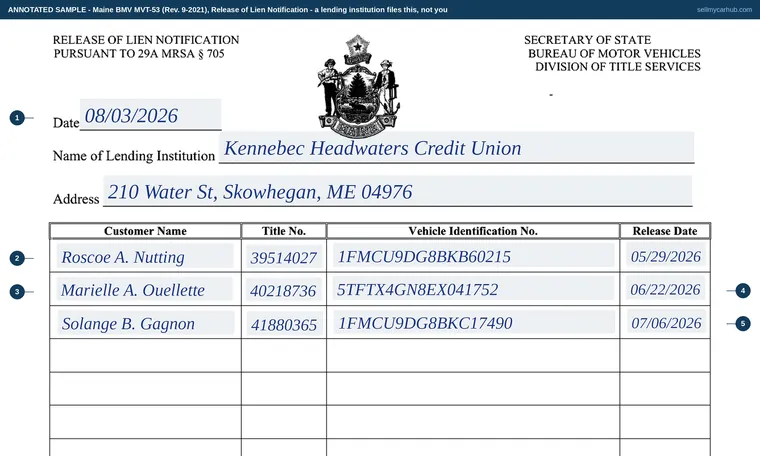
Not a form you will ever sign, and worth two minutes anyway, because it explains something that puzzles Maine sellers: you paid off the loan, no release ever arrived, and the clear title turned up in the post regardless. This is why. A lending institution can discharge a batch of liens on one sheet by writing to the Secretary of State under section 705, listing each customer, title number, vehicle identification number and release date on its own row. Your loan is one line in somebody else's table.
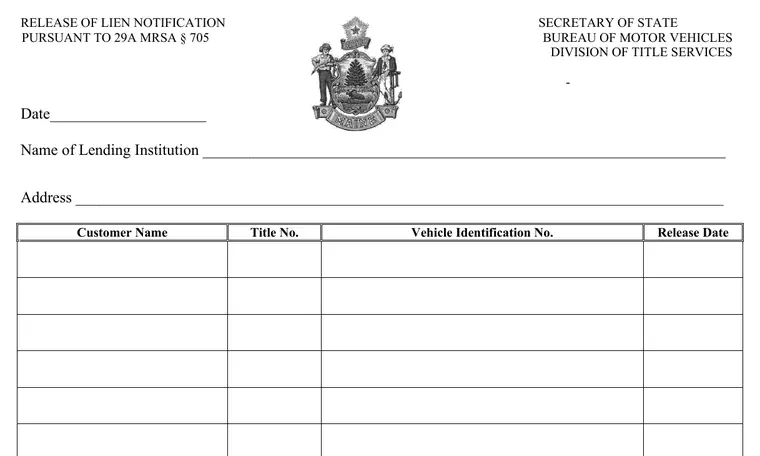
Written against MVT-53 (Rev 9-2021), issued under 29-A M.R.S. section 705. If your lender tells you it has already notified the Secretary of State, ask which route: a release on the face of the certificate is in your hands now, and a line on a notification like this one is somewhere in a queue in Augusta. Only one of the two lets a buyer pay you this week.
Two documents, and they are not the same thing. Take the blank MVT-53 from the maine.gov copy so you get the revision that is current today, then print our MVT-53 guide and keep it beside you while you fill theirs in.
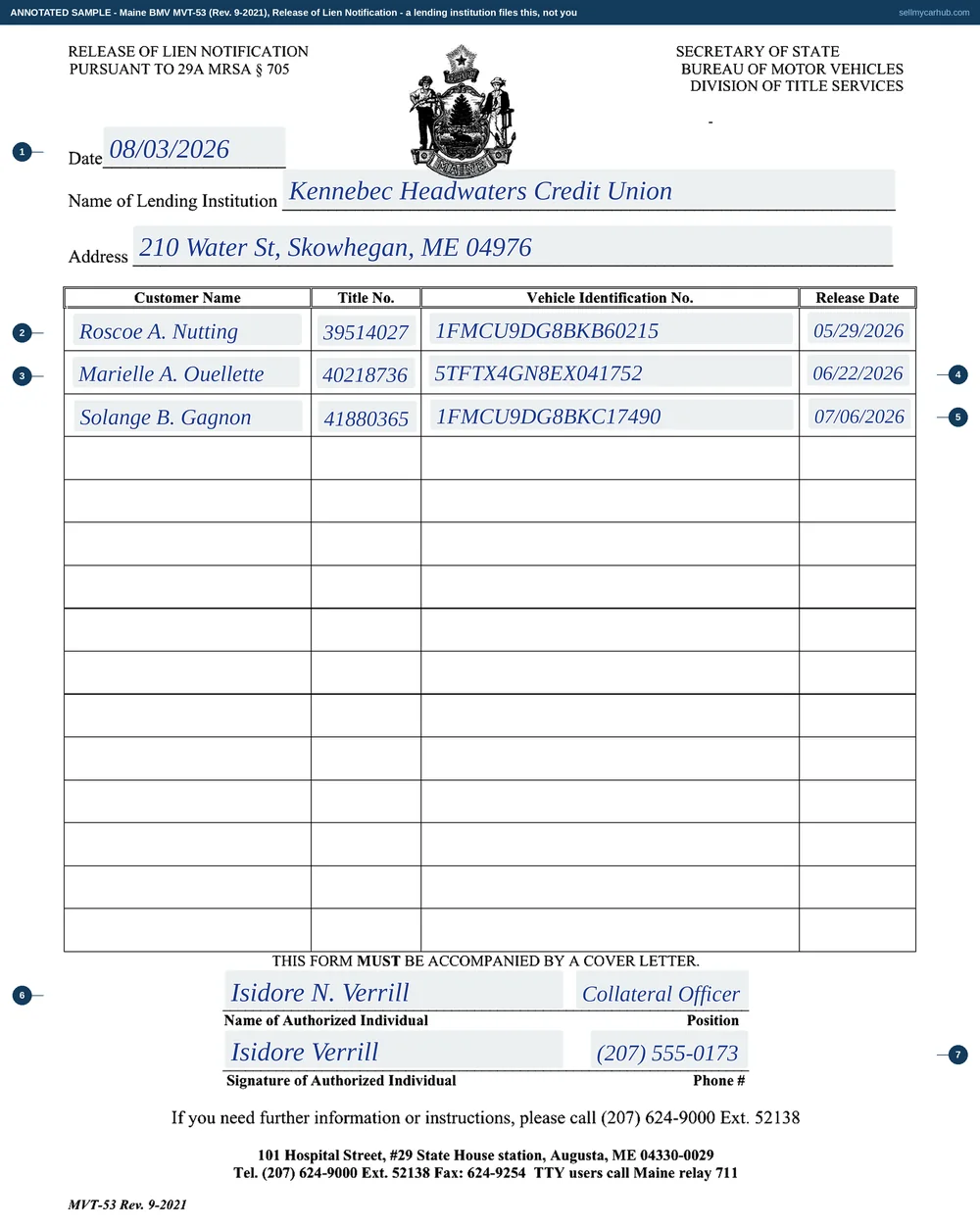
This is the actual MVT-53, rendered from the PDF the Maine Bureau of Motor Vehicles publishes and completed end to end: letterhead, every field, and the blocks at the foot.
The date of the notification, then the lending institution's name and address.
Watch out: A branch name here rather than the institution's is the version that comes back, because the Bureau matches the notifier against the lienholder printed on each certificate.
First column of the table, one row per released loan.
Watch out: It is the borrower's name, which is not always the same as every name printed on the certificate. Where a Maine title names two owners, only one of them may be on the loan.
Second column, off the face of the certificate.
Watch out: This is the key to the whole row. A wrong digit here releases nothing and nobody finds out until a sale falls over.
Third column, seventeen characters for anything modern.
Watch out: It is the cross-check against the title number. Where the two disagree the Bureau stops rather than guessing which is right.
Fourth column, the day that particular security interest ended.
Watch out: Each row carries its own date. A single date typed across a whole batch is a sign the sheet was filled in from a spreadsheet rather than from the loan records.
A separate letter, which the form demands in printed capitals.
Watch out: There is nowhere on the sheet to write it, which is why it is forgotten. The notification is returned without one.
Four lanes at the foot for the authorised individual.
Watch out: The telephone number is the working part. It is how Augusta resolves a row it cannot match, and a blank there turns a query into a returned form.
| On the form | What to put in it |
|---|---|
| Date | One line at the top, the date of the notification itself. |
| Name of lending institution | The institution, not a branch and not an officer. |
| Address | One line, the institution's. |
| The table | Four columns repeated down the page - customer name, title number, vehicle identification number, release date - so one letter clears many loans at once. |
| Cover letter | The form prints its own requirement in capitals across the middle: this form must be accompanied by a cover letter. It is not optional and it is not on the sheet. |
| Authorized individual | Printed name, position, signature and a telephone number, in four lanes at the foot. |
Every line here was read off MVT-53 (Rev 9-2021) itself — the PDF is here — and off the Maine Bureau of Motor Vehicles pages. This is plain-language help with a form, not legal advice, and where our wording and the agency's differ, theirs governs.
Back to all Maine seller paperwork, or what selling a car in Maine involves.