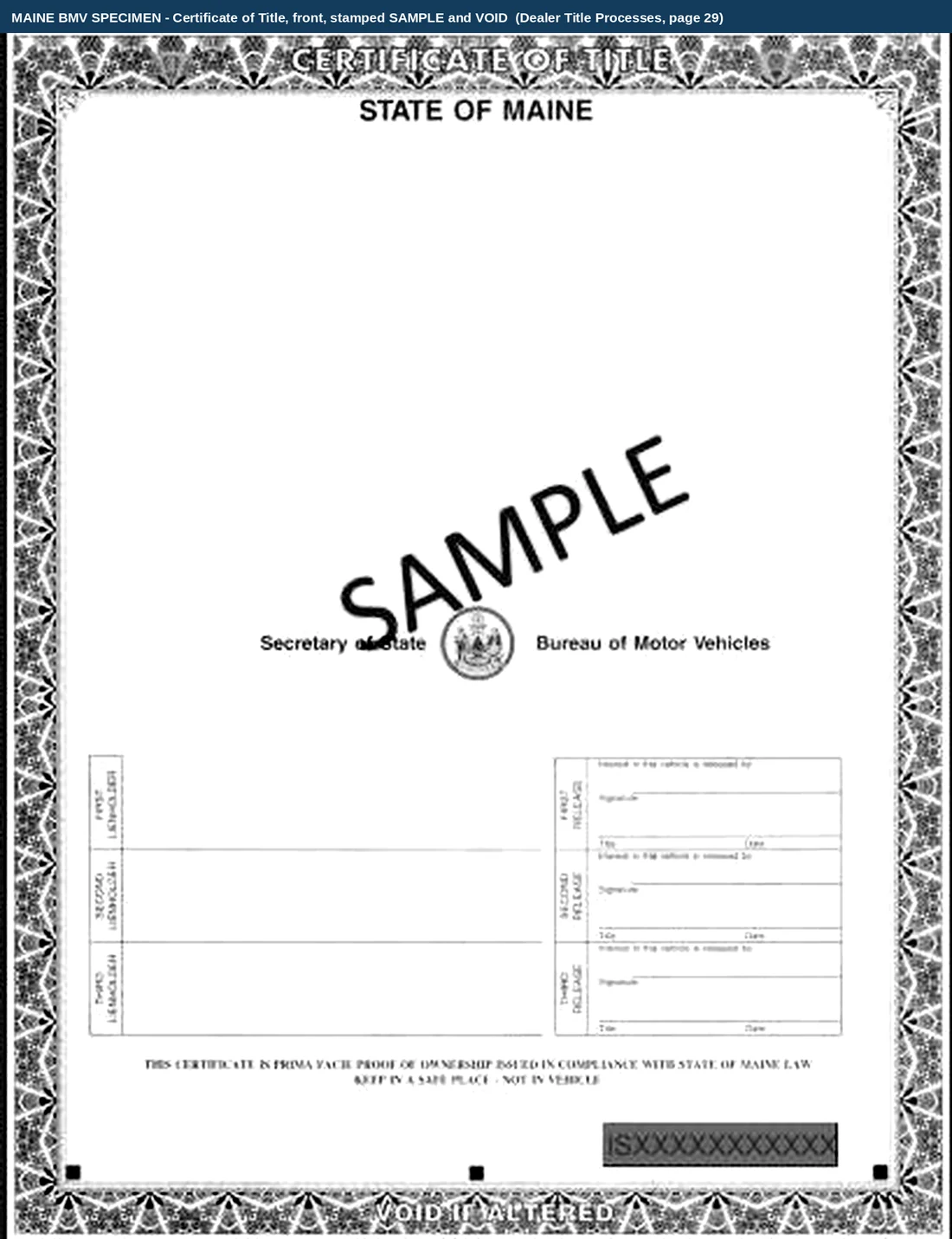
Maine puts the whole private transfer in the top third of the reverse, in one block headed ASSIGNMENT OF OWNERSHIP. Eight printed rows, one green-highlighted blank for the mileage, two caution boxes and a line for the buyer at the foot. Everything below that block belongs to somebody else. The pictures on this page are the Bureau's own: it publishes both faces of the current certificate inside the deck it gives to licensed Maine dealers, the front stamped SAMPLE and VOID and the reverse entirely blank, so nothing here is a member of the public's document.
Last updated .
Your 10 boxes
As a private seller you complete these and nothing else:
There is no blank Maine title to download, and there never will be - the assignment is printed on the certificate the Division of Title Services posted to you, on security stock, and the Bureau does not publish a printable version of it. What it does publish is a picture of both faces inside the deck it gives to licensed dealers, and that is what this walkthrough is built on.
ANY FALSE STATEMENT IS A CRIMINAL OFFENSE. ANY CHANGE OR ERASURE WILL VOID THIS TITLE.
Print the buyer's name the way their licence prints it, and print your own the way the front of the certificate prints yours. The block asks for your signature and your hand printed name in two separate lanes on the same row, and both of them are wanted - a signature with the printed lane left empty is the commonest thing sent back.
The Bureau's own SAMPLE certificate
Both faces of the current Maine certificate, published by the Bureau itself
This is the picture on page 29 of Dealer Title Processes, the deck the Bureau issues to licensed Maine dealers, under the heading Maine Certificate of Title Issued April 2019 to Current. The front is overprinted SAMPLE in red and VOID across the whole security tint, and where a real certificate carries a title number this one carries a row of X characters. Nothing on it is filled in and nobody's name appears on it.
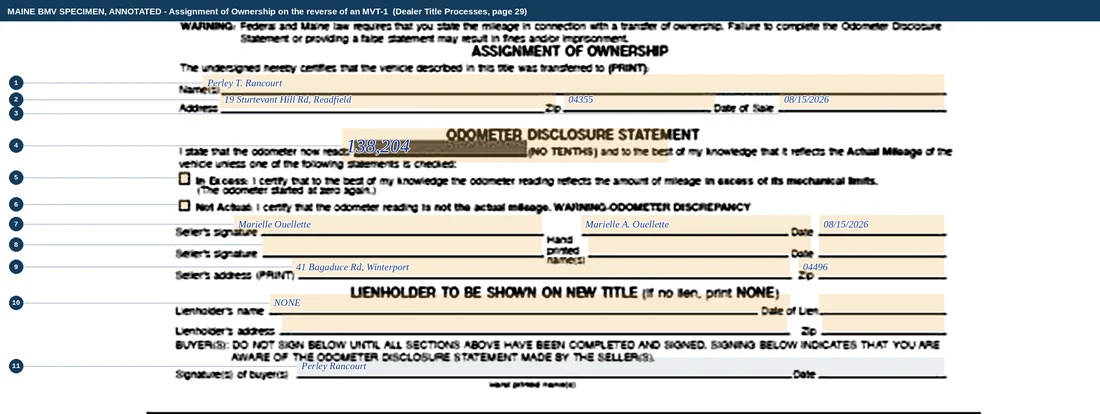
Amber — you write it, in pen
Grey — not yours to fill
Numbered — matches the steps below
Click or tap the picture to open it full size.
Nothing on this face is a seller's to write on, and one panel on it decides whether you can sell at all. The three LIENHOLDER rows at the lower left are where a lender is recorded, and the three RELEASE panels beside them are where that lender signs the interest away. If a lienholder is printed on your certificate and the release panel next to it is empty, the car is not yours to assign yet - and that release happens on this side of the sheet, not on the reverse where the sale does.
Eight printed rows and the whole transfer
Assignment of Ownership, filled in
The reverse of the same specimen, with our sample sale written into it. The amber lanes are the ones a seller works down; the green stripe across the odometer blank is the Bureau's own highlighter, marking the one figure it is most tired of chasing. The buyer's row at the foot is greyed because it is theirs, not yours.
Click or tap the picture to open it full size.
Look at the two caution boxes and leave them alone. The printed sentence above them already certifies the reading as the actual mileage unless one of them is ticked, so an untouched pair is the normal answer and not an omission. And look at the lienholder lane: the heading itself tells you what to write when there is no lender, and NONE written in is the difference between a clean transfer and a certificate the counter has to ask about.
Click or tap the picture to open it full size.
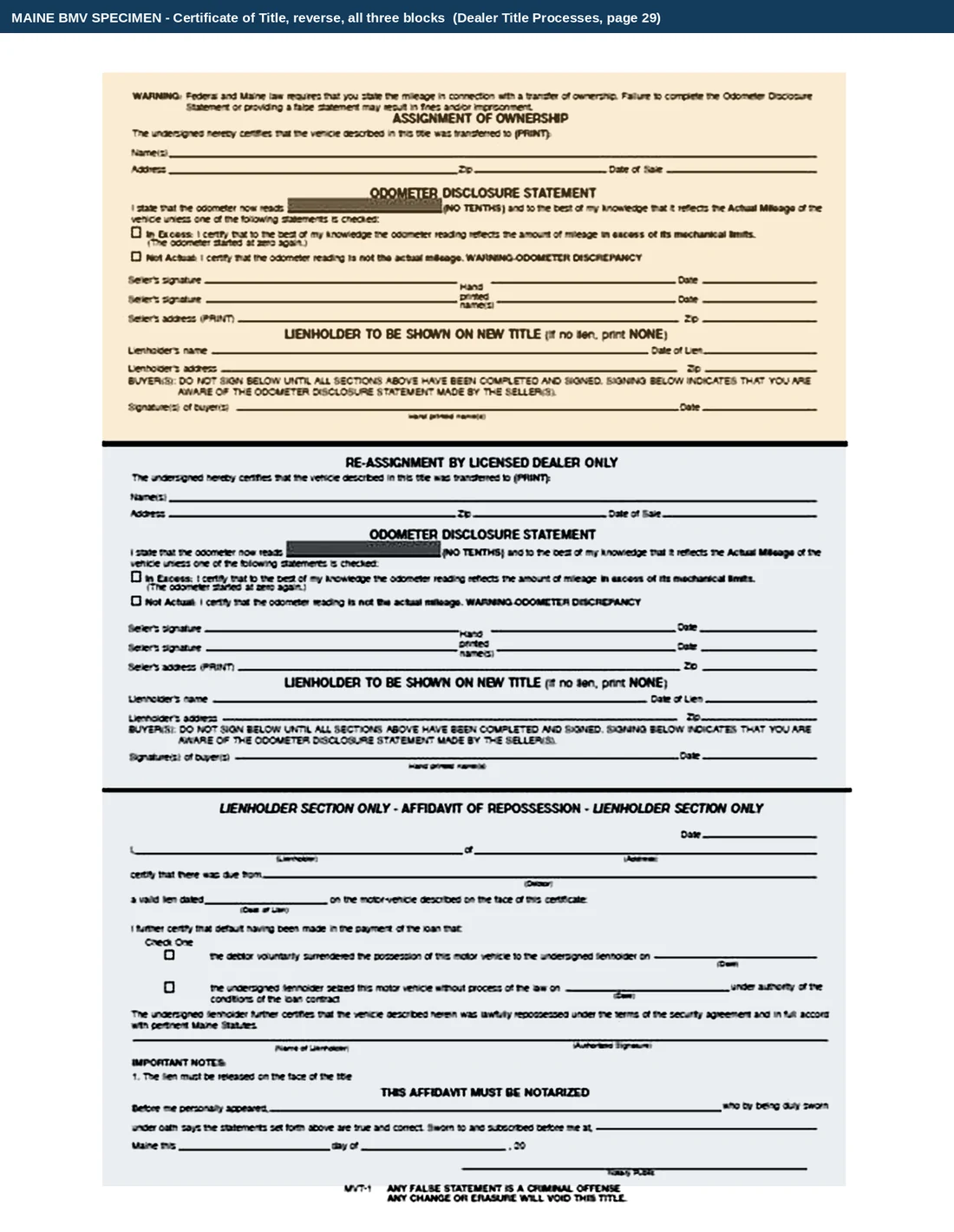
Two thirds of this side is not yours, and the middle block is the one that catches people. It is an exact copy of the assignment above it, same rows in the same order, and it is headed BY LICENSED DEALER ONLY. A seller who runs out of room in the top block and carries on into it has not found more space - they have written in a dealer's re-assignment, on a document whose own last line says any change or erasure will void it. The block at the foot is a lender's affidavit after a repossession, and it is the only place on a Maine title where a notary appears.
Before you watch. This one is addressed to buyers, not to sellers. Its own description, published by the department, reads “Before buying, do your research and learn to recognize the signs of fraud”, and it runs thirty-one seconds. It is here because the fraud it describes is the same transaction seen from the other side of the bonnet, and because a seller who knows what a cautious Maine buyer has been told to look for has an easier afternoon.
Thirty-one seconds, published by the Maine Department of the Secretary of State on 5 August 2026. Nothing loads from YouTube until you press play.
Step by step
Every box, in the order you meet it
1
You fill this in
Name(s) - the buyer, printed
The first rule under ASSIGNMENT OF OWNERSHIP. The printed sentence above it reads that the vehicle described in this title was transferred to, and then asks for it in capitals: PRINT.
Watch out: Take it from the licence in their hand rather than from whatever name the advert was answered under. If two people are buying together, both names go on this one rule - and both of them will have to sign at the foot of the block.
2
You fill this in
Address, and the Zip beside it
The buyer's street and town on the long rule, their zip in the short lane after the word Zip.
Watch out: This address and the name above it are what tie your odometer statement to a real person. A post-office box with no street behind it is what makes a counter clerk start asking questions.
3
You fill this in
Date of Sale
The short lane at the right-hand end of the same row.
Watch out: Use the day the money and the keys actually changed hands. It is the date the buyer's thirty-day clock runs from, and it is the date after which the car's behaviour stops being your problem under section 662.
4
You fill this in
The odometer blank, in whole miles
The blank inside ODOMETER DISCLOSURE STATEMENT - the one the Bureau has run a green highlighter across on its own specimen. The printed words NO TENTHS sit immediately after it.
Watch out: Whole miles, no decimal, no comma required but no tenths permitted. The statute says the same thing in its own words: the odometer reading at the time of transfer, not to include one tenth of miles.
5
You fill this in
In Excess: the odometer started at zero again
The first of two tick boxes underneath. It says the reading reflects mileage in excess of the odometer's mechanical limits.
Watch out: This is for a five-digit instrument that has rolled past 99,999 and begun again, and almost nothing sold in Maine today has one. Ticking it on a six-digit odometer that is simply showing a big number is a false statement on a document whose own footer calls that a criminal offence.
6
You fill this in
Not Actual: odometer discrepancy
The second box, printed beside the words WARNING-ODOMETER DISCREPANCY.
Watch out: Tick it if the number is wrong for any other reason - a replaced cluster, an instrument that stopped, miles you cannot vouch for. It brands the car for the rest of its life, and hiding the problem instead is worse: Maine also requires a notice on the left doorframe when an odometer has been reset, and leaving that off is a Class D crime.
7
You fill this in
Seller's signature, hand printed name, Date
Three lanes across one row: sign on the left, print the same name in the middle lane under the words Hand printed name(s), date it on the right.
Watch out: Sign it the way the front of the certificate prints your name. A married name over a maiden name on the face, or an initial where the record has a full middle name, is enough to have the assignment queried.
8
You fill this in
The second seller's row
An identical row underneath, for a second owner named on the front of the certificate.
Watch out: If the face of the title names two people, this row is not optional and neither is the printed name beside it. If it names one, leave the row empty - do not use it for the buyer.
9
You fill this in
Seller's address (PRINT), and Zip
Your own street and town, and your zip in the lane after it.
Watch out: Yours, not the buyer's. Two address rows on one block is exactly the trap it looks like, and writing the buyer's address twice is a correction that cannot be made without voiding the certificate.
10
You fill this in
Lienholder to be shown on new title
Two rows for a lender's name, date of lien, address and zip - under a heading that ends, in bold, with the words if no lien, print NONE.
Watch out: Write NONE. This block is about the buyer's lender rather than yours, and on a cash sale it is the answer. If the buyer is financing, their lender's details go here and the new certificate will be posted to the lender rather than to them.
11
The buyer fills this in
Signature(s) of buyer(s)
The last row of the block, with a Date lane at its end and the words hand printed name(s) printed underneath.
Watch out: Watch it happen before the car leaves. The printed line above that row tells the buyer not to sign until every section above has been completed and signed, and their signature is what records that they saw your mileage statement.
Before the pen
Six things to settle before the pen comes out
Six habits, and the first one exists because a Maine certificate says in print what happens if you scribble on it.
Check the model year first
If the car is model year 2000 or older on today's date, stop looking for a title. Maine has not issued one for it since the twenty-five-year line passed it, and the sale runs on the registration certificate and a bill of sale instead.
One attempt, in ink
The last printed line on the reverse says any change or erasure will void this title. There is no correction fluid answer and no initialled-in-the-margin answer - a spoiled certificate means $33 and a wait for a replacement.
Never leave the buyer's name off
An assignment with the top rule blank is an open title. It leaves a car that somebody else is driving still tied to your name in Augusta, and section 662 will not protect an owner who did not complete the assignment.
Sign and print, in two different lanes
The row has a signature rule, a hand printed name rule and a date lane. All three get ink. The printed name is the one people skip and it is the one the counter checks against the front of the certificate.
Write NONE where there is no lender
The lienholder heading asks for it in as many words. An empty lane there is an unanswered question rather than an answer.
Stay out of the two blocks below
They are headed RE-ASSIGNMENT BY LICENSED DEALER ONLY and LIENHOLDER SECTION ONLY. Both are exact copies of rows you have just filled in above, which is precisely why people wander into them.
Three things said with total confidence about selling a car in Maine. Each is wrong, each has the State's own source under it, and each of them costs somebody either a wasted trip to Augusta, a plate they should not still be holding, or tax they never owed.
"Leave the plates on for the buyer, they can sort it out at the town office."
They cannot, and you should not. Maine registration expires the moment the owner transfers title or interest in the vehicle, so from the handshake onward those plates are backing nothing at all. They are also not yours to give away: section 463 opens with the flat statement that registration plates issued by the Secretary of State continue to be the property of the State. Take them off. Move them onto your next vehicle for an $8 transfer fee, or - if you have no intention to renew or transfer inside six months - post them to Augusta with the registration certificate, which is what the same section tells you to do.
"Download the title application, fill it in for them, and it's done in one trip."
There is nothing to download. The Bureau answers this one itself in its title FAQ: the MVT-2 is a carbon copy form and can only be found at your local BMV branch, town hall or municipal office. The same is true of two more forms a seller can end up needing - the MVT-16 transfer sheet used when the back of the certificate cannot be used, and the MVT-102 salvage application. All three exist only on paper, in multi-part sets, and the way to get one without a counter visit is to order it from the stockroom in Augusta on an MVT-44.
"Sell to somebody from New Hampshire and they still owe Maine the 5.5%."
Not if the car leaves. Maine Revenue Services is explicit that Maine sales tax does not apply to a motor vehicle purchased in Maine by a person who is not a Maine resident, if the vehicle is intended to be driven or transported outside the State immediately upon delivery by the seller. The catch is the return trip rather than the sale: if the vehicle comes back to Maine within twelve months of the purchase date, whoever registers it may be liable for use tax on the original purchase price. Nothing about that is yours to collect or to police - the tax is charged to the buyer at registration, not to you.
Six rules about who signs the reverse, and only two of the signatures on it are yours:
Every owner named on the front of the certificate
The block prints two seller's signature rows for that reason. If the face of the title names two people, both rows get used and both names get hand printed beside them.
Signature in one lane, hand printed name in the next
They are two separate printed rules with the words Hand printed name(s) between them, and the Bureau wants ink in both. This is not a formality anyone waives.
The buyer, on the last row of the block only
Their signature goes under a printed instruction telling them not to sign until everything above is complete. They do not touch the odometer boxes and they do not sign anywhere else on the sheet.
The lienholder line, even when there is no lienholder
The heading is LIENHOLDER TO BE SHOWN ON NEW TITLE (if no lien, print NONE). A blank there reads as unanswered rather than as none.
Nobody, in either of the two blocks underneath
One is headed RE-ASSIGNMENT BY LICENSED DEALER ONLY and the other LIENHOLDER SECTION ONLY. A private sale uses the top block and only the top block.
No notary, anywhere in the assignment
The only notary printed on the reverse is inside the lienholder's repossession affidavit at the foot of the sheet. If someone tells you a Maine title has to be sworn, they are looking at that block.
Once it is signed
Filling in the assignment is the whole of your legal duty in Maine. What is left is the part nobody writes down: the plates in your hand are the State's, and the fee you paid for them can follow you onto the next car.