Sell My Car Hub

How to fill out Maine MVT-32

The standalone odometer statement, and the form the Bureau's own duplicate-title application points at the moment a reading stops being straightforward. Its first printed instruction is the one that surprises people: this form may be required even though the Application for Certificate of Title provides for odometer information. Where a Maine dealer sold the vehicle the dealer signs it; otherwise the current owner does, which on a private sale is you.
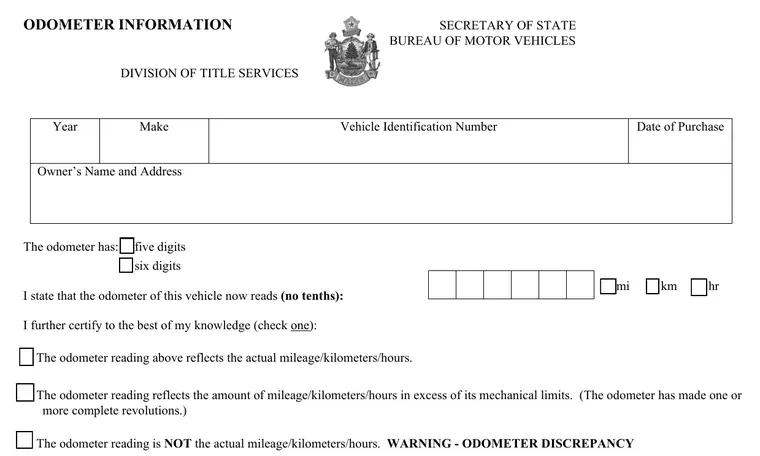
Written against MVT-32 (Rev 9-2021), issued under 29-A M.R.S. sections 752 and 752-A. The Bureau draws this form's revision line below the bottom edge of the page, so it is visible on a printed sheet and invisible to anything reading the file itself. The revision quoted above had to be recovered from the page's own drawing instructions rather than from its footer, which is a small warning about trusting any automated summary of a Maine form.

Two documents, and they are not the same thing. Take the blank MVT-32 from the maine.gov copy so you get the revision that is current today, then print our MVT-32 guide and keep it beside you while you fill theirs in.

Filled in

What a completed one looks like

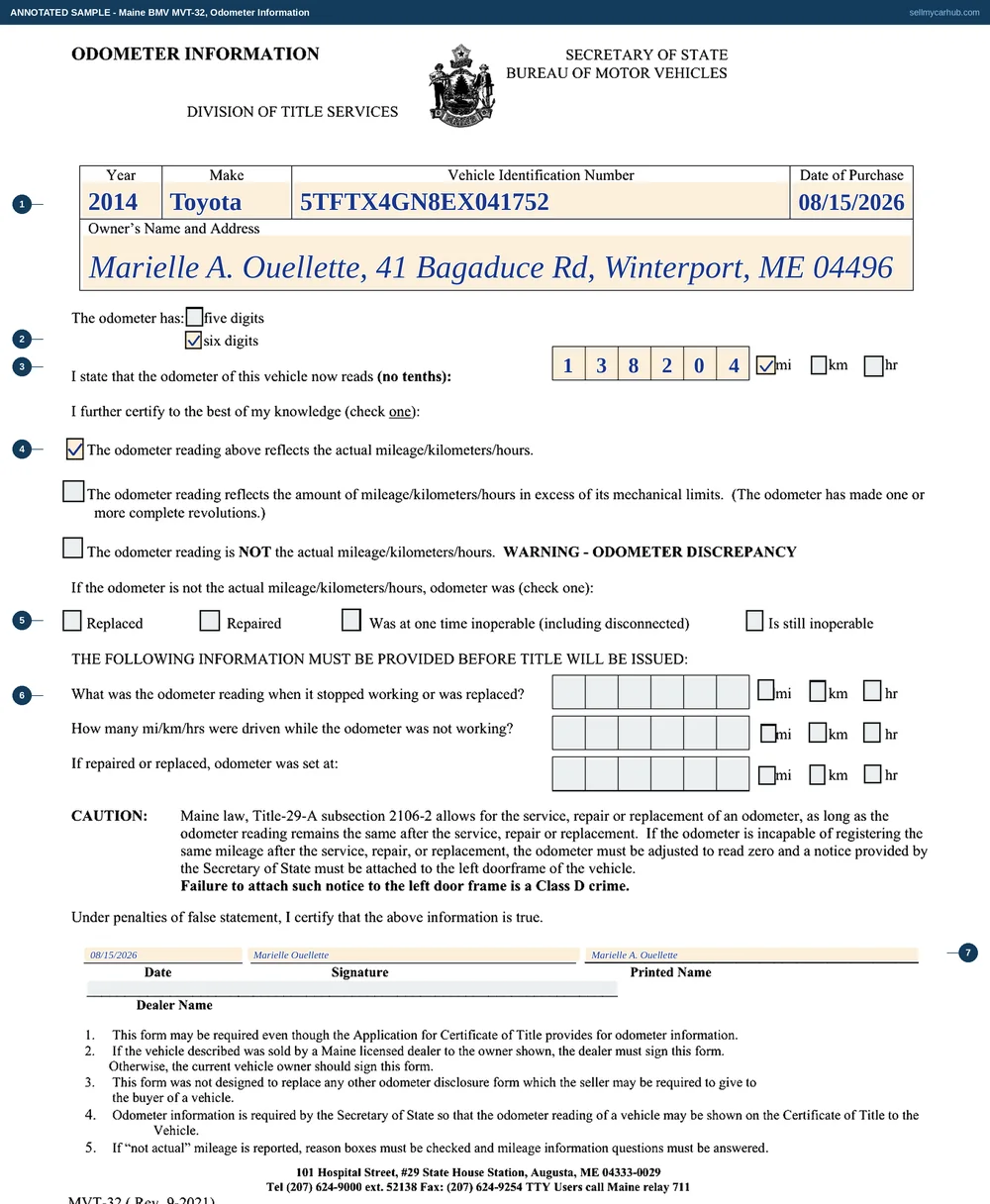
This is the actual MVT-32, rendered from the PDF the Maine Bureau of Motor Vehicles publishes and completed end to end: letterhead, every field, and the blocks at the foot.

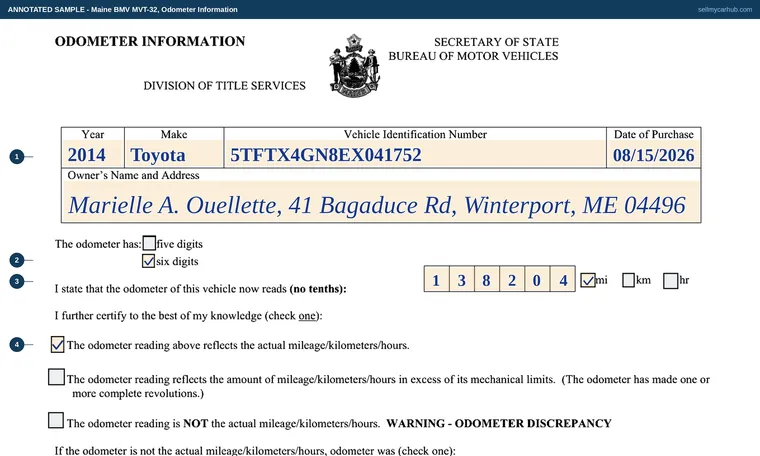
The Maine MVT-32 Odometer Information form filled in as an annotated sample for a 2014 Toyota Tacoma. The six-digit box is ticked, the reading is 138,204 with the miles unit selected, and the certification that the reading reflects the actual mileage is the one ticked. The replaced, repaired and inoperable boxes and the three follow-up questions below them are greyed out as blocks that only a not-actual reading fills in, and Marielle A. Ouellette has signed and printed her name with the dealer line left empty.
Most of the lower half of this form is greyed here on purpose. Those boxes exist for a reading that is not the actual mileage, and the Bureau's own instruction is that if not actual is reported, the reason boxes must be checked and the mileage information questions must be answered - all of them, not one.
Field by field

Every line, in the order you meet it

  1. 1
    You fill this in

    The vehicle and the date of purchase

    Year, make, vehicle identification number and the date of purchase, then your name and address.

    Watch out: Date of purchase means the date this transfer happened, not the day you bought the car years ago. It anchors the reading to a moment.

  2. 2
    You fill this in

    Five digits or six

    Tick which the instrument has.

    Watch out: Count the wheels, not the number showing. A five-digit odometer reading 38,204 on a fifteen-year-old truck is a very different claim from a six-digit one.

  3. 3
    You fill this in

    The reading

    The figure with no tenths, and a tick for miles, kilometres or hours.

    Watch out: Hours is there for equipment rather than cars, and kilometres for a vehicle that came over the border. Ticking the wrong one changes the number by a factor of about one and a half.

  4. 4
    You fill this in

    Certify what the reading is

    One of three: actual mileage, in excess of its mechanical limits, or not the actual mileage.

    Watch out: In excess of its mechanical limits means the instrument has rolled over. It is not a polite way of saying the number is unreliable, and the Bureau reads it literally.

  5. 5
    You fill this in

    If it is not actual, say what happened

    Replaced, repaired, was at one time inoperable including disconnected, or is still inoperable.

    Watch out: This is the box people skip when they have already ticked not actual. The two go together and the form is returned without it.

  6. 6
    You fill this in

    The three follow-up questions

    The reading when it stopped or was replaced, the distance covered while it was not working, and what the replacement was set at.

    Watch out: The heading over them says this information must be provided before title will be issued. A guess here is worse than a blank, because a guess is a certified statement.

  7. 7
    You fill this in

    Date, sign, print

    All three, under penalties of false statement.

    Watch out: Leave the dealer name line empty on a private sale. It exists only for a vehicle a Maine licensed dealer sold to the owner named above, and the dealer signs the form in that case rather than you.

At a glance

What goes where

On the formWhat to put in it
The vehicleYear, make, vehicle identification number and date of purchase, then the owner's name and address.
The odometer hasFive digits or six. This is not trivia - it decides at what reading the instrument rolls over, and the answer changes what the mileage means.
The readingOne figure with no tenths, and a choice of unit: miles, kilometres or hours.
The three-way certificationThe reading reflects the actual mileage; or it reflects the amount in excess of its mechanical limits, glossed on the form as the odometer having made one or more complete revolutions; or it is NOT the actual mileage, which prints WARNING - ODOMETER DISCREPANCY beside it.
If it is not actual, what happenedReplaced, repaired, was at one time inoperable including disconnected, or is still inoperable.
The three follow-up questionsThe Bureau prints these under the heading that the following information must be provided before title will be issued: the reading when it stopped working or was replaced, how many miles or kilometres or hours were driven while it was not working, and what the replacement was set at.
Signature blockDate, signature and printed name, under a certification given under penalties of false statement. A dealer name line sits underneath for the case where a licensed dealer is the one signing.

What gets this one rejected

Rules that decide whether it is accepted

Every line here was read off MVT-32 (Rev 9-2021) itself — the PDF is here — and off the Maine Bureau of Motor Vehicles pages. This is plain-language help with a form, not legal advice, and where our wording and the agency's differ, theirs governs.

Back to all Maine seller paperwork, or what selling a car in Maine involves.

Want the paperwork handled instead?

Get My Instant Offer → Online · about 2 minutes · free

Or send the details — we'll come to you

An odometer that has been apart is a conversation with every buyer who turns up. Tell us the reading and the story and we will price it once.

or call/text (877) 405-1808