Sell My Car Hub

How to fill out Maine MVT-5

The lender's sworn statement that it has taken a vehicle back, and the document that stops a repossessed car from being untitleable afterwards. It is in this section because a Maine seller can be on the wrong end of it - the car is gone, the loan is not, and the paperwork that follows is somebody else's to complete. The form is explicit about who it belongs to: it says the affidavit is for use by lending institutions when a vehicle is repossessed.
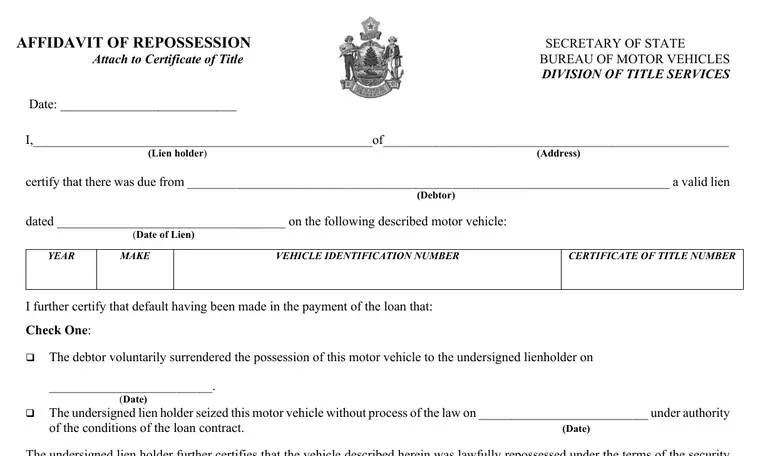
Written against MVT-5 (Rev 9/2021), issued under 29-A M.R.S. section 666. If your car has been repossessed, this affidavit is the paperwork that lets somebody else be titled as its owner, and it is completed without your signature anywhere on it. Voluntary surrender and seizure are both provided for, and which box is ticked is a fact about your file rather than about your consent.

Two documents, and they are not the same thing. Take the blank MVT-5 from the maine.gov copy so you get the revision that is current today, then print our MVT-5 guide and keep it beside you while you fill theirs in.

Filled in

What a completed one looks like

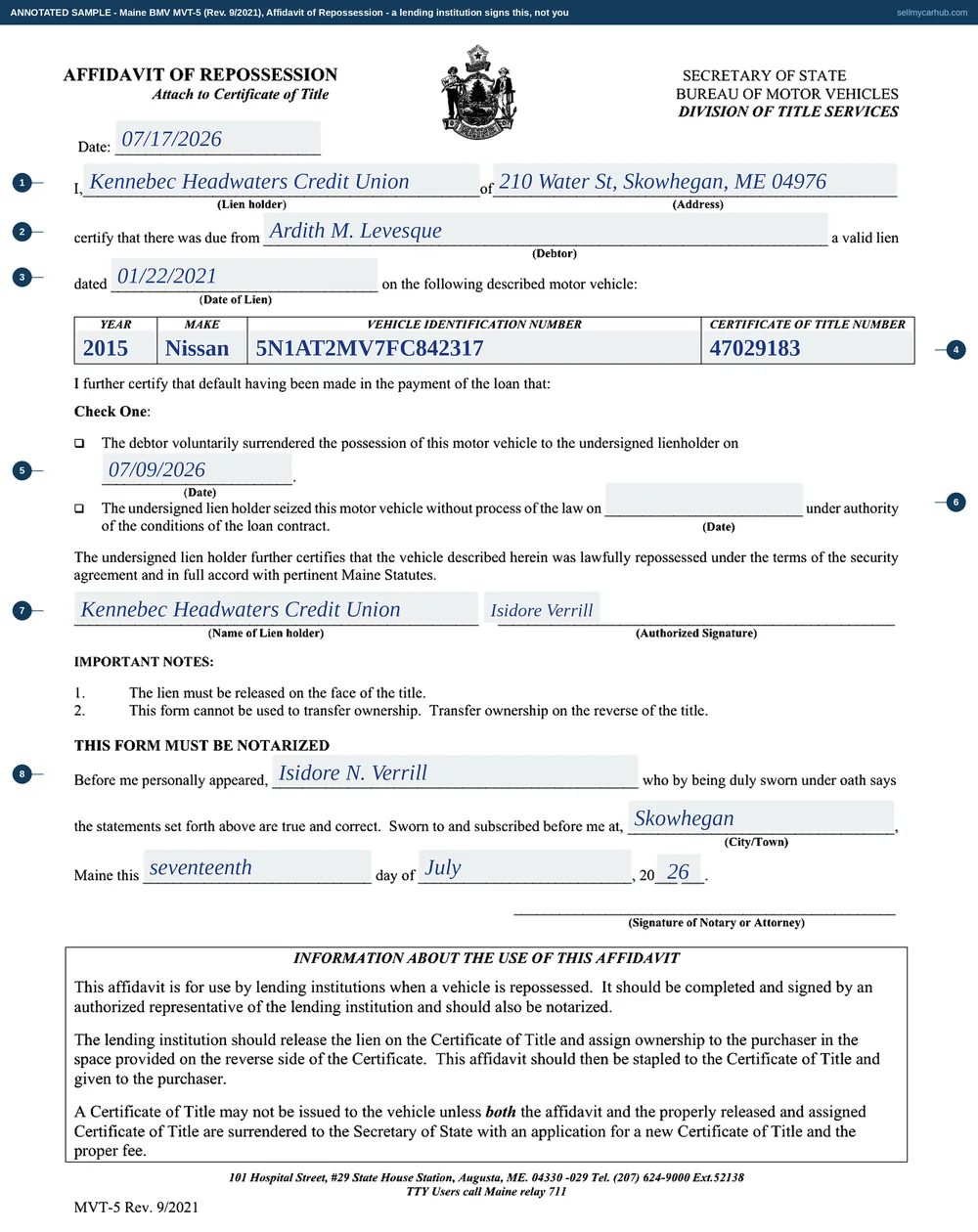
This is the actual MVT-5, rendered from the PDF the Maine Bureau of Motor Vehicles publishes and completed end to end: letterhead, every field, and the blocks at the foot.

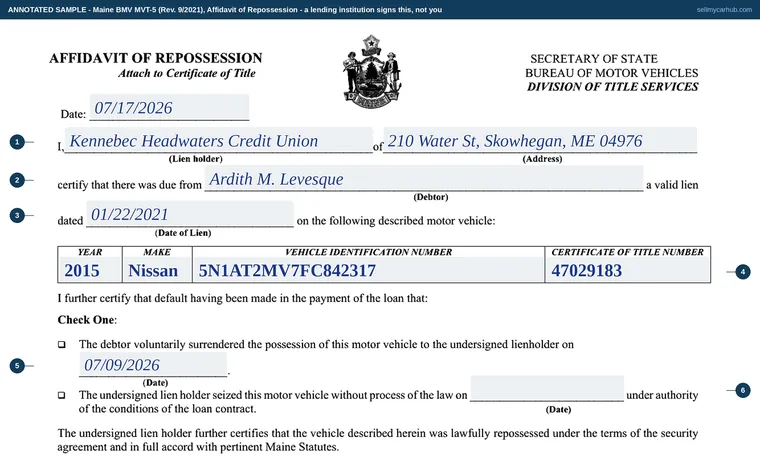
The Maine MVT-5 Affidavit of Repossession filled in as an annotated sample. Kennebec Headwaters Credit Union of Skowhegan certifies a valid lien against Ardith M. Levesque dated January 2021 on a 2015 Nissan Rogue with its vehicle identification number and certificate of title number. The date beside the voluntary surrender wording is completed and the date beside the seizure wording is greyed out, and the notarisation at the foot carries the appearer, the town, the day, the month and the year.
The two squares in the middle of this sheet carry no fillable box, so the sample makes the choice visible in the only place it can: the date lane under the voluntary surrender wording is completed and the one beside the seizure wording is greyed. The alternative reads seized without process of the law under authority of the conditions of the loan contract, and it is the harsher of the two.
Field by field

Every line, in the order you meet it

  1. 1
    The lienholder fills this in

    Date and lienholder

    The date, then the institution's name and address in the opening sentence.

    Watch out: The sentence begins with I rather than with the institution's name, which is why the authorised signature lower down matters more than it looks.

  2. 2
    The lienholder fills this in

    Name the debtor

    The person the lien was due from.

    Watch out: This is the name on the loan, which on a two-owner Maine certificate may be only one of the two names printed on the front.

  3. 3
    The lienholder fills this in

    Date of lien

    The date the lien itself was created, not the date it was paid.

    Watch out: Not the day of default and not the day of the repossession. Both of those have their own lanes further down the sheet.

  4. 4
    The lienholder fills this in

    The vehicle and its title number

    Year, make, vehicle identification number and certificate of title number.

    Watch out: The title number is on this form because the affidavit is stapled to the certificate itself, and the two are expected to agree.

  5. 5
    The lienholder fills this in

    Tick how possession was taken

    Either the debtor gave the vehicle up voluntarily, or the lender seized it without process of law - each with the date it happened.

    Watch out: Only one box, and the date beside it is part of the sworn statement rather than a formality.

  6. 6
    The lienholder fills this in

    Sign as an authorised representative

    The lien holder's name, then the authorised signature.

    Watch out: What is being certified is that the repossession was lawful under the security agreement and in full accord with Maine statutes. It is a bigger claim than it looks on the page.

  7. 7
    Somebody else fills this in

    Have it notarised

    A notary or attorney completes the block at the foot.

    Watch out: The requirement is printed in capitals and there is no waiver. An unnotarised affidavit stops the buyer being titled, not the lender being paid.

At a glance

What goes where

On the formWhat to put in it
DateOne line at the head of the sheet.
The lienholderName and address, written into a printed sentence beginning I certify.
The debtorThe name of the person the debt was due from, in the same sentence.
Date of lienThe day the security interest was created, not the day of the seizure.
The vehicleYear, make, vehicle identification number and certificate of title number in one row.
How possession was takenTwo boxes and one must be picked: the debtor voluntarily surrendered the possession of this motor vehicle to the undersigned lienholder on a stated date, or the undersigned lien holder seized this motor vehicle without process of the law on a stated date under authority of the conditions of the loan contract.
The lawfulness certificationPrinted: that the vehicle was lawfully repossessed under the terms of the security agreement and in full accord with pertinent Maine statutes.
SignaturesThe lien holder's name and an authorized signature.
NotarizationA full notary block. The form prints THIS FORM MUST BE NOTARIZED in capitals above it.

What gets this one rejected

Rules that decide whether it is accepted

Every line here was read off MVT-5 (Rev 9/2021) itself — the PDF is here — and off the Maine Bureau of Motor Vehicles pages. This is plain-language help with a form, not legal advice, and where our wording and the agency's differ, theirs governs.

Back to all Maine seller paperwork, or what selling a car in Maine involves.

Want the paperwork handled instead?

Get My Instant Offer → Online · about 2 minutes · free

Or send the details — we'll come to you

If a lender is circling and you would rather sell the car than lose it, tell us the payoff figure and we will tell you where you stand.

or call/text (877) 405-1808