Sell My Car Hub

How to fill out Louisiana DPSMV 1958

How to find out what the department actually holds on a vehicle. A seller reaches for it when the buyer has gone quiet and the car is still showing in their name, when a lien that was paid off years ago is still on the record, or when a certificate has been assigned twice and nobody can say what the last transaction was. It buys copies of the documents in the title file rather than a summary, which is the difference between knowing what happened and being told.
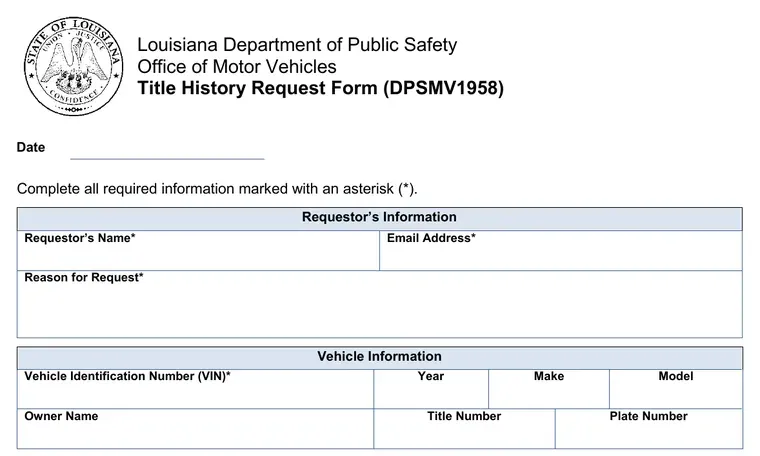
Written against DPSMV 1958 (no revision printed), issued under R.S. 32:709, indices and files kept by the commissioner. No revision is printed on this form either - the footer is a page number and nothing else. The fees quoted here are the ones printed on the sheet as published today, and they are the department's own figures rather than a schedule looked up somewhere else.

Two documents, and they are not the same thing. Take the blank DPSMV 1958 from the public.powerdms.com copy so you get the revision that is current today.

Filled in

What a completed one looks like

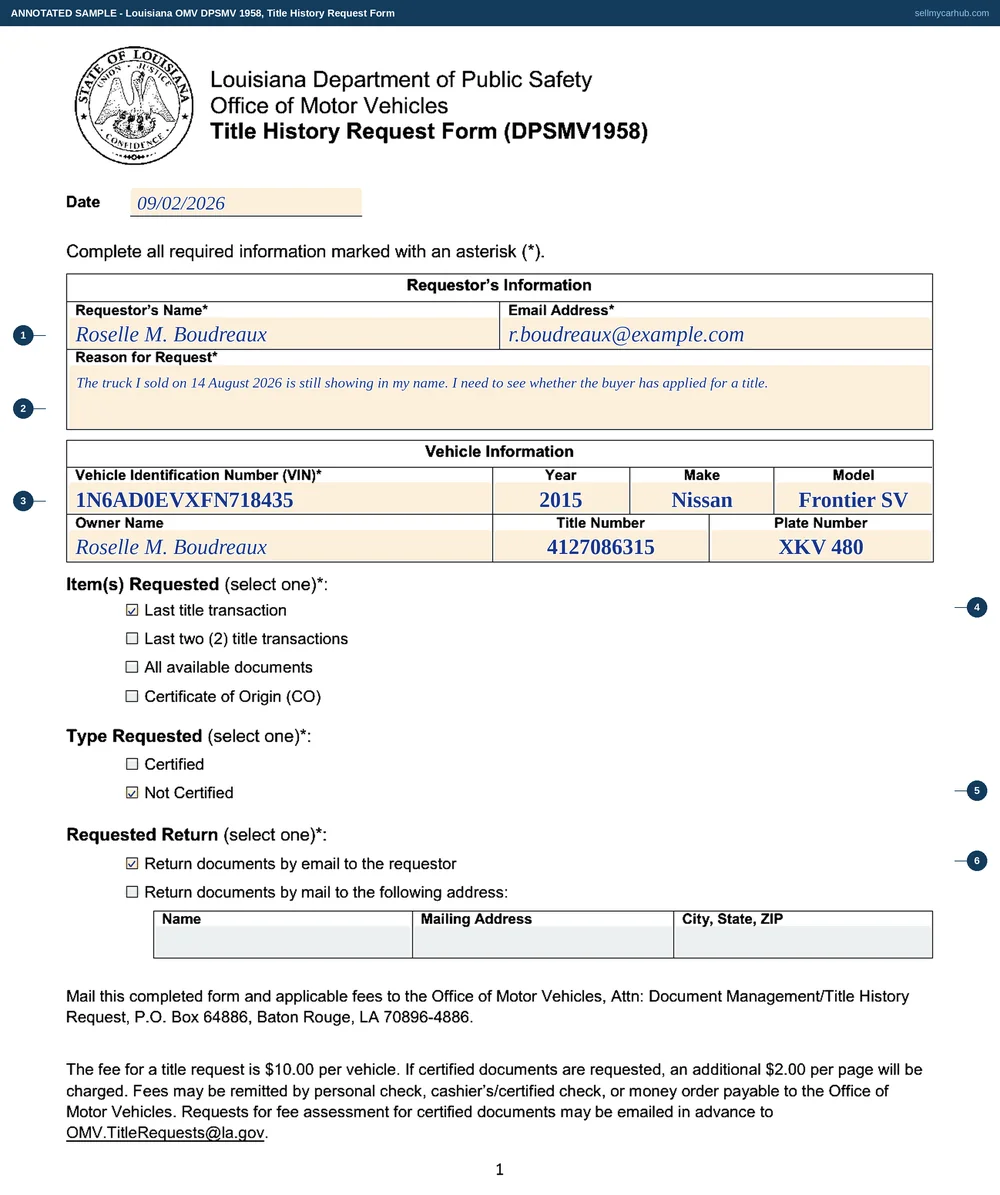
This is the actual DPSMV 1958, rendered from the PDF the Louisiana Office of Motor Vehicles publishes and completed end to end: letterhead, every field, and the blocks at the foot.

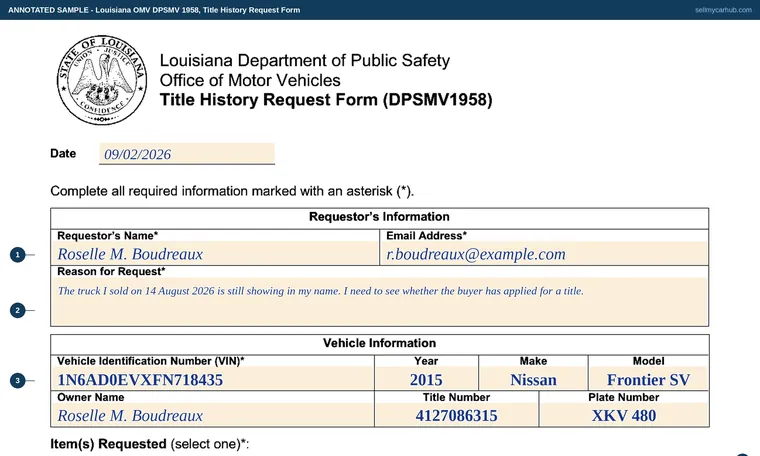
A Louisiana DPSMV 1958 title history request form filled in: requestor Roselle M. Boudreaux with an email address, a reason for request explaining that a truck sold on 14 August 2026 still shows in her name, VIN 1N6AD0EVXFN718435 for a 2015 Nissan Frontier SV, title number 4127086315, plate XKV 480, with Last title transaction, Not Certified and Return documents by email all ticked and the mail-to block greyed out.
The actual DPSMV 1958. Three sections that each say select one, and the mail-to block is greyed here because an email return was asked for - ticking both return methods is one of the easiest ways to have the form come back.
Field by field

Every line, in the order you meet it

  1. 1
    You fill this in

    Requestor's Name

    First box of the requestor block, marked with an asterisk.

    Watch out: Your own name, not the current owner's. You are asking for records about a vehicle rather than about a person, and the reason box below is where you explain your connection to it.

  2. 2
    You fill this in

    Reason for Request

    The deep box under the requestor's name and email, also asterisked.

    Watch out: Write the actual situation in plain words - sold on this date, buyer has not titled it, still showing on my record. A blank or a single word here is the most common reason one of these comes back.

  3. 3
    You fill this in

    Vehicle Identification Number (VIN)

    First box of the vehicle row, and the only part of that row that is required.

    Watch out: Year, make and model are optional but worth filling in anyway. A VIN with one character wrong plus a correct year and make is a record the department can still find; a wrong VIN on its own is not.

  4. 4
    You fill this in

    Last title transaction

    First of four ticks under Item(s) Requested.

    Watch out: This is the answer to did the buyer ever title it. All available documents is for a dispute or an inherited vehicle with a tangled history, and it costs the same flat fee but a great deal more in certification if you also ask for that.

  5. 5
    You fill this in

    Not Certified

    One of two ticks under Type Requested.

    Watch out: Certified copies cost $2.00 per page on top of the request fee. Unless something is going in front of a court or another state's agency, uncertified tells you exactly the same thing.

  6. 6
    You fill this in

    Return documents by email to the requestor

    First of two ticks under Requested Return, with a name and address block underneath for the other option.

    Watch out: Tick one, not both. If you choose email, leave the mail-to block empty; if you choose post, fill it in completely, because a partial address there reads as a contradiction rather than as a preference.

At a glance

What goes where

On the formWhat to put in it
DateTop of the sheet, above the requestor block.
Requestor's Name, Email AddressTwo boxes, both marked with an asterisk, and the sheet's instruction is to complete all required information marked with an asterisk.
Reason for RequestA deep free-text box, also required. It is not a formality - the department is releasing personal information out of a vehicle record, and the reason is what justifies it.
Vehicle Identification Number (VIN), Year, Make, ModelThe vehicle row. Only the VIN is required.
Owner Name, Title Number, Plate NumberA second row, none of it required, and all of it useful for narrowing a record down.
Item(s) RequestedFour ticks, select one: last title transaction, last two title transactions, all available documents, or certificate of origin.
Type RequestedTwo ticks, select one: certified or not certified.
Requested ReturnTwo ticks, select one: return documents by email to the requestor, or return documents by mail to an address, with name, mailing address and city, state and ZIP boxes underneath.
The fee paragraphAt the foot: the fee for a title request is $10.00 per vehicle, and if certified documents are requested, an additional $2.00 per page will be charged. Payment by personal check, cashier's or certified check, or money order payable to the Office of Motor Vehicles.

What gets this one rejected

Rules that decide whether it is accepted

Every line here was read off DPSMV 1958 (no revision printed) itself — the PDF is here — and off the Louisiana Office of Motor Vehicles pages. This is plain-language help with a form, not legal advice, and where our wording and the agency's differ, theirs governs.

Back to all Louisiana seller paperwork, or what selling a car in Louisiana involves.

Want the paperwork handled instead?

Get My Instant Offer → Online · about 2 minutes · free

Or send the details — we'll come to you

If the answer to what happened to my truck is a form, a fee and a wait, there is a shorter answer. Tell us about it.

or call/text (877) 405-1808