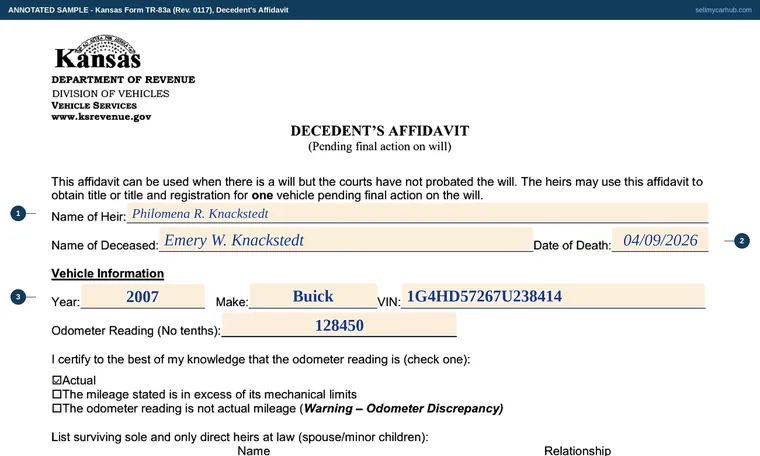
The middle door: a will exists but the courts have not probated it, and the family needs the car moving before the law finishes. The form's own header states its scope - the heirs may use this affidavit to obtain title, or title and registration, for one vehicle pending final action on the will. The affiant certifies heirship, lists the surviving sole and only direct heirs at law, claims the vehicle under K.S.A. 59-403 as exempt personal property if they are the surviving spouse, and - the sentence sellers should read twice - guarantees title to said vehicle to all subsequent purchasers.
Written against TR-83a (Rev. 0117), issued under K.S.A. 59-403. That guarantee sentence deserves a family meeting before anyone signs. The affiant is not just collecting a car - they are personally warranting its title to every later buyer, while a will nobody has probated yet says whatever it says. Where the family is agreed, this affidavit is mercifully quick; where it is not, the quick form is the wrong form.
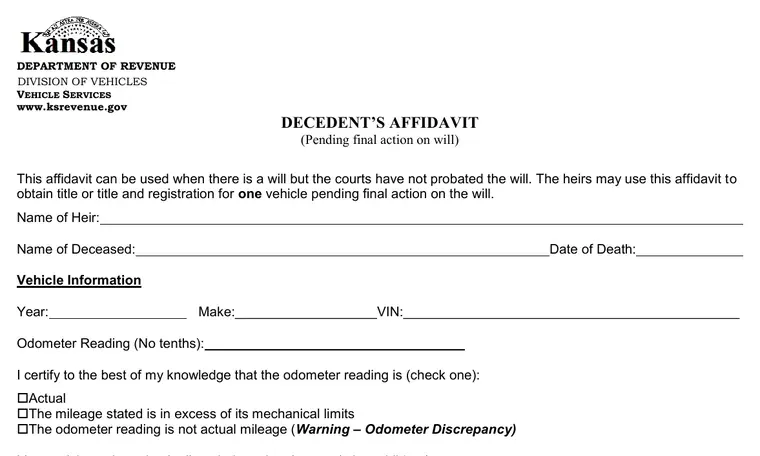
Two documents, and they are not the same thing. Take the blank TR-83a from the ksrevenue.gov copy so you get the revision that is current today, then print our TR-83a guide and keep it beside you while you fill theirs in.
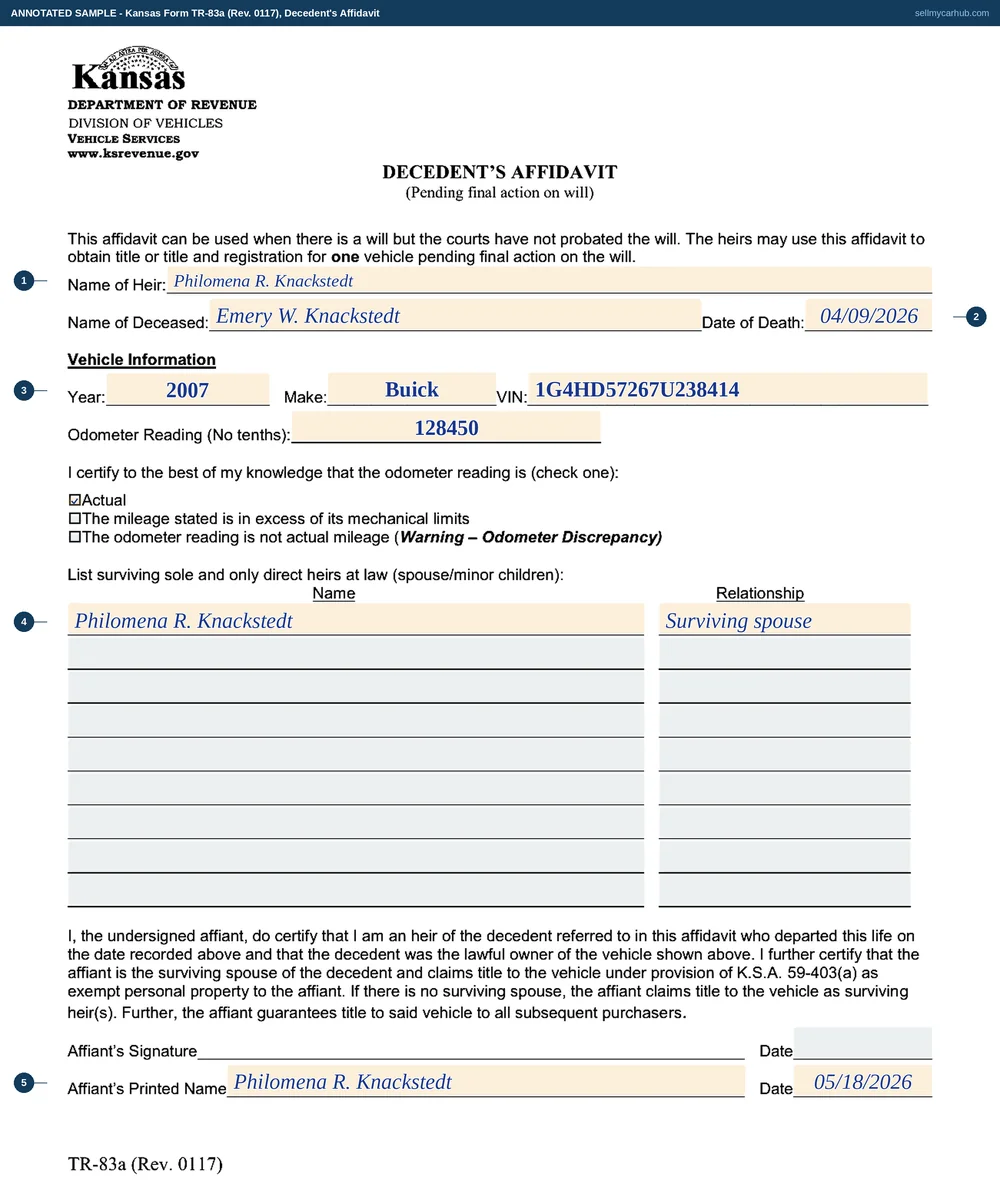
This is the actual TR-83a, rendered from the PDF the Kansas Department of Revenue, Division of Vehicles publishes and completed end to end: letterhead, every field, and the blocks at the foot.
Your name, the owner's name, and the date of death.
Watch out: This affidavit works alongside a will in waiting - if the estate is small and there is no will, compare the small-estates affidavit before choosing this door.
Year, make and VIN.
Watch out: The header limits the form to one vehicle pending final action on the will. A second car is a second conversation, possibly with the probate court.
Odometer with no tenths, and the honest box of the three.
Watch out: Model year 2010 or older vehicles are exempt at ten years under the Division's printed rule - but where the reading is entered, enter it from the dash, not from the last service sticker.
Name and relationship for every surviving direct heir - the form's parenthesis says spouse and minor children.
Watch out: Sole and only is the operative phrase and the sworn one. The table's nine rows are capacity, not a target.
The signature under the certification that claims the vehicle and guarantees title to all subsequent purchasers.
Watch out: Take it with the death certificate to the county treasurer's office. And keep the family consensus in writing - the guarantee is yours personally once the ink dries.
| On the form | What to put in it |
|---|---|
| Name of Heir, Name of Deceased, Date of Death | The three lines that frame the claim. |
| Vehicle Information | Year, make and VIN - one vehicle, which is all this affidavit can carry. |
| Odometer Reading | No tenths, with the three boxes: actual, in excess of mechanical limits, or not actual mileage with the printed odometer discrepancy warning. |
| The heirs table | Nine rows of name and relationship for the surviving sole and only direct heirs at law - the form's parenthesis says spouse and minor children. |
| The certification | The affiant certifies they are an heir, that the decedent was the lawful owner, that a surviving spouse claims under K.S.A. 59-403(a) as exempt personal property - or the surviving heirs claim if there is no spouse - and guarantees title to all subsequent purchasers. |
| Signature block | The affiant's signature and printed name, each with a date. |
Every line here was read off TR-83a (Rev. 0117) itself — the PDF is here — and off the Kansas Department of Revenue, Division of Vehicles pages. This is plain-language help with a form, not legal advice, and where our wording and the agency's differ, theirs governs.
Back to all Kansas seller paperwork, or what selling a car in Kansas involves.