Sell My Car Hub

How to fill out Kansas TR-155

The demand letter with a statute stapled to it. When a paid-off lienholder is slow with the release, this form starts the legal clock: it records the vehicle, the owner, the lienholder, exactly how and when the final payment was made, and where the release must be sent - and beneath the request it reprints K.S.A. 8-1,157 in nine numbered paragraphs, from the three-business-day deadline for cash payoffs to the civil penalties, treble liability, costs and attorneys' fees waiting for a lienholder who ignores it.
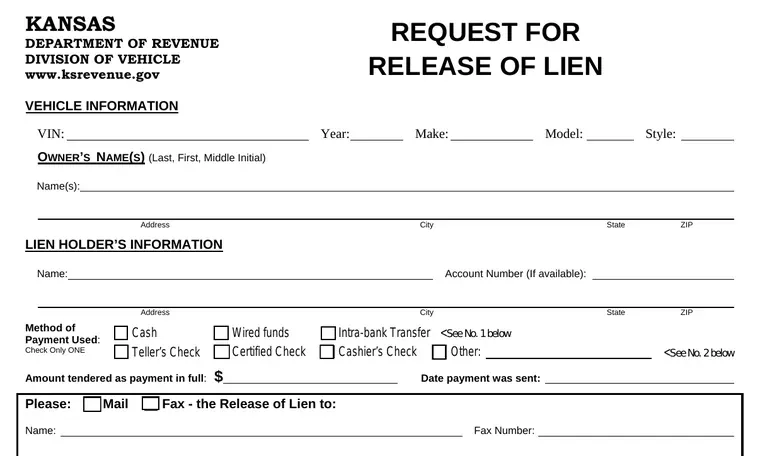
Written against TR-155 (Rev 07/24), issued under K.S.A. 8-1,157. Send this form with the final payment, not after the silence starts. The statute's deadlines run from the receipt of payment and a request for the release - the form's own instruction is to attach it to the final payment or deliver it once the payment is submitted electronically - so a request mailed with the payoff cheque has the clock running before the lender's mailroom has finished opening the envelope.

Two documents, and they are not the same thing. Take the blank TR-155 from the ksrevenue.gov copy so you get the revision that is current today, then print our TR-155 guide and keep it beside you while you fill theirs in.

Filled in

What a completed one looks like

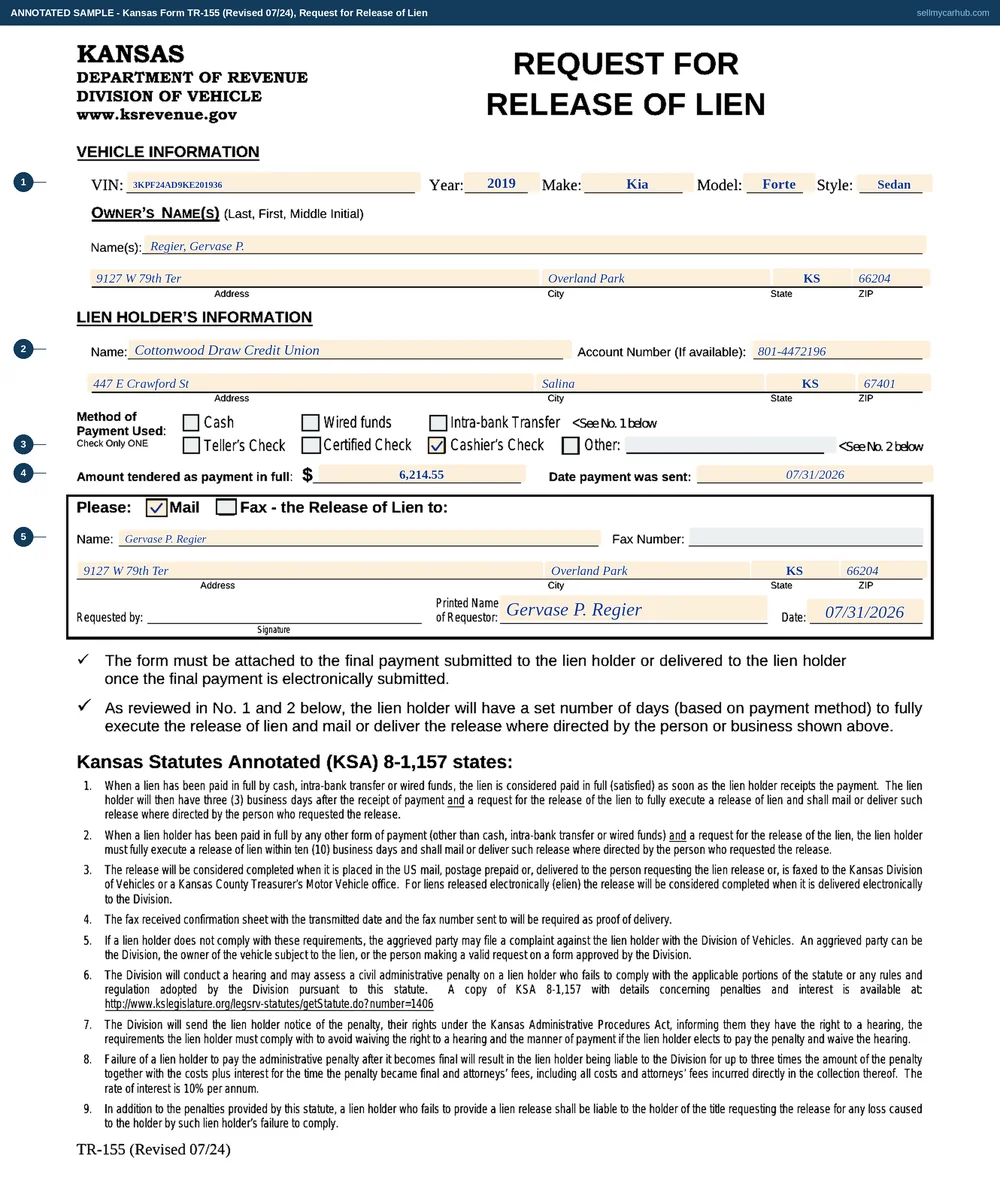
This is the actual TR-155, rendered from the PDF the Kansas Department of Revenue, Division of Vehicles publishes and completed end to end: letterhead, every field, and the blocks at the foot.

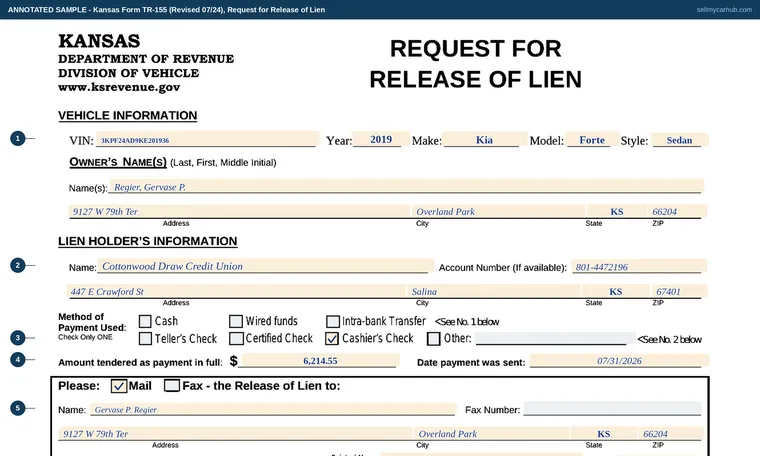
Kansas Form TR-155 Request for Release of Lien filled in: a 2019 Kia Forte, vehicle identification number 3KPF24AD9KE201936, owner Regier, Gervase P. of Overland Park, lienholder Cottonwood Draw Credit Union of Salina with the loan account number recorded, the cashier's check payment box ticked with 6,214.55 dollars tendered as payment in full sent on 07/31/2026, the Mail box ticked directing the release to Gervase P. Regier at his Overland Park address, and the requestor's printed name and date completed with the signature line left for ink.
A payoff by cashier's check, which under the reprinted statute gives the credit union ten business days. Amber is the requestor's work - vehicle, owner, lender, payment facts and destination. The nine numbered paragraphs beneath are the sheet's enforcement half and need no pen.
Field by field

Every line, in the order you meet it

  1. 1
    You fill this in

    Vehicle, owner, lender

    The identification row, your name and address as the record holds them, and the lienholder with an account number if you have one.

    Watch out: The account number is optional on the form and priceless in the lender's mailroom - it is how the request finds the loan without a phone call.

  2. 2
    You fill this in

    How you paid

    One box only: cash, wired funds, intra-bank transfer, teller's check, certified check, cashier's check or other.

    Watch out: The box you tick chooses the deadline - three business days for the first three methods, ten for the rest. Wire the payoff if the calendar matters.

  3. 3
    You fill this in

    Amount and date

    The amount tendered as payment in full and the date the payment was sent.

    Watch out: Payment in full is the operative phrase. A payoff quote expires; if per-diem interest has crept past your figure, the lien is not satisfied and the clock never started.

  4. 4
    You fill this in

    Where the release goes

    Mail or fax, with the name, address and fax number.

    Watch out: Direct it to yourself unless the buyer's county is waiting on it. The statute counts the release complete when mailed, delivered, or faxed to the Division or a county treasurer's office - so aim it where it does the most good.

  5. 5
    You fill this in

    Sign and send with the payment

    Signature, printed name, date - then attach the form to the final payment.

    Watch out: Keep a copy and, if you fax anything, the confirmation sheet: the statute names that page as the required proof of delivery, and it is your exhibit if the Division ever has to hold the hearing.

At a glance

What goes where

On the formWhat to put in it
Vehicle InformationVIN, year, make, model and style on one row.
Owner's Name(s)The owner as the record shows them, with address, city, state and ZIP.
Lien Holder's InformationName, account number if available, and the lender's address.
Method of Payment UsedCheck only one: cash, wired funds, intra-bank transfer, teller's check, certified check, cashier's check, or other - the choice that sets which statutory deadline applies.
Amount and dateAmount tendered as payment in full, and the date payment was sent.
Mail or fax the release toA tick for mail or fax, then the name, address and fax number the executed release must go to.
Requested byThe requestor's signature, printed name and date.
The reprinted statuteNine numbered paragraphs of K.S.A. 8-1,157: the deadlines, what counts as a completed release, the fax confirmation sheet as proof of delivery, the complaint and hearing procedure, and the liability that follows non-compliance.

What gets this one rejected

Rules that decide whether it is accepted

Every line here was read off TR-155 (Rev 07/24) itself — the PDF is here — and off the Kansas Department of Revenue, Division of Vehicles pages. This is plain-language help with a form, not legal advice, and where our wording and the agency's differ, theirs governs.

Back to all Kansas seller paperwork, or what selling a car in Kansas involves.

Want the paperwork handled instead?

Get My Instant Offer → Online · about 2 minutes · free

Or send the details — we'll come to you

A statute, a fax confirmation sheet and a complaint procedure against your own bank - or a buyer who handles lender delays for a living.

or call/text (877) 405-1808