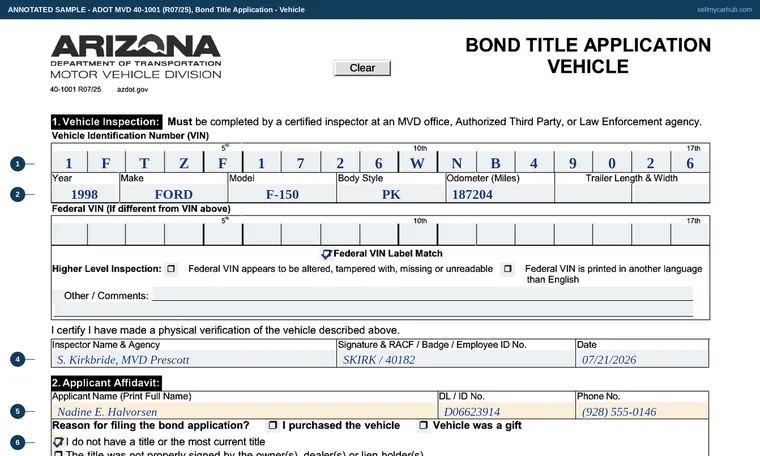
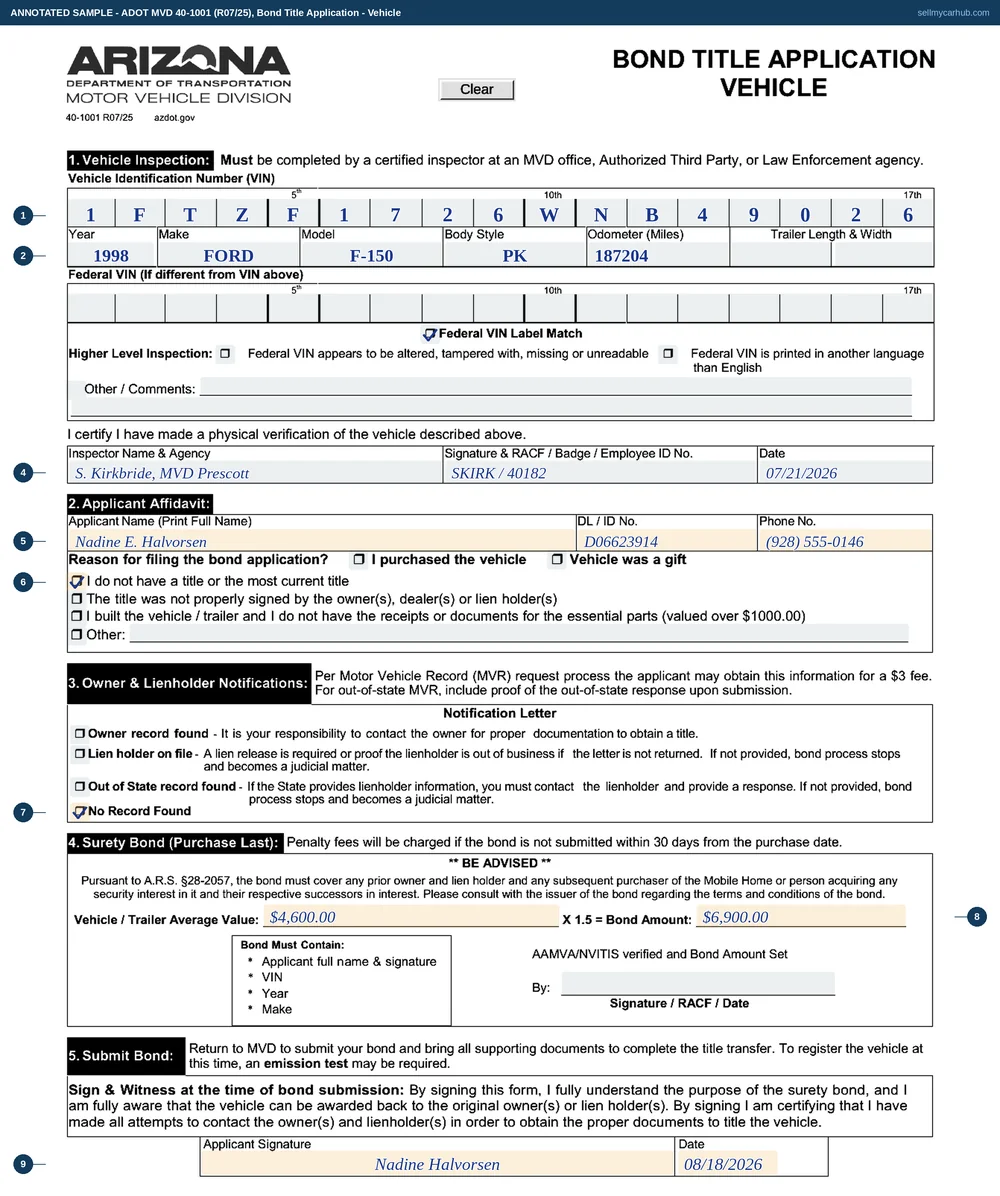
The route to a title for a vehicle whose ownership cannot be proved on paper. It is five numbered steps on one sheet and they happen in order, over weeks rather than an afternoon: an inspection, an affidavit, a records search, a surety bond bought last, and a return trip to MVD. The bond is set at one and a half times the vehicle's average value and it stays live for years.
Written against 40-1001 (R07/25), issued under A.R.S. 28-2057. Read the sentence above the applicant's signature twice before you start. You are certifying that you are fully aware that the vehicle can be awarded back to the original owner or lien holder - a bonded title is a bet backed by a bond, not a clean title with extra paperwork.
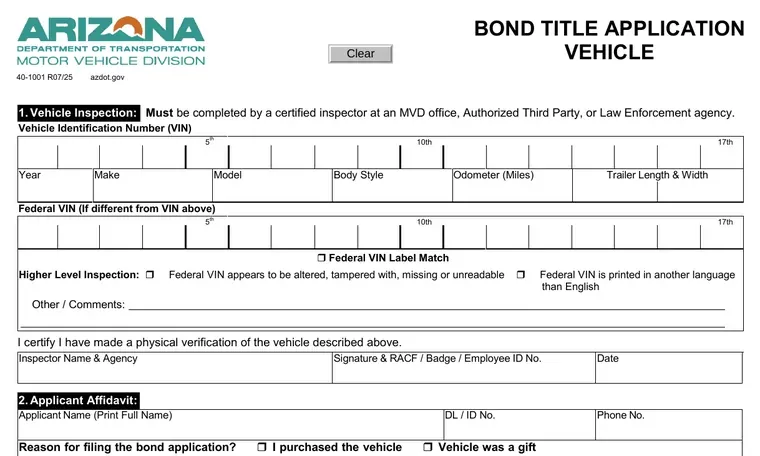
Two documents, and they are not the same thing. Take the blank 40-1001 from the apps.azdot.gov copy so you get the revision that is current today.
This is the actual 40-1001, rendered from the PDF the Arizona Department of Transportation, Motor Vehicle Division publishes and completed end to end: letterhead, every field, and the blocks at the foot.
The public VIN across the first comb and, where they differ, the federal VIN across the second, one character per box.
Watch out: The 5th, 10th and 17th markers above each comb are there to be used. If your last character does not land in the last box, start again rather than squeezing.
Year, make, model, body style, odometer, and length and width for a trailer.
Watch out: This is the inspector's reading of the car in front of them, not yours of the advert. It becomes the record if a title is eventually issued.
Ticked where the federal VIN appears altered, tampered with, missing or unreadable, or is printed in a language other than English.
Watch out: Either box turns a straightforward application into an enforcement matter. It is better to know before you have paid a surety premium.
Completed by a certified inspector at MVD, an Authorized Third Party or a law enforcement agency.
Watch out: You cannot inspect your own vehicle, and a mechanic's letter is not a substitute here. The form names the three places that can do it.
Your details as the person applying for the title.
Watch out: Give a phone number you answer. Steps 3 and 4 both generate questions, and an unanswered application simply stops.
One or more of six reasons, including a purchase, a gift, no title, an improperly signed title, or a vehicle you built without receipts for essential parts valued over $1,000.
Watch out: The improperly signed box is the one most private buyers need. A title signed by somebody who was not the recorded owner is not a title, and no amount of goodwill fixes it.
Which of the four search results applies, and what you did about it.
Watch out: A lien holder on file is the result that most often ends the process. Deal with it before you buy the bond, because the bond will not cure it.
Average value, times 1.5, equals the bond you have to buy.
Watch out: The bond document itself has to carry your full name and signature, the VIN, the year and the make. A surety who leaves one of those off has sold you a piece of paper MVD will not take.
Signed and witnessed at the moment the bond is submitted.
Watch out: The certification covers two things at once: that you understand the bond, and that you tried to find the owner and the lienholder. Both are checkable.
| On the form | What to put in it |
|---|---|
| Step 1, Vehicle Inspection | A boxed VIN comb marked at the 5th, 10th and 17th characters, then year, make, model, body style, odometer, trailer dimensions, and a second comb for a federal VIN if it differs. Three findings can be recorded: a federal VIN label match, a VIN that appears to be altered, tampered with, missing or unreadable, and a VIN printed in a language other than English. |
| Inspector Name & Agency, Signature & RACF / Badge / Employee ID No, Date | Completed by a certified inspector at an MVD office, an Authorized Third Party, or a law enforcement agency - not by you. |
| Step 2, Applicant Affidavit | Your printed name, driver licence or identification number and phone, then the reason: I purchased the vehicle, Vehicle was a gift, I do not have a title or the most current title, the title was not properly signed, I built the vehicle and do not have receipts for essential parts valued over $1,000, or Other. |
| Step 3, Owner & Lienholder Notifications | Four findings from the records search: an owner record found, a lien holder on file, an out-of-state record found, or no record found. Each carries its own consequence, printed beside it. |
| Step 4, Surety Bond | The vehicle's average value, multiplied by 1.5 to give the bond amount, with a note of what the bond document must contain: the applicant's full name and signature, the VIN, the year and the make. |
| Step 5, Submit Bond | Applicant Signature and Date, under a certification that you understand the vehicle can be awarded back to the original owner or lienholder and that you have made all attempts to contact them. |
Every line here was read off 40-1001 (R07/25) itself — the PDF is here — and off the Arizona Department of Transportation, Motor Vehicle Division pages. This is plain-language help with a form, not legal advice, and where our wording and the agency's differ, theirs governs.
Back to all Arizona seller paperwork, or what selling a car in Arizona involves.