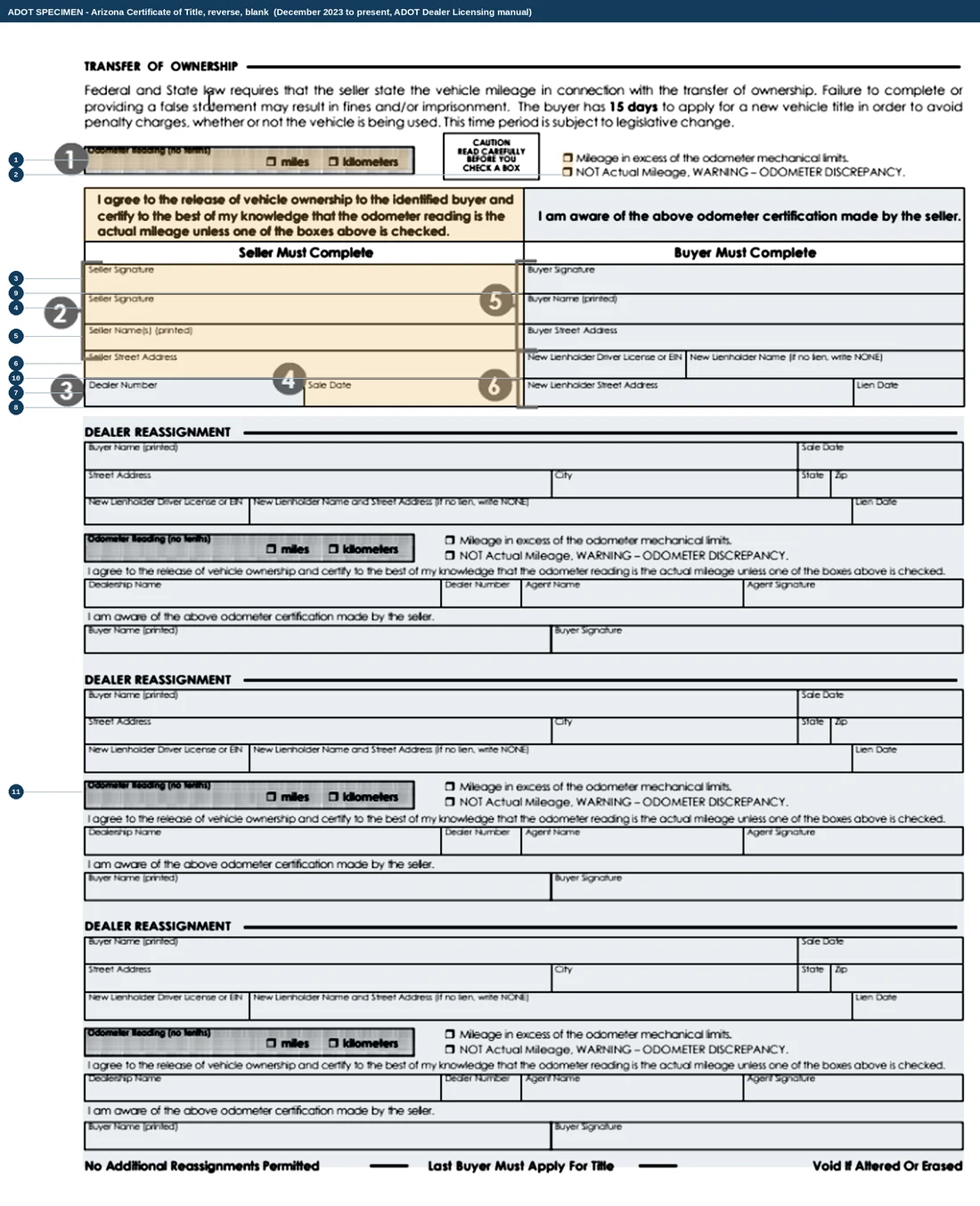
The whole private sale happens in one ruled block on the back of the certificate, headed TRANSFER OF OWNERSHIP. Thirteen stops below, nine of them yours, and the first one happens before you touch a pen. Everything here is transcribed from the blank specimen ADOT MVD publishes of that side of the current certificate; the numbered badges in the margin of our pictures are ours, and the grey circles printed on the sheet itself are the department's.
Last updated .
Your 9 boxes
As a private seller you complete these and nothing else:
There is no blank Arizona title to download, and there should not be: it is security stock with an eagle watermark, and the department's own warning band says the document is void without it. What ADOT does publish is a picture of the blank, in its Dealer Licensing manual, and that picture is what this page is built from.
The last line printed on the back of the certificate reads Void If Altered Or Erased, and the department means it literally.
Write in ink and write once. ADOT's signature rule is that the signature provided on any legal document accepted by the Division must be in ink and may not contain any alterations, white-outs or cross-outs.
ADOT's own blank specimen
The back of an Arizona title, exactly as the department publishes it
Not a drawing, not a photograph of anybody's document: this is the exhibit ADOT MVD prints in its Dealer Licensing manual under the heading Description of Back of Arizona Title (December 2023 - Present). Every field is empty. The grey circles are the department's own callouts, printed on the exhibit. Our shading marks what a private seller writes on — the top strip and the left column — and leaves the three dealer panels beneath in grey, because none of them is yours.
Amber — you write it, in pen
Grey — not yours to fill
Numbered — matches the steps below
Click or tap the picture to open it full size.
Look at the proportions. The part a private seller uses is the top fifth of the sheet; the rest of it exists so a licensed dealer can pass a car along without a new title being issued each time. The line along the bottom, No Additional Reassignments Permitted — Last Buyer Must Apply For Title, is the end of that chain and not an instruction to you.
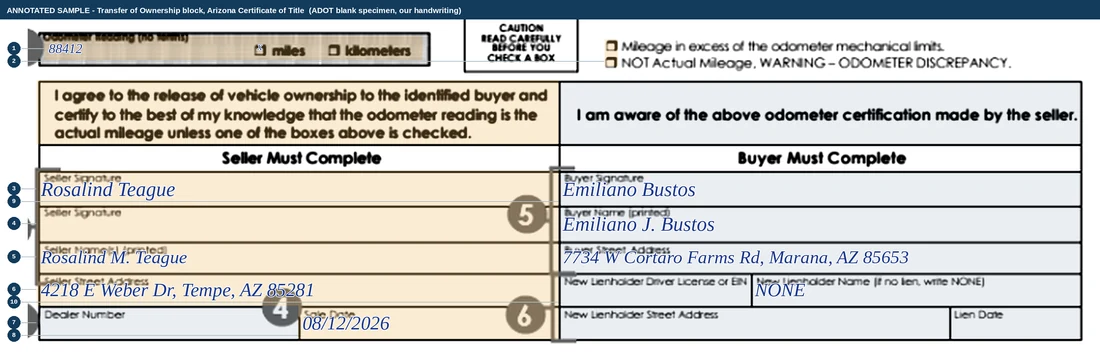
The same block, filled in
Transfer of Ownership, completed for one private sale
The handwriting is ours and the sale is invented: Rosalind M. Teague of Tempe selling a 2016 Toyota Tacoma to Emiliano J. Bustos of Marana on 12 August 2026, at 88,412 miles. The sheet underneath is the department's blank exhibit with nothing removed. Amber marks the boxes you complete, grey the ones you leave, and the numbers in the margin match the list further down this page.
Click or tap the picture to open it full size.
Two details worth copying. The mileage goes in whole miles with no comma and no tenths, and the word NONE is written across the new lienholder line rather than left blank — ADOT's own field label asks for it in those words. The Dealer Number box beside the sale date stays empty on a private sale; it is there for licensed dealers only.
Click or tap the picture to open it full size.
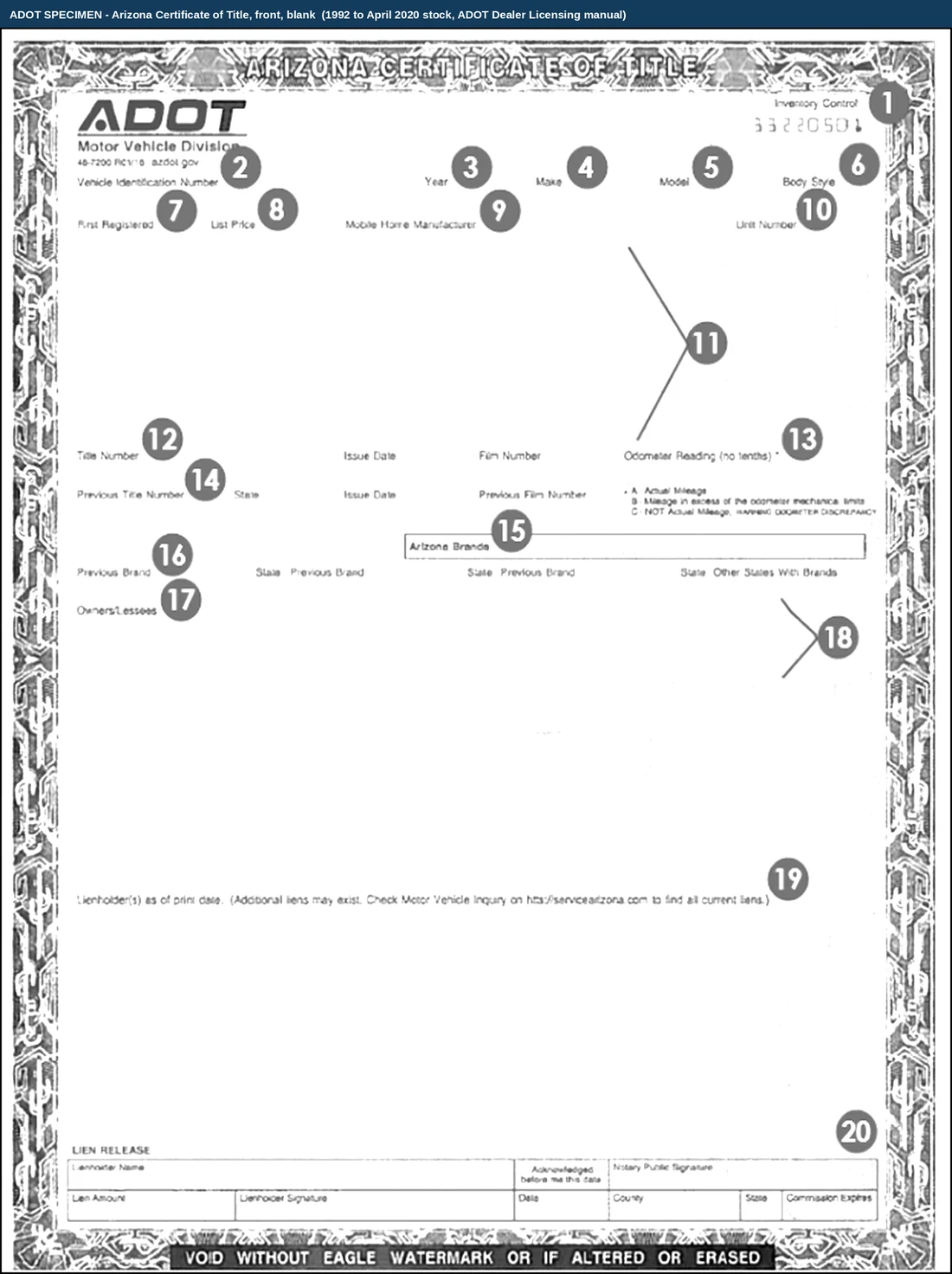
This is the older stock, 1992 to April 2020, and it is the only blank front ADOT publishes — its two pictures of the current front are photographs of one real issued title behind grey bars, which is not something we will reproduce. The blocks still tell you what the front is for: it is printed by the department and read by everybody else. The one part of it a person ever completes is the LIEN RELEASE strip at the foot, and that belongs to a lender.
Before you watch. Watch it for the shape of the process rather than for the screens. ADOT's current written instructions carry three details worth having in front of you as you watch: both accounts need Enhanced Authentication completed, the Transfer Code is valid for 48 hours, and a transfer that has started has to be finished within 24 hours or it expires. No runtime is printed beside this video because we could not read one: the watch page and every player endpoint refused this machine on the day it was checked, and an estimate is not a fact.
Published by ADOT on its own channel, youtube.com/@ArizonaDOT, and verified there through YouTube's oEmbed endpoint on 23 August 2026. It is a screen recording of the online transfer from both sides, which is the part of the process no written walkthrough can really show. Nothing loads from YouTube until you press play.
Step by step
Every box, in the order you meet it
0
You fill this in
Before any box: find out whether you have a title
Sign in to AZ MVD Now and look at the vehicle. Arizona stores title information electronically and you no longer automatically receive a paper title, so there may be nothing to sign.
Watch out: If there is no paper, do not order one out of habit. Either run the sale through eTitle Transfer, which needs no document at all, or complete a Title Transfer Bill of Sale on form 38-1306 instead.
1
You fill this in
Odometer Reading (no tenths)
The shaded window at the top left of the block. Whole miles, copied off the dash, with no comma and nothing after the decimal point.
Watch out: This is the one figure that cannot be tidied later. A correction has to be made before the transfer and on a different document, never on this one.
2
You fill this in
The miles and kilometers boxes
Two small squares immediately to the right of the reading. Tick one.
Watch out: If a kilometre car ever reaches an Arizona counter, ADOT's instruction to its own staff is that no conversion will be completed. Ticking the wrong box changes the recorded mileage by a factor of 1.6.
3
You fill this in
The two exception boxes
Mileage in excess of the odometer mechanical limits, and NOT Actual Mileage, WARNING - ODOMETER DISCREPANCY. Leave both alone unless one is true.
Watch out: When neither box is checked, ADOT reads the entry as actual mileage. That is a certification, not a default, and the sentence above your signature says so.
4
You fill this in
Seller Signature
The first line under Seller Must Complete. Sign it the way your name is printed on the face of the certificate.
Watch out: You may sign less of your name than is printed but never more. Add a middle name that is not on the face and the buyer needs a One and the Same Certificate to go with it.
5
You fill this in
The second Seller Signature line
There for a co-owner. Whether it has to be used is decided by the Legal Status word printed on the front: OR, AND or AND/OR.
Watch out: OR is the only one where a single owner can sell alone. On AND and AND/OR titles a missing second signature stops the transaction at the counter, after the car has gone.
6
You fill this in
Seller Name(s) (printed)
Your name in block capitals under the signature, and a co-owner's beside it.
Watch out: ADOT treats this as optional where the Division can verify the signature. Filling it in costs nothing and removes a judgement call from somebody who has never seen your handwriting.
7
You fill this in
Seller Street Address
Where you live, on the line under the printed name.
Watch out: The department does not require it here, though it warns there may be times when the Division will require proof of address. The buyer's address, on the other side of the block, is not optional at all.
8
Dealers only
Dealer Number
The box at the bottom left, beside the sale date. It carries a licensed dealer's number.
Watch out: On a private sale it stays empty. Writing anything in it tells MVD a dealer handled the transaction, which is a claim the Enforcement and Compliance Division takes an interest in.
9
You fill this in
Sale Date
The day the buyer takes the car. It starts the buyer's fifteen-day clock and your ten-day one.
Watch out: Once written it is fixed: the sale date cannot be changed or altered. Correcting it later means a Statement of Error signed by you, after the buyer has already been charged a penalty.
10
The buyer fills this in
Buyer Signature, printed name and street address
Three lines in the right-hand half. The signature acknowledges the mileage you certified.
Watch out: The buyer's full street address is genuinely required, on the title or on the application, before a new certificate can be issued. A post-office box on its own is not an address.
11
The lienholder fills this in
The new lienholder lines
Driver licence or EIN, name, street address and lien date, for whoever is financing the buyer.
Watch out: If nobody is, the field label asks for the word NONE rather than a blank. A blank invites somebody to fill it in later, and the certificate is void if altered.
12
Dealers only
The three DEALER REASSIGNMENT panels
Everything below the transfer block. Each panel is a complete transfer with its own odometer window, so a dealer can pass a car on without a new title being printed.
Watch out: Private parties cannot reassign the title to a new owner. If the transfer block above is already used up, the answer is a Title Transfer Bill of Sale, not the next panel down.
Before the pen
Before the plate comes off the car
Six habits worth having before the pen touches the certificate. The first one is about finding out whether you have a certificate at all.
Check whether a paper title exists first
Arizona holds most titles electronically. Reaching for a document you have never seen is how a Saturday sale becomes a six-week wait.
Read the Legal Status word on the front
OR, AND and AND/OR decide whether one signature is enough. It is printed between the owners' names and it is easy to miss.
Sign no more of your name than the title shows
Less is allowed, more is not, and more costs the buyer an extra certificate.
Whole miles, one box ticked, no tenths
The mileage window is the only entry on the sheet that cannot be corrected on the sheet.
Write NONE rather than leaving a line empty
The new lienholder field asks for the word. An empty line on a document that is void if altered is an invitation.
Do not write in a DEALER REASSIGNMENT panel
Three of them sit under the block you want, they look identical, and a private seller may not use any of them.
The ink rule is ADOT MVD's own: “The signature provided on any legal document accepted by the Division must be in ink and may not contain any alterations, white-outs or cross-outs.”
— ADOT MVD Dealer Licensing manual, Title Document Overview.
Check your source
What Arizona sellers get told about the MVD that is wrong
Three things repeated confidently about selling a car in Arizona. Each has a source underneath it, and each of them costs a seller either a wasted trip or somebody else's parking ticket.
"Leave the plate on so the buyer can get home."
Arizona reverses this. The plate belongs to you under A.R.S. 28-2356(A), ADOT tells you to remove it before the new owner takes possession of the vehicle, and the Sold Notice repeats that it must be kept in your possession. You then have thirty days to move it to another vehicle, hand it in, or file an affidavit of license plate destruction. Leave it on and it is still your plate, on somebody else's car, in MVD's records.
Not in Arizona. Titles here are electronic by default, and there are two ways to sell without ever holding one: eTitle Transfer, which runs the whole transaction through AZ MVD Now and costs the seller nothing, and the Title Transfer Bill of Sale, form 38-1306, which the department accepts in place of a signed title for a vehicle currently titled in Arizona. Ordering a paper title first adds $4 and up to six weeks for nothing.
It is the middle. Two things still have to happen and both are on your side of the deal: the Sold Notice within ten days, which is what protects you from tickets, accidents and a $500-or-worse abandoned-vehicle bill, and the registration credit, which has to be asked for and cannot be backdated. Neither happens because the buyer went to an office.
Six signature rules, and the surprising one is the fifth:
You, on the Seller Signature line
One line for one owner, a second line underneath for a co-owner. Sign the way your name is printed on the face of the title.
You again, in Seller Name(s) (printed)
ADOT's manual notes that the seller's printed name is not required on the back of the title if the Division can verify the signature. Print it anyway; verification is somebody else's judgement call.
Both owners, if the Legal Status reads AND or AND/OR
Only OR lets one of two owners sign alone. Look at the word printed on the face before you assume.
The buyer, on the Buyer Signature line
The buyer signs and prints in the right-hand half, and adds a street address. Their address is the one MVD requires; yours is optional on this document.
Nobody, in front of a notary
There is no notary block in this part of the certificate. The only acknowledgement printed anywhere on an Arizona title is in the LIEN RELEASE section on the front, and ADOT records that as of September 24, 2022 a notary is no longer required on the Lien Release section of the title.
No private seller, in the reassignment panels
The three DEALER REASSIGNMENT blocks below are licensed dealers' only. Private parties cannot reassign the title to a new owner.
The number in red at the top right of the front is the Inventory Control number of the blank stock. It is not the title number — that is printed lower down, in the Title Number field, and it is the one MVD will ask you for.
Once it is signed
Signing is not the last step in Arizona, and the last step is not a form you post. It is ten days on the clock, a plate in your hand and a credit you have to ask for.