Sell My Car Hub

What it costs to charge an electric car

Charging an electric car has one honest formula and a lot of noise around it. The formula is the car's kilowatt-hours per 100 miles, printed on the window sticker, multiplied by what you pay for a kilowatt-hour, printed on your utility bill or the charger's screen. Everything else is a modifier: the off-peak plan that cuts the home rate in half, the fast charger that can triple it, the cold morning that cuts efficiency by 39 percent, the losses between the wall and the battery. Here is each piece with its source, and a worked example against a gas car at this week's pump price.

Last updated .

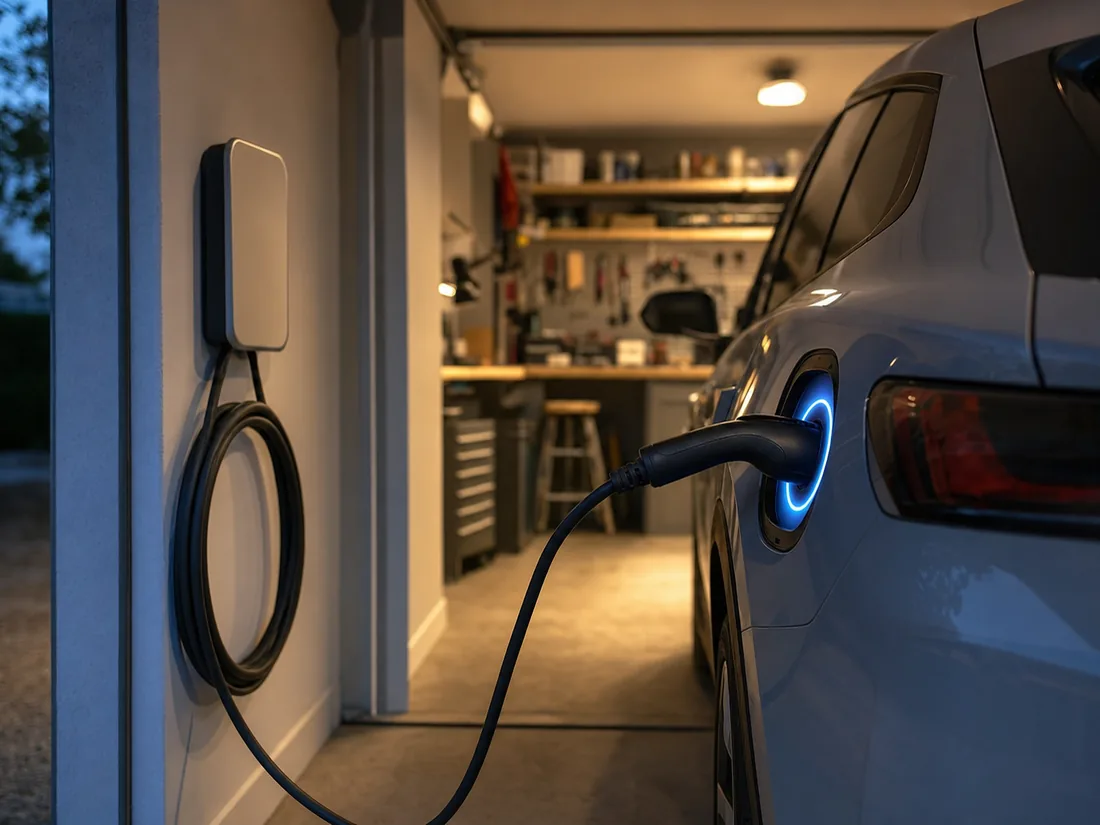
An electric car plugged into a wall-mounted home charger in a garage at evening, the charge-port ring glowing blue, a workbench of tools behind

The sticker gives you half the formula: kilowatt-hours per 100 miles

Every new EV's window sticker, and its page on fueleconomy.gov, carries a consumption figure in kWh per 100 miles, and it is more honest than it looks. The EPA measures it at the wall outlet rather than at the battery, assuming a 240-volt Level 2 charge, so the energy wasted in the cable and the onboard charger is already inside it. Multiply it by your price per kilowatt-hour and you have the cost of 100 miles.

Here are combined ratings for a spread of current models, each linked to its fueleconomy.gov entry. Efficient sedans and crossovers cluster between 25 and 31; full-size pickups need almost twice the energy.

Model (EPA combined)kWh per 100 milesPer 100 miles at 18.34¢/kWh
2026 Tesla Model 3 Premium RWD25$4.59
2026 Tesla Model Y Long Range RWD25$4.59
2026 Hyundai Ioniq 5 RWD30$5.50
2026 Chevrolet Equinox EV FWD31$5.69
2026 Ford Mustang Mach-E RWD31$5.69
2025 Ford F-150 Lightning 4WD, extended range48$8.80
2026 Chevrolet Silverado EV, extended range50$9.17

The third column uses the June 2026 national average home rate, which the next section breaks down by state; if you know your own rate, swap it in.

At home, the price is your utility's rate, and in June 2026 that ran from 13 cents to 53

The Energy Information Administration publishes every state's average residential price each month. Its latest table, for June 2026, puts the U.S. average at 18.34 cents per kilowatt-hour, up from 17.47 cents a year earlier. The spread underneath that average is what an EV owner should care about: the same car costs more than two and a half times as much to run in Sacramento as in Reno.

StateResidential price, June 202625 kWh/100 mi car31 kWh/100 mi car
Nevada13.11¢$3.28$4.06
Florida15.10¢$3.78$4.68
Texas15.94¢$3.99$4.94
Georgia16.36¢$4.09$5.07
U.S. average18.34¢$4.59$5.69
Illinois19.89¢$4.97$6.17
Michigan22.99¢$5.75$7.13
New York29.49¢$7.37$9.14
California34.74¢$8.69$10.77
Hawaii52.72¢$13.18$16.34

All prices are from EIA Table 5.6.A for June 2026, the most recent month published as of September 2026; the dollar columns multiply that price by the two consumption figures. Two cautions. These are averages across every customer and every hour, so a household on a tiered or time-of-use plan pays something different at the margin, and an EV adding a few hundred kilowatt-hours a month can push a tiered bill into a pricier block. And the number moves: the national figure rose about 5 percent in a year, which is why the table names its month.

An off-peak plan can halve the home rate, but only if the car charges while you sleep

Most EV drivers charge overnight at home, and the Department of Energy's Alternative Fuels Data Center notes that some utilities offer residential time-of-use rates built around exactly that habit. Two real tariffs, read in September 2026, show how different "off-peak" can be.

Pacific Gas & Electric's EV2-A plan prices every hour of the day. In the rate sheet effective June 1, 2026, off-peak energy is $0.22558 per kWh all year, and the 4 to 9 p.m. peak costs $0.53809 in summer and $0.41099 in winter. Off-peak runs from midnight to 3 p.m. For the 31 kWh Equinox EV that is $6.99 per 100 miles charged overnight versus $16.68 plugged in at dinner time in July.

Georgia Power's Overnight Advantage plan goes further. Its super off-peak energy charge is 2.1859 cents per kWh from 11 p.m. to 7 a.m., every day of the year, against 10.1676 cents the rest of the day and 29.7868 cents on summer weekday afternoons. That is the energy charge before the utility's riders and fees, the plan asks for a 12-month commitment and a $30 setup fee, and about a third of the year's hours fall inside the window. At the overnight rate the Equinox EV's energy comes to roughly 68 cents per 100 miles.

The catch is behavioral. A time-of-use plan is only cheaper if the car actually charges in the window, so set a charge-start or departure time in the car once and leave it alone. And the plan covers the whole house, not just the car, so the dryer and the air conditioner pay the late-afternoon price. Both utilities publish calculators; run them on a year of your own bills before switching.

The charger itself costs anywhere from nothing to about $1,650, and what you are buying is speed

Most EVs come with a cord for an ordinary 120-volt outlet, though Tesla sells its Mobile Connector separately, listed at $300 on its home-charging page as of May 2026. The AFDC says many owners cover their daily miles that way with no installation at all, provided a dedicated outlet sits near where the car parks. It is slow. The Idaho National Laboratory's cost breakdown puts a 20-amp household circuit at about 1.9 kW, or roughly 17 hours to refill an average battery from empty. For a 30-mile commute that is plenty. For a 300-mile weekend it is not.

A 240-volt Level 2 unit fixes the speed problem. The same INL report, published in August 2022, surveyed hardware prices and real installation records: a basic wall-mounted Level 2 unit had a median price of $549 within a $335 to $899 range, and the median residential installation cost $1,098, with 45 percent of installs coming in under $800. Unit plus labor, call it $1,650 for a typical attached garage. The expensive cases are the ones where the panel is full: installs that needed a service upgrade totaled $2,558 to $5,341 in the same data. An electrician can usually tell which case you are from a photo of the breaker panel.

Public fast charging is priced station by station, and the networks no longer post one national rate

DC fast charging is where the per-mile math flips. It costs far more per kilowatt-hour than a home outlet, and the big networks set prices per location rather than publishing one national figure.

Electrify America's pricing page, checked September 16, 2026, gives no number at all: pricing is set by charger location, plan and energy delivered, shown in the app or on the charger screen, with time-of-use pricing at select stations and idle fees after a session ends. Its Pass+ membership is pitched as saving about 25 percent for a monthly fee.

EVgo's pricing page, as captured June 6, 2026, lists three tiers: Pay As You Go with no monthly fee and a $0.99 session fee, Plus at $6.99 a month, and PlusMax at $12.99 a month, the two subscriptions without session fees, plus a $2.99 transaction fee on sessions started with a credit card at the charger. Per-kWh or per-minute rates are station-specific and live in the app, with time-of-use pricing in select regions.

In practice, read the per-kWh price on the screen before you plug in and multiply by your car's rating. The table below uses assumed prices to show the shape of the answer; they are not quotes from any network.

Assumed fast-charge price25 kWh/100 mi (Model 3)31 kWh/100 mi (Equinox EV)48 kWh/100 mi (Lightning)
35¢/kWh (illustrative)$8.75$10.85$16.80
45¢/kWh (illustrative)$11.25$13.95$21.60
55¢/kWh (illustrative)$13.75$17.05$26.40

Set those beside the home table: at an assumed 45 cents, the Equinox EV's 100 miles cost $13.95 on the road and $5.69 at the average home rate, a factor of two and a half. A membership only pays back if you fast-charge often.
Two things make the real bill higher than the label math: charging losses and cold

Losses first. The wall meter always reads more than the battery receives. DOE's fueleconomy.gov puts battery charging efficiency at 84 to 93 percent across the studies it cites, and a 2017 measurement study in the journal Energy found one-way losses of 12 to 36 percent, most of them in the AC-to-DC power electronics, with the worst efficiency at low power and low state of charge. By the same logic, a slow 120-volt trickle likely spends a bigger share of each kilowatt-hour on conversion heat.

If you calculate from the EPA figure, the losses are already counted. If you calculate from the car's own trip screen, which reports energy leaving the battery, divide by 0.84 to 0.93 to get what the meter will show. A dash reading of 250 Wh per mile is 27 to 30 kWh per 100 miles at the wall.

Cold is the bigger effect. Fueleconomy.gov's winter page says an EV's fuel economy can drop roughly 39 percent at 20°F in mixed driving, and range by 41 percent, with about two-thirds of the extra energy going to heat the cabin; with the heater off the loss shrinks to 8 percent of efficiency and 12 percent of range. AAA's dynamometer testing, the basis for those figures, found the same 41% at 20°F with the climate system on and a 17% range loss at 95°F with the air conditioning running, and put the cost of cabin heat at 20°F at almost $25 more per 1,000 miles than driving at 75°F, at the electricity prices of the time.

Applied to the Equinox EV, a 39 percent efficiency loss turns 31 kWh per 100 miles into about 51, and $5.69 into $9.32 at the average home rate. The two mitigations fueleconomy.gov names are warming the cabin before you unplug, and using seat heaters instead of the cabin heater. One shifts the heating energy onto the wall before you leave; the other cuts it.

Against gasoline at $4.32, home charging costs about a third as much per mile, and fast charging can erase the gap

The EIA's weekly survey put regular gasoline at $4.319 a gallon on September 14, 2026, from $3.806 in Texas to $5.827 in California. The fair comparison is the same body with two powertrains, both from fueleconomy.gov: the 2026 Chevrolet Equinox with the 1.5-liter turbo, rated 27 mpg combined, against the Equinox EV at 31 kWh per 100 miles; and the 2026 Ford F-150 4WD with the 2.7-liter V6, rated 20 mpg combined, against the Lightning at 48. For scale, EPA's trends report puts the average model year 2024 new vehicle at 27.2 mpg, so the gas Equinox is a fair stand-in for an ordinary car.

Cost per 100 milesEquinox 1.5T (27 mpg) or Equinox EV (31 kWh)F-150 2.7L (20 mpg) or Lightning (48 kWh)
Gasoline, U.S. average $4.319$16.00$21.60
Gasoline, Texas $3.806$14.10$19.03
Gasoline, California $5.827$21.58$29.14
Home charging, U.S. average 18.34¢$5.69$8.80
Home charging, Texas 15.94¢$4.94$7.65
Home charging, California 34.74¢$10.77$16.68
Home charging, PG&E EV2-A off-peak 22.558¢$6.99$10.83
Fast charging at 45¢ (illustrative)$13.95$21.60

Now a worked year, every assumption labeled: 12,000 miles, 85 percent charged at home at the national average and 15 percent on fast chargers at an assumed 45 cents, both figures illustrative rather than measured. The Equinox EV's electricity comes to about $580 at home plus $251 on the road, $831 for the year. The gas Equinox at $4.319 burns about $1,920. The gap is roughly $1,090 before winter; drive a quarter of those miles at the cold-weather rate of about 51 kWh per 100 miles and the extra 600 kilowatt-hours cost about $110 at the home price. Charge everything at home in Texas and the electricity is under $600 for the year. Do it all on fast chargers at an assumed 55 cents and the year costs about $2,050, more than the gasoline.

The Level 2 charger is the other first-year cost: the INL median of $1,098 installed plus a $549 unit is about $1,650, which the example's savings repay in roughly a year and a half.

What the charging bill says about owning one, and about selling it

Charging cost is the running-cost argument for an EV, and it is local. In Nevada or Texas with a garage and an overnight rate, the electricity for 12,000 miles is a few hundred dollars. In a California apartment with no outlet, living on fast chargers at 45 to 55 cents, it is not clearly cheaper than gasoline. The car is identical; the address decides.

That is also why an EV's resale story leans on where it lived and how it was charged. A buyer with a driveway wants to hear the car slept on a Level 2 charger; an apartment dweller wants to know which networks sit near work. The installed charger usually stays with the house, so it adds nothing to the car's price, but the record of home charging does, because it is the cheap kind and, as our battery-life guide covers, possibly the gentler kind too. And if the charging arithmetic never worked at your address, that is a good reason to pass the car to a driver for whom it will.

Common questions

What people ask about this

How much does it cost to charge an electric car at home?

Multiply the car's EPA kWh-per-100-miles rating by your electricity rate. At the June 2026 U.S. average of 18.34 cents, a 25 kWh/100 mi Tesla Model 3 costs about $4.59 per 100 miles and a 48 kWh/100 mi F-150 Lightning about $8.80. Refilling the Model 3 from empty to its 363-mile rating draws about 91 kWh from the wall, around $16.60. On an overnight rate plan it can be far less.

Is charging an EV cheaper than buying gas?

At home, usually by a wide margin. A gas Chevrolet Equinox at 27 mpg and $4.319 gasoline costs about $16.00 per 100 miles; the Equinox EV at the average home rate costs $5.69. Public fast charging closes most of that gap, and at an assumed 55 cents per kWh it can cost more than gasoline. Where you charge matters more than which EV you drive.

Why does my meter show more kilowatt-hours than the car says it took?

Charging losses. The onboard charger and cable turn some of the energy into heat, and DOE's fueleconomy.gov puts charging efficiency at 84 to 93 percent; a measurement study in Energy found one-way losses of 12 to 36 percent, worst at low power. The EPA's kWh/100 mi rating is measured at the wall, so it already includes them. Your car's dash consumption figure does not.

Is a time-of-use electricity plan worth it for an EV?

If the car can reliably charge inside the cheap window, yes. PG&E's EV2-A plan charges $0.22558 per kWh off-peak against $0.53809 at the summer peak; Georgia Power's Overnight Advantage energy charge is 2.1859 cents from 11 p.m. to 7 a.m. The whole house moves onto the plan, so late-afternoon use gets pricier. Run the utility's calculator on a year of your own bills before switching.

How much more does an EV cost to run in winter?

At 20 degrees F, fueleconomy.gov says efficiency can drop about 39 percent and range 41 percent, with roughly two-thirds of the extra energy heating the cabin. AAA's testing put the cost of that heat at almost $25 more per 1,000 miles than at 75 degrees. Preheating while plugged in and using seat heaters instead of the cabin heater are the two fixes the DOE names.

Rather just sell the car?

Get My Instant Offer → Online · about 2 minutes · free

Or send the details — we'll come to you

If the charging math never worked at your address, tell us the year, model and rough mileage; we make an offer on the car as it sits, charged or flat, and we come to you.

or call/text (877) 405-1808