Sell My Car Hub

EV batteries and the environment

An EV battery is the most mined, most argued-over object most people will ever own. The arguments usually run on numbers nobody sourced. Here are the ones that hold up: what is inside a pack, which countries dig it up, how far you drive before the manufacturing debt is repaid, what the water bill in the Atacama really looks like, who in the US recycles packs and how much they get back, and why a battery health readout now moves the price of a used EV.

Last updated .

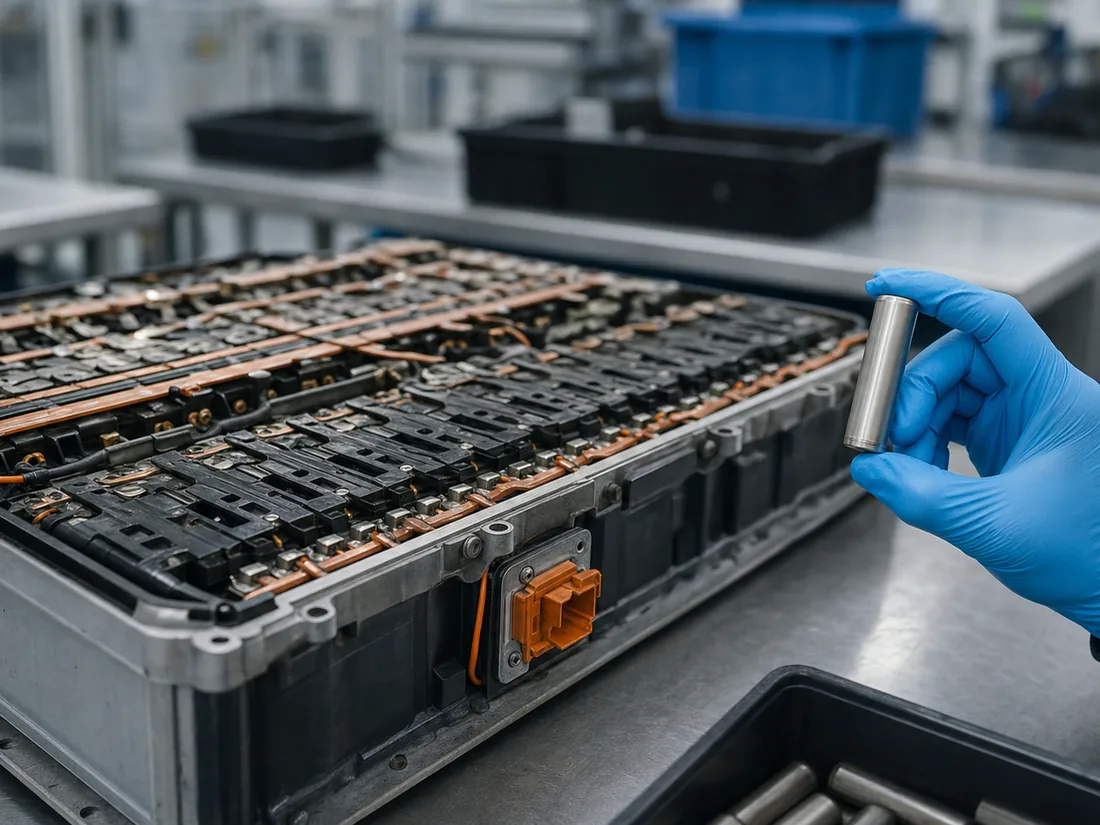
An electric-car battery pack with its casing removed on a workshop bench, rows of cells and copper busbars exposed, a blue-gloved hand holding one cylindrical cell

A battery pack is mostly ordinary metal, and the cathode decides which minerals matter

Most of a pack by sight is aluminum, steel, coolant lines, and electronics. The argued-over minerals live inside the cells, which make up 70% to 85% of a pack's weight according to the IEA's critical minerals report. Inside each cell, lithium sits in the cathode along with some mix of nickel, cobalt, and manganese, the anode is graphite, and the current collector is copper.

Which minerals a given car needs comes down to its cathode chemistry, and the two families are very different. Nickel-manganese-cobalt (NMC) cathodes carry the metals that draw the mining headlines; the IEA notes that the NMC721 and NMC811 variants hold roughly 10% cobalt in their metal content. Lithium iron phosphate (LFP) cathodes use no nickel, cobalt, or manganese at all, though they need about 50% more copper than NMC. That matters more every year, because LFP made up over 55% of EV batteries deployed worldwide in 2025, up from nearly 50% in 2024.

Scale is the other thing. The IEA's figure for a 75 kWh pack is that a typical electric car uses about six times the mineral inputs of a conventional car. A US 300-mile car is bigger than that: the ICCT's 2024 modeling, built on EPA fleet data, assumes an 85 kWh pack for a sedan and 98 kWh for an SUV. An EV front-loads its mineral use into one component, and that component's chemistry sets how heavy the footprint is.

Lithium comes from Australia and Chile, cobalt from Congo, nickel from Indonesia, graphite from China

The US Geological Survey publishes mine output by country each year; the 2025 figures below are its February 2026 estimates.

MineralTop producer, 2025SecondWhere it gets refined
LithiumAustralia, 92,000 t of a 290,000 t world totalChina 62,000 t; Chile 56,000 tChina, close to 60% of lithium chemicals
CobaltCongo (Kinshasa), 73% of world mine outputIndonesia, 14%China, the leading refiner and consumer
NickelIndonesia, 2.6 million t of 3.9 million tPhilippines 270,000 t; Russia 200,000 tNo US primary refinery since 1985
Natural graphiteChina, 82% of world productionMadagascar 80,000 t; Tanzania 75,000 t; Brazil 65,000 tChina, 55% of US anode imports

Lithium is the least concentrated of the four. USGS counts Australia at 92,000 metric tons, China at 62,000, and Chile at 56,000 out of roughly 290,000 tons worldwide in 2025. The US imports its lithium from Chile (54%) and Argentina (43%), and the one commercial US source is a Nevada brine operation. Batteries now take 88% of all lithium used. Concentration appears at the processing step: the IEA puts China at close to 60% of global lithium chemical production.

Cobalt is the concentrated one. Congo (Kinshasa) mined an estimated 73% of the world's cobalt in 2025, with Indonesia second at 14%, and Congo suspended cobalt exports in February 2025 before switching to quotas. The human-rights concern is artisanal digging, and the data there is better than the reputation. A USGS study found artisanal output peaked around 2008 at 40% to 53% of Congo's cobalt production and had fallen to 9% to 11% by 2020. That is still tens of thousands of tons a year, and it is why carmakers keep moving to lower-cobalt cathodes; USGS notes that iron-and-phosphorus substitutes held significant market share in China.

Nickel is the newest concentration. Indonesia produced about 2.6 million of the world's 3.9 million tons in 2025, roughly two-thirds, while Australian output fell 54% as mines closed on low prices. The US mines a little nickel in Michigan, and its last primary nickel refinery shut in 1985. Graphite, the anode, is even more lopsided: China produced an estimated 82% of natural graphite in 2025 and the US mined none.

Building the battery creates a carbon debt, and the studies agree on roughly how far you drive to repay it

Making an EV emits more than making a gasoline car, almost entirely because of the pack. The two best US answers come from the ICCT and from Argonne's GREET model, which the Department of Energy uses.

The ICCT's July 2024 brief states its assumptions in full: model-year 2024 cars, an NMC622 pack of 85 kWh (sedan) or 98 kWh (SUV) for 300 miles of range, a life of about 195,000 miles for sedans and 209,000 for SUVs, and a US grid averaging 231 g CO2e per kWh. On those terms, a BEV sedan's extra manufacturing emissions are paid off after roughly 15,200 miles against a gasoline car, and an SUV's after about 11,800 miles. Over the full life, BEV sedans come out 66% to 70% lower than gasoline and SUVs 71% to 74% lower. The ICCT's earlier global study put the 2021 US figure at 60% to 68% lower.

The DOE's GREET-based comparison lands lower, partly because it holds the grid at its 2022 mix instead of letting it decarbonize over the car's life. Its August 2024 fact sheet says a 2024 small electric SUV with 300 miles of range produces 52% fewer lifecycle emissions than the gasoline version, with battery production adding 30 g CO2e per mile over a 183,363-mile life on the 2022 grid. Multiply those two DOE numbers and the pack's debt is about 5.5 metric tons of CO2e. The same sheet shows why it clears: the EV's electricity costs 149 g per mile against 75 g for making gasoline, but nearly three-quarters of a gas car's emissions leave the tailpipe.

StudyLifetime reduction vs gasolinePaybackKey assumptions
ICCT, July 202466–70% sedans, 71–74% SUVs15,200 mi sedan, 11,800 mi SUVMY2024, NMC622, 231 g/kWh grid
DOE / Argonne GREET, Aug 202452% (small SUV)Not stated; battery adds 30 g/miMY2024, 2022 US grid, 183,363 mi
DOE / Argonne GREET, Aug 202348% (small SUV)Not statedMY2020, gasoline SUV at 429 g/mi, 178,102 mi
IEA, global averageAbout halfNot stated15 years / 200,000 km, current policies

Grid mix is the swing variable. The IEA's supply-chain review finds a medium-size EV at about half the lifecycle emissions of a gasoline car as a global average, over 60% lower in the UK and Chile, and only 20% lower in India. The EPA's own summary of the Argonne work is blunt about the direction: lifetime emissions of an EV are typically lower than a gasoline car's even after counting manufacturing.
The water and land costs fall on a few dry places, and they are real

Carbon nets out. Water does not; it is taken from a specific valley. Two facts frame the problem. The IEA finds that over 50% of today's lithium and copper production sits in areas of high water stress. And brine lithium is produced by pumping salty groundwater into ponds where the sun concentrates it to 1–6% lithium over hundreds of days, before fresh-water chemical steps turn it into lithium carbonate.

A 2025 study in Communications Earth & Environment measured how much fresh water actually flows into 28 lithium basins in Chile, Argentina, and Bolivia. The answer is very little: freshwater inflows of just 2 to 33 millimeters a year, and the global hydrology models that companies and regulators lean on substantially overestimate streamflow and freshwater availability. Using measured flows instead, the authors classify the Salar de Atacama, Chile's main producing basin, as critically water-scarce. They also caution that direct lithium extraction, often sold as the low-water alternative, is not automatically so: the one production-scale plant they could assess uses double the fresh water per tonne of lithium carbonate of the evaporation operations at Atacama and Olaroz.

Hard-rock mining trades water for land. Spodumene in Australia and nickel laterite in Indonesia come out of open pits, and the IEA's assessment is that open-pit methods use less energy than underground mining but cause more land-use change, with tailings dams as the tail risk. None of this is unique to batteries; it is what mining does. What is specific to EVs is the pace: the IEA's climate-driven scenarios have mineral demand from EVs and storage growing at least thirty-fold to 2040. Recycling and lower-cobalt chemistries are the two levers that bend that curve.

Recycling works chemically; the bottleneck is that almost no EV batteries have died yet

The technology question is settled. The Department of Energy's loan office, reviewing Redwood Materials' Nevada plant, puts the company's yield at more than 95% of a spent pack's lithium, nickel, cobalt, manganese and copper, and Redwood says it processes over 20 GWh of lithium-ion batteries a year from production scrap, packs, and consumer devices. The EPA's position is that recycling EV batteries cuts the emissions of making an EV by reducing the need for new material.

The supply question is not settled, because very few EV packs have reached end of life. The IEA's 2026 outlook expects that factory offcuts, not dead car packs, will make up most recycler feed until the mid-2030s, when retired EV batteries finally overtake them, and that China hosts over 85% of global recycling capacity, with capacity worldwide well ahead of the material to feed it. On current policies, the IEA has recycled material supplying a tenth to a fifth of the lithium and nickel the world needs in 2050, and more than 30% of its cobalt; a scenario that meets national climate pledges pushes those to 25% for lithium and nickel and 40% for cobalt.

The US industry is young and federally seeded. The DOE's October 2022 award round put $75 million into Cirba Solutions' Lancaster, Ohio recycling plant and $164 million into Ascend Elements' cathode plant in Hopkinsville, Kentucky, and a further $44.8 million into eight recycling-cost projects in October 2024.

US recyclerSiteWhat the federal record says
Redwood MaterialsMcCarran and Sparks, Nevada$2 billion DOE conditional loan commitment; over 95% recovery of Li, Ni, Co, Mn, Cu
Cirba SolutionsLancaster, Ohio$75 million DOE award to expand; output sized for over 200,000 EVs a year
Ascend ElementsHopkinsville, Kentucky$164 million DOE award for cathode material from recycled feed

The EPA's rule for owners is that a lithium-ion pack never goes in the trash or curbside bin, because even a used battery holds enough energy to injure someone or start a fire; for a car pack it points you to the dealer, shop, or salvage yard that handles the vehicle.

Second life is real for some packs, and mostly for the cobalt-free ones

A pack leaves a car long before it is useless. The engineering convention, restated in a 2022 peer-reviewed field study, is that an automotive battery reaches end of life when its capacity drops to around 70–80% of new, and that at that point it can be moved, without disassembly, into less demanding stationary jobs such as home, industrial, and renewable storage where nobody cares about weight or acceleration.

Whether that is worth doing depends on chemistry. A Stanford Graduate School of Business working paper prices the trade-off and finds that LFP batteries leaving EVs are generally worth more than 40% of a new battery's market value, while nickel-cobalt packs have only a marginal case for repurposing in the US. That lines up with where stationary storage already is: LFP accounted for over 90% of grid battery installations in 2025. Expect the cheap, cobalt-free packs to get a second career and the nickel-rich ones to go straight to the recycler.

Battery health is becoming a number on the dash, and the used market prices it

Everything above is invisible to a buyer. What a buyer increasingly can see is a state-of-health percentage. California's data-standardization rule requires that a zero-emission vehicle display its battery state of health in the vehicle, to the driver, without any tools, reachable within five screens of the home display, on a 0–100% scale, reported no more than five points high. The rule covers at least 40% of a maker's 2026 model-year ZEVs and all of them from 2027. Its enforcement is in dispute: CARB's own page describes 2025 federal actions purporting to revoke the state's Clean Air Act waiver, which the state is contesting, so treat the readout as something most new EVs will have rather than a guarantee.

The trade is already pricing the number. Black Book, whose values dealers and lenders use, introduced Battery Adjusted Values in January 2024, moving a VIN's valuation up or down on battery condition data from Recurrent, and reported that 94% of the EVs Recurrent evaluated scored 90 or above on range. The resulting market is healthier than the headlines: Recurrent's Q3 2026 report has used EV prices up 5.1% from January to June 2026, with cars under $20,000 up 9.4%, used EVs at a record 2.8% of the used market in April, and used EVs selling faster than used gas cars for a second straight month.

The counterexample shows what happens without trust. In China, the IEA reports three-year-old EVs retaining about 46% of their value in 2024 against 55% for the wider used market, and an estimated 80% of used-car dealers refusing BEVs over five years old, with battery-health worry named as a cause. A verifiable health number separates the two markets. How fast packs actually degrade, and what warranties promise, is covered in our guide to how long EV batteries last.

If you are selling an EV, the battery is the story to tell

Pull the state-of-health screen if your car has one, or get a third-party battery report, and put the number in the listing. A buyer who can see 92% will pay for 92%; a buyer who cannot will price in the worst case, which is exactly the Chinese pattern above.

If the pack itself is the problem, remember that it is the most valuable pile of metal on the car. It should end at a recycler or a second-life integrator, not a scrapyard shredder, and a buyer who understands that will pay more for a dead EV than one who does not. If a state scrappage program wants the old car in exchange for a rebate, compare that offer with a straight sale first; the state-by-state incentive guide lists which programs still pay.

Common questions

What people ask about this

Are EV batteries really worse for the environment than gasoline engines?

Making one is worse; using one is much better, and use wins over a normal life. The ICCT's 2024 US analysis finds a 300-mile BEV sedan repays its extra manufacturing emissions after about 15,200 miles and ends up 66% to 70% lower than a gasoline car over its life. The DOE's GREET-based figure for a small SUV is 52% lower. Even on India's coal-heavy grid, the IEA still finds an EV about 20% lower over its life.

Where does the lithium in an EV battery come from?

Mostly Australia, China, and Chile. USGS estimates 2025 mine output at about 92,000 tons for Australia, 62,000 for China, and 56,000 for Chile, out of roughly 290,000 tons worldwide. The US imports its lithium from Chile and Argentina and has one commercial brine operation in Nevada. About 60% of the world's lithium chemicals are refined in China, which is the real chokepoint.

Does my EV have cobalt in it?

It depends on the cathode. Nickel-manganese-cobalt (NMC) and NCA packs do, at roughly 10% of the cathode metal for the common NMC721 and NMC811 types. Lithium iron phosphate (LFP) packs contain no cobalt, nickel, or manganese, and LFP made up over 55% of EV batteries deployed worldwide in 2025. The maker's specifications normally state the cell chemistry, and a dealer can look it up by VIN if they do not.

Can EV batteries actually be recycled?

Yes, and at high yield: the Department of Energy's loan office records that Redwood Materials recovers over 95% of the lithium, nickel, cobalt, manganese, and copper in an end-of-life pack. The real constraint is supply. The IEA expects manufacturing scrap to dominate recycling feedstock until the mid-2030s, because most EVs on the road are still young, and it puts the rapid growth in end-of-life packs after 2035.

How much water does lithium mining use?

There is no honest single number, because it depends on the basin and the method. What is established is that over half of lithium production sits in high-water-stress regions, and a 2025 study found the South American lithium basins receive only 2 to 33 millimeters of fresh water inflow a year, far less than the standard hydrology models assume. The same study found one direct-extraction plant used twice the fresh water per tonne of the evaporation ponds it was meant to replace.

Rather just sell the car?

Get My Instant Offer → Online · about 2 minutes · free

Or send the details — we'll come to you

Selling an EV, battery worries and all? Tell us about the car. We price the pack for what it is, we buy it as it sits, and we come to you.

or call/text (877) 405-1808