Fleet studies covering tens of thousands of cars put the loss at 2.3% per year average, and fewer than 4% of monitored EVs have ever had a battery replaced. The regulation everyone quotes says 80,000 miles, not 100,000 — here is the actual text, the manufacturer terms, and what a replacement costs.
Last updated .
Longer than the car, on current evidence. Two fleet studies that between them watch tens of thousands of cars put the loss of capacity at 2.3% per year average (Geotab Inc., 2025 analysis (Geotab's annual update)) and generally 1-2% range degradation per year (Recurrent Auto).
Replacement is rarer than the reputation suggests: overall, fewer than 4% of evs in recurrent's 30,000+ vehicle community have had a battery replaced (including 10+ year old cars) — Recurrent Auto, Published November 11, 2025, referencing 2024-2025 data. Set that against the average car on American roads, which is now 12.8 years old (S&P Global Mobility), and a battery warranted for eight to ten years is covering most of a normal ownership life.
This is the claim repeated on nearly every page about EV batteries, and it is wrong in three ways.
The federal rule is in 40 CFR 85.2103(d)(1) (eCFR via Cornell LII). It lists the “specified major emission control components” that carry a warranty of 8 years / 80,000 miles — eighty thousand, not a hundred thousand. The regulation says:
“the following specified major emission control components have a warranty period of eight years or 80,000 miles...(v) Batteries serving as a Renewable Energy Storage System for electric vehicles”
Second, the traction battery was not on that list until recently. EV/PHEV traction batteries were NOT part of the federal 'specified major emission control component' list until a 2024 EPA rule, and are phased in (not yet mandatory for all vehicles) The text is explicit about the phase-in:
“This paragraph (d)(1)(v) is optional before model year 2027 for light-duty vehicles and light-duty trucks at or below 6,000 pounds GVWR.”
So for the EVs already on the road, this federal provision generally does not apply at all (Added by 89 FR 28152 (Apr. 18, 2024); amended 89 FR 50234 (Jun. 13, 2024) and 91 FR 7759 (Feb. 18, 2026)).
Third, it is a defect warranty, not a capacity guarantee. It covers the battery failing. It does not promise the battery will still hold a given percentage of its original range.
Where the 100,000-mile figure really comes from: California. Under 13 CCR 1962.8, California Air Resources Board Final Regulation Order, Advanced Clean Cars II requires 70% for MY2026-2030; 75% for MY2031 and later, both for a warranty period of 8 years/100,000 miles:
“to deteriorate to less than 70% for a warranty period of eight years or 100,000 miles...and 75%...for 2031 and subsequent model years”
That is a capacity floor with a mileage figure attached, and because manufacturers build to the strictest market, it became the de facto national norm — which is why everyone repeats it as though Congress wrote it.
Separately, the federal “useful life” standard for light-duty vehicles is 10 years or 120,000 miles (manufacturers may optionally certify to 15 years/150,000 miles) (40 CFR 86.1805-17 (eCFR via Cornell LII)). That governs emissions compliance, not your warranty claim.
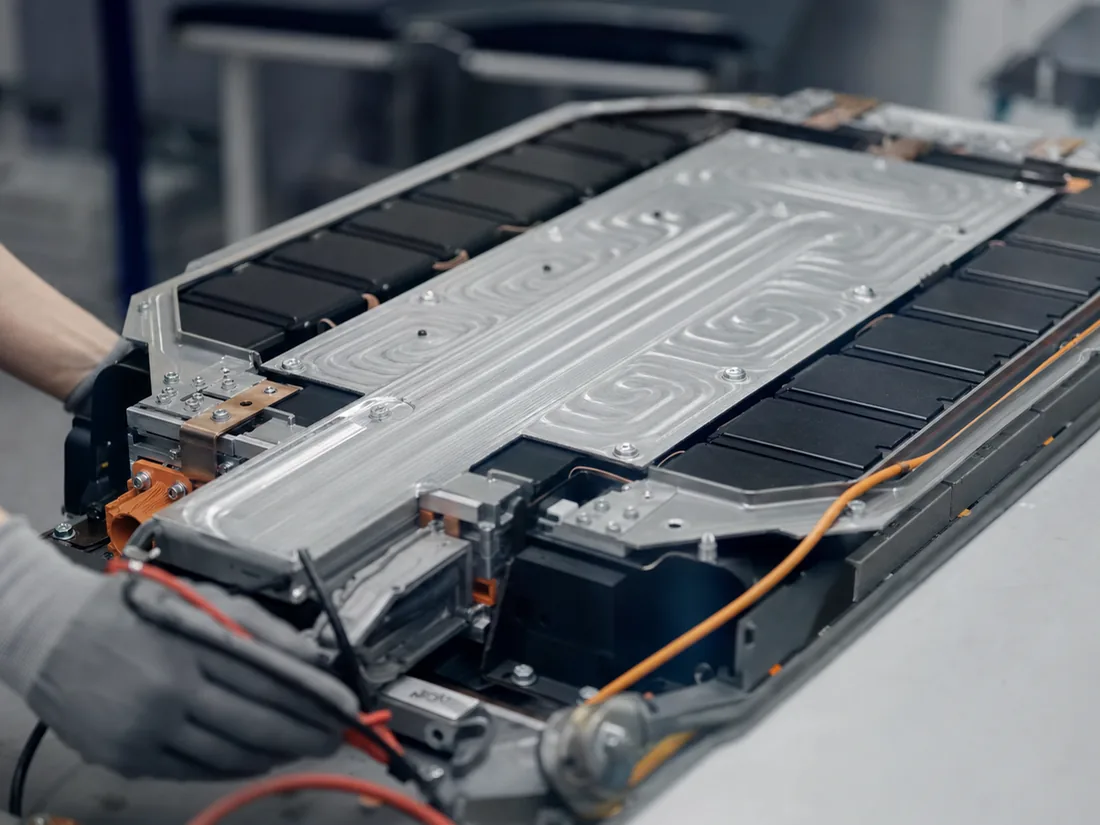
Read the capacity percentage, not just the years. A warranty that replaces a battery only when it fails outright is a different product from one that replaces it when capacity drops below 70%.
| Brand | Battery warranty | Source |
|---|---|---|
| BMW | 8 years / 100,000 miles against defects in materials/workmanship; a separate 75% state-of-health capacity coverage is reported for certain 2022-2025 model year Certified vehicles | BMW of North America, LLC |
| Ford | 8 years / 100,000 miles; excessive capacity loss defined as capacity below 70% of beginning-of-life capacity (65% for cutaway/chassis-cab configurations) | Ford Motor Company |
| Hyundai | 10 years / 100,000 miles; will not degrade more than 70% of original capacity during the warranty period | Hyundai Motor America |
| Kia | 10 years / 100,000 miles for the high-voltage battery and EV drivetrain components; a 70% capacity threshold is commonly cited but not confirmed in the specific PDF opened | Kia America |
| Mercedes-Benz EQ | 8 years/100,000 miles (EQB); 10 years/155,000 miles (EQE, EQS, EQE SUV, EQS SUV); capacity guarantee stated in absolute amp-hours, not a percentage | Mercedes-Benz USA, LLC |
| Nissan LEAF lithium-ion | 96 months / 100,000 miles, whichever comes first; capacity loss covered if it falls below 9 of 12 bars on the battery capacity gauge (~75%) | Nissan North America, Inc. |
| Rivian | 8 years / 175,000 miles (Large pack, Quad-Motor); 8yr/150,000mi (Large or Max pack, Dual-Motor); 8yr/120,000mi (Standard/Standard+ pack); covered if pack loses 30% or more of usable rated capacity (i.e., below ~70%) | Rivian Automotive, LLC |
| Toyota bZ4X | 8 years / 100,000 miles; covered if capacity falls below 70% of original | Toyota Motor Sales, U.S.A., Inc. |
| Volkswagen ID.4 | 8 years / 100,000 miles (whichever occurs first); a 70% capacity floor is commonly cited but not stated on the fetched VW page | Volkswagen of America |
Each row read off that manufacturer’s own warranty page, 12 September 2026. Several brands (Tesla, GM, Volvo among them) block automated reading of their warranty documents; rather than repeat figures we could not open ourselves, they are left out. Check the warranty booklet for the specific model year — terms change.
The honest position here is that the two best datasets do not agree, and pages that give you a confident answer are picking a side.
Geotab Inc. finds that frequency/power of dc fast charging correlates with faster degradation — Low DCFC usage (<12% of sessions): 1.5%/year; high-power DCFC (>40% of sessions above 100kW): 3.0%/year -- roughly double.
But Recurrent Auto looked at its own Tesla fleet and no statistically significant dc fast-charging effect on tesla range degradation.
Both are large real-world datasets. The plausible reconciliation is that thermal management differs sharply between models, so a finding across mixed fleets need not hold for one well-cooled pack — but that is inference, not something either study states. If you want a rule that both datasets support: the manufacturers’ own guidance is consistent about heat and about leaving a pack sitting at a very low state of charge for long periods.
Pack prices have collapsed. BloombergNEF put the 2025 average at $108 per kWh overall average (down 8% from 2024), against Battery pack prices were above $1,200/kWh in 2010, falling to $132/kWh by 2021 -- an 89% real-terms decline.
What an owner is quoted is a different number — it includes labour, and older packs are the ones being replaced. Recurrent Auto collected real quotes: Nissan LEAF 24kWh: $4,000-$6,500; LEAF 40kWh: $8,000-$12,500; Chevy Bolt: dealership quote of $16,250 for a 60kWh pack (used packs $5,000-$9,000); Tesla Model S: $12,000-$22,000 depending on quote/date.
Those quotes span 2018-2023 and predate the recent price falls, so treat them as the top of the range rather than today’s price. A remanufactured or third-party pack is usually cheaper than a dealer replacement.
Two things worth knowing before you decide. A battery still inside its capacity warranty may be replaceable at the manufacturer’s cost, which is worth checking before selling at a discount that assumes it is not. And degradation is measurable — a state-of-health readout gives a buyer a number instead of a worry, which is usually worth more than the reading costs.
If you would rather not deal with any of it, whether a repair is worth doing at all works through the same arithmetic for the rest of the car.
Every figure on this page is listed with its source and the date it describes in this CSV, including the verbatim quote each one came from. Free to reuse with a link back.
Findings we could not verify against a primary source are excluded from the page and the CSV rather than reported with a hedge. If you think a figure here is wrong, the corrections address is on our press and data page.
On fleet evidence, longer than most people keep a car. Geotab Inc. measured 2.3% per year average across 22,700 electric vehicles covering 21 vehicle models, and the average vehicle on US roads is 12.8 years old.
No. 40 CFR 85.2103(d)(1) specifies eight years or 80,000 miles, it is a defect warranty rather than a capacity guarantee, and traction batteries were only added to that list by a 2024 EPA rule that is optional before model year 2027. The 100,000-mile figure comes from California's Advanced Clean Cars II rule, which manufacturers generally follow nationally.
Overall, fewer than 4% of EVs in Recurrent's 30,000+ vehicle community have had a battery replaced (including 10+ year old cars) — and for 2022 and later models the rate falls to a fraction of a percent.
The evidence is genuinely mixed. Geotab finds a correlation between high-power fast charging and faster degradation; Recurrent found no statistically significant effect in its own Tesla fleet data. Anyone telling you this is settled is picking a side.
Pack prices are now $108 per kWh overall average (down 8% from 2024) at the cell-pack level, down from over $1,200/kWh in 2010. Owner quotes are higher because they include labour: Recurrent has collected real quotes from about $4,000 for a small older pack upward.
Get a state-of-health reading. It turns an unknown into a number, and if the pack is still inside its capacity warranty the manufacturer may owe a replacement — worth establishing before pricing the car as though it does not.