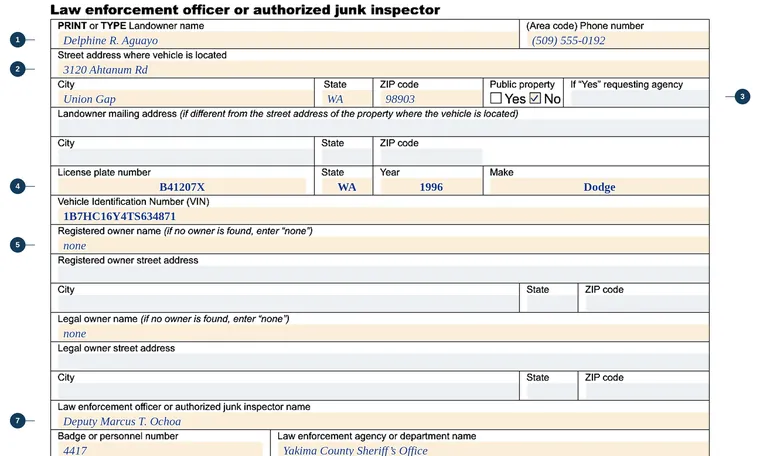
A landowner's form, signed by a police officer or an authorised inspector, and the end of the road for a vehicle that has been abandoned on somebody's property. For a seller it is the other side of a mirror: it is the document that turns your abandoned car into somebody else's property, and it is also the route out for a landowner who has ended up with a vehicle nobody has claimed.
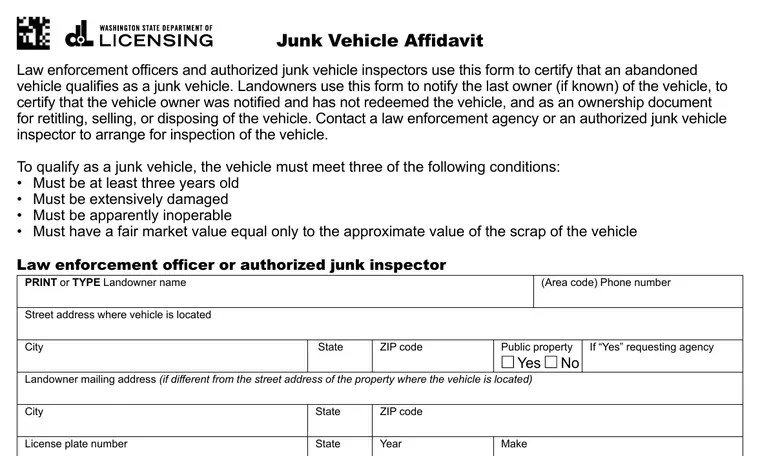
Written against 420-549 (R/5/20), issued under RCW 46.55.010 and RCW 46.55.230. If you are the person whose car is sitting on somebody else's land, the fifteen days are real and they start when the form is posted to the address on your vehicle record. That is one more reason to keep the address on that record current, and one more reason to file a Report of Sale on the day you part with a vehicle rather than the week after.
Two documents, and they are not the same thing. Take the blank 420-549 from the dol.wa.gov copy so you get the revision that is current today.
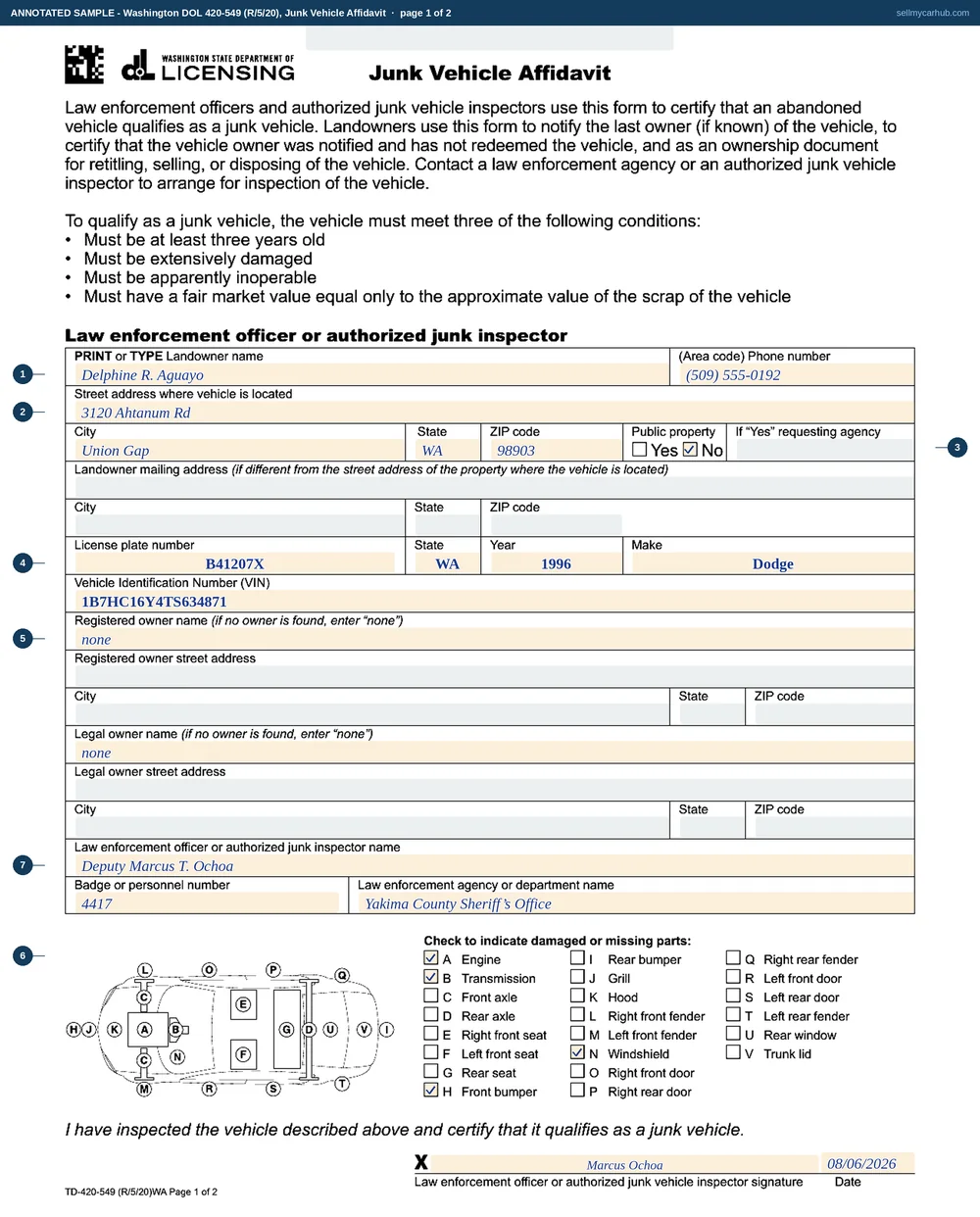
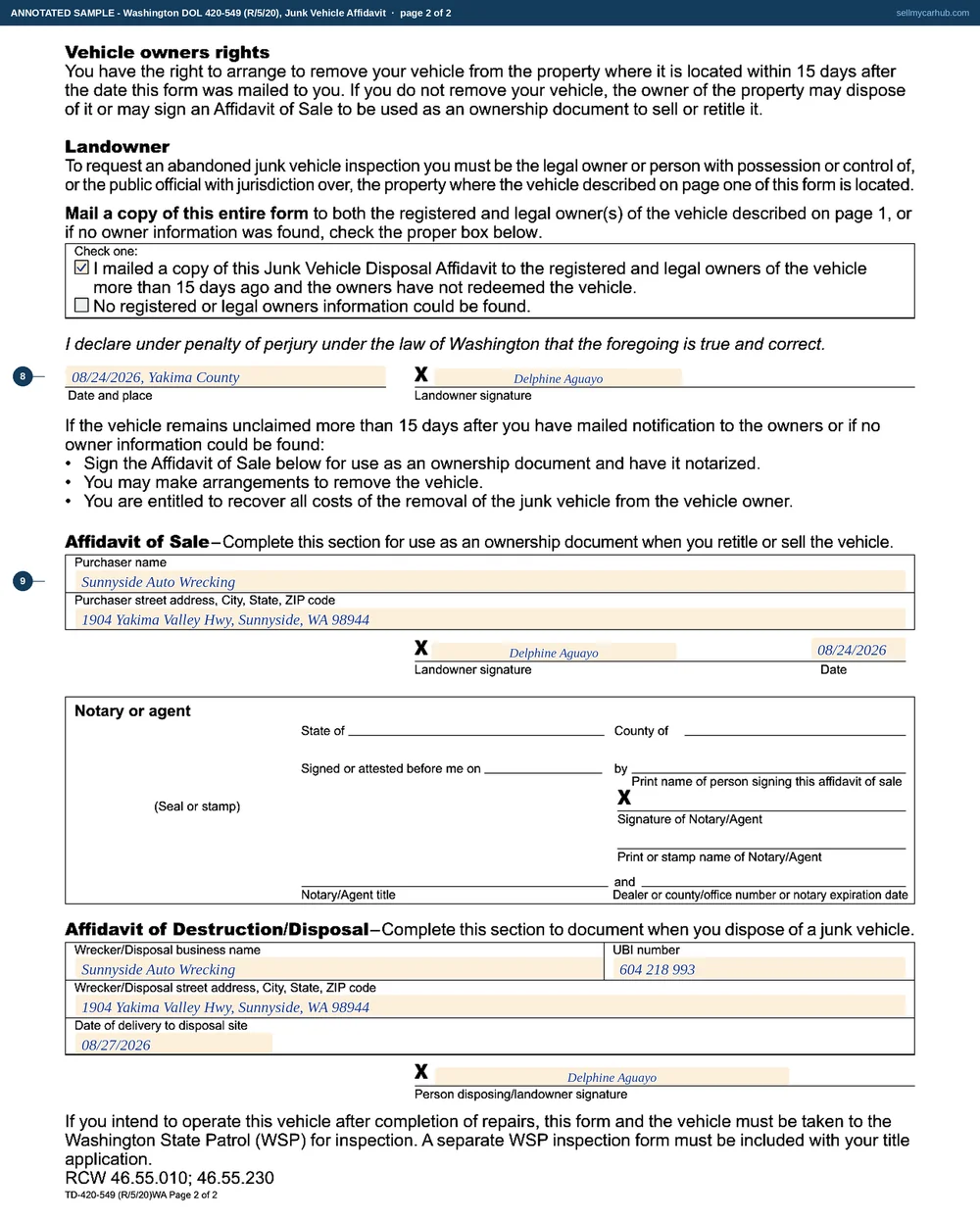
This is all 2 pages of the actual 420-549, rendered from the PDF the Washington State Department of Licensing publishes and completed end to end: letterhead, every field, and the blocks at the foot.
At least three years old, extensively damaged, apparently inoperable, and worth only its scrap value. Three of the four have to be true.
Watch out: This is read before anything is filled in. A vehicle that fails the test is not a junk vehicle, and the rest of the form has nothing to attach to.
Name, telephone, and the street address where the vehicle actually is - with a separate mailing address if that differs.
Watch out: The location is where the inspector will go. A description like behind the barn is not an address, and the inspection does not happen.
A yes-or-no tick, with a line for the agency if the vehicle is on public land.
Watch out: A vehicle on public property is somebody else's process entirely. Ticking yes here hands the form to the agency with jurisdiction.
Plate number and state, year, make and the identification number.
Watch out: Where the plate is gone the identification number carries the whole record. An inspector who cannot find one will say so, and the vehicle takes a different route.
Both blocks, completed from the record - and the word none where no owner can be found.
Watch out: Blank and none are not the same answer. Blank looks like an incomplete form; none is a finding.
Twenty-two ticks from engine and transmission to trunk lid and rear window.
Watch out: This is the evidence for the damage limb of the test. An inspector ticking two boxes on an otherwise complete car has not established anything.
Name, badge or personnel number, agency, and the signature certifying the vehicle qualifies as a junk vehicle.
Watch out: It is signed by law enforcement or an authorised inspector. A landowner signing it has produced a document the department will not accept.
One of two ticks on page two - either that copies were posted to both owners more than fifteen days ago and nobody redeemed the vehicle, or that no owner could be found.
Watch out: Sign this before the fifteen days have run and the affidavit of sale beneath it is worthless, however carefully the rest was completed.
Purchaser's name and address, the landowner's signature, and a notary or agent block.
Watch out: This is the section that becomes an ownership document, so it is the one that has to be notarised. The rest of the form is a report; this part is a title.
| On the form | What to put in it |
|---|---|
| The three-of-four test | Printed at the top: to qualify, the vehicle must meet three of four conditions - at least three years old, extensively damaged, apparently inoperable, and a fair market value equal only to the approximate value of the scrap. |
| Landowner name, phone and the street address where the vehicle is located | The property, and the person responsible for it. |
| Public property - Yes/No, and requesting agency | A tick, with a line for the agency where the answer is yes. |
| Landowner mailing address | Only where it differs from the property address. |
| License plate number, State, Year, Make, and the identification number | The vehicle band. |
| Registered owner name and address, Legal owner name and address | Two blocks with the instruction that if no owner is found, enter none. |
| Law enforcement officer or authorized junk inspector name, badge or personnel number, agency | Who inspected it. |
| Damaged or missing parts | Twenty-two lettered ticks, from engine and transmission through to trunk lid, describing what is left of the vehicle. |
| The inspector's certification and signature | I have inspected the vehicle described above and certify that it qualifies as a junk vehicle. |
| Vehicle owner's rights | Page two opens with the owner's fifteen days to arrange removal from the date the form was mailed to them. |
| Landowner declaration | Two ticks - either that a copy was mailed to the registered and legal owners more than 15 days ago and they have not redeemed the vehicle, or that no owner information could be found - then a signature under penalty of perjury. |
| Affidavit of Sale | A purchaser's name and address, the landowner's signature, and a notary or agent block. This is the section that becomes an ownership document. |
| Affidavit of Destruction/Disposal | Wrecker or disposal business name, its unified business identifier number and address, and the date the vehicle was delivered. |
Every line here was read off 420-549 (R/5/20) itself — the PDF is here — and off the Washington State Department of Licensing pages. This is plain-language help with a form, not legal advice, and where our wording and the agency's differ, theirs governs.
Back to all Washington seller paperwork, or what selling a car in Washington involves.