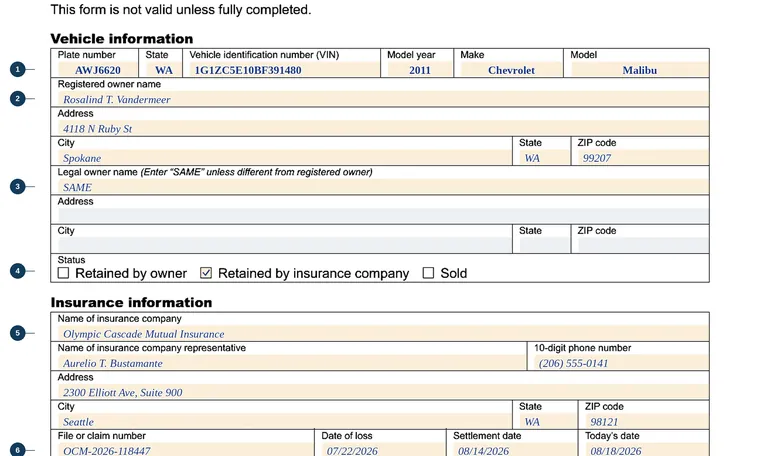
An insurer's form, and the reason a written-off car stops being your problem. Its first line names its author: insurance companies use this form to notify us within 15 days of settling a total loss claim on a vehicle. A seller reads it to understand what the insurer is telling the department about the vehicle - and in particular the single yes-or-no answer that decides whether the record ends up carrying a WA rebuilt brand.
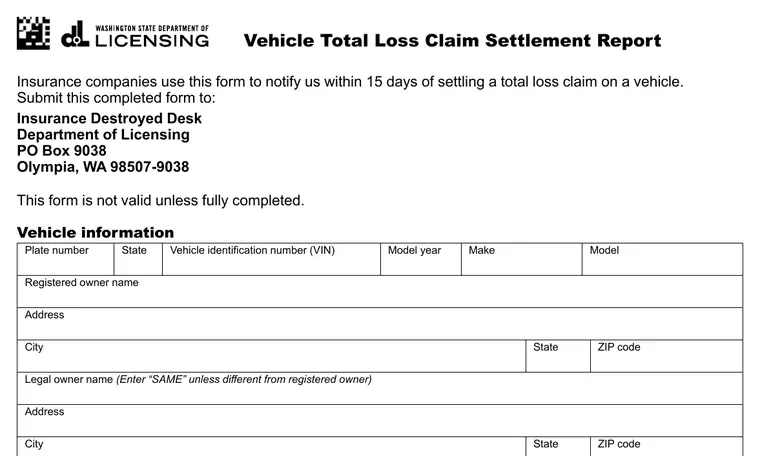
Written against 420-074 (R/7/21), issued under RCW 46.04.514 and RCW 46.12.600. If your insurer has settled a total loss and taken the car, a Report of Sale is still worth filing - the department's own list of things you must report includes turning a vehicle over to an insurance company. The insurer's form and your report answer different questions and neither substitutes for the other.
Two documents, and they are not the same thing. Take the blank 420-074 from the dol.wa.gov copy so you get the revision that is current today.
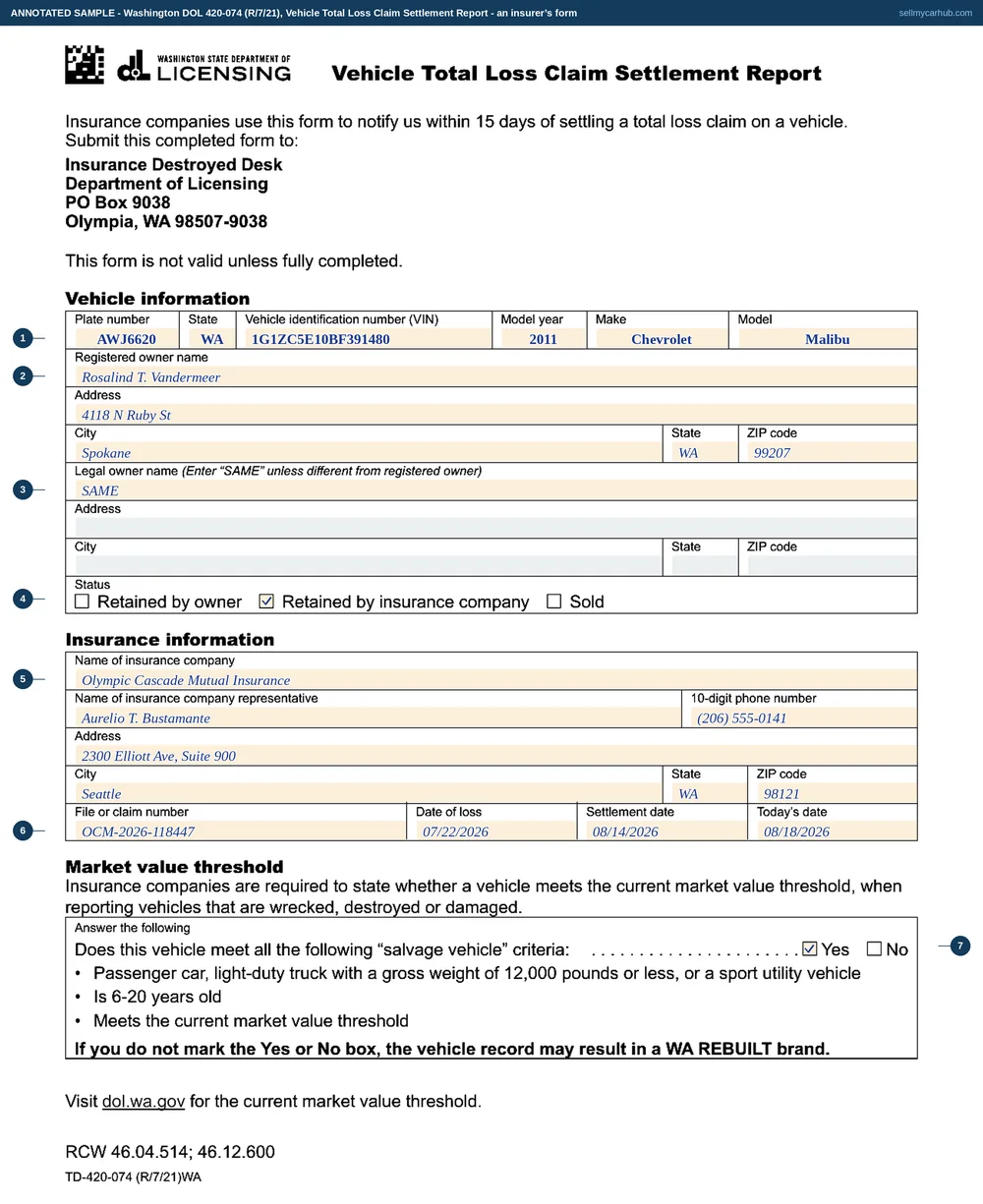
This is the actual 420-074, rendered from the PDF the Washington State Department of Licensing publishes and completed end to end: letterhead, every field, and the blocks at the foot.
Plate number and state, identification number, model year, make and model.
Watch out: The plate state matters here - a total loss settled in Washington on a vehicle plated elsewhere is still reportable, and the form has a box for it.
Your name and address, as the department holds them.
Watch out: This is the block that ties the settlement to your record. If it is wrong, the write-off attaches to somebody else's vehicle history.
A lender if there is one, or the word SAME.
Watch out: Where a loan is outstanding the settlement usually goes to the lender first, and this box is what tells the department to expect that.
Three ticks describing what happens to the wreck.
Watch out: Retained by owner is the tick that leaves you holding a vehicle you now have to deal with. It is worth knowing which box was ticked before the cheque clears.
Company, named representative, address and a ten-digit telephone number.
Watch out: The named representative is the person to ask if the department's record does not update. There is nobody else on the form to ring.
File or claim number, date of loss, settlement date and today's date.
Watch out: The fifteen-day clock runs from the settlement date, not from the crash. Those two can be months apart.
One yes-or-no answer to a three-part test about the vehicle's type, age and value.
Watch out: Leaving it blank is not neutral. The form warns that an unanswered question may result in a WA REBUILT brand on the record.
| On the form | What to put in it |
|---|---|
| Plate number, State, identification number, Model year, Make, Model | The vehicle band across the top. |
| Registered owner name and address | You, as the department has you on the record. |
| Legal owner name and address | A lender if there is one, with the instruction to enter SAME unless different from registered owner. |
| Status: Retained by owner / Retained by insurance company / Sold | Three ticks, and they describe three quite different futures for the vehicle. |
| Name of insurance company and its representative | Who is filing, and the person at the insurer who can be rung about it. |
| Insurance company address | One block. |
| File or claim number | The insurer's own reference. |
| Date of loss, Settlement date, Today's date | Three dates. The fifteen-day clock runs from the settlement date. |
| Market value threshold - the salvage vehicle question | A single yes-or-no answer to a three-part test: whether the vehicle is a passenger car, light-duty truck of 12,000 pounds gross weight or less, or sport utility vehicle; whether it is 6-20 years old; and whether it meets the current market value threshold. |
| The consequence of not answering | Printed under the question: if you do not mark the Yes or No box, the vehicle record may result in a WA REBUILT brand. |
Every line here was read off 420-074 (R/7/21) itself — the PDF is here — and off the Washington State Department of Licensing pages. This is plain-language help with a form, not legal advice, and where our wording and the agency's differ, theirs governs.
Back to all Washington seller paperwork, or what selling a car in Washington involves.