Sell My Car Hub

How to fill out Vermont VT-021

Two pages that decide who is allowed to sign the assignment block on a dead owner's certificate. The first is a decision table - four routes through an estate, each with its own list of documents - and the second carries the exception that moves up to two vehicles to a surviving spouse for no fee and no tax, with the statement that claims it printed at the foot. It is a bulletin rather than an application, which is why it is so often missed: nobody searches the forms index for a bulletin, and this is where the answer is.
Written against VT-021 (05/2018), issued under 23 V.S.A. s. 2023(e) for the surviving spouse exception and s. 3816 for vessels, snowmobiles and all-terrain vehicles; the statement is made under penalties of 23 V.S.A. s. 202, s. 203 and s. 3829(a)(4). The two pages answer different questions and only the second one has anything to sign. Read page one to find out which documents you need, and complete the statement on page two only if you are the surviving spouse claiming the no-fee exception.

Two documents, and they are not the same thing. Take the blank VT-021 from the dmv.vermont.gov copy so you get the revision that is current today, then print our VT-021 guide and keep it beside you while you fill theirs in.

Filled in

What a completed one looks like

This is all 2 pages of the actual VT-021, rendered from the PDF the Vermont Department of Motor Vehicles, Agency of Transportation publishes and completed end to end: letterhead, every field, and the blocks at the foot.

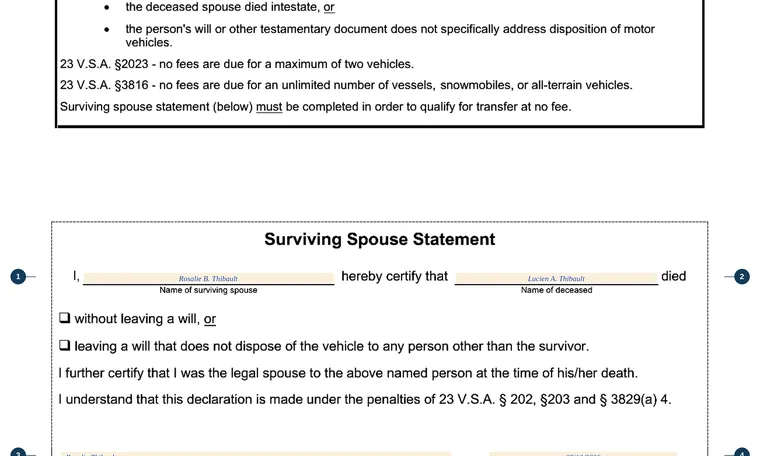
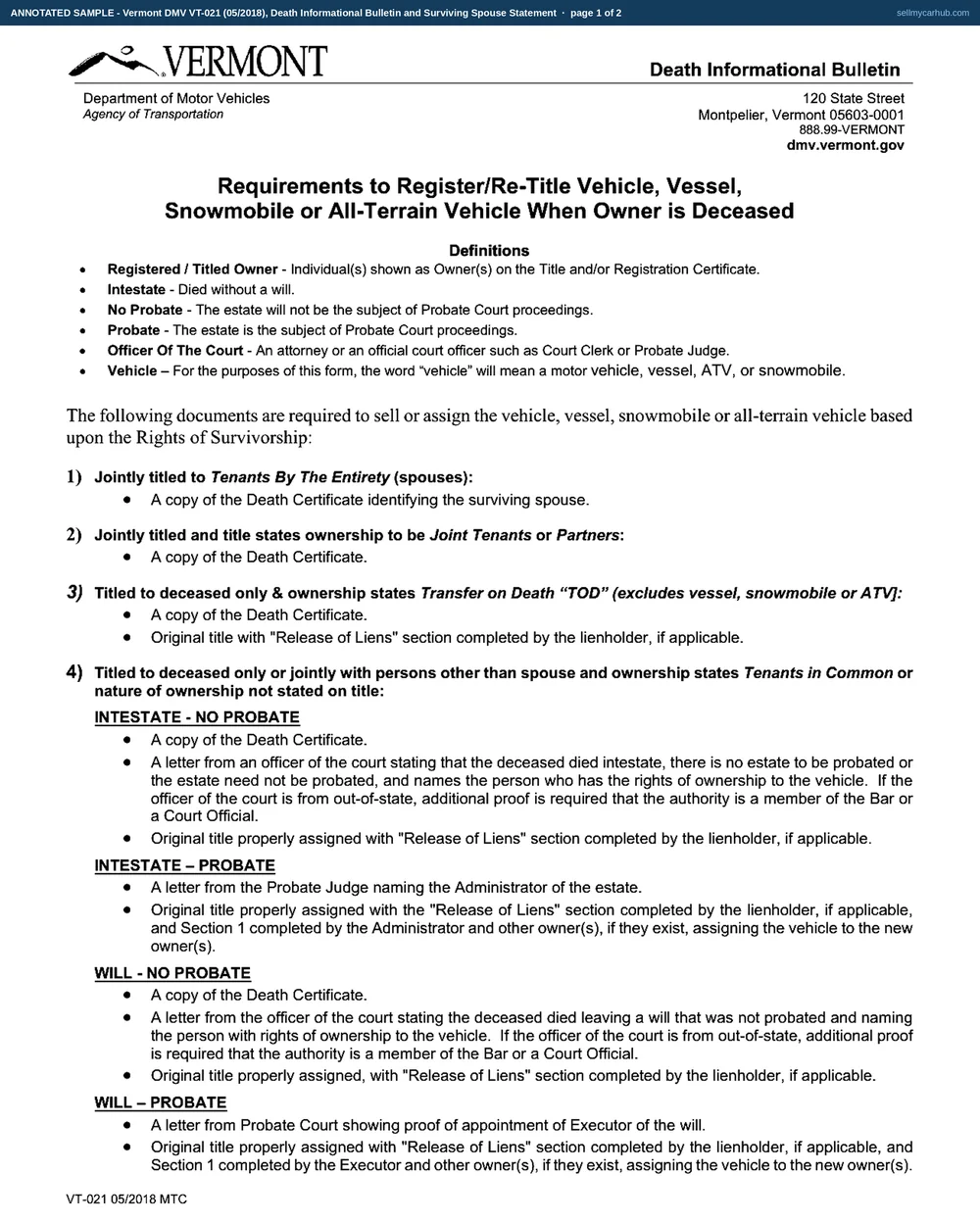
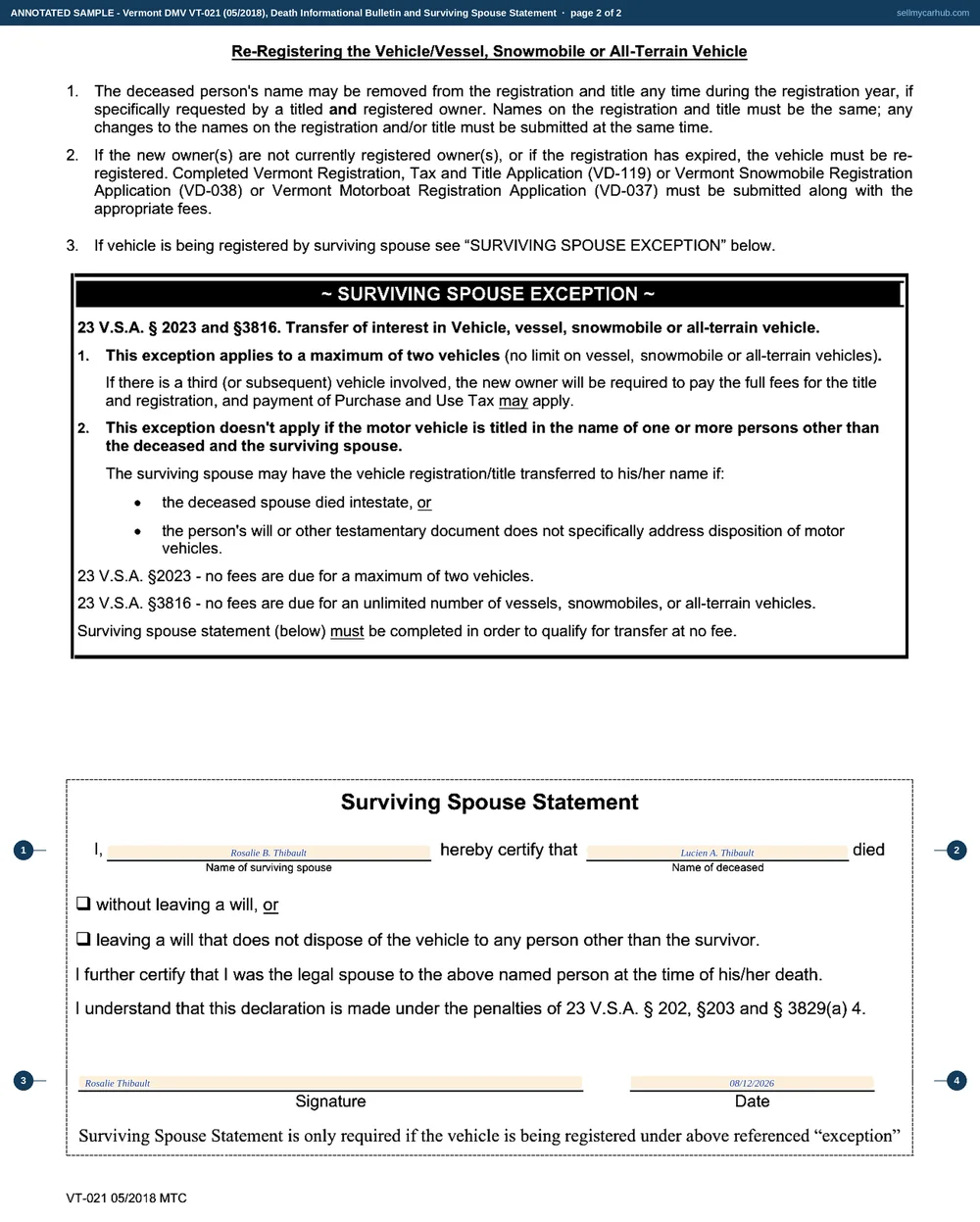
Both pages of the Vermont Death Informational Bulletin, form VT-021. The first page is the department's decision table, with the four routes through an estate shaded as printed text rather than boxes to complete. The second page carries the surviving spouse exception and, at its foot, the Surviving Spouse Statement completed in the name of Rosalie B. Thibault certifying that Lucien A. Thibault died, with her signature and a date of 12 August 2026 written on the two rules beneath.
Page 1 of 2.
Both pages of the Vermont Death Informational Bulletin, form VT-021. The first page is the department's decision table, with the four routes through an estate shaded as printed text rather than boxes to complete. The second page carries the surviving spouse exception and, at its foot, the Surviving Spouse Statement completed in the name of Rosalie B. Thibault certifying that Lucien A. Thibault died, with her signature and a date of 12 August 2026 written on the two rules beneath.
Page 2 of 2.
Field by field

Every line, in the order you meet it

  1. 1
    You fill this in

    Read the legend on the certificate first

    TEN ENT, JTEN, TEN COM, PTNRS, TOD, or nothing printed at all.

    Watch out: Everything on page one branches from that one abbreviation, and the difference between two of them is a death certificate against a letter from a probate judge.

  2. 2
    You fill this in

    Route 1 or 2: get a copy of the death certificate

    For tenants by the entirety, the copy has to identify the surviving spouse.

    Watch out: Vermont town clerks issue certified copies of death certificates for deaths recorded in the town. Order two while you are there; the buyer's application keeps one.

  3. 3
    You fill this in

    Route 3: the TOD certificate

    A copy of the death certificate and the original title with the Release of Liens section completed if a lienholder is printed on it.

    Watch out: The named beneficiary is now the owner and signs as the seller. Nothing they signed before the death has any effect.

  4. 4
    You fill this in

    Route 4: work out which of the four sub-routes you are on

    Intestate or a will, probate or no probate. Four combinations, four different letters.

    Watch out: The letter has to name the person who has the rights of ownership to the vehicle. A letter that merely confirms a death is not the letter the department is asking for.

  5. 5
    You fill this in

    Section 1 on the back of the title

    Completed by the administrator or the executor, with any other owners, assigning the vehicle to the new owner.

    Watch out: It is signed in the name of the estate's officer, not in the deceased's name. Signing a dead person's name into an assignment is a false statement, not a shortcut.

  6. 6
    You fill this in

    Surviving spouse: check the two conditions before the statement

    No more than two vehicles, and nobody other than the deceased and the spouse on the title.

    Watch out: The cap is per person, not per estate, and the third vehicle simply reverts to the ordinary fees and tax. It is not a refusal.

  7. 7
    You fill this in

    The Surviving Spouse Statement

    Your name, the deceased's name, one of the two boxes ticked, and your signature and date.

    Watch out: Tick the limb that is actually true. The second limb - a will that does not dispose of the vehicle to anyone other than you - is the one people miss because they assume any will closes the exception.

  8. 8
    You fill this in

    Then the registration application

    A VD-119 for a new owner who is not already a registered owner, or where the registration has expired.

    Watch out: Under the exception no fee is assessed on up to two vehicles and the transaction is exempt from purchase and use tax, which is worth knowing before somebody pays it at the counter.

At a glance

What goes where

On the formWhat to put in it
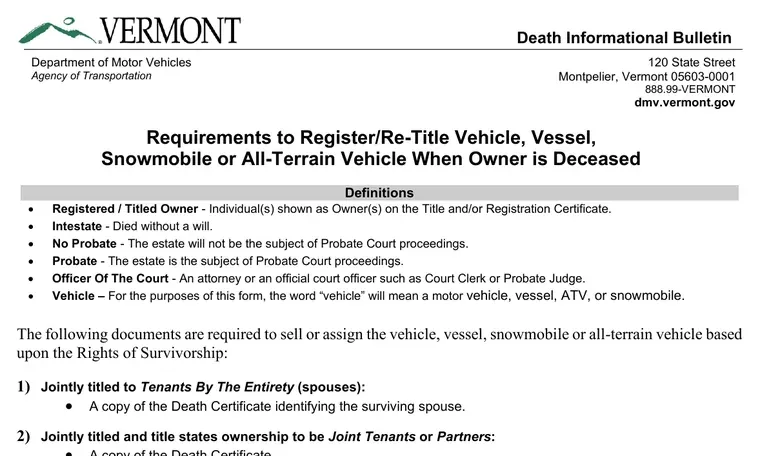
DefinitionsSix of them, and they carry weight later: registered/titled owner, intestate, no probate, probate, officer of the court - an attorney or an official court officer such as a court clerk or probate judge - and vehicle, which here includes a vessel, an ATV and a snowmobile.
Route 1 - Jointly titled to Tenants By The Entirety (spouses)One document: a copy of the death certificate identifying the surviving spouse. Nothing else.
Route 2 - Joint Tenants or PartnersA copy of the death certificate. The department treats both legends the same way here, which is itself the answer to a question its own forms disagree about.
Route 3 - Titled to deceased only with Transfer on DeathA copy of the death certificate, and the original title with the Release of Liens section completed by the lienholder if there is one. Excludes vessels, snowmobiles and ATVs.
Route 4 - Tenants in Common, or no legend printed, split four waysIntestate with no probate, intestate with probate, will with no probate, will with probate. Each needs a different letter from a different court officer before anybody can sign.
Re-registering the vehicleThree numbered notes: the deceased's name may be removed at any time during the registration year at a titled owner's request; names on registration and title have to match and change together; and a new owner who is not already a registered owner re-registers on a VD-119.
Surviving Spouse Exception - the conditionsTwo vehicles maximum, no limit on vessels, snowmobiles or ATVs; it does not apply if anybody other than the deceased and the surviving spouse is on the title; and it applies where the spouse died intestate or the will does not specifically address the disposition of motor vehicles.
Surviving Spouse Statement: I, [name of surviving spouse], hereby certify that [name of deceased] diedTwo blanks in one sentence, and the whole of the claim.
Without leaving a will / leaving a will that does not dispose of the vehicle to any person other than the survivorTwo boxes, one of which must be ticked. They are the two limbs of s. 2023(e).
I further certify that I was the legal spouse to the above named person at the time of his/her deathThe second certification, printed above the signature line.
Signature and DateOne signature. The note underneath limits when it is needed: the statement is only required if the vehicle is being registered under the exception.

What gets this one rejected

Rules that decide whether it is accepted

Every line here was read off VT-021 (05/2018) itself — the PDF is here — and off the Vermont Department of Motor Vehicles, Agency of Transportation pages. This is plain-language help with a form, not legal advice, and where our wording and the agency's differ, theirs governs.

Back to all Vermont seller paperwork, or what selling a car in Vermont involves.

Want the paperwork handled instead?

Get My Instant Offer → Online · about 2 minutes · free

Or send the details — we'll come to you

If a car is sitting in a dead relative's name and nobody can work out which letter is needed, tell us what you have and we will tell you what it is worth as it stands.

or call/text (877) 405-1808