The designation that has to be made while the owner is alive, and the reason a Vermont certificate can read TOD. It names the person who becomes the owner on the titled owner's death, and it changes nothing at all before then: the designated transferee is not listed on the registration, has no rights of ownership, and cannot stop or join a sale. For a seller this form matters twice - once because the legend on your own certificate may be it, and once because a car you are being offered with a TOD legend is a car whose seller has to be alive and has to be the titled owner.
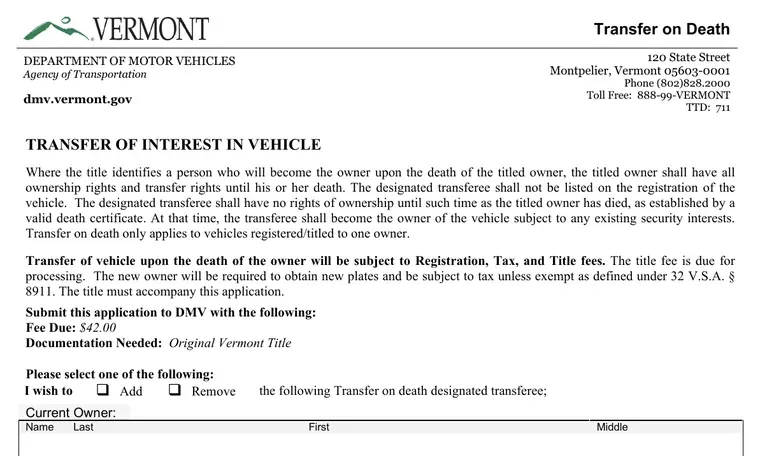
Written against VT-007 (12/2023), issued under 23 V.S.A. s. 2023(f), transfer on death designation, with the fee at s. 2002(a)(3) and the tax exemptions at 32 V.S.A. s. 8911; certified under 23 V.S.A. s. 202, s. 203, s. 2082, s. 2083 and 32 V.S.A. s. 8901-8915. If you are selling a car whose certificate reads TOD, the designation does not have to be removed first - your right to transfer is unaffected while you are alive - but the buyer's application will be read against a certificate carrying a legend, so have the explanation ready rather than discovering it at the counter.
Two documents, and they are not the same thing. Take the blank VT-007 from the dmv.vermont.gov copy so you get the revision that is current today, then print our VT-007 guide and keep it beside you while you fill theirs in.
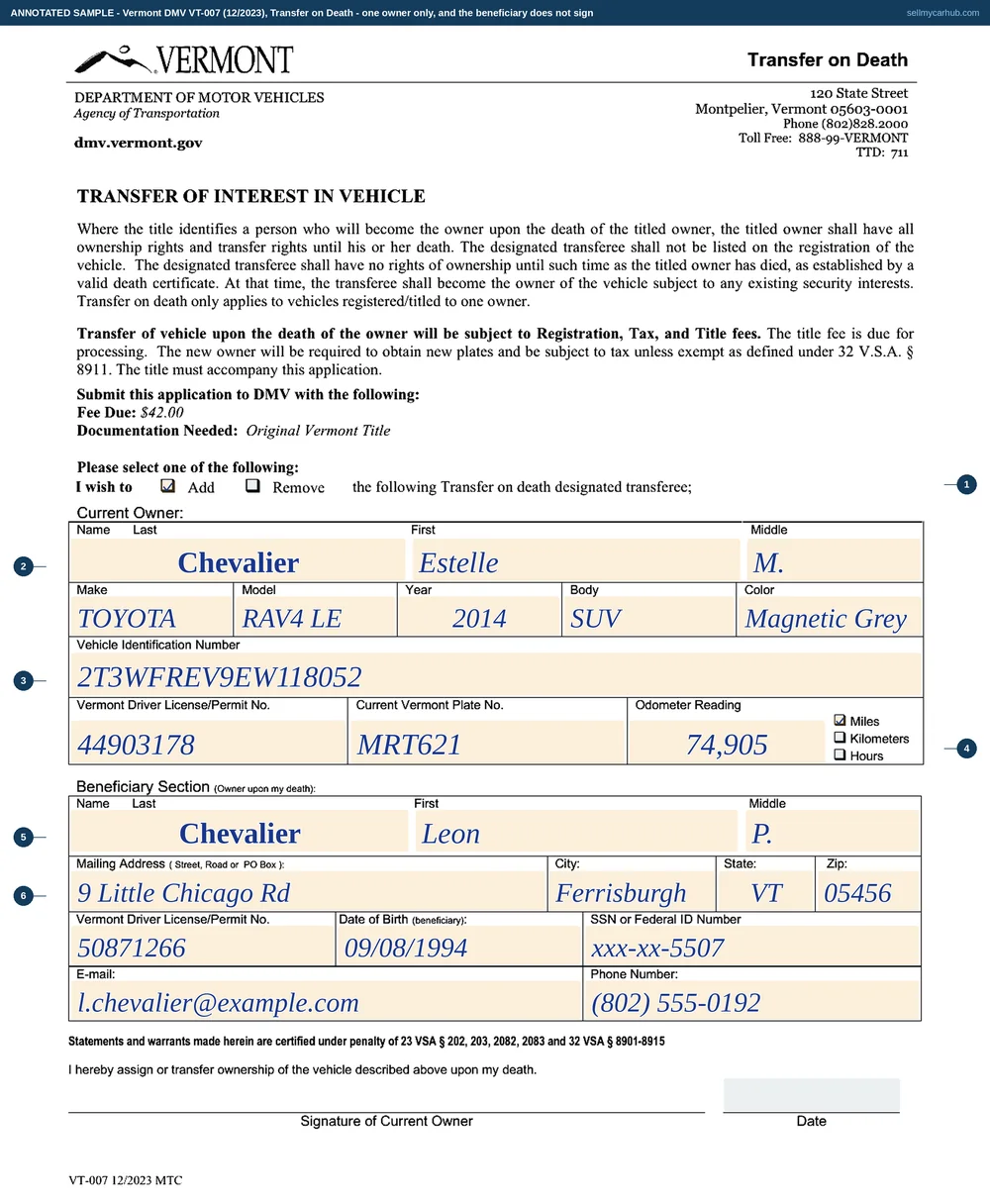
This is the actual VT-007, rendered from the PDF the Vermont Department of Motor Vehicles, Agency of Transportation publishes and completed end to end: letterhead, every field, and the blocks at the foot.
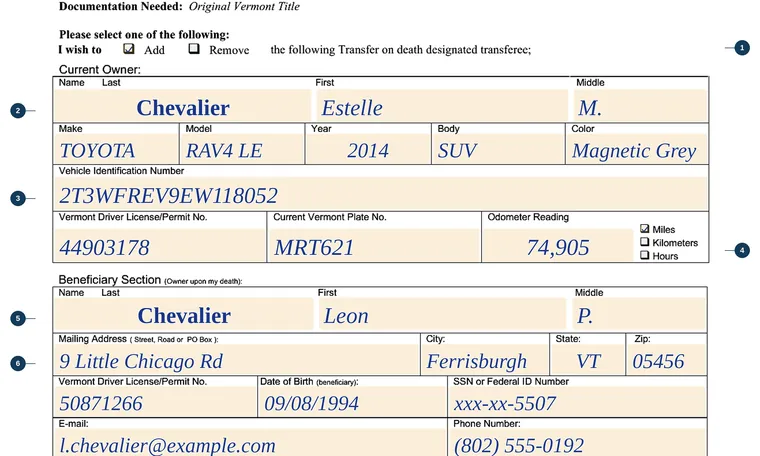
One tick at the top. The same form makes a designation and cancels one.
Watch out: Changing your mind about who is named means Remove and then Add, and the department charges the title fee for the new certificate either way.
The titled owner - singular, because the form only works on a single-owner vehicle.
Watch out: If your certificate has two names on it, this is not your form. A jointly held Vermont vehicle already carries a survivorship rule in its legend, and JTEN or TEN ENT does the same job.
The one vehicle this designation covers.
Watch out: Two cars is two forms and two fees. There is no combined designation in Vermont and nothing on this sheet pretends otherwise.
Seventeen characters, from the certificate you are about to post with it.
Watch out: Read it against the certificate one more time. The certificate is going into the envelope, so a mismatch is discovered by somebody in Montpelier rather than by you.
Your credential, the current plate, and a whole-number reading with its unit ticked.
Watch out: The reading is a record, not a disclosure - no sale is happening here - but write the true figure anyway, because it is the number the next certificate is printed with.
The person who becomes the owner at your death, and nobody else.
Watch out: Tell them. Nothing in this process notifies the person you have named, and a designation nobody knows about is found in the same drawer as the certificate, months late.
Their full postal address.
Watch out: An address that goes stale is the usual failure here. It is worth checking the designation every time you renew the registration.
The identification block for the person being named.
Watch out: You will have to ask them for these, which is a second reason the designation cannot really be kept a secret.
One signature, under the sentence assigning ownership of the vehicle upon your death.
Watch out: Post it with the original Vermont title and $42.00. All three go together, and an application arriving without the certificate stops at the first desk it reaches.
| On the form | What to put in it |
|---|---|
| I wish to Add / Remove the following Transfer on death designated transferee | Two ticks at the head of the form. The same sheet makes a designation and cancels one, and a designation that is being replaced needs the old one removed. |
| Current Owner: Name, Last, First, Middle | The titled owner, and only one of them. The form states the limit in a line of its own: transfer on death only applies to vehicles registered and titled to one owner. |
| Make, Model, Year, Body, Color | The vehicle. A designation covers one vehicle, and a second car needs a second form and a second fee. |
| Vehicle Identification Number | One wide box across the sheet, copied from the certificate that will accompany the application. |
| Vermont Driver License/Permit No., Current Vermont Plate No., Odometer Reading with Miles, Kilometers or Hours | Your credential, the plate on the car now, and a reading in whole numbers with one of three unit ticks beside it. |
| Beneficiary Section (Owner upon my death): Name, Last, First, Middle | The person who becomes the owner. One name, and the form has room for no other. |
| Beneficiary Mailing Address, City, State, Zip | Where the department will write when the time comes. |
| Beneficiary Vermont Driver License/Permit No., Date of Birth, SSN or Federal ID Number | The identification block for the person being named, filled in now rather than by them later. |
| Beneficiary E-mail and Phone Number | Two contact boxes, and the only route the department has to somebody who may not know they have been named. |
| I hereby assign or transfer ownership of the vehicle described above upon my death - Signature of Current Owner and Date | One signature. No notary, no witness, no beneficiary signature - the person being named does not sign this form at all. |
Every line here was read off VT-007 (12/2023) itself — the PDF is here — and off the Vermont Department of Motor Vehicles, Agency of Transportation pages. This is plain-language help with a form, not legal advice, and where our wording and the agency's differ, theirs governs.
Back to all Vermont seller paperwork, or what selling a car in Vermont involves.