Sell My Car Hub

How to fill out Vermont VT-008

The department's own release form, signed by the lender rather than by you. Vermont does not run an electronic lien system, so a paid-off loan leaves a certificate with a lienholder still printed on its face and nothing in the department's record to contradict it. This form, or a letter on the lender's letterhead, is what clears it - and the fee is the point most sellers miss: the release travels with the existing title and $42.00, because what the department is doing is issuing a fresh certificate without the lender's name on it.
Written against VT-008 (11/2023), issued under 23 V.S.A. s. 2045, release of security interest, declared under penalties of 23 V.S.A. s. 202, s. 203 and s. 3829. The odometer block on this form is a real disclosure, not a formality - it carries the same three certifications as the title. Do not let a lender's back office write a rounded figure into it on a car whose reading you have already disclosed on a VT-005.

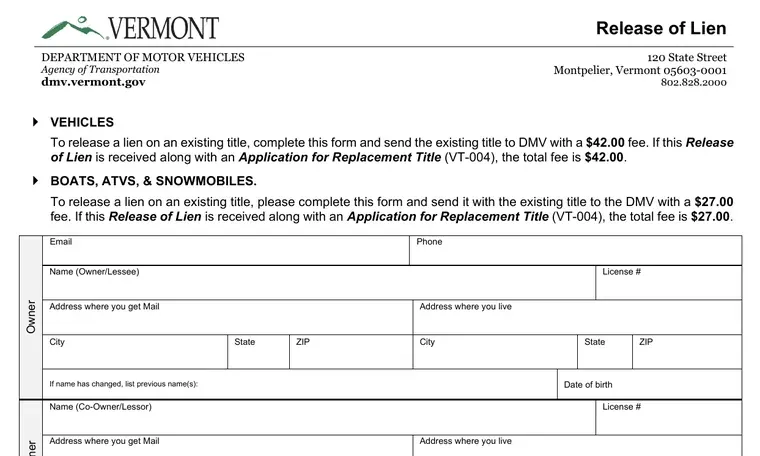
Two documents, and they are not the same thing. Take the blank VT-008 from the dmv.vermont.gov copy so you get the revision that is current today, then print our VT-008 guide and keep it beside you while you fill theirs in.

Filled in

What a completed one looks like

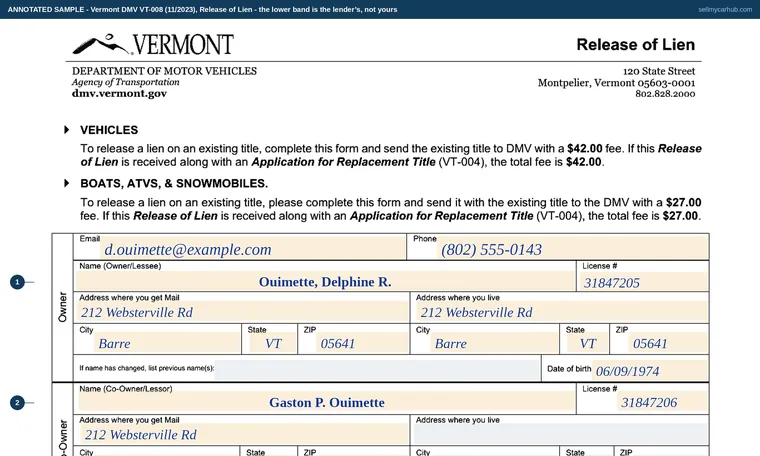
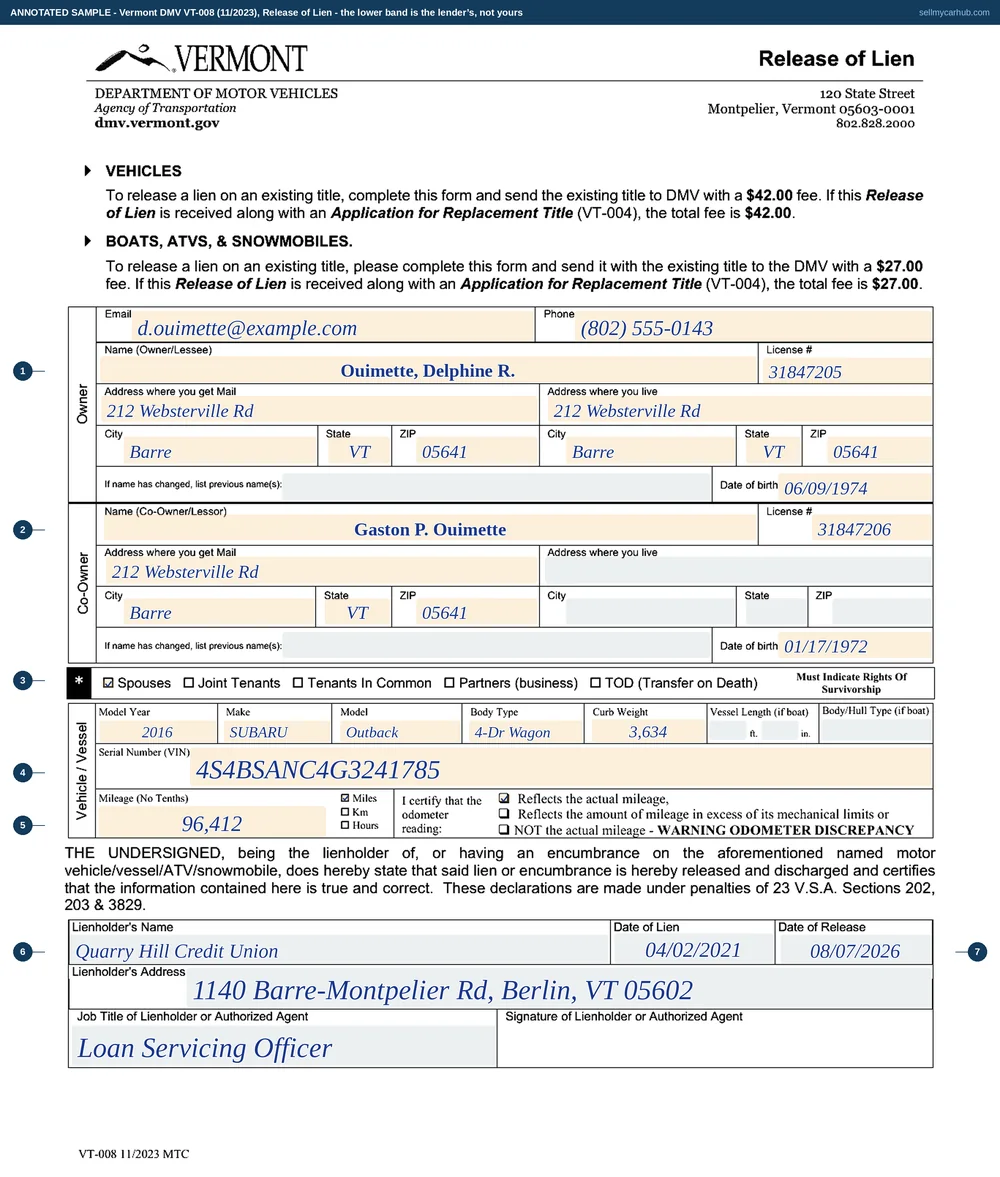
This is the actual VT-008, rendered from the PDF the Vermont Department of Motor Vehicles, Agency of Transportation publishes and completed end to end: letterhead, every field, and the blocks at the foot.

A completed Vermont Release of Lien, form VT-008, clearing Quarry Hill Credit Union from the certificate of a 2016 Subaru Outback: the owner named as Ouimette, Delphine R. of Barre with a co-owner Gaston P. Ouimette, the Spouses survivorship box ticked, model year 2016, make Subaru, model Outback, body type 4-Dr Wagon, curb weight 3,634, vehicle identification number 4S4BSANC4G3241785, mileage 96,412 with the actual-mileage certification, and the lienholder block naming the credit union with a lien date of 04/02/2021, a release date of 08/07/2026 and the job title Loan Servicing Officer.
Rendered from the department's own PDF. Everything in the lower band is greyed because it belongs to the lender: the seller fills in the vehicle and the owners, and the release itself is somebody else's signature. The credit union is invented, nobody in this sample exists, and the VIN carries a correct check digit but identifies no vehicle.
Field by field

Every line, in the order you meet it

  1. 1
    You fill this in

    Name (Owner/Lessee), and License #

    Your name exactly as the certificate prints it, with your Vermont credential number.

    Watch out: If the certificate carries a name you no longer use, fill in the previous-names box rather than writing today's name and hoping. The department matches this against the record it already holds.

  2. 2
    You fill this in

    The two address lines

    Where you get mail and where you live, each with its own city, state and ZIP.

    Watch out: The corrected certificate is posted to the mailing address. Getting it wrong on a document that only exists to produce a new title is an expensive kind of careless.

  3. 3
    You fill this in

    Rights of survivorship

    One of five ticks, compulsory wherever two owners are named.

    Watch out: It has to match what is already printed on the certificate. This form is not the place to change it - that is VT-019, and it costs a title fee.

  4. 4
    You fill this in

    Model Year, Make, Model, Body Type, Curb Weight

    Five boxes describing the car, curb weight included.

    Watch out: Curb weight is on the certificate and on the registration. It is not the towing capacity and it is not the gross weight.

  5. 5
    You fill this in

    Serial Number (VIN)

    Seventeen characters, matching the certificate you are surrendering.

    Watch out: This form and the certificate travel in the same envelope, so a mismatch is caught immediately - but it is caught in Montpelier, a week later.

  6. 6
    You fill this in

    Mileage, and its certification

    The reading at the moment of release, in whole numbers, with one of three boxes ticked.

    Watch out: Use the same figure you gave the buyer. Two different readings for one car in one month is exactly the pattern the department's brand codes exist to record.

  7. 7
    The lienholder fills this in

    Lienholder's Name, Date of Lien and Date of Release

    The lender's own block: who held the security interest, when it was created and when it ended.

    Watch out: The lien date has to match what is printed on the certificate. A lender's system sometimes carries the funding date instead, and the two can be days apart.

  8. 8
    The lienholder fills this in

    Job Title of Lienholder or Authorized Agent

    A named role, beside the signature.

    Watch out: A signature with no title is the most common reason a release comes back. It costs the lender ten seconds and it costs you two weeks.

At a glance

What goes where

On the formWhat to put in it
Email and PhoneContact details for the owner, at the head of the form rather than the foot.
Owner: Name (Owner/Lessee), License #You, as the person named on the certificate, with your Vermont credential number.
Address where you get Mail, and Address where you liveTwo separate lines with their own city, state and ZIP boxes. The department wants both where they differ.
If name has changed, list previous name(s), and Date of birthA box that exists because a certificate issued before a marriage carries a name that no longer matches a licence.
Co-Owner: Name (Co-Owner/Lessor), and the same address block againThe second owner, where the certificate names one.
Rights of survivorship: Spouses, Joint Tenants, Tenants In Common, Partners (business), TODFive ticks under a heading in red reading Must Indicate Rights Of Survivorship. It is compulsory on a certificate in more than one name.
Model Year, Make, Model, Body Type, Curb WeightThe vehicle block. Curb weight is asked for here and not on most of the sibling forms.
Vessel Length (if boat), and Body/Hull Type (if boat)Blank on a car, and the reason the fee on this form has two figures.
Serial Number (VIN)Seventeen characters, matching the certificate being surrendered.
Mileage (No Tenths), with Miles, Km or HoursThe reading at the moment of release, with one of three units.
I certify that the odometer reading: three certificationsReflects the actual mileage; reflects the amount of mileage in excess of its mechanical limits; or NOT the actual mileage - warning odometer discrepancy.
Lienholder's Name, Date of Lien, Date of ReleaseThe lender, the date the security interest was created and the date it ended. Two dates, and the department reads them against its own record.
Lienholder's AddressIn full. It is how the department matches the release to the lien printed on the certificate.
Job Title of Lienholder or Authorized Agent, and SignatureA job title as well as a signature, because the department is checking that whoever signed had authority to.

What gets this one rejected

Rules that decide whether it is accepted

Every line here was read off VT-008 (11/2023) itself — the PDF is here — and off the Vermont Department of Motor Vehicles, Agency of Transportation pages. This is plain-language help with a form, not legal advice, and where our wording and the agency's differ, theirs governs.

Back to all Vermont seller paperwork, or what selling a car in Vermont involves.

Want the paperwork handled instead?

Get My Instant Offer → Online · about 2 minutes · free

Or send the details — we'll come to you

If the payoff is more than the car is worth and you would rather stop, tell us the year, the mileage and the balance and we will tell you where the two numbers actually sit.

or call/text (877) 405-1808