The instruction that lets a buyer's money reach your lender and the certificate come back released. It is signed by you as the owner but issued and countersigned by a Vermont dealer or an insurance company, which is why it is not a form to download and post on your own - it exists for the case where somebody else is handling the payoff. Read it anyway, because its middle sentence is the exact wording your own lender needs to hear before it will release paper to a stranger.
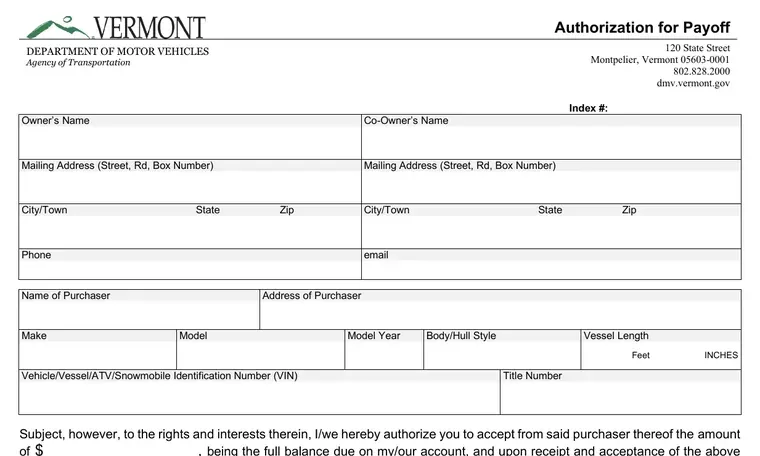
Written against VT-023 (11/2023), issued under 23 V.S.A. s. 2045 and s. 2046, lienholder's duties on release, certified under penalties of 23 V.S.A. s. 202, s. 203, s. 2082, s. 2083, s. 3829 and s. 3830. Because a dealer or an insurance company issues this, the copy you are handed may be pre-filled with their details and a payoff figure quoted on a particular day. Check the figure and the date before you sign, not afterwards.
Two documents, and they are not the same thing. Take the blank VT-023 from the dmv.vermont.gov copy so you get the revision that is current today, then print our VT-023 guide and keep it beside you while you fill theirs in.
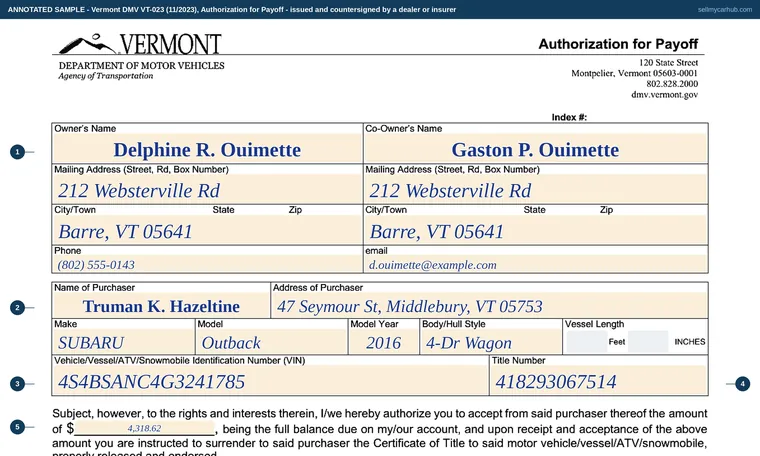
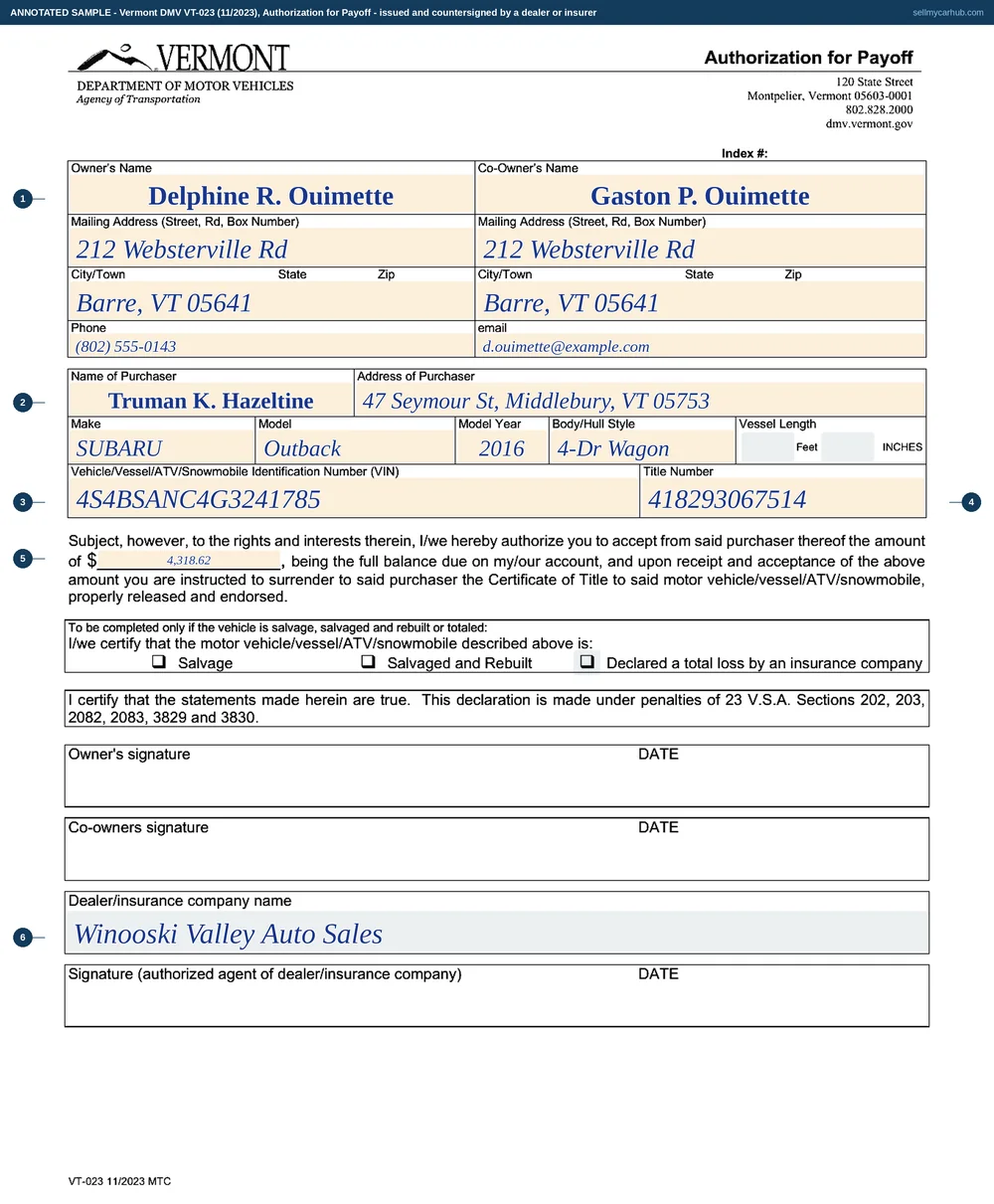
This is the actual VT-023, rendered from the PDF the Vermont Department of Motor Vehicles, Agency of Transportation publishes and completed end to end: letterhead, every field, and the blocks at the foot.
Both owners, with their own address blocks beneath.
Watch out: Use the names the lender has on the loan, not the ones on the title, if by some accident they differ. This form is read by the lender first.
The person or dealership the certificate is to be surrendered to.
Watch out: This is the whole point of the form. A lender that cannot identify the purchaser will post the certificate to you instead, three weeks later.
Four boxes describing the car as the certificate describes it.
Watch out: Body style is the department's word for it, not the manufacturer's trim name. Wagon rather than Premium.
Seventeen characters, and the number printed on the certificate the lender is holding.
Watch out: If you cannot find the title number because the lender has the certificate, it is also noted on the face of your registration.
The full balance due on the account, written into the sentence rather than into a labelled box.
Watch out: Ask for a per-diem figure as well as a payoff quote. A ten-day quote that expires on a Friday is how a Saturday completion falls apart.
Three boxes, completed only if any of them applies.
Watch out: A branded car still has to be disclosed to the purchaser orally and in writing. A lender's paperwork does not do that job for you.
Both, with dates, under a certification made under six statutory sections.
Watch out: Read the payoff figure once more immediately above your pen. It is the number the lender will act on and the number the buyer will hand over.
The countersignature that turns this into a three-party instruction.
Watch out: If nobody is going to countersign it because there is no dealer involved, do not use this form at all. Write to your lender with the same sentence and get a payoff letter back.
| On the form | What to put in it |
|---|---|
| Owner's Name and Co-Owner's Name | Both, where the certificate carries two, with their mailing addresses beneath. |
| Mailing Address, City/Town, State, Zip, Phone, email | A full contact block for each owner, because the lender may need to reach either of them. |
| Name of Purchaser and Address of Purchaser | The buyer, or the dealer taking the car in. This is who the lender is being told to surrender the certificate to. |
| Make, Model, Model Year, Body/Hull Style, Vessel Length | The vehicle block, in the same order as VT-017. |
| Vehicle/Vessel/ATV/Snowmobile Identification Number (VIN), and Title Number | The certificate being talked about, identified twice over. |
| the amount of $______, being the full balance due on my/our account | The payoff figure, written into a sentence rather than into a labelled box. |
| upon receipt and acceptance of the above amount you are instructed to surrender to said purchaser the Certificate of Title | The operative instruction - properly released and endorsed, in the form's own words. |
| To be completed only if the vehicle is salvage, salvaged and rebuilt or totaled | Three ticks, the same three as on VT-005, because a payoff on a branded car is still a disclosure event. |
| Owner's signature and Co-owner's signature, with dates | Both, under a certification made under six separate statutory sections. |
| Dealer/insurance company name, and Signature (authorized agent of dealer/insurance company), with date | The countersignature that makes this a three-party instruction rather than a letter. |
Every line here was read off VT-023 (11/2023) itself — the PDF is here — and off the Vermont Department of Motor Vehicles, Agency of Transportation pages. This is plain-language help with a form, not legal advice, and where our wording and the agency's differ, theirs governs.
Back to all Vermont seller paperwork, or what selling a car in Vermont involves.