Sell My Car Hub

How to fill out Rhode Island TR-6

The form for a title application that should never have been filed - a sale that collapsed after the paperwork went in. It asks the DMV to withdraw all supporting documents relative to an application for Rhode Island Motor Vehicle Certificate of Title, and it carries two warnings a private seller should read before signing: the fees are gone, and there is a ten-day clock.
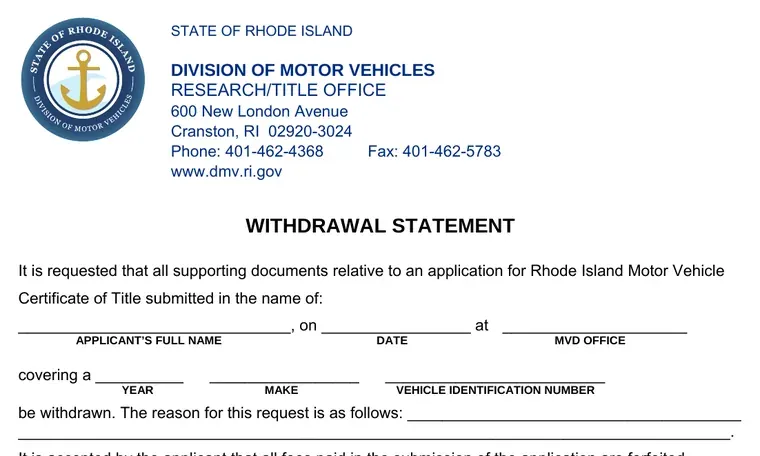
Written against TR-6 (Rev 11/24), issued under RI DMV Research/Title Office. The fees are stated as forfeited in a printed sentence directly above the signature rule, not in small print at the bottom. On a Rhode Island title transaction that is the whole title fee gone, plus whatever registration fee was paid at the same counter.

Two documents, and they are not the same thing. Take the blank TR-6 from the dmv.ri.gov copy so you get the revision that is current today, then print our TR-6 guide and keep it beside you while you fill theirs in.

Filled in

What a completed one looks like

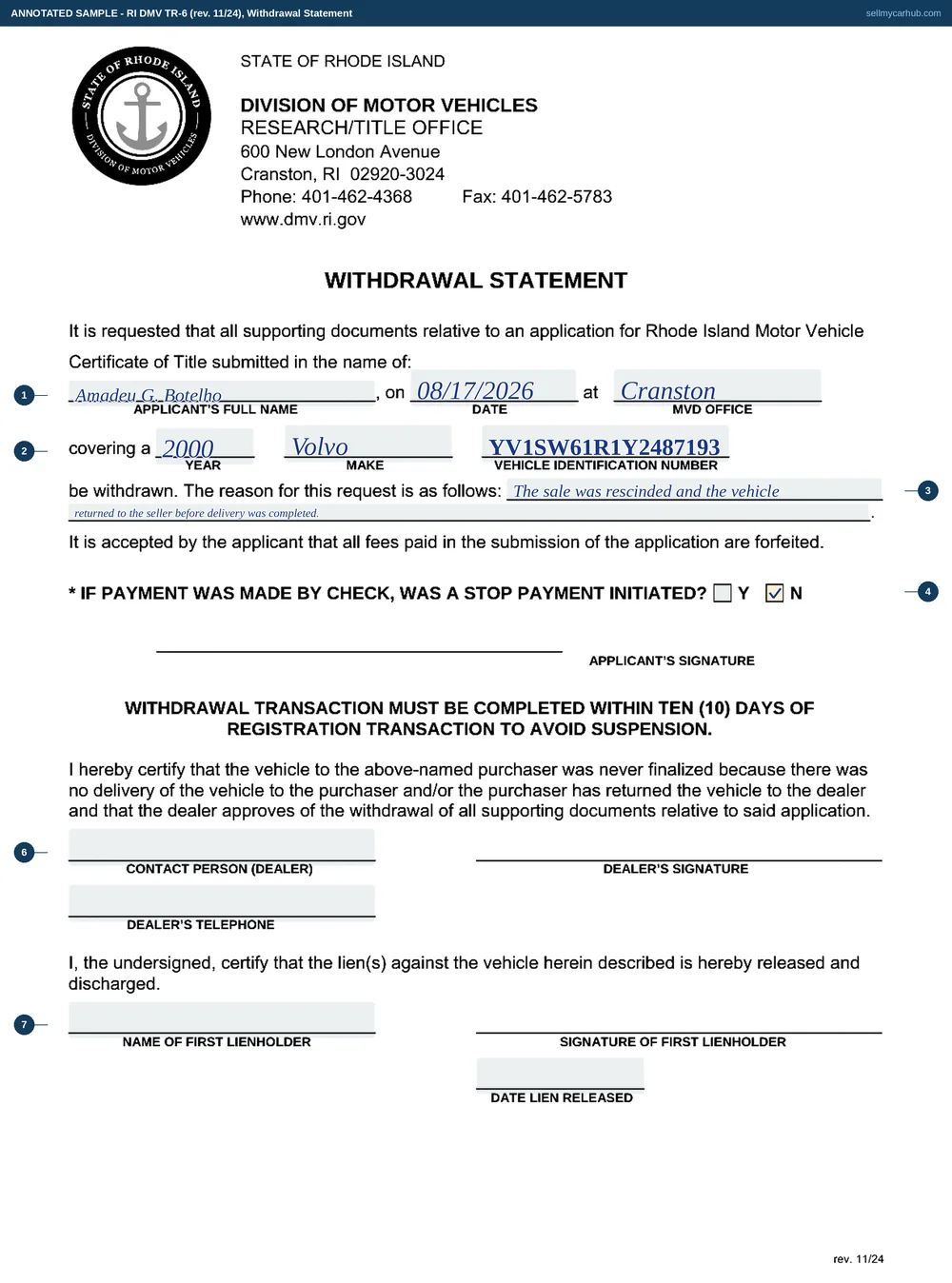
This is the actual TR-6, rendered from the PDF the Rhode Island Division of Motor Vehicles publishes and completed end to end: letterhead, every field, and the blocks at the foot.

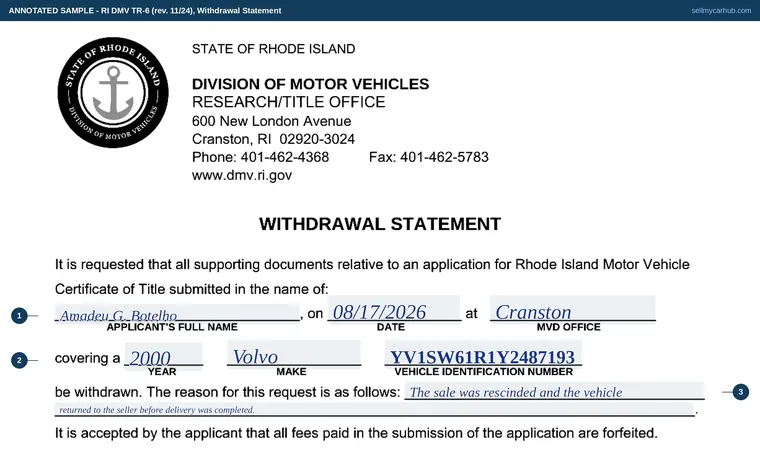
The Rhode Island Withdrawal Statement filled in as an annotated sample: an application submitted in the name of Amadeu G. Botelho on 17 August 2026 at the Cranston office, covering a 2000 Volvo with its vehicle identification number, a stated reason that the sale was rescinded and the vehicle returned to the seller before delivery was completed, the stop payment question answered No, and the dealer certification and lien release blocks below left empty and greyed.
The top third is the applicant's and the rest is not. Read the sentence directly above the signature line - all fees paid in the submission of the application are forfeited - and then read the capitals underneath it, which give ten days from the registration transaction before a suspension follows.
Field by field

Every line, in the order you meet it

  1. 1
    The buyer fills this in

    Identify the application

    The applicant's full name, the date it was submitted and the office it went to, written into the opening sentence.

    Watch out: The applicant is whoever filed for the title, which on a collapsed private sale is the buyer rather than you. If they will not sign it, there is nothing on this sheet a seller can do alone.

  2. 2
    The buyer fills this in

    The vehicle

    Year, make and vehicle identification number on three short rules.

    Watch out: No plate number is asked for. The identification number is how the Research Office finds the pending application.

  3. 3
    The buyer fills this in

    Say why

    Two rules of free text after the words the reason for this request is as follows.

    Watch out: Be factual and short. The DMV is deciding whether to unwind a transaction, not reading an account of the disagreement.

  4. 4
    The buyer fills this in

    Answer the stop-payment question

    Yes or no, against the question about a cheque.

    Watch out: If a stop payment has been put on the cheque, saying so here is what stops the DMV chasing a payment that will not arrive. Silence on it is what turns a withdrawal into a suspension.

  5. 5
    The buyer fills this in

    Sign, having read the forfeiture sentence

    One rule, under the printed acceptance that all fees paid are forfeited.

    Watch out: Then read the capitals below it. Ten days from the registration transaction is the window, and it is measured from the counter rather than from the day the deal fell apart.

  6. 6
    Dealers only

    The dealer block, if there is a dealer

    A certification that the vehicle was never delivered or has been returned to the dealership, with a contact person, a signature and a telephone number.

    Watch out: On a private sale there is nobody to sign this. That is not fatal - it is the applicant's signature above that carries the request - but expect the Research Office to ask what happened.

  7. 7
    The lienholder fills this in

    The lienholder block

    The first lienholder certifying that the lien is released and discharged, with a date.

    Watch out: It only applies where a lien was recorded as part of the transaction being withdrawn. On a cash sale it stays empty.

At a glance

What goes where

On the formWhat to put in it
Applicant's full name, date and MVD officeThree rules across the opening sentence, identifying the application to be withdrawn and where it was submitted.
The vehicleYear, make and vehicle identification number.
The reason for this requestTwo rules of free text.
The forfeitureA printed sentence, not a box: it is accepted by the applicant that all fees paid in the submission of the application are forfeited.
Stop paymentA yes or no tick against the question - if payment was made by check, was a stop payment initiated?
Applicant's signatureOne rule, above the printed ten-day warning.
Dealer certificationA separate block certifying that there was no delivery of the vehicle to the purchaser and/or the purchaser has returned the vehicle to the dealer, with a contact person, a dealer's signature and a dealer's telephone.
Lien releaseA final block where a first lienholder certifies that the lien against the vehicle is hereby released and discharged, with a signature and a date lien released.

What gets this one rejected

Rules that decide whether it is accepted

Every line here was read off TR-6 (Rev 11/24) itself — the PDF is here — and off the Rhode Island Division of Motor Vehicles pages. This is plain-language help with a form, not legal advice, and where our wording and the agency's differ, theirs governs.

Back to all Rhode Island seller paperwork, or what selling a car in Rhode Island involves.

Want the paperwork handled instead?

Get My Instant Offer → Online · about 2 minutes · free

Or send the details — we'll come to you

A sale that fell apart after the paperwork went in is a bad week. If you would rather the next buyer be one who does not change their mind, talk to us.

or call/text (877) 405-1808