Rhode Island puts the private transfer on the back of the certificate, in the block section 31-3.1-7(c) calls the form for assignment and warranty of title by the owner. The DMV describes its two halves in one sentence on another page entirely, telling a widow to print and sign her name in both the buyer and seller areas on the back of the title and to include the vehicle's current mileage reading. What follows is that block, laid out from the statutes that define it, plus the answer to the question this state raises more than any other: what to sign when the car has no certificate at all.
Last updated .
Your 7 boxes
As a private seller you complete these and nothing else:
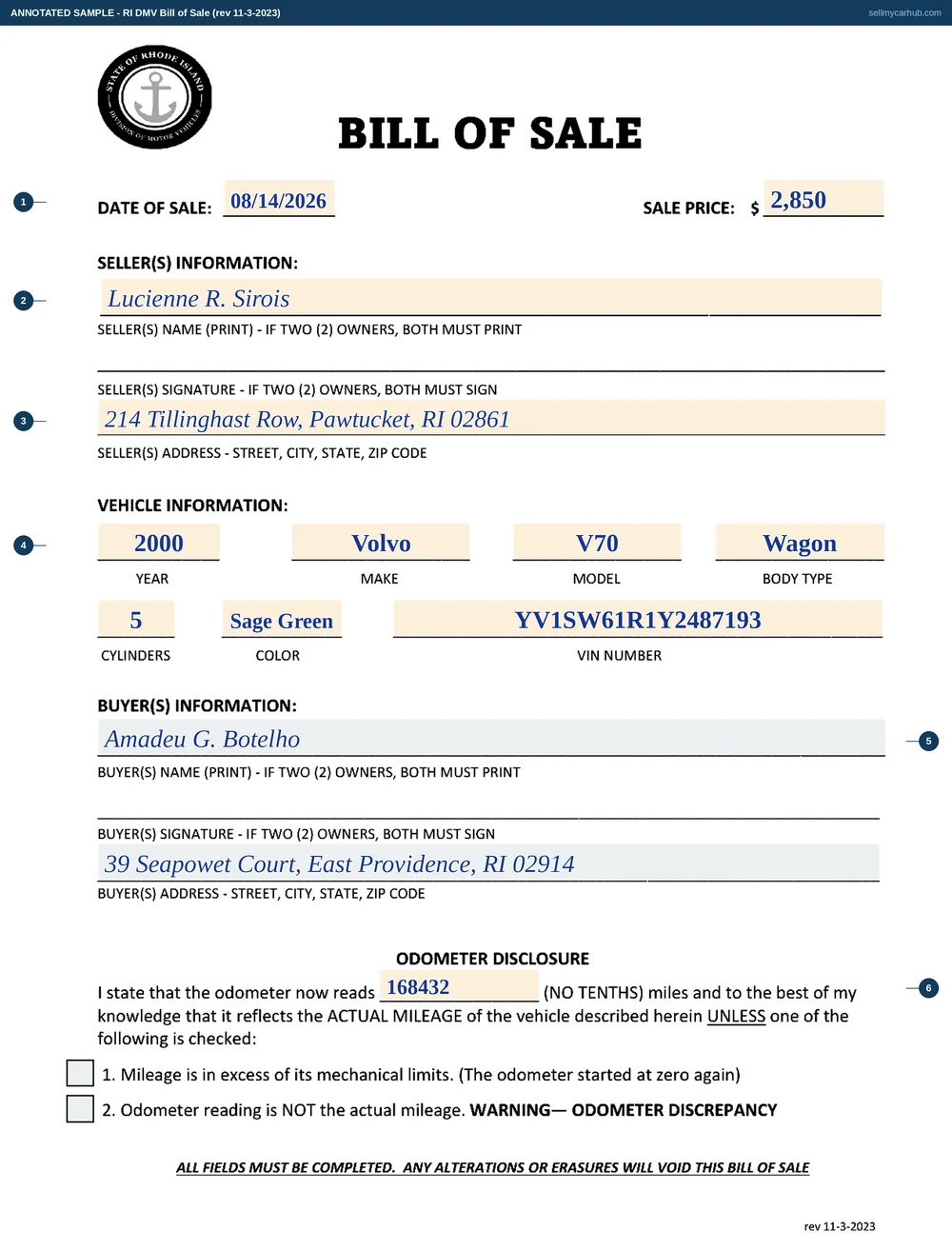
There is no blank Rhode Island title to download. The certificate arrives in the post from the Research and Title Office in Cranston, the assignment lives on the back of the one you already have, and the DMV publishes no printable version of it and no picture of it either. What it does publish is a bill of sale carrying the same odometer disclosure, and that is what the second picture on this page is.
ANY ALTERATIONS OR ERASURES WILL VOID THIS BILL OF SALE
The requirement is spread over three statutes rather than printed as a checklist, and it is worth having in one place before the buyer arrives: an assignment and warranty of title to a named transferee, executed at the time of delivery of the vehicle; the mileage entered and the form signed by both seller and buyer with a statement that both parties have viewed the odometer; and the same mileage entered on the owner's title certificate.
Drawn, not photographed
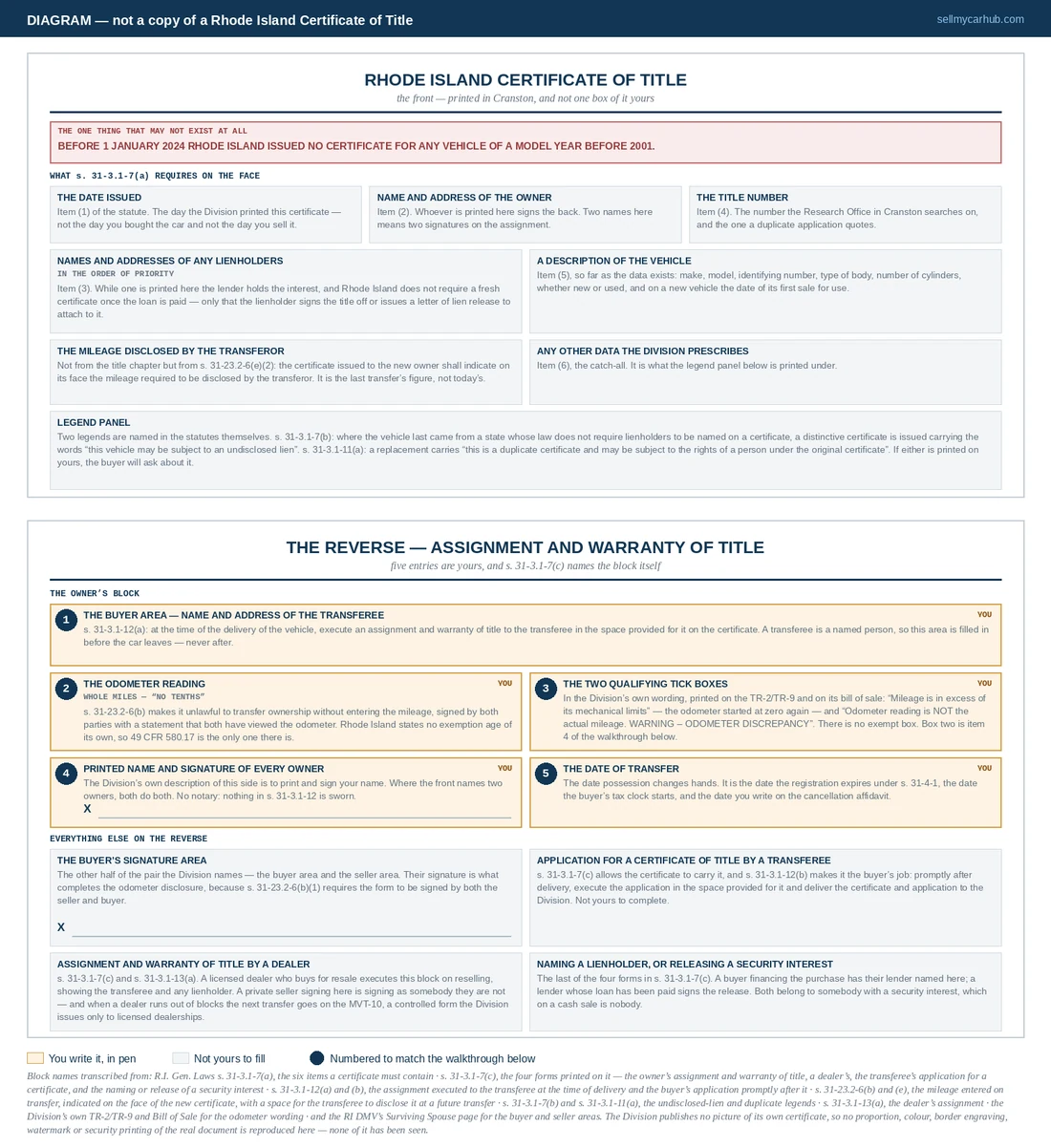
A Rhode Island Certificate of Title, laid out from the statute that says what has to be on it
The RI DMV publishes no image of its own certificate. Four sources were checked: every PDF on its six form indexes, downloaded and listed raster by raster; the Dealer Rules and Regulations at 280-RICR-30-20-1, which carries no images at all; the Titles page and the Checklist for Titles printed as page three of the TR-2/TR-9; and every part of the Rhode Island Code of Regulations under the DMV's own chapter. Nothing there is a specimen. So this is a diagram, marked as one on the image itself, and every block on it is named from a statute or from a page the DMV publishes.
Amber — you write it, in pen
Grey — not yours to fill
Numbered — the five entries that are yours, in order
Click or tap the picture to open it full size.
A diagram, not a reproduction. Every block name on it is transcribed from a source: R.I. Gen. Laws s. 31-3.1-7(a) for the six things every certificate must contain and s. 31-3.1-7(c) for the four forms printed on it; s. 31-3.1-12(a) for the assignment and warranty of title to the transferee; s. 31-23.2-6(e) for the mileage on the face and the space for the transferee to disclose mileage at a future transfer; s. 31-3.1-7(b) and s. 31-3.1-11(a) for the two legends; and the DMV's own Surviving Spouse page for the buyer and seller areas on the back. No proportion, colour, border engraving, watermark or security printing of the real certificate is shown here, because none of it has been seen.
A real one, filled in
The DMV's own bill of sale, which carries the same odometer disclosure
Rhode Island does not publish its certificate, but it does publish the document that sits beside it on every private sale, and that document reprints the assignment's own odometer wording word for word: the reading in whole miles, no tenths, the sentence about actual mileage, and the same two qualifying statements. If you want to see the shape of the block you are about to fill in on the back of a certificate, this is the closest thing the state prints - and you need it anyway.
Click or tap the picture to open it full size.
The DMV's own sheet, completed for a private sale. Read the line across the foot before you start writing: all fields must be completed, and any alterations or erasures will void this bill of sale. That is the same standard the certificate is held to, which is why the pen matters more here than the handwriting.
Step by step
Every box, in the order you meet it
1
You fill this in
The buyer area - the transferee's name and address
The first thing in the assignment block. Section 31-3.1-12(a) requires the assignment and warranty of title to be executed to the transferee, so it is a named person and their address, written by you.
Watch out: Copy it off the licence they showed you rather than off the message they sent. An assignment with this area blank is an open title: the registration in your name has already expired under section 31-4-1, and nothing on paper records who has the car.
2
You fill this in
The odometer reading, in whole miles
One figure, and every Rhode Island form that carries this disclosure prints the same instruction beside it: no tenths.
Watch out: Miles, not kilometres, and the number that is on the dial today rather than the one printed on the front of the certificate from the last transfer. Section 31-23.2-6(e) requires the face of the new certificate to show the mileage you disclose, so this figure follows the car.
3
You fill this in
Tick box one - mileage is in excess of its mechanical limits
Tick it only if the odometer has run past its own maximum and started again from zero. The DMV's bill of sale spells out what that means in brackets: the odometer started at zero again.
Watch out: This is not the box for an old car with a lot of miles on it. It is a factual claim that the dial has rolled over, and on a five-digit instrument in a car of this age it may well be true - but tick it only if it is.
4
You fill this in
Tick box two - the reading is not the actual mileage
For a replaced cluster, a broken instrument, or any reading you cannot vouch for. Rhode Island prints the consequence next to the box: WARNING - ODOMETER DISCREPANCY.
Watch out: Ticking it marks the record for the life of the car, and leaving it unticked when you know better is worse. Chapter 31-23.2 makes a false statement to a transferee a violation in its own right and gives the buyer a cause of action.
5
You fill this in
The seller area - print, sign, and date the transfer
Your name printed, your signature, and the date of the transfer. Everyone named on the front of the certificate does all three.
Watch out: Section 31-3.1-12(a) fixes the moment: at the time of the delivery of the vehicle. Signing days early and leaving the certificate in a drawer while the buyer thinks about it is a signed assignment with no delivery behind it.
6
The buyer fills this in
The buyer signs the buyer area, in front of you
Their signature completes the odometer disclosure, which under section 31-23.2-6(b)(1) has to be signed by both parties with a statement that both have viewed the odometer.
Watch out: A certificate with your half done and theirs empty is not a transfer, and you will not get it back once the car has gone. Photograph both sides before you hand it over.
7
The buyer fills this in
The application for a new certificate, underneath
Section 31-3.1-7(c) says the certificate may carry a form for application for a certificate of title by a transferee, and section 31-3.1-12(b) makes it their job to execute it promptly after delivery.
Watch out: Nothing here is yours to complete, but check they have not filled it in as the seller by mistake. Two blocks on the back of a certificate both ask for a name and only one of them is yours.
8
Dealers only
The dealer's assignment, which is not yours
The statute prints a separate form for assignment and warranty of title by a dealer, used when a licensed dealer buys for resale and passes the car on without a new certificate being issued in between.
Watch out: A private seller who runs out of room and continues into the dealer block has not found extra space, they have signed as somebody they are not. When a dealer runs out of blocks the next transfer goes on the MVT-10, which is a controlled form issued only to licensed Rhode Island dealerships.
9
You fill this in
Hand over the certificate and a bill of sale together
The certificate goes with the car. So does a bill of sale: the DMV lists it as a required document for a private-party sale, separately from the title.
Watch out: If the car is model year 2000 or older and Rhode Island never issued a certificate, the bill of sale is not a supporting document, it is the transfer - and the buyer also needs proof of previous ownership in your name, such as the old registration or a stamped paid sales tax form.
10
You fill this in
Take the plates off and cancel the registration
Online through the DMV's cancellation service in a few minutes, free, with a confirmation email at the end. Then the plates may be destroyed or recycled.
Watch out: Do it the same day. The registration expired the moment ownership moved, but the town's excise record and the DMV's insurance verification record do not know that until you tell them, and both of those cost money to argue with afterwards.
Before the pen
Before you write anything on the back of the certificate
Six habits, and the first exists because a Rhode Island certificate has no undo.
One attempt, in ink
Rhode Island's own instruction on the TR-1 is to please use blue or black ink only, and its bill of sale voids itself on an alteration or an erasure. A spoiled certificate is a $53.50 duplicate, a notary, and a wait.
Never leave the buyer area blank
An open assignment leaves a car in your name that somebody else is driving. The registration has already expired under section 31-4-1, so what you are left with is exposure and no record.
Whole miles, no tenths
Every Rhode Island form that carries the odometer disclosure prints those two words beside the box. The figure follows the car onto the face of the buyer's new certificate.
Print the name as well as signing it
Signature and printed name are separate entries in the block, and the DMV's description of the back of the title is print and sign your name.
Write the bill of sale even though the title is the transfer
The DMV lists a bill of sale among the documents a private-party buyer must bring, and if your car is older than the 2001 line it is the only transfer document that exists.
Photograph both faces before it leaves
It is the only record you will have of the mileage you disclosed and the date you disclosed it on, and Rhode Island gives a seller nothing else to keep.
Three things Rhode Islanders tell each other about selling a car here
Three things Rhode Islanders say confidently about selling a car here. Each is wrong, each has the state's own source under it, and each of them costs a seller either an excise bill, an insurance suspension or a wasted trip to Cranston.
"Drop the plates at the DMV on your way home."
Not any more, and turning up to try is a wasted morning. The DMV states it twice on the same page: it no longer accepts cancelled plates in person and you should not make a reservation to cancel your registration, and once plates are cancelled through the online service they may be destroyed and discarded. Cancel online and keep the confirmation email, or use a branch drop box or certified mail with the Affidavit for Cancellation of Registration - and if you use the paper route, enclose a photocopy of your photo identification or of the registration, because plates returned without this documentation will not be cancelled.
"Ring the insurer as soon as the car drives away."
Do that first and you have opened a gap on a registration that is still live in the DMV's records, because cancelling the registration is a separate act you have not done yet. Rhode Island's Motor Vehicle Reparations Act requires financial security for the duration of the registration, and the DMV runs an Insurance Verification Program that exists to find gaps - its own explanation for why registrations must be cancelled names the two consequences together, excise taxes and insurance revocation fines. Cancel the registration, wait for the confirmation, then cancel the policy.
"My car's a 1999, so there is no title and nothing to do."
That was true and stopped being true on 1 January 2024. Section 31-3.1-38 still exempts model years before 2001 - but only until ownership is transferred, and the DMV's own announcement is that all used vehicles regardless of model year will now be issued a Rhode Island Certificate of Title upon payment of sales tax or registration. In practice the buyer gets a title out of the transaction. What you have to supply is proof of previous ownership in your name - a valid registration, an expired registration, or a stamped paid sales tax form - and a bill of sale. If none of those survives, the Research Office will issue a Title Law Letter, and the request costs $13.50.
Six rules about who signs the back of the certificate, and only two of those signatures are yours:
Every owner named on the front
If the face of the certificate names two people, both sign the seller's area. The DMV applies the same rule to its own bill of sale in bold - if two owners, both must print and both must sign.
Print as well as sign
The DMV's description of the block is print and sign your name, and every Rhode Island form that reproduces the odometer disclosure gives the signature and the printed name separate boxes.
The buyer, in the buyer area of the same block
Section 31-23.2-6(b)(1) is explicit that the mileage form shall be signed by both the seller and buyer and contain a statement that both parties have viewed the odometer of the motor vehicle. Watch it happen before the car goes.
Nobody from a bank, unless a lien is printed on the face
A lienholder signs the title off or gives you a letter of lien release to attach to it. Rhode Island does not require a new title once the loan is paid, so an old certificate with a released lien on it is still the certificate you sell on.
No notary
Not on the assignment, not on the bill of sale, not on the immediate-family gift letter. The notary blocks in this state's forms belong to duplicates, affidavits, powers of attorney and gifts to people outside the family.
An attorney-in-fact, only on a notarised Limited Power of Attorney
It expires when the transaction is processed or thirty days from signature, whichever comes first, and it explicitly cannot be used for a title assignment on a vehicle subject to federal odometer disclosure - that needs the secure MVT-10, which is issued to licensed dealers only.
Once it is signed
Signing the back is half of it. The other half is that the registration in your name expired on transfer without anybody telling the town, and the excise bill keeps arriving until you cancel it.