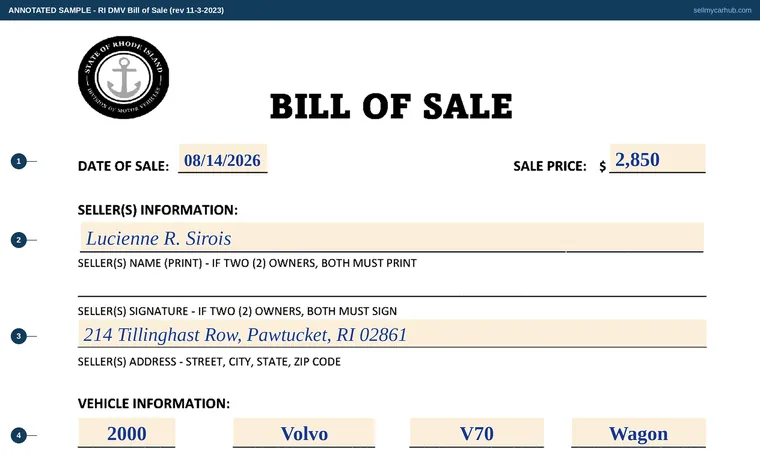
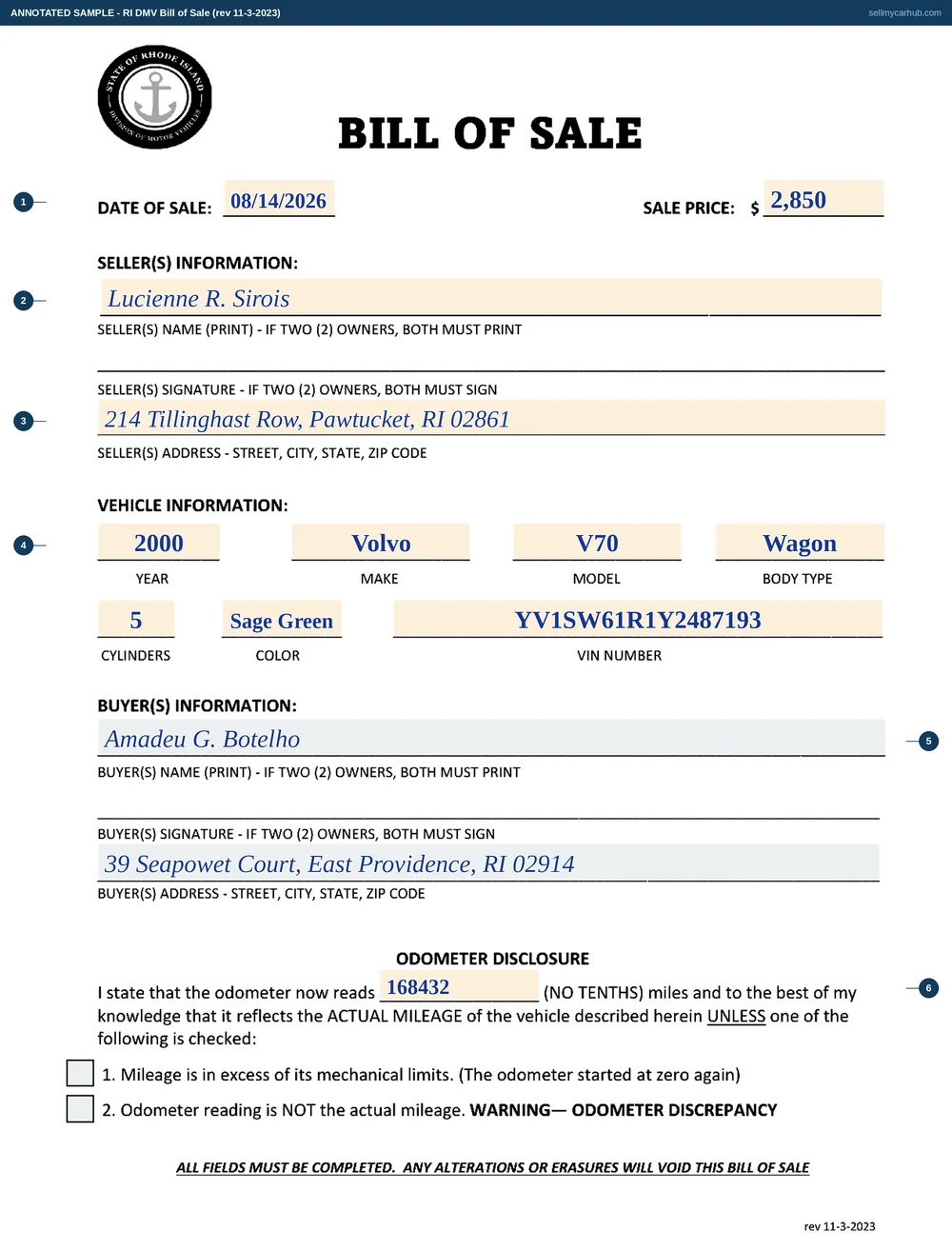
The DMV publishes its own bill of sale and lists it as a required document for a private-party sale, alongside the title rather than instead of it. On a car of model year 2000 or older that Rhode Island never titled, it stops being a supporting document and becomes the transfer itself - which is why it carries the same odometer disclosure the back of a certificate does, word for word.
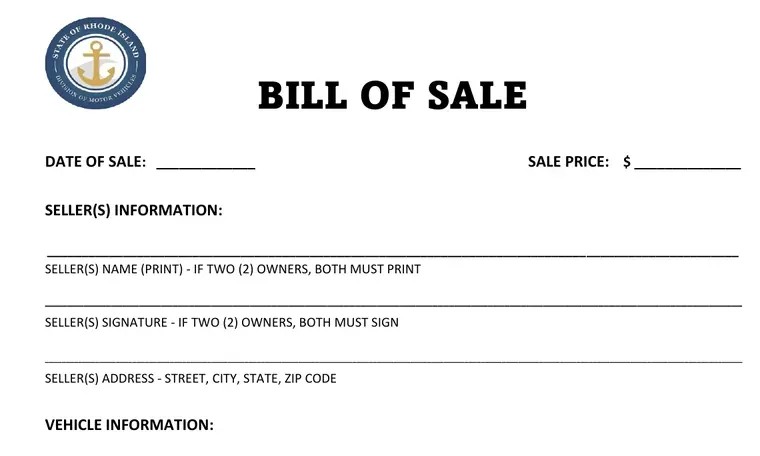
Written against Bill of Sale (Rev 11-3-2023), issued under RI DMV, documents required for a private party sale. The DMV's fillable copy has no widget behind the two signature rules or behind the odometer tick boxes, so those are completed in pen even when the rest is typed. Print the sheet before either party signs - a typed bill of sale with an unsigned signature line is the version that turns up at the counter.
Two documents, and they are not the same thing. Take the blank Bill of Sale from the dmv.ri.gov copy so you get the revision that is current today, then print our Bill of Sale guide and keep it beside you while you fill theirs in.
This is the actual Bill of Sale, rendered from the PDF the Rhode Island Division of Motor Vehicles publishes and completed end to end: letterhead, every field, and the blocks at the foot.
The two boxes across the top. The date is the day possession changes hands, not the day you agreed the price.
Watch out: That date starts the buyer's tax clock - sales tax is due by the 20th of the month following the month in which the sale took place, whether or not they have registered the car.
Two rows, and every owner named on the registration or the certificate appears on both.
Watch out: Print it the way the registration prints it. This sheet and the proof of ownership behind it have to name the same person, and on an untitled car there is nothing else to reconcile them against.
Street, city, state and ZIP on one rule.
Watch out: Use the address the DMV holds for you rather than a forwarding one. If the town's excise office later queries the sale, this is the address it works from.
Year, make, model, body type, cylinders, colour and the vehicle identification number.
Watch out: Copy the identification number off the car, not off an old insurance document, and read it back once. Seventeen characters written from memory is how a bill of sale and a registration stop matching.
The same three rules again, on the lower half of the sheet.
Watch out: Watch them write it and check it against the licence they showed you. An address that turns out to be wrong is a problem for the buyer at the counter and a problem for you if the town keeps billing.
Whole miles in the box marked NO TENTHS, then leave both numbered alternatives alone unless one of them is true.
Watch out: The bracket after the first alternative is the DMV explaining itself - the odometer started at zero again. That is what it means, and it is not a general disclaimer for a high-mileage car.
Section 31-23.2-6(a) requires a sales agreement to carry, conspicuously and prominently, that both buyer and seller have examined the title certificate of this motor vehicle and it correctly reflects the mileage as it appears on the odometer.
Watch out: The DMV's sheet does not print it. Writing it in is a line of your own handwriting and it is the only place in the transaction where Rhode Island asks for those words.
The buyer takes the original to the DMV. You keep the other.
Watch out: On a car Rhode Island never titled, the buyer's copy is the transfer document and your copy is your entire evidence that the sale happened at all.
| On the form | What to put in it |
|---|---|
| Date of sale and sale price | Two boxes across the top of the sheet, and the price is the figure the Division of Taxation will read. |
| Seller(s) information | Printed name, signature and full address. Both entries carry the same instruction in capitals - if two owners, both must print, and if two owners, both must sign. |
| Vehicle information | Year, make, model, body type, cylinders, colour and the vehicle identification number. |
| Buyer(s) information | Printed name, signature and address, with the same two-owner rule as the seller's block. |
| Odometer disclosure | The reading in whole miles marked NO TENTHS, the sentence certifying it as actual mileage, and two numbered alternatives: mileage is in excess of its mechanical limits, with the DMV's own gloss in brackets - the odometer started at zero again - and odometer reading is NOT the actual mileage, WARNING - ODOMETER DISCREPANCY. |
Every line here was read off Bill of Sale (Rev 11-3-2023) itself — the PDF is here — and off the Rhode Island Division of Motor Vehicles pages. This is plain-language help with a form, not legal advice, and where our wording and the agency's differ, theirs governs.
Back to all Rhode Island seller paperwork, or what selling a car in Rhode Island involves.