Sell My Car Hub

How to fill out North Carolina MVR-4C

The notice that goes on the record when an insurer has paid a total loss claim and you have kept the car. Most of the page is completed by the insurance company; the only thing an owner does is read one paragraph and sign underneath it. That paragraph is the reason this page exists, because it changes what you have to say the next time you sell.
Written against MVR-4C (Rev 12/21), issued under N.C. General Statute 20-109.1. Keeping a totalled car is a legitimate choice and this form is what makes it a documented one. What it does not do is quietly go away — the disclosure obligation it spells out applies every time the vehicle changes hands afterwards, not just the next time.

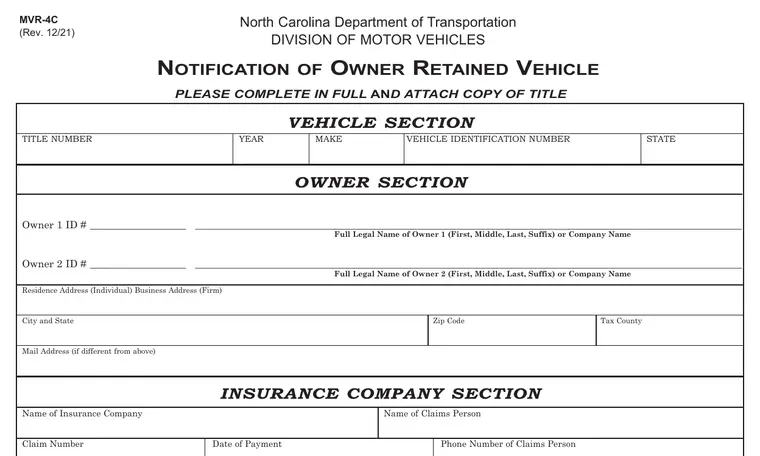
Two documents, and they are not the same thing. Take the blank MVR-4C from the ncdot.gov copy so you get the revision that is current today, then print our MVR-4C guide and keep it beside you while you fill theirs in.

Filled in

What a completed one looks like

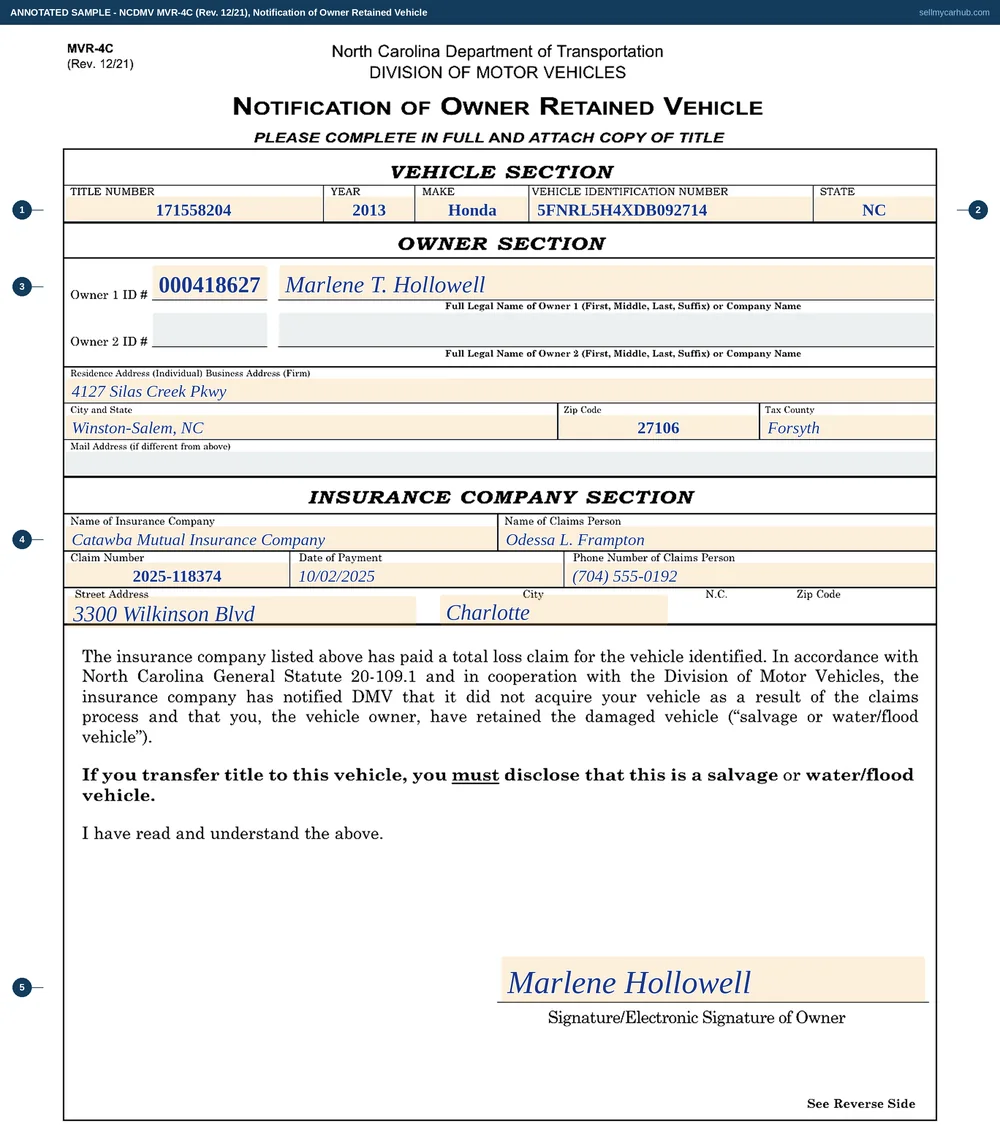
This is the actual MVR-4C, rendered from the PDF the North Carolina Division of Motor Vehicles publishes and completed end to end: letterhead, every field, and the blocks at the foot.

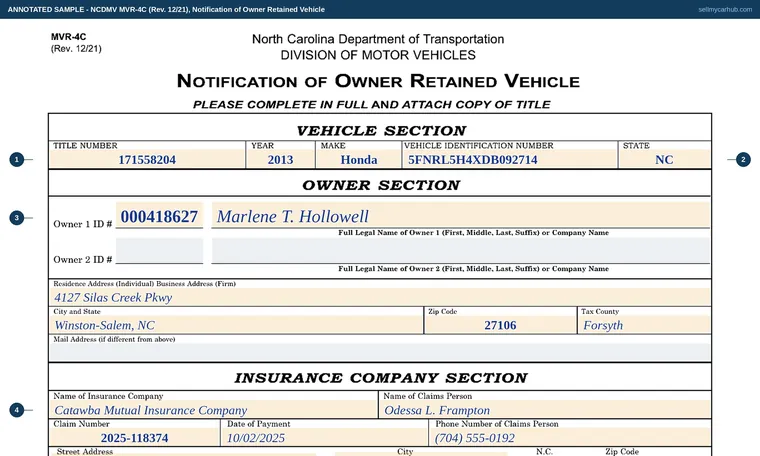
A North Carolina MVR-4C notification of owner retained vehicle filled in: title number 171558204 for a 2013 Honda with VIN 5FNRL5H4XDB092714, owner Marlene T. Hollowell of Winston-Salem in Forsyth County, an insurance company section naming the insurer, a claims person, a claim number and a payment date of 2 October 2025, and the owner's signature under the acknowledgement.
The actual MVR-4C at revision 12/21, completed for a minivan flooded in a storm and kept by its owner. Note how little of this page belongs to the owner: one signature, under a paragraph written by the Division and a set of boxes filled in by the insurer.
Field by field

Every line, in the order you meet it

  1. 1
    You fill this in

    Title number

    First box on the vehicle row, with the year, make, VIN and state beside it.

    Watch out: The title number ties the notice to the certificate the Division already holds a record of. It is on the face of your certificate and on any registration card.

  2. 2
    You fill this in

    Vehicle identification number

    The VIN, in the fourth box of the vehicle row.

    Watch out: This is the number the brand attaches to. It follows the car into every later sale, in this state and out of it.

  3. 3
    You fill this in

    Owner name and identification number

    Owner 1's licence number and full legal name, with the residence address, tax county and ZIP underneath.

    Watch out: The name has to match the certificate. If the car is in two names, both go on and both belong on the signature side of the transaction.

  4. 4
    The lienholder fills this in

    Insurance company section

    The insurer's name, the claims person, the claim number, the date of payment, a phone number and the company's address.

    Watch out: Chase your adjuster for this rather than guessing at it. A claim number transposed by one digit is a notice the Division cannot match to a settlement.

  5. 5
    You fill this in

    Signature of owner

    One line, under the paragraph that begins: I have read and understand the above.

    Watch out: What you are acknowledging is the sentence in bold above it — that if you transfer title to this vehicle you must disclose that it is a salvage or water/flood vehicle. That obligation is the one that outlives the claim.

At a glance

What goes where

On the formWhat to put in it
Vehicle sectionTitle number, year, make, vehicle identification number and the state, across one row.
Owner sectionOwner 1 and owner 2 identification numbers and full legal names, then residence or business address, city and state, ZIP, tax county and a mailing address if different.
Insurance company sectionName of the insurance company and of the claims person, the claim number, the date of payment, a telephone number, and the insurer's own street address, city and ZIP.
The notice itselfThe insurance company listed above has paid a total loss claim for the vehicle identified. In accordance with G.S. 20-109.1 and in cooperation with the Division, the insurer has notified NCDMV that it did not acquire the vehicle as a result of the claims process and that you, the vehicle owner, have retained the damaged vehicle.
The disclosure warningPrinted in bold under it: if you transfer title to this vehicle, you must disclose that this is a salvage or water/flood vehicle.
The acknowledgementI have read and understand the above, then a single signature line for the owner — the form accepts a signature or an electronic signature.
The reverseThe text of G.S. 20-109.1 itself, beginning with the option to keep the title and the procedures that follow depending on whether the owner keeps the vehicle.

What gets this one rejected

Rules that decide whether it is accepted

Every line here was read off MVR-4C (Rev 12/21) itself — the PDF is here — and off the North Carolina Division of Motor Vehicles pages. This is plain-language help with a form, not legal advice, and where our wording and the agency's differ, theirs governs.

Back to all North Carolina seller paperwork, or what selling a car in North Carolina involves.

Want the paperwork handled instead?

Get My Instant Offer → Online · about 2 minutes · free

Or send the details — we'll come to you

Totalled, kept, and now hard to move — a branded car is still a car we will make an offer on.

or call/text (877) 405-1808