This one is not yours, and the page is here so that you can recognise it when it arrives. The purpose block on the reverse says it plainly: the form is used by a North Carolina insurance company when a salvage vehicle owner fails to assign and deliver the certificate of title to the insurer within 30 days of payment of the claim, and by a salvage dealer where an owner or lienholder abandons a vehicle.
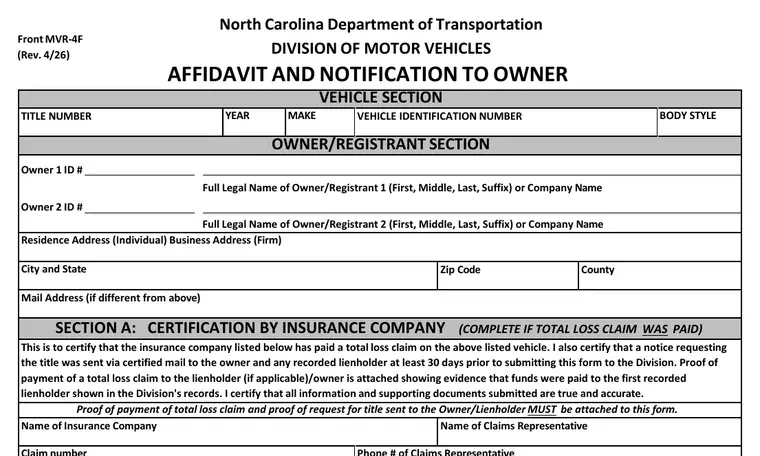
Written against MVR-4F (Rev 4/26), issued under N.C. General Statute 20-109.1. If a letter arrives by certified mail asking you to send a title to an insurer, the thirty days it refers to are real and this is the form that follows them. Answering the letter is cheaper than being notified about it.
Two documents, and they are not the same thing. Take the blank MVR-4F from the ncdot.gov copy so you get the revision that is current today, then print our MVR-4F guide and keep it beside you while you fill theirs in.
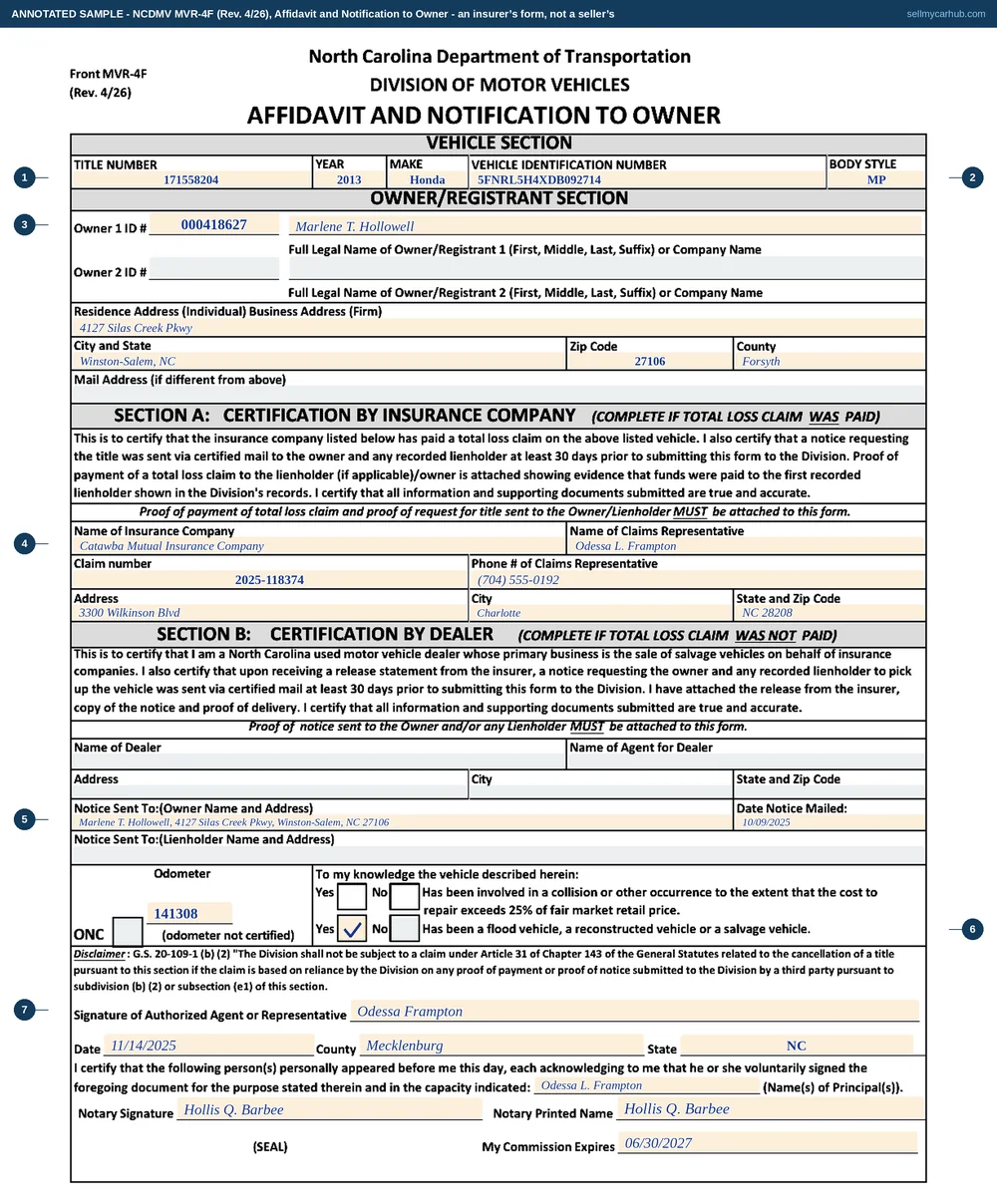
This is the actual MVR-4F, rendered from the PDF the North Carolina Division of Motor Vehicles publishes and completed end to end: letterhead, every field, and the blocks at the foot.
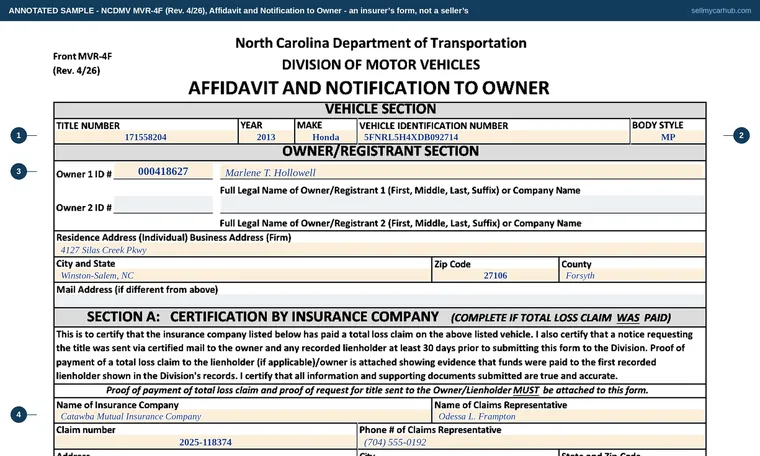
The first box of the vehicle row, with the year, make, VIN and body style.
Watch out: The insurer takes this from the Division's record rather than from the certificate, because the certificate is the thing it does not have.
In the vehicle row, and the number every certification on the page attaches to.
Watch out: If you receive a copy of one of these, check the VIN against your own paperwork first. It is the one field a mistake here would make everything else wrong.
Your name, identification number, address and county — completed by the insurer from the Division's record.
Watch out: An out-of-date address on this line is how a certified notice goes to a house you left three years ago. Keeping your address current with NCDMV is what prevents that.
The insurance company, the claims representative, the claim number and the insurer's address, under a certification about payment and about notice sent by certified mail.
Watch out: Section B underneath is the dealer's alternative, used where no total loss claim was paid. Only one of the two sections is completed on any given form.
Your name and address, and the date the certified notice was mailed.
Watch out: That date starts the thirty days. If the letter reached you and you still hold the title, the window to deal with it directly is measured from there.
An odometer reading, an ONC box, a collision question and a yes/no on flood, reconstructed or salvage.
Watch out: The submitter certifies this about your car without your signature anywhere on the page — which is the strongest argument for handling the title yourself while you still can.
Signed by the insurer's or dealer's representative and acknowledged by their notary.
Watch out: There is no line here for the registered owner, and that absence is the whole point of this page.
| On the form | What to put in it |
|---|---|
| Vehicle section | Title number, year, make, vehicle identification number and body style. |
| Owner/registrant section | Owner identification numbers and full legal names, residence or business address, city and state, ZIP, county and a mailing address if different. All of it about you, none of it written by you. |
| Section A, certification by insurance company | Completed if a total loss claim was paid. The insurer certifies that it has paid the claim and that a notice requesting the title was sent by certified mail to the owner and any recorded lienholder at least 30 days before the form was submitted. |
| Section B, certification by dealer | Completed if a total loss claim was not paid. A used motor vehicle dealer whose primary business is selling salvage vehicles on behalf of insurers certifies that a notice to collect the vehicle was sent by certified mail at least 30 days earlier. |
| Notice sent to | The owner's name and address, the date the notice was mailed, and separately the lienholder's name and address. |
| Odometer and damage certification | An odometer reading, an ONC box for odometer not certified, a collision question with a 25% threshold, and a yes/no on whether the vehicle is a flood, reconstructed or salvage vehicle. |
| The disclaimer | A printed paragraph citing G.S. 20-109.1(b)(2) about the Division not being subject to a claim based on its reliance on proof of payment or proof of notice submitted by a third party. |
| Signature and notary | Signature of the authorised agent or representative, date, county and state, and a notary block — the insurer's notary, not yours. |
| The instructions on the reverse | Separate sets for the insurance company and for the dealer, each ending with the fee the Division charges to issue an MVR-40 salvage certificate in return: $15.00 for the insurer and $25.50 for the dealer. |
Every line here was read off MVR-4F (Rev 4/26) itself — the PDF is here — and off the North Carolina Division of Motor Vehicles pages. This is plain-language help with a form, not legal advice, and where our wording and the agency's differ, theirs governs.
Back to all North Carolina seller paperwork, or what selling a car in North Carolina involves.