Sell My Car Hub

How to fill out New Mexico MVD-11103

The form that puts the word Salvage on a record for good. Filed by the insurance company - or by the owner, if self-insured - it declares the vehicle a total loss under one of three printed scenarios: stolen and never recovered, stolen and recovered, or wrecked or damaged, each with its date lines. The request it makes is permanent by design: that the division flag the registration and title record as Salvage in accordance with Section 66-3-10.1 of the Motor Vehicle Code, and that every subsequent title carry the Salvage brand.
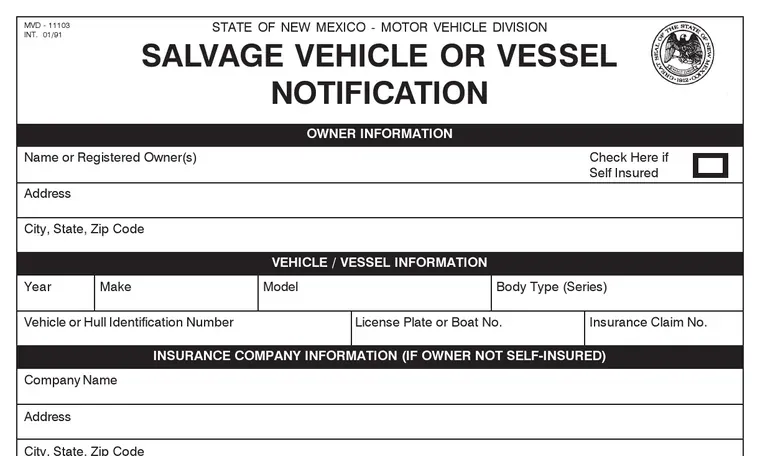
Written against MVD-11103 (INT. 01/91), issued under NMSA 1978 ยง66-3-10.1. For a seller, this form matters mostly for what it did to the record before you ever advertised: a Salvage flag set years ago follows the vehicle onto every subsequent title, and no agreement between buyer and seller unwinds it. Check what your title says across its face before you price the car as clean.

Two documents, and they are not the same thing. Take the blank MVD-11103 from the realfile.tax.newmexico.gov copy so you get the revision that is current today, then print our MVD-11103 guide and keep it beside you while you fill theirs in.

Filled in

What a completed one looks like

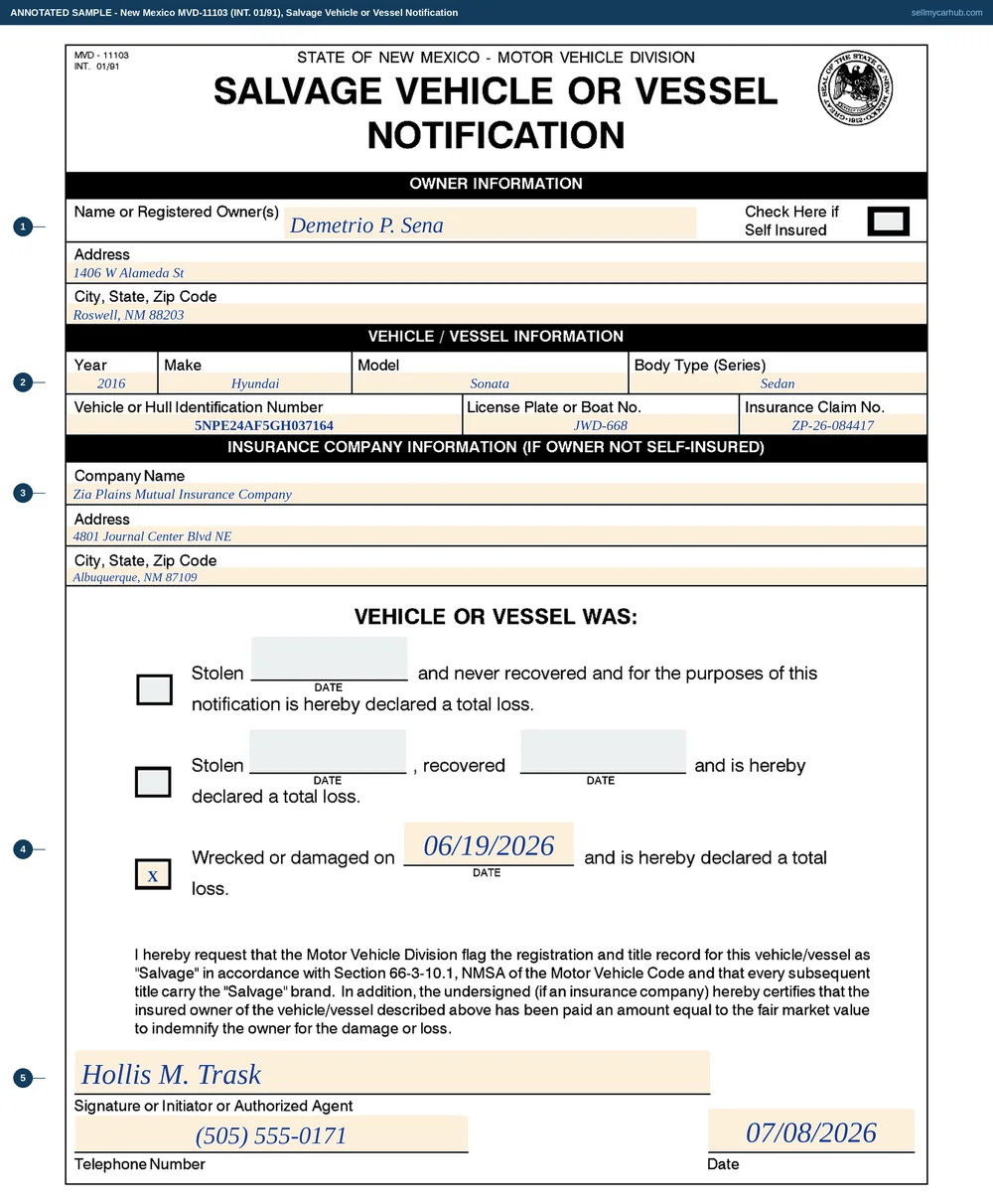
This is the actual MVD-11103, rendered from the PDF the New Mexico Taxation and Revenue Department, Motor Vehicle Division publishes and completed end to end: letterhead, every field, and the blocks at the foot.

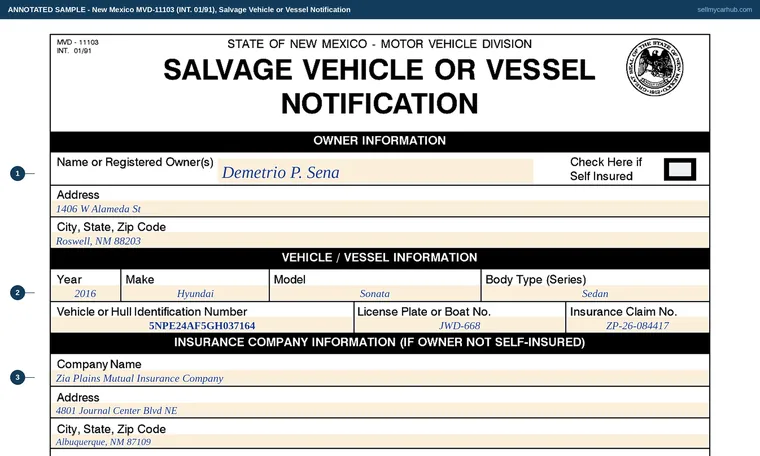
New Mexico form MVD-11103, Salvage Vehicle or Vessel Notification, filled in: owner Demetrio P. Sena of Roswell, a 2016 Hyundai Sonata with VIN 5NPE24AF5GH037164, insurer Zia Plains Mutual Insurance Company with a claim number, the wrecked-or-damaged scenario dated June 19, 2026 and declared a total loss, signed and dated by the company's authorized agent.
An insurer's filing after a hailstorm total: the third scenario dated, the two theft scenarios left grey, and the agent's signature under the request that the record be flagged Salvage and every subsequent title carry the brand.
Field by field

Every line, in the order you meet it

  1. 1
    Somebody else fills this in

    Owner block - and the self-insured question

    The registered owner's details, with the self-insured box ticked only when no insurer stands behind the loss.

    Watch out: Self-insured genuinely means self-insured - a fleet or an owner who lawfully carries their own risk. An uninsured wreck is a different conversation, mostly with the owner-retained notice.

  2. 2
    Somebody else fills this in

    Vehicle, claim and insurer

    The vehicle's identification, the insurance claim number, and the company's block if one is involved.

    Watch out: The claim number is the thread the division can pull to verify the loss - include it even though the box looks optional.

  3. 3
    Somebody else fills this in

    Date one scenario

    Stolen-never-recovered, stolen-and-recovered, or wrecked - with the printed date lines completed for whichever applies.

    Watch out: The recovered scenario wants both dates. A theft with no recovery date yet belongs in the first scenario, and the brand question waits for the car.

  4. 4
    Somebody else fills this in

    The certification and signature

    The insurer certifies the owner was paid fair market value; the initiator or authorized agent signs, dates, and adds a telephone number.

    Watch out: An owner signing as self-insured is adopting the whole request - including its permanence. Nothing about this filing is reversible by asking nicely later.

At a glance

What goes where

On the formWhat to put in it
OWNER INFORMATION, and the Check Here if Self Insured boxThe registered owner's name and address. The self-insured box is what turns this from an insurer's form into an owner's.
Year, Make, Model, Body Type (Series)The vehicle or vessel being written off.
Vehicle or Hull Identification Number, License Plate or Boat No., Insurance Claim No.Identification, tied to the claim the payout ran through.
INSURANCE COMPANY INFORMATION (IF OWNER NOT SELF-INSURED)The insurer's name and address - the party normally making this declaration.
Stolen ___ and never recoveredThe first scenario: a date of theft, and a total-loss declaration for a vehicle that is simply gone.
Stolen ___, recovered ___The second: two dates, for the car that came back too damaged to matter.
Wrecked or damaged on ___The third and commonest: one date, one wreck.
The request paragraphThe filer asks the division to flag the record Salvage and adds, if an insurance company, a certification that the insured owner has been paid an amount equal to the fair market value to indemnify the owner for the damage or loss.
Signature of Initiator or Authorized Agent, Telephone Number, DateWhoever is declaring the loss - insurer's agent or self-insured owner - signs and dates it.

What gets this one rejected

Rules that decide whether it is accepted

Every line here was read off MVD-11103 (INT. 01/91) itself — the PDF is here — and off the New Mexico Taxation and Revenue Department, Motor Vehicle Division pages. This is plain-language help with a form, not legal advice, and where our wording and the agency's differ, theirs governs.

Back to all New Mexico seller paperwork, or what selling a car in New Mexico involves.

Want the paperwork handled instead?

Get My Instant Offer → Online · about 2 minutes · free

Or send the details — we'll come to you

Salvage brand on the title? Say so up front - we buy branded vehicles and price them without theatre.

or call/text (877) 405-1808