Sell My Car Hub

How to fill out New Hampshire TDMV 20A

One short page signed by the lender, not by you, releasing a security interest that is recorded against the vehicle. It matters to a seller more than its length suggests: the Division's own instruction on the duplicate title application is that even though the lien may have been previously satisfied, if the original title named a lienholder, a lien release is needed - so a loan you finished paying years ago still has to be signed off in writing before the paperwork will move.
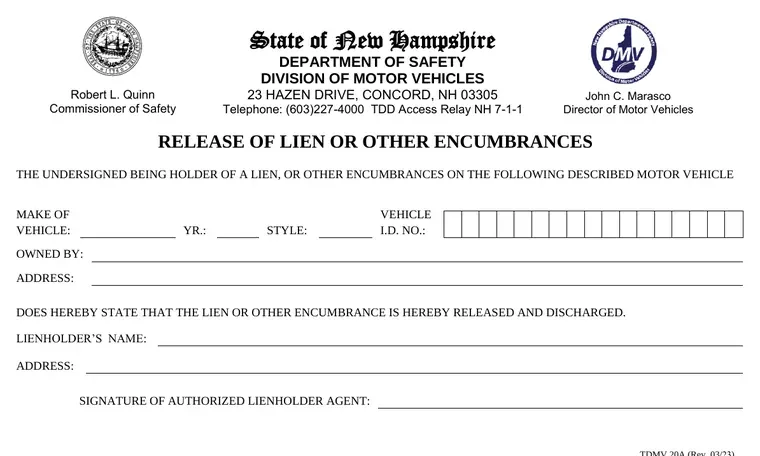
Written against TDMV 20A (Rev 03/23), issued under RSA 261:27 and RSA 261:38. Start this before you advertise, not after you have a buyer. New Hampshire titles take approximately 30 to 50 calendar days to issue once the application is received, and if a duplicate certificate is also needed because the lender is holding the original, that is a separate five to ten calendar days and a second fee on top. A buyer standing in your driveway is not a good moment to discover that a lender in another state needs two weeks to sign one page.

Two documents, and they are not the same thing. Take the blank TDMV 20A from the dmv.nh.gov copy so you get the revision that is current today, then print our TDMV 20A guide and keep it beside you while you fill theirs in.

Filled in

What a completed one looks like

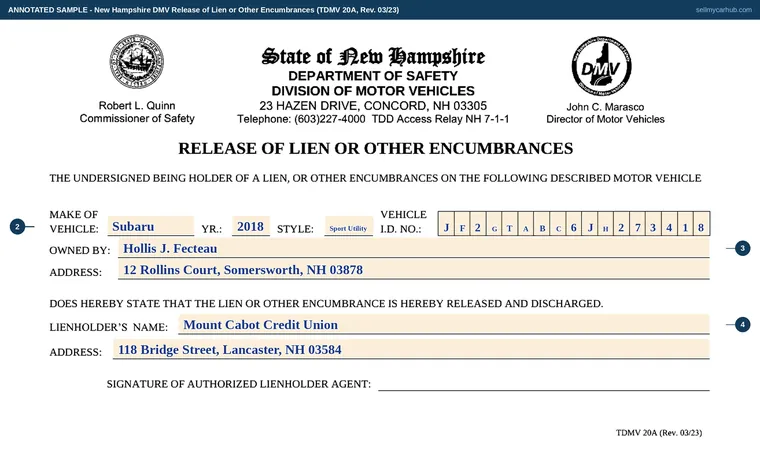
This is the actual TDMV 20A, rendered from the PDF the New Hampshire Division of Motor Vehicles publishes and completed end to end: letterhead, every field, and the blocks at the foot.

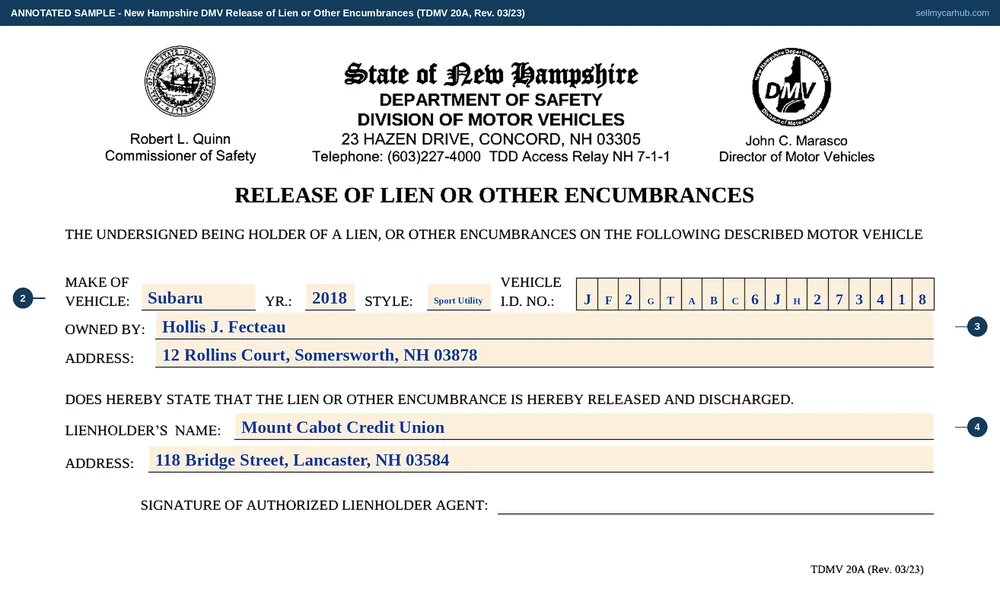
The New Hampshire Release of Lien or Other Encumbrances, form TDMV 20A, filled in as an annotated sample. The vehicle row reads Subaru, 2018, Sport Utility, with the vehicle identification number written one character per cell across a seventeen-cell comb. The vehicle is shown as owned by Hollis J. Fecteau of Somersworth. Below the printed release sentence the lienholder is given as Mount Cabot Credit Union of Lancaster, with a signature rule for an authorised lienholder agent at the foot.
Four lines of information and one signature, and none of it is the seller's to write. The line that matters is the last one: an authorised agent of the lender, in original ink. A release that arrives with a printed signature block and no pen mark on it is not a release.
Field by field

Every line, in the order you meet it

  1. 1
    You fill this in

    Check the front of the certificate first

    Look for a lienholder named on the face of the title. If there is one, this form or a bank letter is required whatever the state of the loan.

    Watch out: This is worth doing the day you decide to sell. A lien that was satisfied in 2019 and never released still stops the transfer in 2026.

  2. 2
    The lienholder fills this in

    Vehicle description

    Make, year, style and the identification number across the comb.

    Watch out: Send the lender a photograph of the front of the certificate so the description they write matches the record the Bureau holds.

  3. 3
    The lienholder fills this in

    Owned by, and address

    Your name and address as the registered owner.

    Watch out: As printed on the certificate. If your name has changed since the title was issued, that is a separate job and there is a separate form for it.

  4. 4
    The lienholder fills this in

    Lienholder's name and address

    Who is releasing the interest.

    Watch out: It has to be the entity named on the certificate. Where a lender has been bought out, the successor generally signs and adds a line saying so - ask them to, rather than hoping the counter will infer it.

  5. 5
    The lienholder fills this in

    Signature of authorized lienholder agent

    An original signature on the printed rule at the foot of the page.

    Watch out: There is no notary block on this form and none is needed. What is needed is ink.

  6. 6
    You fill this in

    Keep it with the certificate

    The release goes to the town or city clerk with the assigned title and the title application.

    Watch out: Photograph it before you hand it over. It is one page, it is irreplaceable in practice, and it is the page most likely to be left on a kitchen table.

At a glance

What goes where

On the formWhat to put in it
Vehicle descriptionMake of vehicle, year, style and the vehicle identification number, which is a seventeen-cell comb rather than a plain line.
Owned byThe registered owner's name, on a full-width line.
AddressThe owner's address underneath it.
The releasing sentencePrinted, not filled in: 'DOES HEREBY STATE THAT THE LIEN OR OTHER ENCUMBRANCE IS HEREBY RELEASED AND DISCHARGED.'
Lienholder's name and addressTwo lines identifying who is letting go.
Signature of authorized lienholder agentA printed rule with no field behind it, at the foot of the page.

What gets this one rejected

Rules that decide whether it is accepted

Every line here was read off TDMV 20A (Rev 03/23) itself — the PDF is here — and off the New Hampshire Division of Motor Vehicles pages. This is plain-language help with a form, not legal advice, and where our wording and the agency's differ, theirs governs.

Back to all New Hampshire seller paperwork, or what selling a car in New Hampshire involves.

Want the paperwork handled instead?

Get My Instant Offer → Online · about 2 minutes · free

Or send the details — we'll come to you

If the lender is slow, unresponsive, or has been absorbed into a bank that has never heard of your loan, that is a common enough problem that it is worth just telling us where you are with it.

or call/text (877) 405-1808