Sell My Car Hub

How to fill out New Hampshire TDMV 16

The lienholder's sworn account of taking a vehicle back, and the document that lets a new certificate be issued without the previous owner's signature. It is on this site because the person who searches for it is often the person it was used against: if your car has been repossessed, this is what was filed, and reading it tells you exactly what the lender had to swear to.
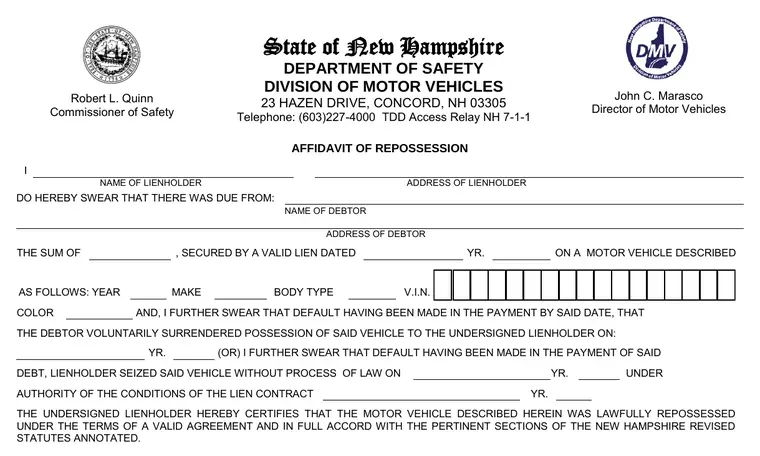
Written against TDMV 16 (Rev 03/23), issued under RSA 261:16, II. If you are the debtor named on one of these, the sentence to read twice is the one about seizure without process of law under the authority of the conditions of the lien contract. New Hampshire lets a lender take a vehicle back on the strength of the agreement you signed rather than a court order, and this affidavit is where the lender states which route it used and on what date. That date is worth checking against your own record of events.

Two documents, and they are not the same thing. Take the blank TDMV 16 from the dmv.nh.gov copy so you get the revision that is current today, then print our TDMV 16 guide and keep it beside you while you fill theirs in.

Filled in

What a completed one looks like

This is the actual TDMV 16, rendered from the PDF the New Hampshire Division of Motor Vehicles publishes and completed end to end: letterhead, every field, and the blocks at the foot.

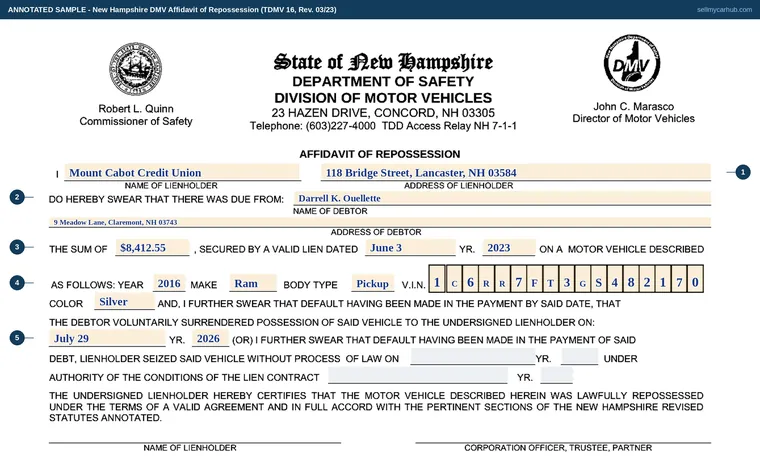
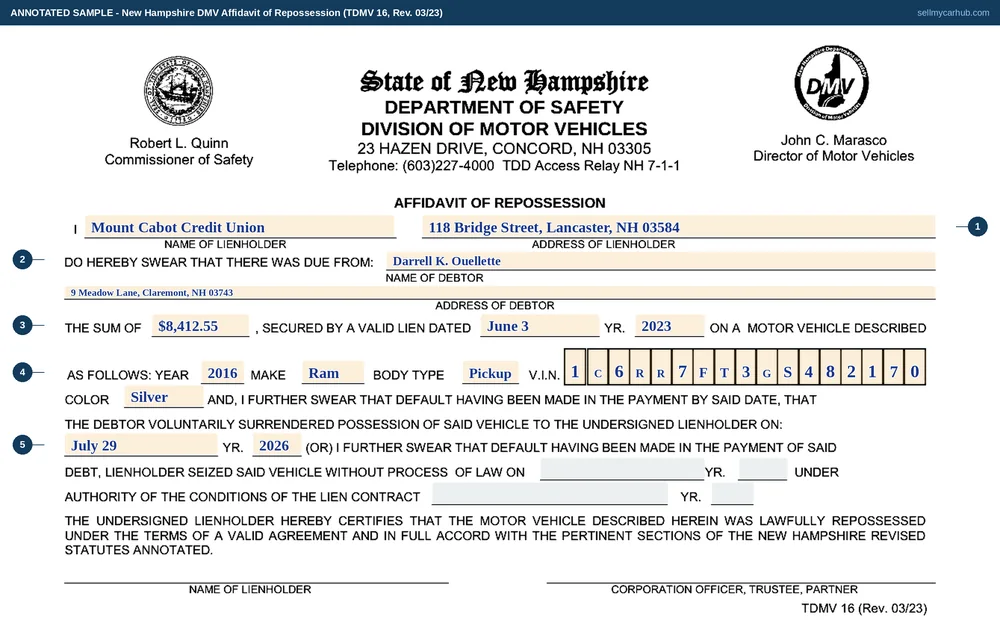
The New Hampshire Affidavit of Repossession, form TDMV 16, filled in as an annotated sample. The lienholder is Mount Cabot Credit Union of Lancaster and the debtor is Darrell K. Ouellette of Claremont. The sum due and the lien date are completed, and the vehicle is described as a 2016 Ram pickup with its identification number across a seventeen-cell comb. The voluntary surrender date is filled in and the seizure alternative is left blank. The signature block names the credit union and a corporation officer.
Everything on this page is the lender's, and the greyed blocks are the alternative it did not use. Only one of the two dates should ever be filled in - voluntary surrender or seizure - because they describe two different things that cannot both have happened to one car.
Field by field

Every line, in the order you meet it

  1. 1
    The lienholder fills this in

    The lienholder identifies itself

    Name and address, inside the swearing sentence at the top.

    Watch out: This has to be the entity named on the certificate of title, which is not always the entity that services the loan.

  2. 2
    The lienholder fills this in

    The debtor

    Name and address of the person the debt was due from.

    Watch out: If that is you, check the address. A repossession affidavit carrying an address you left years ago tells its own story about what notice you were given.

  3. 3
    The lienholder fills this in

    The sum and the lien date

    The amount secured and the date of the valid lien.

    Watch out: The lien date should match the date recorded against the title, not the date of the last missed payment.

  4. 4
    The lienholder fills this in

    The vehicle

    Year, make, body type, identification number and colour.

    Watch out: The identification number is combed, one character per cell, so there is no room for an abbreviated entry.

  5. 5
    The lienholder fills this in

    Voluntary surrender, or seizure

    One of the two alternatives, with the date it happened.

    Watch out: These are not interchangeable. Voluntary surrender means the debtor handed the car over; seizure without process of law means the lender took it under the contract.

  6. 6
    The lienholder fills this in

    The certification and signature

    That the repossession was lawful and in accord with the statutes, signed by an officer, trustee or partner.

    Watch out: The form says SWEAR twice. It is an affidavit, and a lender that treats it as a routine form is making a sworn statement carelessly.

At a glance

What goes where

On the formWhat to put in it
Name and address of lienholderWho is swearing, at the top of the page inside the sentence 'I ______ DO HEREBY SWEAR THAT THERE WAS DUE FROM'.
Name and address of debtorThe person the money was owed by.
The sum, and the lien dateThe amount secured, and the date of the valid lien with its year.
Vehicle described as followsYear, make, body type, vehicle identification number in a seventeen-cell comb, and colour.
Which of two things happenedEither that the debtor voluntarily surrendered possession on a stated date, or that the lienholder seized the vehicle without process of law on a stated date under the authority of the conditions of the lien contract.
The certificationThat the vehicle was lawfully repossessed under the terms of a valid agreement and in full accord with the pertinent sections of the New Hampshire Revised Statutes Annotated.
Signature blockName of lienholder, and the corporation officer, trustee or partner signing for it.

What gets this one rejected

Rules that decide whether it is accepted

Every line here was read off TDMV 16 (Rev 03/23) itself — the PDF is here — and off the New Hampshire Division of Motor Vehicles pages. This is plain-language help with a form, not legal advice, and where our wording and the agency's differ, theirs governs.

Back to all New Hampshire seller paperwork, or what selling a car in New Hampshire involves.

Want the paperwork handled instead?

Get My Instant Offer → Online · about 2 minutes · free

Or send the details — we'll come to you

A car that is behind on payments and heading for a repossession is usually worth more sold than taken. If that is where you are, get a number from us first.

or call/text (877) 405-1808